 100% FREE ACCESS
12th Standard CBSE Syllabus & Materials
12th Standard CBSE
CBSE 12th Economics Government Budget and the Economy Previous year Question Papers Study Material - QB365 Set A
NEW12th Standard CBSE
CBSE 12th Computer Science Interface Python with MySQL - New Previous year Question Papers Study Material - QB365 Set A
NEW12th Standard CBSE
CBSE 12th Computer Science Database Concept - New Previous year Question Papers Study Material - QB365 Set A
NEW12th Standard CBSE
CBSE 12th Computer Science Data Communication - New Previous year Question Papers Study Material - QB365 Set A
NEW12th Standard CBSE
CBSE 12th Computer Science Data Structures - New Previous year Question Papers Study Material - QB365 Set A
NEW12th Standard CBSE
CBSE 12th Computer Science Functions - New Previous year Question Papers Study Material - QB365 Set A
Published on: 02/11/2025
Download CBSE Class 12th Standard CBSE Chemistry question papers, sample papers, important questions, and previous year solved papers in PDF format. Get free study materials, NCERT solutions, and exam preparation resources for Class 12th Standard CBSE Chemistry
Questions + Answers key
Take MCQ Chemistry Test
1.
Arrange the following in the order of their increasing basicity: p-toluidine, N, N-dimethyl-p-toluidine, p-nitroaniline, aniline
2.
Outer hard shells oftwo eggs are removed one of the egg is placed in pure water and the other is placed in saturated solution of sodium chloride. What will be observed and why?
3.
How many grams of sucrose (M.wt. = 342) should be dissolved in 100g water in order to produce a solution with 105.0°C difference between the freezing point and the boiling point ?(Kf = 1.86°C/m, Kb = 0.51°C/m)
4.
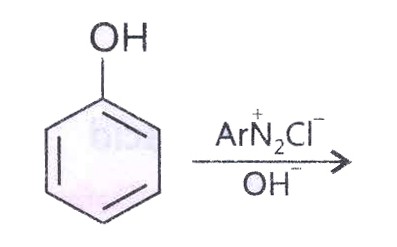
Complete the following reaction.
5.
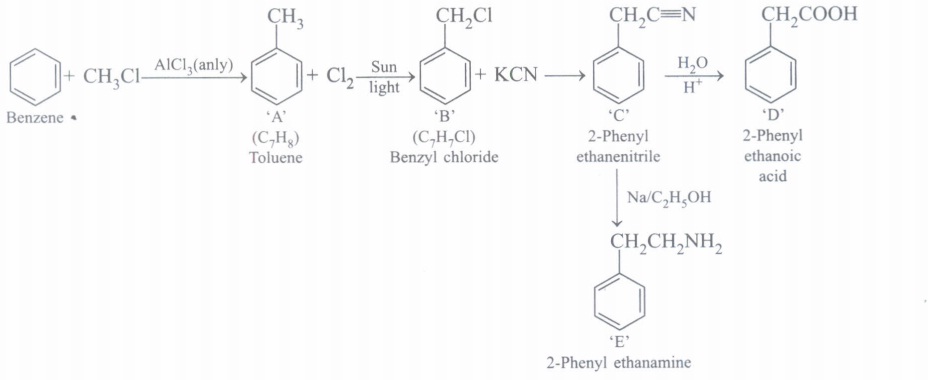
When benzene reacts with CH3CI in presence of AICI3 to give 'A' (C7H8), 'A' reacts with 1 mole of CI2 in presence of sun light to form 'B' (C7H7CI). 'B' on reaction with KC to form 'C'. 'c' on hydrolysis gives 'D'. 'C' on reduction with Na and C2H5OH gives 'E'. Identify 'A' to 'E' and explain the reactions.
6.
Explain with example the concept of minimum boiling azeotropes and maximum boiling azeotropes.
7.
A solution containing 15g urea (molar mass = 60 g mol-1) per litre of solution in water has the same osmotic pressure (isotonic) as a solution of glucose (molar mass = 180 g mol-1 ) in water. Calculate the mass of glucose present in one litre of its solution.
8.
Why does bromination of aniline, even under very mild conditions, gives 2, 4, 6-tribromoaniline instantaneously?
9.
Two isomeric compounds A and B having molecular formula C4H11N, both lose N2 on treatment with HNO2 and gives compound C and D respectively. C is resistant to oxidation but immediately responds to Lucas reagent, where as 'D' responds to Lucas reagent after 5 minutes and gives a positive iodoform test. Identify A and B.
10.
Which one of the following pairs will not form an ideal solution?
Benzene and toluene
n-hexane and n-heptane
Ethanol and acetone
Bromoethane and chloroethane
11.
Acid anhydrides on reaction with primary amines give ____________
amide
imide
secondary amine
imine
12.
Which one of the following can be prepared by Gabriel phthalimide synthesis?
Aniline
o-Toluidine
Benzylamine
N-Methyl ethanamine
13.
Name the product(s) formed during the reaction of primary aliphatic amines with nitrous acid at room temperature?
\(\begin{equation} R \mathrm{~N}_{2}^{+} \mathrm{Cl^-} \end{equation}\)
ROH
Both (a) and (b)
None of the above
14.
At 40°C the vapour pressure of pure liquids, benzene and toluene, are 160 mmHg and 60 mmHg respectively. At the same temperature, the vapour pressure of an equimolar solution of the two liquids, assuming the ideal solution should be
140 mmHg
110 mmHg
220 mmHg
100 mmHg
15.
Which gives black precipitate on reaction with CS2 followed by addition of HgCl2?
(CH3)3CNH2
(C2H5)2NH
(CH3)3N
all the three
16.
Benzylamine may be alkylated as shown in the following equation:
C6H5CH2NH2+R-X \(\longrightarrow \) C6H5CH2NHR
Which of the following alkyl halides is best suited for this reaction through SN 1 mechanism?
CH3Br
C6H5Br
C6H5CH2Br
C2H5Br
17.
An ideal solution is formed by mixing two volatile liquids A and B. XA and XB are the mole fractions of A and B respectively in the solution and YA and YB are the are the mole fractions of A and B respectively in the vapour phase. A plot of 1/YA along y - axis against 1/XA along x - axis gives a straight line. What is the slope of the straight line ?
\({ p }_{ B }^{ o }/{ p }_{ A }^{ o }\)
\({ p }_{ A }^{ o }/{ p }_{ B }^{ o }\)
\({ p }_{ B }^{ o }-{ p }_{ A }^{ o }\)
\({ p }_{ A }^{ o }-{ p }_{ B }^{ o }\)
18.
The values of van't Hoff factors for KCI, NaCI and K2SO4, respectively, are ................. .
2,2 and 2
2,2 and 3
1,1, and 2
1,1 and 1
19.
An aqueous solution of methanol in water has vapour pressure
equal to that of water
equal to that of methanol
more than that of water
less than that of water
20.
(a) Write the structures of the main products of the following reactions:
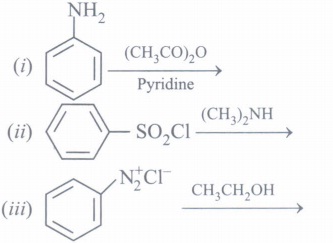
(b) Give a simple chemical test to distinguish between Aniline and N,N-dimethylaniline.
(c) Arrange the following in the increasing order of their pKb values:
C6H5NH2 , C2H5NH2 , C6H5NHCH3
21.
What is the solubility of a solid in liquid? Describe the various factors on which the solubility of a solid in a liquid depends?
22.
(a) Calculate the freezing point of solution when 1.9 g of MgCI2 (M = 95 g mol-1) was dissolved in 50 g of water, assuming MgCI2 undergoes complete ionization. (Kf for water = 1.86 K kg mol-1)
(b) (i) Out of 1 M glucose and 2 M glucose, which one has a higher boiling point and why?
(ii) What happens when the external pressure applied becames more than the osmotic pressure of solution?
23.
(i) tert-Butylamine cannot be prepared by the action of NH3 on tert-butyl bromide. Explain why?
(ii) Suggest a convenient method for the preparation of tert-butylamine.
24.
Assertion: A solution is a homogeneous mixture of two or more chemically non-reacting substances.
Reason: Solutions can be made between any two states of matter.
Codes:
A) Assertion and reason both are correct statements and reason is correct explanation for assertion.
B) Assertion and reason both are correct statements but reason is not correct explanation for assertion.
C) Assertion is correct statement but reason is wrong statement.
D) Assertion is wrong statement but reason is correct statement.
25.
26.
Assertion: Controlled nitration of aniline at low temperature mainly gives m-nitroaniline.
Reason: In acidic medium, -NH2 group gets converted into m-directing group.
Codes:
(a) Assertion and reason both are correct statements and reason is correct explanation for assertion.
(b) Assertion and reason both are correct statements but reason is not correct explanation for assertion.
(c) Assertion is correct statement but reason is wrong statement.
(d) Assertion is wrong statement but reason is correct statement.
27.
In the following questions. an Assertion (A) is followed by a corresponding Reason (R) Use the following keys to choose the appropriate answer.
Assertion (A) Aromatic primary amines cannot be prepared by Gabriel phthalimide synthesis.
Reason (R) Aryl halides do notundergo electrophilic substitution with anion formed by phthalimide.
Codes:
(a) Both (A) and (R) are correct, (R) is the correct explanation of (A).
(b) Both (A) and (R) are correct, (R) is not the correct explanation of (A).
(c) (A) is correct; (R) is incorrect.
(d) (A) is incorrect; (R) is correct.
28.
29.
Organic compounds containing amine as functional group are present in wide variety of compounds namely amino acids, hormones, neurotransmitters, DNA, alkaloids, dyes etc. Drugs including nicotine, morphine, codein, heroin etc. which have physiological effects on human also contain -NH2 group in one form or another. Amines are basic in nature due to presence of lone pair of electron on nitrogen. Adrenaline hormone and ephedrine drug, both contain second amino group are used for increasing blood pressure. Novacain, a synthetic compound contains both primary ana tertiary amino group, is used as anaesthetic in dentistry. Benadryl, a widely used antihistamine drug contains tertiary amino group, Quarternary ammonium salts of long chain, tertiary amines are used as cationic detergents. Diazonium salts are used for synthesis of azodyes and useful aromatic compounds.
(a) Write the formula of tertiary amine with molecular formula C3H9N, which does not react with Hinsberg reagent?
(b) Convert Aniline to p-hydroxy azo benzene.
(c) Give one example of cationic detergent.
(d) What is formula of paracetamol, (crosin), a well known antipyretic?
(e) How will you distinguish between Aniline and Benzyl amine?
1.
p-nitroanlline < aniline < p-toluidine < N,N-dimethyl p-toluidine.
2.
The egg placed in pure water will swell because the concentration of proteins is high inside the egg as compared to water. Therefore water diffuses through the semi- permeable membrane of egg and egg swells.
On the other hand the egg placed in sodium chloride solution will shrink due to osmosis, water will move out of the egg membrane. thereby, shrinking the egg.
3.
72 g
4.

5.
6.
Maximum boiling azeotropes
Maximum boiling azeotropes are those which boil at a higher temperature than the boiling point of each component in a pure state,
e.g., 68 % nitric acid and 32 % water by mass.
Minimum boiling azeotropes
Minimum boiling azeotropes are those which boil at a lower temperature than boiling point of each component in the pure state,
e.g., 95.5 % ethyl alcohol and 4.5 % water by mass.
7.
Here,
\( Here, W_{1}=15 \mathrm{~g}, M_{1}=60 \mathrm{~g} \mathrm{~mol}^{-1}, V_{1}=1 \mathrm{~L}\)
\(M_{2}=180 \mathrm{~g} \mathrm{~mol}^{-1}, V_{2}=1 \mathrm{~L}\)
\(\pi=C R T=\frac{W}{m} \frac{R T}{V} \)
For both solutions, \(\pi\), R, T and V are same.
For urea solution, \(\pi=\frac{15 R T}{60}\)
For glucose solution,\(\pi=\frac{W_{2} R T}{180}\)
\(\because\frac{15 R T}{60} =\frac{W_{2} R T}{180} \)
\(\therefore W_{2} =\frac{15 \times 180}{60}=45 \mathrm{~g}\)
8.
Due to strong electron-donating effect of the -NH2 group, the electron density increases at the 0-, positions. Further, when aniline is treated with Br2 the Br+ attacks the benzene ring at o- and p-positions to form carbocation intermediates which are stabilized not only by the usual resonance of the Henzene ring. but also by the -NH2 group as shown below: In case of o-bromination, the carbocation intermediate is stabilized not only by usual resonating structure (I, III and IV) but is also stabilized by resonance structure (II) in which the lone pair of electrons on the N. atom interacts with the positively charged carbon of the ring. Similarly, in case of p-bromination, the carbocation is stabilized not only by the usual resonating structures (V, VI, and VIII) but is also stabilized by the resonance structure (VII) in which the lone pair of electrons on the N-atom interacts with the positively charged carbon of the ring. These additional resonating structures (II and VII) increase the stability of the carbocation to such an extent that bromination occurs instantaneously at the p- and two. o- positions giving 2, 4, 6-tribromoaniline.
9.
s.jpg)
10.
(c)
Ethanol and acetone
11.
(a)
amide
12.
(c)
Benzylamine
13.
(b)
ROH
14.
(b)
110 mmHg
15.
Only \({ 1 }^{ \circ }\) amines undergo Hofmann Mustard oil reaction and thus give a black ppt. of HgS.
16.
Since C6H5CH2Br on ionization gives a resonance stabilized benzyl carbocation \(\left( { C }_{ 6 }{ H }_{ 5 }{ CH }_{ 2 }^{ + } \right) \) , therefore, C6H5CH2Br is best suited for SN1 reaction.
17.
(a)
\({ p }_{ B }^{ o }/{ p }_{ A }^{ o }\)
18.
(b)
2,2 and 3
19.
Methanol being more volatile than water, the solution of methanol in water will have more vapour pressure than water (a case of positive deviation).
20.
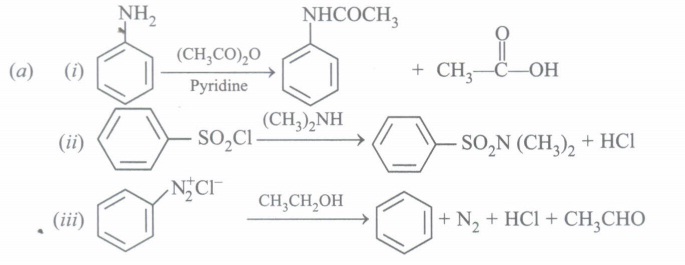
(b) Carbylamine test: Add CHCl3 and KOH to each of them, aniline will give offensive smelling compound whereas N, N-Dimethyl aniline will not react
(c) C2H5NH2 < C6H5NHCH3 < C6H5NH2 is increasing order of their pKb due to decreasing order of basic character.
21.
Solubility of Solids In Liquids:
Solubility is the interaction between particles of the solute and the solvent. Hence, it depends on the nature of the solute and the solvent, as well as on the temperature and pressure. But the solubility of solids in liquids is independent of pressure.
Factors affecting solubility
1. Temperature. Basically, solubility increases with temperature.
2. Polarity. In most cases solutes dissolve in solvents that have a similar polarity.
3. Pressure. Solid and liquid solutes.
4. Molecular size.
5. Stirring increases the speed of dissolving.
22.
(a) \(\Delta { T }_{ f }=i\frac { { K }_{ f }{ W }_{ b }\times 1000 }{ { M }_{ b }\times { W }_{ a } } \)
\(\Delta { T }_{ f }=3\times \left( \frac { 1.86\times 1.9 }{ 95\times 50 } \right) \times 1000\)
= 2.23 K
\(\Delta { T }_{ f }-{ \Delta T }_{ f }^{ ' }=\frac { 273.15-2.23 }{ 273-2.23 } \)
\({ T }_{ f }^{ ' }\) = 270.92 K or 270.77 K
(b) (i) 2 M glucose has a higher boiling point because higher the number of particles lesser is the vapour pressure.
(ii) Reverse osmosis.
23.
(i) tert-Butyl bromide being a 3° alkyl halide on treatment with a base (i.e. NH3) prefers to undergo elimination rather than substitution. Therefore, the product is isobutylene rather than tert-butylamine.

1° amines containing tert-alkyl groups can be prepared by action of suitable Grignard reagents on O-methylhydroxylarnine. For example,
.png)
24.
B) Assertion and reason both are correct statements but reason is not correct explanation for assertion.
Explanation:
A homogeneous mixture consists of a single phase which has properties that may differ from those of the individual components i.e., solute and solvent.
25.
26.
(a): Under acidic condition, aniline gets protonated to anilinium ion (-NH3+ group). This is deactivating and m-directing group. Thus, controlled nitration of aniline mainly gives m-nitroaniline.
27.
(c) Aromatic primary amines cannot be prepared by the Gabriel phthalimide synthesis because aryl halides do not undergo nucleophilic substitution reaction with the anion formed by phthalimide. Thus, (A) is correct but (R) is incorrect
28.
29.
(a) (CH3)3N does not react with Hinsberg reagent.
(b)

(c)
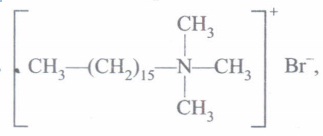 cetyltrimethyl ammonium bromide.
(d)
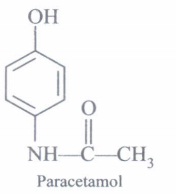
(e) Add NaNO2 and cone, HCI. Cool it to 0 - 5°C. Then add alkaline solution of phenol. Aniline will give orange, azo dye, whereas Benzyl amine does not.

12th Standard CBSE Syllabus & Materials
12th Standard CBSE
CBSE 12th Computer Science Python Revision Tour I - New Previous year Question Papers Study Material - QB365 Set A
NEW12th Standard CBSE
CBSE 12th Business Studies Planning Important Questions And Answers Study Material - QB365 Set A
NEW12th Standard CBSE
CBSE 12th Business Studies Business Environment Important Questions And Answers Study Material - QB365 Set A
NEW12th Standard CBSE
CBSE 12th Business Studies Principles of Management Important Questions And Answers Study Material - QB365 Set A



NCERT Books

Syllabus

Exam Pattern

Sample Question Papers

Previous year Question Papers

Important Notes

MCQ Practice test

NCERT Exemplers

Case study Questions

Image Based Questions

Passage based Questions

HOT Questions

Value Based Questions

Model Questions Papers
NCERT ( Book Back ) Questions

Assertion and Reason
Important Questions And Answers

CBSE 12th Standard CBSE Subjects
CBSE Standards