
 100% FREE ACCESS
12th Standard CBSE Syllabus & Materials
12th Standard CBSE
CBSE 12th Economics Government Budget and the Economy Previous year Question Papers Study Material - QB365 Set A
NEW12th Standard CBSE
CBSE 12th Computer Science Interface Python with MySQL - New Previous year Question Papers Study Material - QB365 Set A
NEW12th Standard CBSE
CBSE 12th Computer Science Database Concept - New Previous year Question Papers Study Material - QB365 Set A
NEW12th Standard CBSE
CBSE 12th Computer Science Data Communication - New Previous year Question Papers Study Material - QB365 Set A
NEW12th Standard CBSE
CBSE 12th Computer Science Data Structures - New Previous year Question Papers Study Material - QB365 Set A
NEW12th Standard CBSE
CBSE 12th Computer Science Functions - New Previous year Question Papers Study Material - QB365 Set A

Published on: 02/11/2025
Download CBSE Class 12th Standard CBSE Chemistry question papers, sample papers, important questions, and previous year solved papers in PDF format. Get free study materials, NCERT solutions, and exam preparation resources for Class 12th Standard CBSE Chemistry
Questions + Answers key
Take MCQ Chemistry Test
1.
Calculate the boiling point of a 1M aqueous solution (density 1.04 g mL-1) of potassium chloride (Kb for water = 0.52 K kg mol-1, Atomic masses : K = 39 u, CI = 35.5 u). Assume, potassium chloride is completely dissociated in solution.
2.
45 g of ethylene glycol (C2H4O2) is mixed with 600 g of water. Calculate
(i) the freezing point depression and
(ii) the freezing point of the solution.
3.
Discuss the applications of thermodynamic concept of reduction for the extraction of iron from its oxides
4.
The unit cube length for LiCi (NaCl structure) is 5.14 \(\mathring { A } \) Assuming anion-anion contact, calculate the ionic radius for chloride ion.
5.
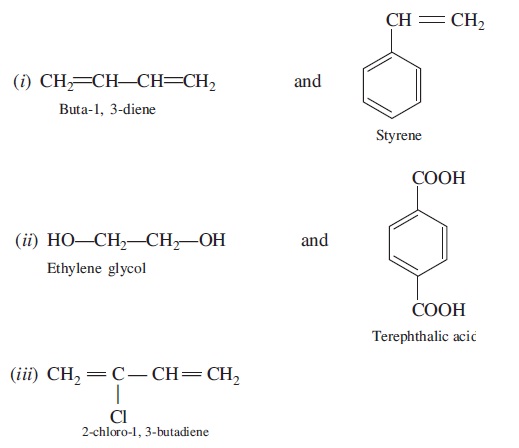
Write the names and structures of the monomers of the following polymers:
(i) Buna-S
(ii) Dacron
(iii) Neoprene
6.
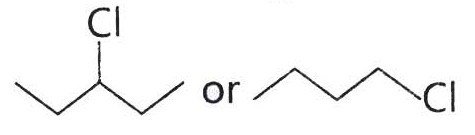
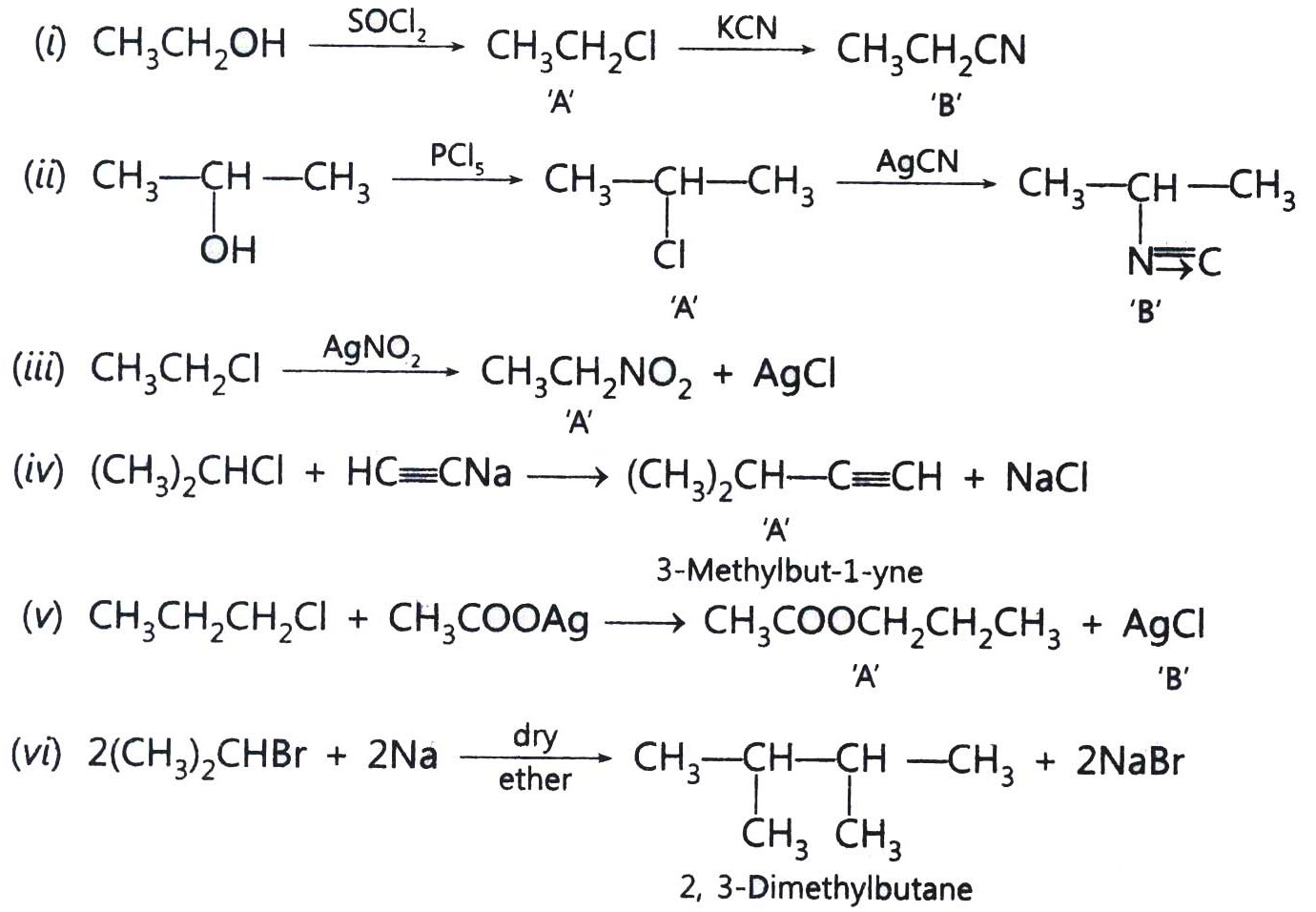
Complete the following reactions:
(i) \(CH_3CH_2OH \xrightarrow{SOCI_2}'A' \xrightarrow{KCN} 'B'\)
(ii) \(CH_3-CH-CH_3 \xrightarrow{PCl_5} 'A' \xrightarrow{AgCN}'B' \\ \quad \quad \quad \ \ | \\ \quad \quad \quad \ OH\)
(iii) \(CH_3CH_2\xrightarrow{AgNO_2}\ 'A'\)
(iv) (CH3)2CHCI + CH \(\equiv \) CNa \(\rightarrow\) 'A'
(v) \(CH_3CH_2CH_2Cl+CH_3COOAg \rightarrow \ 'A' +\ 'B'\)
(vi) \(2(CH_2)_2CHBr + 2Na \xrightarrow{dry \ ether}\)
7.
Write the differences between physisorption and chemisorption with respect to the following:
(i) Specificity
(ii) Temperature dependence
(iii) Reversibility
(iv) Enthalpy change
8.
Define conductivity and give its units. Why is alternating current not used in place of direct current for measuring the electrolytic.
9.
Why water from the soil rises to the top of a tall free?
10.
(a) A blackish brown coloured solid 'A' when fused with alkali metal hydroxides in presence of air, produces a dark green coloured compound 'B', which on electrolytic oxidation in alkaline medium gives a dark purple coloured compound C. Identify A,B and C and write the reactions involved.
(b) What happens when an acidic solution of the green compound (B) is allowed to stand for some time ? Give the equation involved. What is this type of reaction called ?
11.
Rate of a reaction is given by the equation: Rate = k[A]2[B]. What are the units for the rate and the rate constant for this reaction?
12.
Ethylbenzene is generally prepared by acetylation of benzene followed by reduction and not by direct alkylation. Think of a possible reason.
13.
\(\underset{\text { Impure }}{\mathrm{Ni}}+4 \mathrm{CO} \stackrel{330-350 \mathrm{~K}}{\longrightarrow} \mathrm{Ni}(\mathrm{CO})_{4}\)
\(\mathrm{Ni}(\mathrm{CO})_{4} \stackrel{450-470 \mathrm{~K}}{\longrightarrow} \underset{\text { Pure }}{\mathrm{Ni}}+4 \mathrm{CO}\)
The above reactions are of the purification of Ni by
Mond's process
van-Arkel method
Hall-Heroult process
None of these
14.
The reaction taking place in the cell
Pt | H2 (g) | HCl (1.0 M) | AgCl | Ag is 1 atm
\(AgCl+\left( 1/2 \right) { H }_{ 2 }\longrightarrow Ag+{ H }^{ + }+{ Cl }^{ - }\)
\(Ag+{ H }^{ + }+{ Cl }^{ - }\longrightarrow AgCl+\left( 1/2 \right) { H }_{ 2 }\)
\(2{ Ag }^{ + }+{ H }_{ 2 }\longrightarrow 2Ag+2{ H }^{ + }\)
\(2Ag+2{ H }^{ + }\longrightarrow 2{ Ag }^{ + }+{ H }_{ 2 }\)
15.
Name a member of lanthanide series which is well known to exhibit + 4 oxidation state :
Ce
La
Lu
Pr
16.
The role of a catalyst is to change .............. .
Gibbs energy of reaction
enthalpy of reaction
activation energy of reaction
equilibrium constant
17.
Which of them is not equal to zero for an ideal solution ?
\({ \Delta V }_{ mix }\)
\(\Delta P={ P }_{ observed }-{ P }_{ Raoult }\)
\({ \Delta H }_{ mix }\)
\({ \Delta S }_{ mix }\)
18.
KCl crystallises in the same type of lattice as does NaCl.Given that rNa+/rCl-=0.55 and rK+/rCl-=0.74.Calculate the side of the unit cell of KCl to that of NaCl
1.123
0.891
1.414
0.414
1.732
19.
C17H35COO-Na+
20.
LDP
21.
d4
22.
E0 (Fe3+, Fe)
23.
The experimental data for the decomposition of N2O5,
[2N2O5 \(\rightarrow\) 4NO2+O2]
in gas phase of 318 K are given below:
| t/s | 10-2 x [N2O5] /mol L-1 |
| 0 | 1.63 |
| 400 | 1.36 |
| 800 | 1.14 |
| 1200 | 0.93 |
| 1600 | 0.78 |
| 2000 | 0.64 |
| 2400 | 0.53 |
| 2800 | 0.43 |
| 3200 | 0.35 |
(i) Plot [N2O5]against t.
(ii) Find the half-life period for the reaction.
(iii) Draw a graph between log[N2O5] and t.
(iv) What is the rate law?
(v) Calculate the rate constant.
(vi) Calculate the half-life period from k and compare it with (ii).
24.
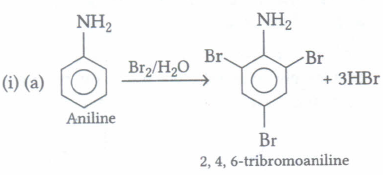
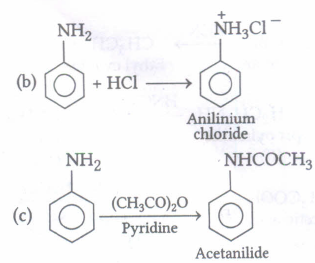
(a) Write the structures of the main products when aniline reacts with the following reagents:
(i) Br2 water
(ii) HCI
(iii) (CH3CO)2O / pyridine
(b) Arrange the following in the increasing order of their boiling point:
C2H5NH2 , C2H5OH, (CH3)3N
(c) Give a simple chemical test to distinguish between the following pair of compounds:
(CH3)2NH and (CH3)3N
25.
Due to hectic and busy schedule, Mr. Singh started taking junk food in the lunch break and slowly became habitual of eating food irregularly to excel in his field. One day during meeting he felt severe chest pain and fell down. Mr. Khanna, a close friend of Mr. Singh took him to doctor immediately. The doctor diagnosed that Mr. Singh was suffering from acidity and prescribed some medicines. Mr. Khanna advised him to eat home made food and change his lifestyle by doing yoga, meditation and some physical exercise. Mr. Singh followed his friend's advice and after few days he started feeling bener.
After reading the above passage, answer the following:
(i) What are the values (at least two) displayed by Mr. Khanna?
(ii)What are antacids? Give one example.
(iiii)Would it be advisable to take antacids for a long period of time? Give reason
26.
(a) When 2.56 g of sulphur was dissolved in 100 g of CS2, the freezing point lowered by 0.383 K. Calculate the formula of sulphur (SX). (Kf for CS2 = 3.83 K kg mol-1, Atomic mass of sulphur = 32 g mol-1).
(b) Blood cells are isotonic with 0.9 % sodium chloride solution. What happens if we place blood cells in a solution containing;
(i) 1.2 % sodium chloride solution?
(ii) 0.4% sodium chloride solution?
27.
Benzene on reaction with HOCI in presence of an acid produces organic compound (A), (A) on treatment with NaNH2/liq. NH3 furnishes another organic compound (B). (B) on treatment with HBF4 affords an organic compound (C) wich on heating with NaNO2 gives organic compound (D). Identify (A), (B), (C) and (D).
28.
What is the formula of a compound in which the element Y forms ccp lattice and atoms of X occupy 2/3rd of tetrahedral voids?
1.
Molar mass of KCI = 39 + 35.5 = 74.35 g mol-1
A KCI dissociates completely, number of ions produced are 2.There, Van't Hoff factor, i = 2
Mass of KCI solution = 1000 \(\times\)1.04 = 1040 g
Mass of solvent = 1040 - 74.5 = 965.5 g = 0.9655 kg1/2
Molality of the solution :
\(\\ \frac { No.\quad of\quad moles\quad of\quad solute }{ Mass\quad of\quad solvent\quad in\quad kg } =\frac { 1\quad mol }{ 0.9655\quad kg } =1.0357\quad m\)
Tb = i \(\times\)Kb \(\times\)m
= 2 \(\times\) 0.52 \(\times\)1.0357 = 1.078 \(°\) C
Therefore, boiling point of solution
= 100 = 1.078 = 101.078\(°\)C
2.
Depression in freezing point is related to the molality, therefore, the molality of the solution with respect to ethylene glycol \(=\frac{\text { moles of ethylene glycol }}{\text { mass of water in kilogram }}\)
\(\text {Moles of ethylene glycol }=\frac{45 \mathrm{~g}}{62 \mathrm{~g} \mathrm{~mol}^{-1}}=0.73 \mathrm{~mol}\)
\(\text {Mass of water in } \mathrm{kg}=\frac{600 \mathrm{~g}}{1000 \mathrm{~g} \mathrm{~kg}^{-1}}=0.6 \mathrm{~kg}\)
\(\text {Hence molality of ethylene glycol }=\frac{0.73 \mathrm{~mol}}{0.60 \mathrm{~kg}}=1.2 \mathrm{~mol} \mathrm{~kg}^{-1}\)
Therefore freezing point depression,
ÄTf = 1.86 K kg mol–1 x 1.2 mol kg–1 = 2.2 K
Freezing point of the aqueous solution = 273.15 K – 2.2 K = 270.95 K
3.
Thermodynamics help us to understand how coke reduces the oxide and why blast furnace is chosen for this process. The main reduction reaction is:
FeO(s) + C(s) ⟶ Fe(s or l) + CO(g)
This reaction is a combination of two simple oxidation-reduction reactions. In one reaction, reduction of FeO is taking place and in the other carbon is being oxidised to CO as:
\(FeO(s) ⟶ Fe(s)+{1\over 2}O_2{(g})\ \ ΔG(FeO,\ Fe)\)
\((s)+{1\over 2}O_2 \longrightarrow CO(g)\ \ ΔG(C, CO)\)
When both the reactions (ii) and (iii) take place
to give equation (i) the net Gibbs energy change is :
ΔG(C, CO) + ΔG(FeO, Fe) = ΔrG
The net reaction [Eq. (i)] will occur' when the resultant ΔrG is negative. In Ellingham diagram ΔG vs T plot representing Eq. (ii) goes upward while that representing the change C⟶ CO (i.e., C, CO line) goes downward. At temperature about 1073 K (approx), the C, CO line falls below Fe, FeO line [G(C.CO)<∆G(FeO.Fe)].This means that in this temperature range, coke can reduce FeO to Fe and it will itself be oxidised to CO. Similarly, the reduction of Fe2O3 and Fe3O4 at relatively lower temperatures by CO can be explained on the basis of lower lying points of intersection of their curves with the COand CO2 curves
In blast furnace, the reduction of oxides takes place at different temperature ranges. For this, hot air is blown from the bottom of the furnace and coke is burnt to give temperature up to 2200 Kin the lower portion. The burning of coke, therefore, supplies most of the heat required for the working temperature of the furnace. The CO and heat moves to upper part of the furnace. In upper part, the temperature is lower and the iron oxides (Fe2O3and Fe3O4) coming from the top are reduced to FeO in steps. Thus, the reduction reactions occurring in the lower temperature range and in the higher temperature range depend on the points of corresponding intersections in the ArG vs T
plots. It is observed that at the bottom of the furnace (higher temperature range) the reducing agent is carbon itself but at the top of the furnace (lower temperature range) the reducing agent is carbon monoxide. These reactions are summarised below:
At lower temperature range in the blast furnace (500-800 K)
3Fe2O3 + CO ⟶ 2Fe3O4+ CO2
Fe3O4 + 4CO ⟶ 3Fe + 4CO2
Fe2O3 + CO ⟶ FeO + CO2
At higher temperature range (900-1500 K) in the blast furnace
C + CO2 ⟶ 2CO
FeO + C ⟶ Fe + CO2
4.
1.81\(\mathring { A } \)
5.
The monomers of the following polymers
6.
7.
| Criteria | Physisorption | Chemisorption |
| Specificity | It is not specific in nature | It is highly specific in nature. |
| temperature dependence | It decreases with increase in temperature. Thus, low temperature is favourable for physisorption. |
It occurs at moderate temperature. It first increases and then decreases with increase in temperature. |
| Reversibility | Reversible in nature. | Irreversible in nature. |
| Enthalpy change | Low enthalpy of adsorption. (20-40 kJmol-1) | High enthalpy of adsorption. (80-240 kJmol-1) |
8.
Conductivity is the conductance of a solution of 1 cm length and having 1 sq.cm as the area of cross-section i.e., of one-centimeter cube.
Direct current results in the electrolysis of the electrolytic solution. As a result, the concentration of the electrolyte near the electrodes changes and these result change in the resistance of the solution.
9.
It is due to osmosis.
10.
\(\underset{Pyrolusite\\ (A)\ Blackish\ brown}{MnO_2 }+ 4KOH + O_2\xrightarrow{Fuse}\underset{Potassium\ magnate\\ (B)-Green\ coloured}{2K_2MnO_4}+2H_2O\)
\(\underset B{2 KMnO_4} + H20 + (0)_2 \xrightarrow[medium]{Alkaline}\underset{Potasium\ permanganate\\ (C)-Purple\ coloured}{2KMnO_4}+2KOH\)
or \(MnO^{-2}_4 \xrightarrow{} MnO_4^- + e^-\)
(b) When acidic solution of green compound (B), i·.e., potassium manganate is allowed to stand for some time, it disproportionates to give permanganate as follows:
\(3 MnO^{2-}_4+ 4H^+\longrightarrow2 MnO^-_4 + MnO_2 + 2 H_2O\)
This reaction is called disproportionation reaction.
11.
Units of rate = mol L-1s-1
\(\mathrm{k}=\frac{\text { Rate }}{[A][B]^2}=\frac{m a l L^{-1} s^{-1}}{\left(m o l L^{-1}\right)\left(m o l L^{-1}\right)^2}\)
12.
It is because reaction does not stop in one step. It can for disubstituted product also.
13.
(a)
Mond's process
14.
(a)
\(AgCl+\left( 1/2 \right) { H }_{ 2 }\longrightarrow Ag+{ H }^{ + }+{ Cl }^{ - }\)
15.
(a)
Ce
16.
In the presence of catalyst , activation energy barrier is lowerd.
17.
(d)
\({ \Delta S }_{ mix }\)
18.
1.123
19.
()
Soap
20.
()
Low density polythene
21.
()
- 1.6
22.
()
- 0.04 V
23.
(i) The plot [N2O5] against time is shown below :
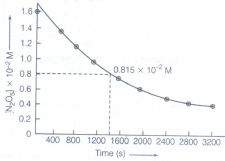
(ii) Initial concentration [at t = 0] of N2O5
= 1.63 x 10⁻² M
Half of its concentration = 1.63X 10⁻²/ 2
= 0.815 x 10⁻² M
From, the above graph, the time which corresponds to 0.815 X 10⁻² M concentration is 1450 s.
Hence, t1/2 = 1450 s
(iii)
| t/s | 10-2 x [N2O5] /mol L-1 | log[N2O5] |
| 0 | 1.63 | -1.79 |
| 400 | 1.36 | -1.87 |
| 800 | 1.14 | -1.94 |
| 1200 | 0.93 | -2.03 |
| 1600 | 0.78 | -2.11 |
| 2000 | 0.64 | -2.19 |
| 2400 | 0.53 | -2.28 |
| 2800 | 0.43 | -2.37 |
| 3200 | 0.35 | -2.46 |
The plot of log [N2O5] and time can be represented as :
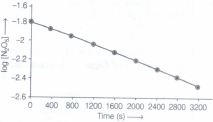
(iv) As the plot of log [N2O5] versus time obtained is a straight line, hence it is a reaction of first order.
ஃ Rate = k [N2O5]
(v) For first order reaction, the slope of the line
\({c} =-\frac{k}{2.303} \)
\(\\ \therefore\text { Slope }=\frac{-2.46-(-1.79)}{3200-0}=\frac{-0.67}{3200} \)
Equating Eqs. (i) and (ii), we get
\({c} -\frac{k}{2.303}=\frac{-0.67}{3200} \)
\(\text {or } k=\frac{0.67 \times 2.903}{3200} \text { or } k=4.82 \times 10^{-1} \mathrm{~s}^{-1} \)
Half-life period (t1/2) are calculated from the formula and slope are approximately the same.
24.
(ii) Alcohols have higher boiling point as compared to that of amines, because oxygen being more electronegative atom, forms strong hydrogen bond as compared to that of nitrogen. In tertiary amine, there is no hydrogen bond formation due to the absence of H-atoms and hence, has the lowest boiling point. Therefore, increasing order of boiling point (CH3)3N < C2H5NH2 < C2H5OH .
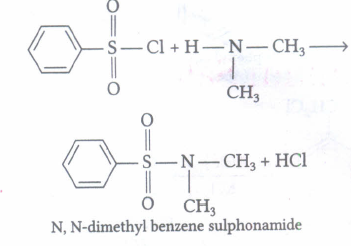
(iii) (CH3)3NH and (CH3)3N are secondary and tertiary arnines respectively. These are distinguished by Hinsberg's reagent which gives sulphonamide with secondary amines and no reaction carried out with tertiary arnines. (CH3)3NH reacts with benzene sulphonyl chloride as follows:
25.
(i) Friendly, caring nature, supportive and has good awareness towards health. (Any two)
(ii) Antacids are the chemical substances which neutralize excess acid in the gastric juices and give relief from acid indigestion, heart bums, acidity and gastric ulcers. e.g., Histamine, Ranitidine, Cimetidine.
(iii) It is not advisable to take antacids for a long time as they control only symptoms and not the cause. Therefore, the patients cannot be treated easily and completely through them. The production of more acid They may also lead to.
26.
\(\Delta { T }_{ f }=\frac { { K }_{ f }{ W }_{ b }\times 1000 }{ { M }_{ b }\times { W }_{ a } } \)
\(0.383=\left( \frac { 3.83\times 2.56 }{ M\times 100 } \right) \times 1000\)
M = 256
S \(\times \) x = 256
32 \(\times \) x = 256
x = 8
(b) (i) If we place blood cells in solution containing 1.2% sodium chloride solution, they shrink.
(ii) It we place blood cells in solution containing 0.4% sodium chloride solution, they swell.
27.
(i) HOCI in presence of an acid generates the reactive electrophile, chloronium ion «r, which attacks benzene to give chlorobenzene (A).
(ii) Chlorobenzene (A) on treatment with NaNH2/liq. NH3 undergaes-dehydrohalogenation via benzyne to afford aniline (B).
(iii) Aniline (B) on treatment with HBF4 forms the corresponding salt anilinium tetrafluoroborate (C) which on heating with NaNO2 undergoes Balz-Schiemann reaction through the intermedium formation of benzenediazonium tetrafluoroborate to afford fluorobenzene (D).
28.
()
Atoms Y adopt hcp arrangement and there are two tetrahedral sites per atom of Y.
Since 2/3rd tetrahedral sites are occupied by atoms of X, then for each atom of Y, the number of X atoms will be = \(2\times \frac { 2 }{ 3 } =\frac { 4 }{ 3 } \).
Formula of compound: X4/3Y
or X4Y3 .

12th Standard CBSE Syllabus & Materials
12th Standard CBSE
CBSE 12th Computer Science Python Revision Tour I - New Previous year Question Papers Study Material - QB365 Set A
NEW12th Standard CBSE
CBSE 12th Business Studies Planning Important Questions And Answers Study Material - QB365 Set A
NEW12th Standard CBSE
CBSE 12th Business Studies Business Environment Important Questions And Answers Study Material - QB365 Set A
NEW12th Standard CBSE
CBSE 12th Business Studies Principles of Management Important Questions And Answers Study Material - QB365 Set A



NCERT Books

Syllabus

Exam Pattern

Sample Question Papers

Previous year Question Papers

Important Notes

MCQ Practice test

NCERT Exemplers

Case study Questions

Image Based Questions

Passage based Questions

HOT Questions

Value Based Questions

Model Questions Papers
NCERT ( Book Back ) Questions

Assertion and Reason
Important Questions And Answers

CBSE 12th Standard CBSE Subjects
CBSE Standards