
 100% FREE ACCESS
12th Standard CBSE Syllabus & Materials
12th Standard CBSE
CBSE 12th Economics Government Budget and the Economy Previous year Question Papers Study Material - QB365 Set A
NEW12th Standard CBSE
CBSE 12th Computer Science Interface Python with MySQL - New Previous year Question Papers Study Material - QB365 Set A
NEW12th Standard CBSE
CBSE 12th Computer Science Database Concept - New Previous year Question Papers Study Material - QB365 Set A
NEW12th Standard CBSE
CBSE 12th Computer Science Data Communication - New Previous year Question Papers Study Material - QB365 Set A
NEW12th Standard CBSE
CBSE 12th Computer Science Data Structures - New Previous year Question Papers Study Material - QB365 Set A
NEW12th Standard CBSE
CBSE 12th Computer Science Functions - New Previous year Question Papers Study Material - QB365 Set A

Published on: 02/11/2025
Download CBSE Class 12th Standard CBSE Chemistry question papers, sample papers, important questions, and previous year solved papers in PDF format. Get free study materials, NCERT solutions, and exam preparation resources for Class 12th Standard CBSE Chemistry
Questions + Answers key
Take MCQ Chemistry Test
1.
Why type of stoichiometric defect is shown by AgCl?
2.
What is the value of Van't Hoff factor \('i'\) for \({ K }_{ 4 }\left[ Fe\left( CN_{ 6 } \right) \right] \) aqueous solution assuming complete ionisation.
3.
How can a carboxylic acid be converted to an amine in one step having one carbon atom less?
4.
Why in any transition series, melting points first increase and then decrease and also they show a dip in the middle ?
5.
Write expression for rate of reactuion in terms of each reactant and product for the reaction
N2 + 3H2 \(\longrightarrow\) 2NH3.
6.
What is relationship between Gibb's free energy of cell reaction in a galvanic cell and the emf of the cell? When will the maximum wirk be obtained from a galvanic cell.
7.
At 10\(°\) C, the average osmotic pressure of blood is 8.8 atm. Find the total concentration of the various constituents in the blood. Assuming that the concentration is the same as the molarity, find the freezing point of the solution (Kf for water = 1.86 K kg mol-1)
8.
45 g of ethylene glycol (C2H4O2) is mixed with 600 g of water. Calculate
(i) the freezing point depression and
(ii) the freezing point of the solution.
9.
The reaction:
\({ Cr }_{ 2 }{ O }_{ 3 }+2Al\rightarrow { Al }_{ 2 }{ O }_{ 3 }+2Cr;\ \triangle { G }^{ ° }=-421\quad kJ\)
is thermodynamically feasible as is apparent from Gibbs energy value. Why does it not take place at room temperature?
10.
CsCl has cubic structure. Its density is 3.99 g cm-3. What is the distance between Cs+ and Cl- ions? (At mass of Cs=133)
11.
Explain the following terms giving a suitable example for each :
(i) Elastomers
(ii) Condensation polymers
(iii) Addition polymers
12.
(i) State one use each of DDT and iodoform.
(ii) Which compound in the following couples will react fastert in SN2 displacement and why?
(a) 1-Bromopentane or 2-bromopentane
(b) 1-Bromo-2-methylbutane or 2-bromo- 2-methylbutane.
13.
Because of lanthanoid contraction, which of the following pairs of elements have nearly same atomic radii ? (Numbers in parenthesis are atomic numbers)
Zr (40) and Hf (72)
Zr (40) and Ta (73)
Ti (22) and Zr (40)
Zr (40) and Nb (41)
14.
Brine solution on electrolysis will give
NaOH
O2
Cl2
H2
15.
The metal that cannot be obtained by electrolysis of an aqueous solution of its salt is
Cr
Ag
Ca
Cu
16.
A relation P \(\longrightarrow\) Q is completed 25 % in 25 min 50 % completed in 25 min if [P] is halved, 25% completed in 50 min if [P] is doubled. The order of reaction is
1
2
0
3
17.
KCl crystallises in the same type of lattice as does NaCl.Given that rNa+/rCl-=0.55 and rK+/rCl-=0.74.Calculate the side of the unit cell of KCl to that of NaCl
1.123
0.891
1.414
0.414
1.732
18.
The osmotic pressure of 0.1 M aqueous solution of NaCl is ................ Osmotic pressure of 0.1 M aqueous solution of glucose
equal to
less than
half of
nearly double
19.
The movement of colloidal particles under the influence of an electric field is called................. .
20.
Shyam living in Shimla, was washing clothes in cold water. He found that the clothes were not getting clean. Sneha, his grandmother, suggested that he wash the clothes in warm water, Washing of clothes with soaps or detergents is easier in luke warm water than cold water.
Answer the following questions:
(i) Why is it easier to wash the clothes in luke warm water?
(ii) What values are associated with these information?
21.
(a) Write the structures of the main products when aniline reacts with the following reagents:
(i) Br2 water
(ii) HCI
(iii) (CH3CO)2O / pyridine
(b) Arrange the following in the increasing order of their boiling point:
C2H5NH2 , C2H5OH, (CH3)3N
(c) Give a simple chemical test to distinguish between the following pair of compounds:
(CH3)2NH and (CH3)3N
22.
Ramesh went to a department store to purchase groceries, On one of shelves he noticed sugar-free tablets, He decided to buy them for his grandfather who was a diabetic. There was three types of sugar-free tablets, Ramesh decided to buy sucralose which was good for his grandfather's health.
(i) Name another sugar-free tablet which Ramesh did not buy,
(ii) Was it right to purchase such medicines without doctor's prescription?
(iii)Wha is quality of Ramesh is reflected above?
23.
(a) Define the following terms:
(i) Mole fraction,
(ii) Ideal solution.
(b) 15.0 g of an unknown molecular material is dissolved in 450 g of water. The resulting solution freezes at - 0.34 \(°\)C. What is the molar mass of the material? [Kf for water=1.86 K Kg mol-1]
24.
Benzene on reaction with HOCI in presence of an acid produces organic compound (A), (A) on treatment with NaNH2/liq. NH3 furnishes another organic compound (B). (B) on treatment with HBF4 affords an organic compound (C) wich on heating with NaNO2 gives organic compound (D). Identify (A), (B), (C) and (D).
25.
At constant temperature and volume, X decomposes as 2 X (g) \(\longrightarrow\) 3 Y (g) + 2 Z (g). Px is the partial pressure of X.
| Observation No. | Time (in minutes) | Px (in mm of Hg) |
|---|---|---|
| 1 | 0 | 800 |
| 2 | 100 | 400 |
| 3 | 200 | 200 |
(i) What is the order of reaction with respect to X?
(ii) Find the time for 75% completion of the reaction.
(iii) Find the total pressure when pressure of X is 700 mm of Hg.
26.
Soap granules
27.
Wood laminates
28.
[Co(NH3)5Cl] Cl2
29.
Aluminium
1.
()
AgCl shows Frenkel defects.
2.
\(K_4\left[\mathrm{Fe}\left(C N_6\right)\right] \longrightarrow 4 K^{+}\left[\mathrm{Fe}\left(C N_6\right)\right]^{4-}\)
3.
Carboxylic acids react with hydrazoic acid (N3H) in presence of conc.H2SO4 to form 1∘ amines containing one carbon atom less than the carboxylic acid.
4.
Melting points first increase because the number of unpaired electrons increases and hence strength of metallic bond increases. After reaching the maximum, the melting points decrease because the pairing of electrons starts in the d-subshell and number of unpaired electrons decreases and so the strength of metallic bond decreases. The dip in the middle is due to exactly half-filled configuration of d-subshell which has higher stability. Hence, electrons are held tightly by the nucleus. As a result, metallic bond is weaker.
5.
\(-\frac{d\left[N_2\right]}{d t}=\frac{1}{3} \frac{d\left[N_2\right]}{d t}=+\frac{1}{2} \frac{d\left[N H_3\right]}{d t}\)
6.
\({ \triangle G }^{ o }={ -nE }^{ o }F,-{ \triangle G }^{ o }={ W }_{ max' }\) decrease in free energy is measure of maximum work obtainable from the cell.
7.
Step-I : Calculation for concentration of the solution.
According to Van't Hoff's equation
p = CRT or C = \(\frac { \pi }{ RT } \)
p = 8.8 atm, T = 40\(°\)C = 313 K
R = 0.0821 L atm K-1 mol-1
\(C=\frac { 8.8 }{ 0.0821\times 313 } \)=0.34 molL-1(M)
Step-II: Calculation of freezing point of the solution depression in freezing point of solution
\(\Delta\)Tf = Kf \(\times\) m
m = 0.34 mol kg-1
(same as molarity as given)
Kf = 1.86 K kg mol-1
\(\Delta\)Tf = 1.86 \(\times\) 0.84 (\(\because\) \(\Delta\) Tf = Kf m)
= 0.63 K = 0.63\(°\)C
Freezing point of the solution = 0 - 0.63 \(°\)C
= - 0.63\(°\) C
8.
Depression in freezing point is related to the molality, therefore, the molality of the solution with respect to ethylene glycol \(=\frac{\text { moles of ethylene glycol }}{\text { mass of water in kilogram }}\)
\(\text {Moles of ethylene glycol }=\frac{45 \mathrm{~g}}{62 \mathrm{~g} \mathrm{~mol}^{-1}}=0.73 \mathrm{~mol}\)
\(\text {Mass of water in } \mathrm{kg}=\frac{600 \mathrm{~g}}{1000 \mathrm{~g} \mathrm{~kg}^{-1}}=0.6 \mathrm{~kg}\)
\(\text {Hence molality of ethylene glycol }=\frac{0.73 \mathrm{~mol}}{0.60 \mathrm{~kg}}=1.2 \mathrm{~mol} \mathrm{~kg}^{-1}\)
Therefore freezing point depression,
ÄTf = 1.86 K kg mol–1 x 1.2 mol kg–1 = 2.2 K
Freezing point of the aqueous solution = 273.15 K – 2.2 K = 270.95 K
9.
The reaction is thermodynamically favourable. Since in the given redox reaction, all the reactants and the products are solids at room temperature, therefore, it does not occur at room temperature. However, at high temperature when chromium melts, the reaction proceeds rapidly. Thus, heating is required for this reaction to start.
10.
357 pm
11.
(i) Elastomers: The polymers in which polymer chains are held together by the weakest intermolecular forces.These weak forces permit the polymer to be stretched.A few 'cross-links' are introduced in between the chains which held the polymer to retract to its original position after the force is released, as in vulcanised rubber
(ii) Condensation polymers: It involves a series of condensation reaction generally involving two monomers.Each monomer normally contains two functional groups.The condensation reactions result in the loss of small molecules usually water and ammonia, e.g. nylon, terylene, bakelite are condensation polymers.This process is Known as 'condensation polymerisation'
(iii) Addition polymers: The polymers which are formed by repeated addition of monomers to the polymer chain.The monomers are unsaturated compounds and commonly derivatives of ethene.the addition polymers have same empirical as their monomers, e.g
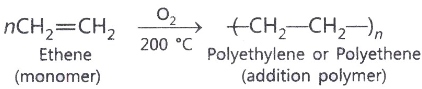
This process is 'addition polymerisation'.
12.
(i) DDT: It is used as insecticide to control flies, mosquitoes, etc. Iodoform: Iodoform is used as an antiseptic.
(ii) 1-Bromopentane, as it is a primary alkyl halide. and
(b) 1-Bromo-2-methyl butane, as it is a primary alkylhalide.
13.
(a)
Zr (40) and Hf (72)
14.
(a)
NaOH
15.
(c)
Ca
16.
(c)
0
17.
1.123
18.
(d)
nearly double
19.
()
electrophoresis
20.
(i) Soaps work due to the formation of micelles. But the formation of micelles takes place at a minimum temperature called 'Kraft temperature'. This temperature is reached in luke warm water.
(ii) Be humble to accept a scientific fact from a elder person.
21.
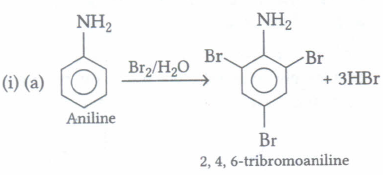
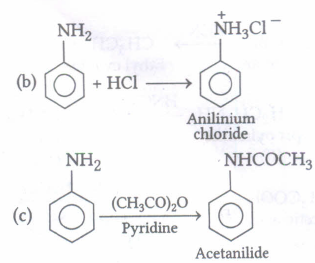
(ii) Alcohols have higher boiling point as compared to that of amines, because oxygen being more electronegative atom, forms strong hydrogen bond as compared to that of nitrogen. In tertiary amine, there is no hydrogen bond formation due to the absence of H-atoms and hence, has the lowest boiling point. Therefore, increasing order of boiling point (CH3)3N < C2H5NH2 < C2H5OH .
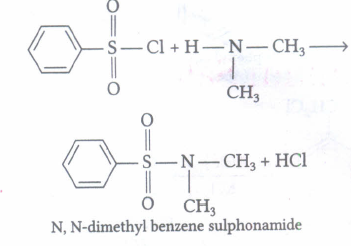
(iii) (CH3)3NH and (CH3)3N are secondary and tertiary arnines respectively. These are distinguished by Hinsberg's reagent which gives sulphonamide with secondary amines and no reaction carried out with tertiary arnines. (CH3)3NH reacts with benzene sulphonyl chloride as follows:
22.
(i) Aspartame, Saccharin (anyone).
(ii) No.
23.
(a) (i) The ratio of number of moles of one component to the total number of moles of solution is known as mole fraction.
(ii) The solution which follows Raoult's law over entire range of concentrations at specific temperature is called ideal solution.
(b) WB = 15 g, WA = 450 g, \(\Delta\)Tf = 0.34 K, MB = ?
\({ M }_{ B }=\frac { 1000\times { K }_{ f }\times { W }_{ B } }{ \Delta { T }_{ f }\times { W }_{ A } } \)
\(=\frac { 1000\times 1.86 \ K \ kg \ { mol }^{ -1 }\times 15 \ g }{ 0.34K\times 450 \ g } \)
= 182.35 g/mol
24.
(i) HOCI in presence of an acid generates the reactive electrophile, chloronium ion «r, which attacks benzene to give chlorobenzene (A).
(ii) Chlorobenzene (A) on treatment with NaNH2/liq. NH3 undergaes-dehydrohalogenation via benzyne to afford aniline (B).
(iii) Aniline (B) on treatment with HBF4 forms the corresponding salt anilinium tetrafluoroborate (C) which on heating with NaNO2 undergoes Balz-Schiemann reaction through the intermedium formation of benzenediazonium tetrafluoroborate to afford fluorobenzene (D).
25.
(i) As pressure of X is changing with time, it cannot be a zero order reaction. Let us now check it for 1st order.
At t = 100 min, \(k={2.303\over 100}log{P_0\over P_t}={2.303\over 100}log {800\over 400}=6.932\times 10^{-3}min^{-1}\)
At t = 200 min, \(k={2.303\over 200}log{800\over 200}={2.303\over 800}log4=6.932\times10^{-3}min^{-1}\)
As k comes out to be constant, hence it is a reaction of 1st order
(ii)\(t_{75./.}={2.303\over k}log{100\over 100-75}={2.303\over 6.932\times10-3min}log4=200min\)
(iii) 2x (g)⟶ 3 y (g) + 2z (g)
Initial Pressure 800mm 0 0
Pressure after time t 800 - 2p 3 p 2 p
When pressure of X is 700 mm, 800 - 2 p = 700 or p = 50 mm
Total pressure = (800 - 2 p) + 3 p + 2 p = 800 + 3 p = 800 + 3 x 50 = 950 mm.
26.
()
dried miniature soap bubbles
27.
()
.Urea-formaldehyde resins
28.
()
Zero
29.
()
0.000093

12th Standard CBSE Syllabus & Materials
12th Standard CBSE
CBSE 12th Computer Science Python Revision Tour I - New Previous year Question Papers Study Material - QB365 Set A
NEW12th Standard CBSE
CBSE 12th Business Studies Planning Important Questions And Answers Study Material - QB365 Set A
NEW12th Standard CBSE
CBSE 12th Business Studies Business Environment Important Questions And Answers Study Material - QB365 Set A
NEW12th Standard CBSE
CBSE 12th Business Studies Principles of Management Important Questions And Answers Study Material - QB365 Set A



NCERT Books

Syllabus

Exam Pattern

Sample Question Papers

Previous year Question Papers

Important Notes

MCQ Practice test

NCERT Exemplers

Case study Questions

Image Based Questions

Passage based Questions

HOT Questions

Value Based Questions

Model Questions Papers
NCERT ( Book Back ) Questions

Assertion and Reason
Important Questions And Answers

CBSE 12th Standard CBSE Subjects
CBSE Standards