
 100% FREE ACCESS
12th Standard CBSE Syllabus & Materials
12th Standard CBSE
CBSE 12th Economics Government Budget and the Economy Previous year Question Papers Study Material - QB365 Set A
NEW12th Standard CBSE
CBSE 12th Computer Science Interface Python with MySQL - New Previous year Question Papers Study Material - QB365 Set A
NEW12th Standard CBSE
CBSE 12th Computer Science Database Concept - New Previous year Question Papers Study Material - QB365 Set A
NEW12th Standard CBSE
CBSE 12th Computer Science Data Communication - New Previous year Question Papers Study Material - QB365 Set A
NEW12th Standard CBSE
CBSE 12th Computer Science Data Structures - New Previous year Question Papers Study Material - QB365 Set A
NEW12th Standard CBSE
CBSE 12th Computer Science Functions - New Previous year Question Papers Study Material - QB365 Set A

Published on: 02/11/2025
Download CBSE Class 12th Standard CBSE Chemistry question papers, sample papers, important questions, and previous year solved papers in PDF format. Get free study materials, NCERT solutions, and exam preparation resources for Class 12th Standard CBSE Chemistry
Questions + Answers key
Take MCQ Chemistry Test
1.
Name two physical quantites that remain unaffected when a reversible reaction is carried out in the presence of a catalyst.
2.
Which type of ionic substances shown Schottky defect in solids?
3.
(a) Calculate \(\Delta G°\)for the reaction Mg(s)+Cu2+\(\rightarrow\)Mg2+(aq)+Cu(s)
Given: \({ E }_{ cell }^{ ° }\)= +2.7V, 1F = 96500 C mol-1
(b) Name the type of cell which was used in Apollo space programme for providing electrical power.
4.
Define azeotropic mixture.
5.
Give reasons for the following : Variations in the radii of transition elements are not as pronounced as those of representative elements.
6.
The rate law for the decomposition of N2O5 is : rate = k[N2O5]. What is the significance of k in this equation ?
7.
In a compoubd, nitrogen atoms (N) make cubic close packed lattice and metal atoms (M)occupy one-third of the tetrahedral voids present. Determine the formula of the compound formed by M and N?
8.
Name the electrophile produced in the reaction of benzene with benzoyl chloride in the presence of anhydrous AlCl3. Name the reaction also.
9.
A 100W and 110 V incandescent lamp is connected in series with an electrolytic cell containing CdSO4 solution. What mass of cadmium will be deposited at the cathode after 4 hrs of electricity?
10.
At 10\(°\) C, the average osmotic pressure of blood is 8.8 atm. Find the total concentration of the various constituents in the blood. Assuming that the concentration is the same as the molarity, find the freezing point of the solution (Kf for water = 1.86 K kg mol-1)
11.
45 g of ethylene glycol (C2H4O2) is mixed with 600 g of water. Calculate
(i) the freezing point depression and
(ii) the freezing point of the solution.
12.
Calculate the Avogadro's number from the following data of AB when has NaCl type structure :
Density of AB = 2.48 g cm-3, M = 58
Distance between A+ and B- in AB = 269 pm.
13.
Identify the four groups into which the polymers are classified on the basis of the magnitude of intermolecular forces present in them. To which group or groups do polythene and bakelite belong ?
14.
General electronic configuration of actinoids is (n - 2) f1-14 (n - 1) d0-2 ns2. Which of the following actinoids have one electron in 6d orbital?
U (Atomic no. 92)
Np (Atomic no. 93
Pu (Atomic no. 94)
Am (Atomic no. 95)
15.
Bauxite ore is made up Al2O3 +SiO2+TiO2+Fe2O3.This ore treated with conc.NaOH solution at 500K and 35 bar pressure for few hours and filtered hot.In the filtrate ,the species present are:
NaAl(OH)4 only
NaTi(OH)6 only
NaAl(OH)4 and Na2SiO3 both
Na2SiO3 only
16.
The equivalent conductance of NaCl at concentration C and at infinite dilution are \({ \lambda }_{ c }\) and \({ \lambda }_{ \infty }\) respectively. The correct relationship between \({ \lambda }_{ c }\) and \({ \lambda }_{ \infty }\) is given by (where the constant B is positive)
\({ \lambda }_{ c }={ \lambda }_{ \infty }+(B)\sqrt { C } \)
\({ \lambda }_{ c }={ \lambda }_{ \infty }+(B) { C } \)
\({ \lambda }_{ c }={ \lambda }_{ \infty }-(B) { C } \)
\({ \lambda }_{ c }={ \lambda }_{ \infty }-(B)\sqrt { C } \)
17.
Two liquids X and Y form an ideal solution. The mixture has a vapour pressure of 400 mm at 300 K when mixed in the molar ratio of 1:1 and a vapour pressure of 350 mm when mixed in the molar ratio of 1:2 at the same temperature. The vapour pressures of the pure liquids X and Y respectively are
250 mm, 550 mm
350 mm, 450 mm
350 mm, 700 mm
500 mm, 500 mm
550 mm, 250 mm
18.
A chemical reaction was carried out at 300 K and 280 K the rate constants were found to be K1 and K2 respectively. Then
K2 = 4K1
K2 = 2K1
K2 = 0.25 K
K2 = 0.5 K1
19.
If the position of Na+ and Cl- are interchanged in NaCl having fcc arrangement of Cl ions then in the unit cell of Nacl - ions then in the unit cell of Nacl
Na+ ions will decrease by 1 while Cl- ions will increase by 1
Na+ ions will increase by 1 while Cl- ions will decrease by 1
Number of Na+ and Cl- ions will remain the same
The crtystal structure of NaCl will change
20.
Antidepressant drug
21.
RNA
22.
\([Co(NH_3)_6][Cr(CN)_6]\)
23.
Lead storage battery
24.
(a) Calculate the freezing point of solution when 1.9 g of MgCI2 (M = 95 g mol-1) was dissolved in 50 g of water, assuming MgCI2 undergoes complete ionization. (Kf for water = 1.86 K kg mol-1)
(b) (i) Out of 1 M glucose and 2 M glucose, which one has a higher boiling point and why?
(ii) What happens when the external pressure applied becames more than the osmotic pressure of solution?
25.
A house wife while working in the kitchen gots a cut on the finger. It started bleeding and become panicked. She immediately called her neighbour.She had kept ferric chloride in her house. She immediately applied it on the affected area and the bleeding stopped.
(i) What is the chemical formula of ferric chloride?
(ii) Why did bleeding stop on applying it on the affected finger?
(iii) What is the name of the phenomenon involved?
(iv) What do we learn from it? What is the value associated with this from the point of view of chemist?
26.
Benzene on reaction with HOCI in presence of an acid produces organic compound (A), (A) on treatment with NaNH2/liq. NH3 furnishes another organic compound (B). (B) on treatment with HBF4 affords an organic compound (C) wich on heating with NaNO2 gives organic compound (D). Identify (A), (B), (C) and (D).
27.
At constant temperature and volume, X decomposes as 2 X (g) \(\longrightarrow\) 3 Y (g) + 2 Z (g). Px is the partial pressure of X.
| Observation No. | Time (in minutes) | Px (in mm of Hg) |
|---|---|---|
| 1 | 0 | 800 |
| 2 | 100 | 400 |
| 3 | 200 | 200 |
(i) What is the order of reaction with respect to X?
(ii) Find the time for 75% completion of the reaction.
(iii) Find the total pressure when pressure of X is 700 mm of Hg.
1.
()
Equilibrium constant and enthalpy change.
2.
()
Those ionic solids in which cation and anion are of almost similar size.
3.
(a) \(\Delta_{r} G^{\circ}=-n \mathrm{E}^{\circ} \mathrm{F}\)
= -2 x 2.71 V x 96500 C
= - 523030 J
= - 523.030 kJ mol-1
| Mg(s) \(\longrightarrow\) Mg2++(aq) + 2e- Cu2+(aq) + 2e- \(\longrightarrow\) Cu(s) ___________________________________ Mg(s) + Cu2+(aq) \(\longrightarrow\) Mg2+(aq) + Cu(s) ___________________________________ |
(b) H2 -O2 Fuel Cell was used in Apollo space programme for providing electrical power.
4.
A mixture of liquids which has a definite composition and boils like a pure liquid is called azeotropic mixture.
5.
As we proceed along a transition series, the nuclear charge increases which tends to decrease the size but the addition of electrons in the d-subshell increases the screening effect which tends to counterbalance the effect of the increased nuclear charge
6.
k represents the rate constant or specific reaction for the reaction and is equal to the rate of reaction when concentration of N2O5 is 1 mol L-1.
7.
Suppose the atoms N in the ccp = n
\(\therefore \) No.of tetrahedral voids = 2n.
As rd of the tetrahedral voids are occupied by atoms M, therefore, no.of atoms M =\(\frac { 2n }{ 3 } \)
\(\therefore \) Ratio of M:N =\(\frac { 2n }{ 3 } \) :n = 2:3. Hence, the formula is M2N3.
8.
Benzene, on reaction with benzoyl chloride gives benzophenone through an intermediate benzoylinium cation.
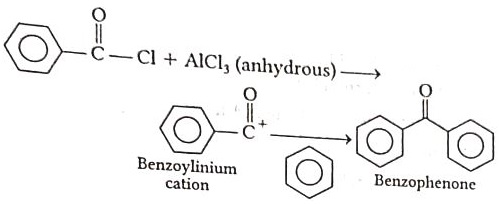
This is an example of Friedel-Crafts acylation reaction.
9.
Step I
Calculation of the quantity of charge passed:
We know that,
Watt = Ampere x Volt
Ampere =\(\frac { Watt }{ Volt } =\frac { 100 }{ 110 } \)
Now charge = Current x Time
=\(\left( \frac { 100 }{ 110 } amp \right) \times 4\times 60\times 60\)
= 13091 C
Step II
Calculation of mass of Cadmium deposited:
The cathodic reaction is
Cd2+(aq)+2e-\(\rightarrow\)Cd(s)
112.2g 2 x 96500C
2 x 96500 C of charge deposited Cd = 112.2 g
13091 C charge will deposite Cd
\(\frac { 112.2g }{ 2\times 96500C } \times 13091C\)
= 7.61g
10.
Step-I : Calculation for concentration of the solution.
According to Van't Hoff's equation
p = CRT or C = \(\frac { \pi }{ RT } \)
p = 8.8 atm, T = 40\(°\)C = 313 K
R = 0.0821 L atm K-1 mol-1
\(C=\frac { 8.8 }{ 0.0821\times 313 } \)=0.34 molL-1(M)
Step-II: Calculation of freezing point of the solution depression in freezing point of solution
\(\Delta\)Tf = Kf \(\times\) m
m = 0.34 mol kg-1
(same as molarity as given)
Kf = 1.86 K kg mol-1
\(\Delta\)Tf = 1.86 \(\times\) 0.84 (\(\because\) \(\Delta\) Tf = Kf m)
= 0.63 K = 0.63\(°\)C
Freezing point of the solution = 0 - 0.63 \(°\)C
= - 0.63\(°\) C
11.
Depression in freezing point is related to the molality, therefore, the molality of the solution with respect to ethylene glycol \(=\frac{\text { moles of ethylene glycol }}{\text { mass of water in kilogram }}\)
\(\text {Moles of ethylene glycol }=\frac{45 \mathrm{~g}}{62 \mathrm{~g} \mathrm{~mol}^{-1}}=0.73 \mathrm{~mol}\)
\(\text {Mass of water in } \mathrm{kg}=\frac{600 \mathrm{~g}}{1000 \mathrm{~g} \mathrm{~kg}^{-1}}=0.6 \mathrm{~kg}\)
\(\text {Hence molality of ethylene glycol }=\frac{0.73 \mathrm{~mol}}{0.60 \mathrm{~kg}}=1.2 \mathrm{~mol} \mathrm{~kg}^{-1}\)
Therefore freezing point depression,
ÄTf = 1.86 K kg mol–1 x 1.2 mol kg–1 = 2.2 K
Freezing point of the aqueous solution = 273.15 K – 2.2 K = 270.95 K
12.
6.0\(\times\) 1023
13.
Elastomers: The polymers in which polymer chains are held together by weakest intermolecular forces.
Fibres: The polymers which are used for making fibres possess high tensile strength and high modulus.There are strong intermolecular forces of attraction like hydrogen bonding e.g. in nylon-66
Thermoplastics: The intermolecular forces of attraction in thermoplastic polymers are moderate.
Thermosetting polymers: These polymers are made from low molecular mass semi-liquid.These have stronger force of attraction due to cross linkage.
Bakelite is thermostting polymer.Polythene belongs to thermoplastics.
14.
(a)
U (Atomic no. 92)
15.
(c)
NaAl(OH)4 and Na2SiO3 both
16.
(d)
\({ \lambda }_{ c }={ \lambda }_{ \infty }-(B)\sqrt { C } \)
17.
(e)
550 mm, 250 mm
18.
(c) : For every 10oC rise in temperature, rate constant is doubled, Hence, for 20oC rise in temperature, rate constant will become 4 times, i.e., K1 = 4 K2 or K2 = 0.25 K1
19.
In NaCl with fcc arrangement of Cl- ions number of Cl- ion=14,Na+ ions=13.On interchanging their positions,Cl- ions will be 13 and Na+ ions will be 14
20.
()
Iproniazid
21.
()
Phosphodiester linkage
22.
()
coordination
23.
()
Pb is anode, PbSO4 is cathode
24.
(a) \(\Delta { T }_{ f }=i\frac { { K }_{ f }{ W }_{ b }\times 1000 }{ { M }_{ b }\times { W }_{ a } } \)
\(\Delta { T }_{ f }=3\times \left( \frac { 1.86\times 1.9 }{ 95\times 50 } \right) \times 1000\)
= 2.23 K
\(\Delta { T }_{ f }-{ \Delta T }_{ f }^{ ' }=\frac { 273.15-2.23 }{ 273-2.23 } \)
\({ T }_{ f }^{ ' }\) = 270.92 K or 270.77 K
(b) (i) 2 M glucose has a higher boiling point because higher the number of particles lesser is the vapour pressure.
(ii) Reverse osmosis.
25.
(i) Chemical formula of ferric chloride is FeCI3.
(ii) Fe3+ ions of FeCl3 neutralize the charge on the colloidal particles of blood. This leads to coagulation of blood. Bleeding therefore, stopped.
(iii) This phenomenon is known as coagulation or flocculation.
(iv) All house wives must keep small bag or kit in their kitchen. It must have ferric chloride kept in small bottle or potash alum, burnol and bandages etc. Minor accidents are very common in kitchen. The kit can be very helpful to deal with emergency skill of applying knowledge, helping others, kindness, etc are the values associated with it.
26.
(i) HOCI in presence of an acid generates the reactive electrophile, chloronium ion «r, which attacks benzene to give chlorobenzene (A).
(ii) Chlorobenzene (A) on treatment with NaNH2/liq. NH3 undergaes-dehydrohalogenation via benzyne to afford aniline (B).
(iii) Aniline (B) on treatment with HBF4 forms the corresponding salt anilinium tetrafluoroborate (C) which on heating with NaNO2 undergoes Balz-Schiemann reaction through the intermedium formation of benzenediazonium tetrafluoroborate to afford fluorobenzene (D).
27.
(i) As pressure of X is changing with time, it cannot be a zero order reaction. Let us now check it for 1st order.
At t = 100 min, \(k={2.303\over 100}log{P_0\over P_t}={2.303\over 100}log {800\over 400}=6.932\times 10^{-3}min^{-1}\)
At t = 200 min, \(k={2.303\over 200}log{800\over 200}={2.303\over 800}log4=6.932\times10^{-3}min^{-1}\)
As k comes out to be constant, hence it is a reaction of 1st order
(ii)\(t_{75./.}={2.303\over k}log{100\over 100-75}={2.303\over 6.932\times10-3min}log4=200min\)
(iii) 2x (g)⟶ 3 y (g) + 2z (g)
Initial Pressure 800mm 0 0
Pressure after time t 800 - 2p 3 p 2 p
When pressure of X is 700 mm, 800 - 2 p = 700 or p = 50 mm
Total pressure = (800 - 2 p) + 3 p + 2 p = 800 + 3 p = 800 + 3 x 50 = 950 mm.

12th Standard CBSE Syllabus & Materials
12th Standard CBSE
CBSE 12th Computer Science Python Revision Tour I - New Previous year Question Papers Study Material - QB365 Set A
NEW12th Standard CBSE
CBSE 12th Business Studies Planning Important Questions And Answers Study Material - QB365 Set A
NEW12th Standard CBSE
CBSE 12th Business Studies Business Environment Important Questions And Answers Study Material - QB365 Set A
NEW12th Standard CBSE
CBSE 12th Business Studies Principles of Management Important Questions And Answers Study Material - QB365 Set A



NCERT Books

Syllabus

Exam Pattern

Sample Question Papers

Previous year Question Papers

Important Notes

MCQ Practice test

NCERT Exemplers

Case study Questions

Image Based Questions

Passage based Questions

HOT Questions

Value Based Questions

Model Questions Papers
NCERT ( Book Back ) Questions

Assertion and Reason
Important Questions And Answers

CBSE 12th Standard CBSE Subjects
CBSE Standards