
 100% FREE ACCESS
12th Standard CBSE Syllabus & Materials
12th Standard CBSE
CBSE 12th Economics Government Budget and the Economy Previous year Question Papers Study Material - QB365 Set A
NEW12th Standard CBSE
CBSE 12th Computer Science Interface Python with MySQL - New Previous year Question Papers Study Material - QB365 Set A
NEW12th Standard CBSE
CBSE 12th Computer Science Database Concept - New Previous year Question Papers Study Material - QB365 Set A
NEW12th Standard CBSE
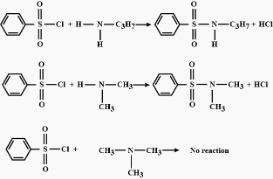
CBSE 12th Computer Science Data Communication - New Previous year Question Papers Study Material - QB365 Set A
NEW12th Standard CBSE
CBSE 12th Computer Science Data Structures - New Previous year Question Papers Study Material - QB365 Set A
NEW12th Standard CBSE
CBSE 12th Computer Science Functions - New Previous year Question Papers Study Material - QB365 Set A

Published on: 20/08/2026
Download CBSE Class 12th Standard CBSE Chemistry question papers, sample papers, important questions, and previous year solved papers in PDF format. Get free study materials, NCERT solutions, and exam preparation resources for Class 12th Standard CBSE Chemistry
Questions + Answers key
Take MCQ Chemistry Test
1.
What will be the correct order for the wavelengths of absorption in the visible region of the following:
[Ni(NO2)6]4-, [Ni(NH3)6]2+, [Ni(H2O)6]2+
2.
Arrange the following in decreasing order of their basic strength:
C6H5NH2, C2H5NH2, (C2H5)2 NH, NH3
3.
Classify the following amines as primary, secondary or tertiary:
(i)
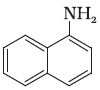
(ii)
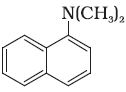
(iii) \(\left(\mathrm{C}_{2} \mathrm{H}_{5}\right)_{2} \mathrm{CHNH}_{2}\)
(iv) \(\left[\mathrm{C}_{2} \mathrm{H}_{5}\right)_{2} \mathrm{NH}\)
4.
Discuss briefly giving an example in each case the role of coordination compounds in:
(a) biological systems,
(b) analytical chemistry,
(c) medicinal chemistry and
(d) extraction/metallurgy of metals.
5.
Give evidence that [Co(NH3)5Cl]SO4 and [Co(NH3)5SO4]Cl are ionisation isomers.
6.
Amongst the following, the most stable complex is
(a) [Fe(H2O)6]3+
(b) [Fe(NH3)6]3-
(c) [Fe(C2O4)3]3-
(d) [FeCl6]3-
7.
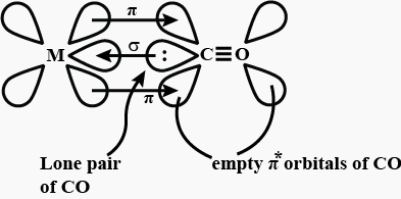
Discuss the nature of bonding in metal carbonyls.
8.
What is meant by unidentate, didentate and ambidentate ligands? Give two examples for each.
9.
Describe a method for the identification of primary, secondary and tertiary amines. Also write chemical equations of the reactions involved.
10.
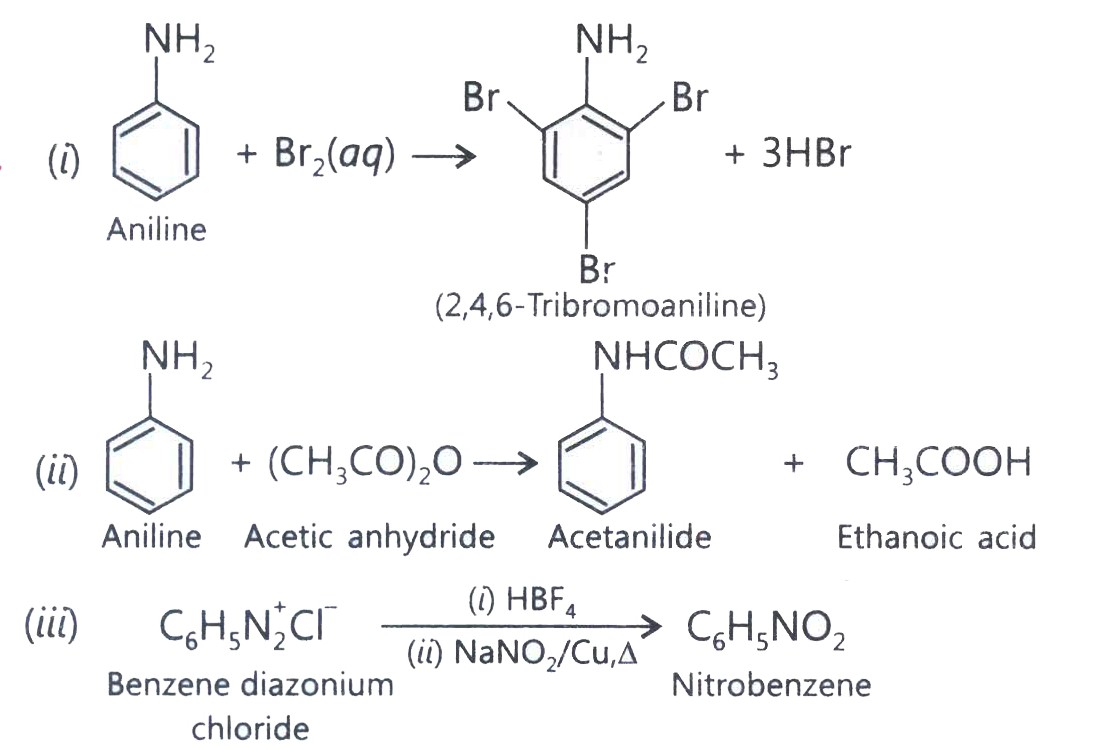
Complete the following reactions:
(i)\(C_6H_5NH_2+Br_2(aq)\rightarrow\)
(ii)\(C_6H_5NH_2+(CH_3CO)_2O\rightarrow\)
(iii)\(C_6H_5N_2Cl\overset { (i)HBF_{ 4 } }{ \underset { (ii)NaNO_{ 2 }/Cu,\Delta }{ \longrightarrow } } \)
11.
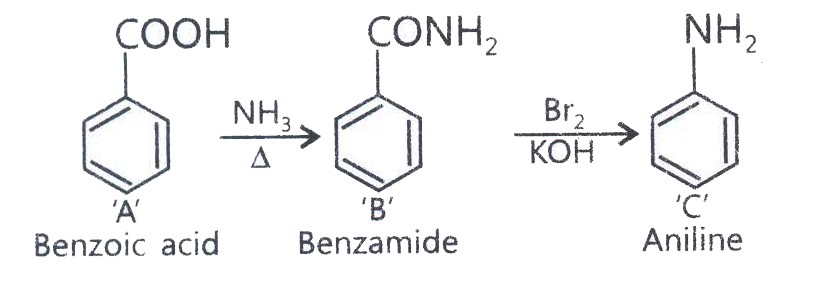
An aromatic compound 'A' on treatment with aqueous ammonia and heating forms compound 'B' which on heating with Br2 and KOH forms a compound 'C' of molecular formula C6H7N. Write the structures and IUPAC names of compounds A, B and C.
12.
Illustrate the following reactions giving a chemical equation in each case:
(i) Gabriel phthalimide synthesis
(ii) A coupling reaction.
(iii) Hoffmann's bromamide reaction.
13.
Draw figure to show splitting of d orbitals in an octahedral crystal field.
14.
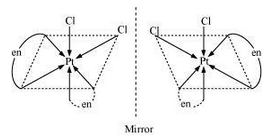
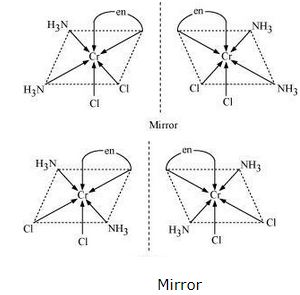
Draw the structures of optical isomers of:
(a) [Cr(C2O4)3]3-
(b) [PtCl2(en)2]2+
(c) [Cr(NH3)2Cl2(en)]+
15.
When a primary amine reacts with chloroform and ethanolic KOH, then the product formed is
isocyanide
aldehyde
cyanide
alcohol
16.
Which of the following is most basic?
Benzylamine
Aniline
Acetanilide
p-Nitroaniline
17.
Amine that cannot be prepared by Gabriel phthalimide synthesis is
aniline
benzylamine
methylamine
isobutylamine
tertiary-butylamine
18.
C6H5CONHCH3 can be converted into C6H5CH2NHCH3 by
NaBH4
H2-Pd/C
LIAIH4
Zn-Hg/HCI
19.
Which of the following reactions will not give a primary amine?
\({ CH }_{ 3 }CON{ H }_{ 2 }\overset { { Br }_{ 2 }/KOH }{ \longrightarrow } \)
\({ CH }_{ 3 }CN\overset { { LiAiH }_{ 4 } }{ \longrightarrow } \)
\({ CH }_{ 3 }NC\overset { { LiAiH }_{ 4 } }{ \longrightarrow } \)
\({ CH }_{ 3 }{ CONH }_{ 2 }\overset { { LiAiH }_{ 4 } }{ \longrightarrow } \)
20.
Nitration of nitrobonzene results in..............
o-dinitrobenzene
1, 3, 5-trinitrobenzene
p-dinitrobenzene
m-dinitrobenzene
21.
Which of the following complexes is used as an anti-cancer agent?
mer-[Co(NH3)3Cl3]
cis-[PtCl2(NH3)2]
cis-K2[PtCl2Br2]
Na2CoCl4
22.
The metal-carbon bond in metal carbonyls possesses
only \(\sigma \) character
only \(\pi \) character
both \(\sigma \) and \(\pi \) character
ionic character
23.
The oxidation state of nickel in [Ni(CO)4] is
4
0
2
3
24.
Which of the following is an outer orbital complex?
[Fe(CN)6]4-
[FeF6]3-
[Co(NH3)6]3+
[Co(CN)6]2+
25.
The primary and secondary valencies of chromium in the complex ion, dichlorodioxalatochromium (III) are respectively
3,4
4,3
3,6
6,3
26.
The complexes [Co (NH3)6] [Cr (CN)6] and [Cr(NH3)6] [Co(CN)6] are the examples of which type of isomerism?
Geometrical isomerism
Linkage isomerism
Ionization isomerism
Coordination isomerism
27.
IUPAC name of [Pt(NH3)3Br(NO2)Cl]Cl is
Triamminechloridobromidonitroplatinum (IV) chloride
Triamminebromidonitrochloridoplatinum (IV) chloride
Triamminebromidochloridonitroplatinum (IV) chloride
Triamminenitrochloridobromidoplatinum (IV) chloride
28.
An example of ambidentate ligand is
Ammine
Aquo
Oxalato
Thiacyanato
29.
Identify A, B, C, D and E in the following sequence of reaction.
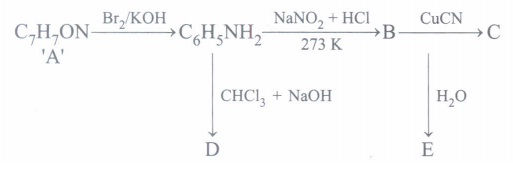
30.
List various types of isomeris possible for coordination compounds, give an example of each.
31.
Write the reactions involved in the following:
(i) Hofmann bromamide degradation reaction
(ii) Diazotisation
(iii) Gabriel phthalimide synthesis
32.
(a) Write the structures of main products when products when benzene diazonium chloride reacts with the following reagents:
(i) H3PO2+H2O
(ii) CuCN/KCN
(iii) H2O
(b) Arrange the following in the increasing order of their basic character in an aqueous solution:
C2H5NH2 , (C2H5)2NH, (C2H5)3N
(c) Give a simple chemical test to distinguish between the following pair of compounds:
C6H5-NH2 and C6H5-NH-CH3
33.
Explain on the basis of valence bond theory that [Ni(CN)4]2- ion with square planar structure is diamagnetic and the [NiCl4]2- ion with tetrahedral geometry is paramagnetic.
34.
In the following questions. an Assertion (A) is followed by a corresponding Reason (R) Use the following keys to choose the appropriate answer.
Assertion (A) Aromatic primary amines cannot be prepared by Gabriel phthalimide synthesis.
Reason (R) Aryl halides do notundergo electrophilic substitution with anion formed by phthalimide.
Codes:
(a) Both (A) and (R) are correct, (R) is the correct explanation of (A).
(b) Both (A) and (R) are correct, (R) is not the correct explanation of (A).
(c) (A) is correct; (R) is incorrect.
(d) (A) is incorrect; (R) is correct.
35.
In the following questions. an Assertion (A) is followed by a corresponding Reason (R) Use the following keys to choose the appropriate answer.
Assertion (A) In the coordination compound \(\begin{equation} \left[\mathrm{Co}\left(\mathrm{H}_{2} \mathrm{NCH}_{2} \mathrm{CH}_{2} \mathrm{NH}_{2}\right)_{3}\right]_{2} \end{equation}\),ethane-1,2-diamine is a neutral ligand.
Reason (R) Oxidation number of Co in the complex ion is +3.
Codes:
(a) Both (A) and (R) are correct, (R) is the correct explanation of (A).
(b) Both (A) and (R) are correct, (R) is not the correct explanation of (A).
(c) (A) is correct; (R) is incorrect.
(d) (A) is incorrect; (R) is correct.
36.
37.
Read the passage given below and answer the following questions:
Valence bond theory considers the bonding between the metal ion and the ligands as purely covalent. On the other hand, crystal field theory considers the metal-ligand bond to be ionic arising from electrostatic interaction between the metal ion and the ligands. In coordination compounds, the interaction between the ligand and the metal ion causes the five d-orbitals to split-up. This is called crystal field splitting and the energy difference between the two sets of energy level is called crystal field splitting energy. The crystal field splitting energy (Δo) depends upon the nature of the ligand. The actual configuration of complexes is divided by the relative values of Δo and P (pairing energy)
If Δo < P, then complex will be high spin.
If Δo > P, then complex will be low spin.
The following questions are multiple choice questions. Choose the most appropriate answer :
(i) Which of the following ligand has lowest Δo value?
| (a) CN- | (b) CO | (c) F- | (d) NH3 |
(ii) The crystal field splitting energy for octahedral (Δo) and tetrahedral (Δt) complex is related as
| (a) \( \Delta_{t}=\frac{1}{2} \Delta_{o}\) | (b) \(\Delta_{t}=\frac{4}{9} \Delta_{o}\) |
| (c) \(\Delta_{t}=\frac{3}{5} \Delta_{o}\) | (d) \(\Delta_{t}=\frac{2}{5} \Delta_{o}\) |
(iii) On the basis of crystal field theory, the electronic configuration of d4 in two situations: (i) Δo > P and (ii) Δo< P are
| (i) | (ii) |
| (a) \(t_{2 g}^{4} e_{g}^{0}\) | \(t_{2 g}^{3} e_{g}^{1}\) |
| (b) \(t_{2 g}^{3} e_{g}^{1}\) | \(t_{2 g}^{4} e_{g}^{0}\) |
| (c) \(t_{2 g}^{3} e_{g}^{1}\) | \(t_{2 g}^{3} e_{g}^{1}\) |
|
(d) \(t_{2 g}^{4} e_{g}^{0}\) |
\(t_{2 g}^{4} e_{g}^{0}\) |
(iv) Using crystal field theory, calculate magnetic moment of central metal ion of [FeF6]4-.
| (a) 1.79 B.M. | (b) 2.83 B.M. | (c) 3.85 B.M. | (d) 4.9 B.M. |
38.
Read the passage given below and answer the following questions:
To explain bonding in coordination compounds various theories were proposed. One of the important theory was valence bond theory. According to that, the central metal ion in the complex makes available a number of empty orbitals for the formation ofcoordination bonds with suitable ligands. The appropriate atomic orbitals of the metal hybridise to give a set of equivalent orbitals of definite geometry. The d-orbitals involved in the hybridisation may be either inner d-orbitals i.e., (n - 1) d or outer d-orbitals i.e., nd. For example, CO3+ forms both inner orbital and outer orbital complexes, with ammonia it forms [Co(NH3)6]3+ and with fluorine it forms [CoF6]3- complex ion.
The following questions are multiple choice questions. Choose the most appropriate answer:
(i) Which of the following is not true for [CoF6]3- ?
| (a) It is paramagnetic. | (b) It has coordination number of 6. |
| (c) It is outer orbital complex. | (d) It involves d2sp3 hybridisation. |
Which of the following is true for [Co(NH3)6]3+ ?
| (a) It is an octahedral, dimagnetic and outer orbital complex. |
| (b) It is an octahedral, paramagnetic and outer orbital complex. |
| (c) It is an octahedral, paramagnetic and inner orbital complex. |
| (d) It is an octahedral, dimagnetic and inner orbital complex. |
(iii) The paramagnetism of [CoF6]3- is due to
| (a) 3 electrons | (b) 4 electrons | (c) 2 electrons | (d) 2 electrons |
(iv) Which of the following is an inner orbital or low spin complex?
| (a) \(\left[\mathrm{Ni}\left(\mathrm{H}_{2} \mathrm{O}\right)_{6}\right]^{3+}\) | (b)\(\left[\mathrm{FeF}_{6}\right]^{3-}\) | (c) \(\left[\mathrm{Co}(\mathrm{CN})_{6}\right]^{3-}\) | (d) \(\left[\mathrm{NiCl}_{4}\right]^{2-}\) |
1.
As metal ion is fixed, the increasing field strengths (CFSE values) of the ligands from the spectrochemical series are in the order: H2O < NH3 < NO2
Thus, the energies absorbed for excitation will be in the order:
[Ni(H2O)6]2+<[Ni(NH3)6]2+< [Ni(NO2)6]4-
As \(E=\frac { hc }{ \lambda } \) the wavelengths absorbed will be in the opposite order.
2.
The decreasing order of basic strength of the given amines and ammonia follows the following order:
(C2H5)NH > C2H5NH2 > NH3 > C6H5NH2
3.
(i) Primary
(ii) Tertiary
(iii) Primary
(iv) Secondary
4.
(a) Biological processes: Chlorophyll contains Mg, which is used in photosynthesis. Haemoglobin contains Fe, which acts as oxygen carrier. Vitamin-B12 contain cobalt which is used to preven anaemia.
(b) Analytical chemistry:
(i) Ni2+ is detected by using DMG (dimethylglyoxime)
(ii) EDTA is used for sofening of hard water.
(c) Medicinal chemistry: cis-Platin is used as anticancer agent.
(d) Metallurgical operation: Cyanide complexes are used in extraction of Ag and Au.
5.
Add BaCI2 solution. [Co(NH 3)5CI]SO4 will give white precipitate due to formation of BaSO4 whereas [Co(NH3)5SO4]CI will not react. Add AgNO3 solution. [Co(NH3)5SO4]CI will give white precipitate due to formation of AgCl whereas [Co(NH3)5CI]SO 4 will not react. It shows that these isomers produce different ions in aqueous solution, but have same chemical formula, therefore, they are ionisation isomers.
6.
In each complex, Fe is in + 3 state , as C2O-4is didentate chelating ligand. which forms chelate rings and hence. it is the most stable complex.
7.
(i) Formation of M←C sigma bond through donation of lone pair of electrons of carbon (of CO) into empty orbital of metal atom. This is dative overlap.
(ii) Formation of M→Cπ bond through donation of electrons from filled metal d-orbitals into vacant antibonding π∗ molecular orbitals of CO.
It is back donation or back bonding. It creates a synergic effect and strengthens the bond between CO and the metal.
8.
A molecule or an ion which has only one donor atom to form one coordinate bond with the central metal atom is called unidentate ligand, e.g.Cl- and NH3.
A molecule or an ion which contains two donor atoms and hence forms two coordinate bonds with the central metal atom is called a didentate ligand, e.g.,
\(\overset { { CH }_{ 2 }{ NH }_{ 2 } }{ \underset { { CH }_{ 2 }{ NH }_{ 2 } }{ | } } and\quad \overset { { COO }^{ - } }{ \underset { { COO }^{ - } }{ | } } \)
a molecule or an ion which contains two donor atoms but only one of them forms a coordinate bond at a time with the central metal atom is called ambidentate ligand, e.g. CN- or NC-and: NO-2 or ONO-
9.
Hinsberg's test is used for the identification of primary, secondary, and tertiary amines.
Hinsberg's reagent is benzenesulphonyl chloride (C6H5SO2Cl).
It reacts differently with primary, secondary, and tertiary amines.
(i) Hinsberg's reagent reacts with primary amines to form N− alkylbenzenesulphonyl amide which is acidic in nature and soluble in alkali.
Note: N− alkylbenzenesulphonyl amide contains a strong electron-withdrawing sulphonyl group. Due to this, the H− atom attached to nitrogen can be removed easily. Hence, it is acidic.
(ii) Hinsberg's reagent reacts with secondary amines to form a sulphonamide which is insoluble in alkali.
Note: As there is no hydrogen atom attached to the N atom in the sulphonamide, it is not acidic and insoluble in alkali.
(iii) Hinsberg's reagent does not react with tertiary amines.
10.
11.
12.
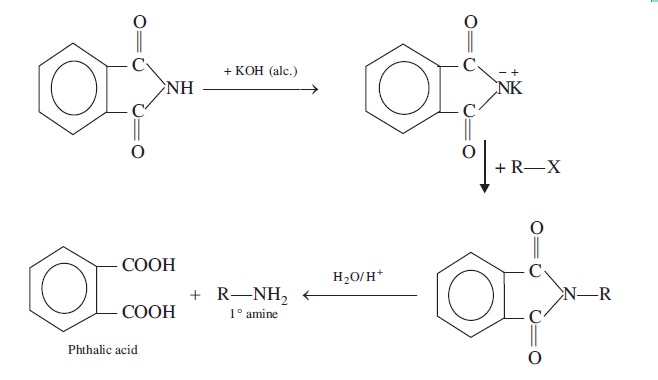
(i) Gabriel phthalimide synthesis: This reaction is used for the preparation of aliphatic primary amines. In this reaction, phthalimide is first of all treated with ethanolic KOH to form potassium phthalimide. Potassium phthalimide on treatment with alkyl halide gives N-alkyl phthalimide, which on hydrolysis with dilute hydrochloric acid gives a primary amine as the product.
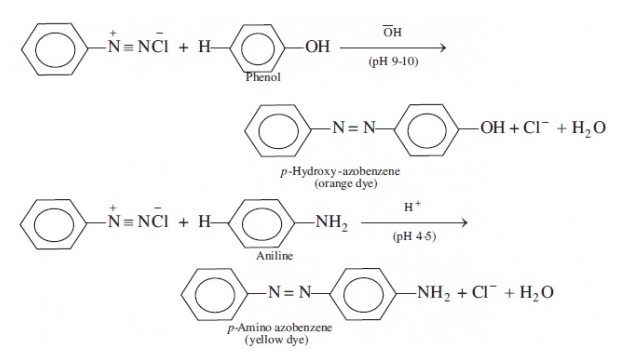
(ii) Coupling reactions: Diazonium salts react with aromatic amines in weakly acidic medium and phenols in weakly alkaline medium to form coloured compounds called azo dyes by coupling at p-position of amines or phenol. The mechanism is basically that of electrophilic aromatic substitutions where the diazonium ion is electrophile.
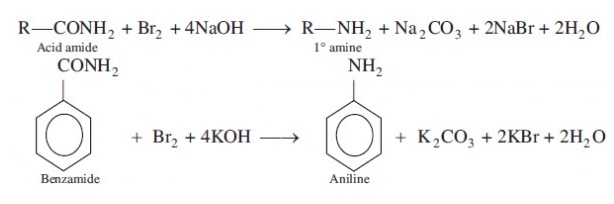
(iii) Hoffman’s bromamide reaction: When a primary acid amide is heated with an aqueous or ethanolic solution of NaOH or KOH and bromine (i.e., NaOBr or KOBr), it gives a primary amine with one carbon atom less.
13.
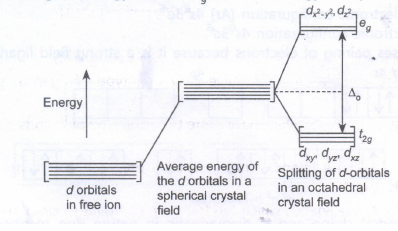
Let us assume that the six ligands are positioned symmetrically along the cartesian axes, with metal atom at the origin. As the ligands approach, first there is an increase in energy of d-orbitals relative to that of the free ion just as would be the case in a spherical field The orbitals lying along the axes (\({ d }_{ { z }^{ 2 } }\)nd \({ d }_{ { x }^{ 2 }-{ y }^{ 2 } }\))get repelled more strongly than dx1 d and dyz and dzx orbitals which have lobes directed between the axes. The \({ d }_{ { z }^{ 2 } }\)and orbitals get raised in energy and dxy dyz d xz orbitals are lowered in energy relative to the average energy in the spherical crystal field. Thus, the degenerate set of d-orbitals get split into two sets : the lower energy orbitals set and the higher energy orbitals eg set. The energy is separated by t2g and the higher energy orbitals eg set. The energy is separated by \({ \Delta }_{ 0 }\)
14.
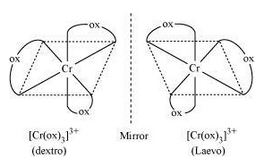
(a) [Cr(C2O4)3]3-
(b) [PtCl2(en)2]2+
(c) [Cr(NH3)2Cl2(en)]+
15.
Carbylamine reaction yields isocyanides.
16.
Benzylamine is most basic
17.
(a)
aniline
18.
(c)
LIAIH4
19.
(c)
\({ CH }_{ 3 }NC\overset { { LiAiH }_{ 4 } }{ \longrightarrow } \)
20.
(d)
m-dinitrobenzene
21.
(b)
cis-[PtCl2(NH3)2]
22.
(c)
both \(\sigma \) and \(\pi \) character
23.
(b)
0
24.
(b)
[FeF6]3-
25.
(c)
3,6
26.
(c)
Ionization isomerism
27.
(a)
Triamminechloridobromidonitroplatinum (IV) chloride
28.
(d)
Thiacyanato
29.
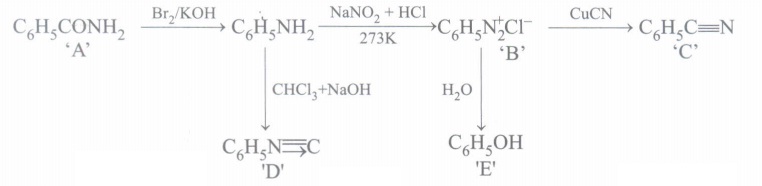
30.
(i) Ionisation isomerism:
Those isomers which produce different ions in aqueous solution are called ionization isomers. In ionization isomers counter ions are ligands which can replace ligands,
e.g. [Co(NH3)5SO4Br and [Co(NH3)5Br]SO4
(ii) Linkage isomers:
Those isomers which have ambidentate ligands can show linkage isomerism. They differ in donor atom forming coordinate bond,
e.g. [Co(NH3) 5 NO2]2+ and [Co(NH3) 5ONO]2+.
(iii) Coordination isomerism:
It arises from the interchange of ligands between cationic and anionic entities of different metal ions present in a complex,
e.g. [Co(NH3)6 ]6Cr(CN)6] and [Cr(NH3)6][Co(CN)6]
(iv) Solvate isomerism:
They differ in number of solvent molecules forming coordinate bond with central metal ion,
e.g. [Cr(H2O)5]CI3 is violet; whereas [Cr(H2 O)5CI]CI2.H2 O is greyish green.
31.
(a) (i) Hofmann Bromamide Degradation Reaction This reaction is used for preparing amine contaning one carbon less than the starting amide. This method was developed for the preparation of primary amines by reacting an amide with Br2/ Cl2 in NaOH/KOH.
In this reaction, migration of an alkyl or aryl group takes place from carbonyl carbon of the amide to the N-atom.
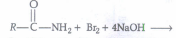
\(\begin{equation} R-\mathrm{NH}_{2}+\mathrm{Na}_{2} \mathrm{CO}_{3}+2 \mathrm{NaBr}+2 \mathrm{H}_{2} \mathrm{O} \end{equation}\)
\(\begin{equation} \text { e.g. } \mathrm{CH}_{3} \mathrm{CH}_{2} \mathrm{CONH}_{2}+\mathrm{Br}_{2}+4 \mathrm{NaOH}\\ \text { Amide } \end{equation}\)⟶\(\begin{equation} \begin{aligned} &3 \mathrm{CH}_{3} \mathrm{CH}_{2} \mathrm{NH}_{2}+\mathrm{Na}_{2} \mathrm{CO}_{3}+2 \mathrm{NaBr}+2 \mathrm{H}_{2} \mathrm{O}\\ &\text { Amine } \end{aligned} \end{equation}\)
(ii) Diazotisation The conversion of primary aromatic amines into their diazonium salts is called diazotisation. Benzene diazonium chloride is prepared by the reaction of aniline with nitrous acid (which is produced by the reaction of NaNO2 and HCI) at 273-278K or 0-5oC as shown below:
\(\begin{array}{r} \mathrm{C}_{6} \mathrm{H}_{5} \mathrm{NH}_{2}+\mathrm{NaNO}_{2}+2 \mathrm{HCl} \stackrel{273-278 \mathrm{~K}}{\longrightarrow} \mathrm{C}_{6} \mathrm{H}_{5} \mathrm{~N^+}_{2}{\mathrm{Cl^-}}+ \mathrm{NaCl}+2 \mathrm{H}_{2} \mathrm{O} \end{array}\)
Due to its unstability, the diazonium salt is not generally stored and is used immediately after its preparation.
(iii) Gabriel Phthalimide Synthesis When a phthalimide is treated with ethanolic KOH, it forms potassium salt of phthalimide which on heating with alkyl halide followed by alkaline hydrolysis forms corresponding primary amines as shown below.
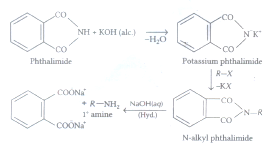
Primary amines are produce through this method without the traces of secondary or tertiary amines. So, this method is preferred for the synthesis of primary amines.
32.
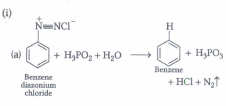
(b) C2H5NH2 < (C2H5)3N < (C2H5)2NH
(c) Add CHCl3 and alc. KOH, C6H5-NH2 gives foul smell of isocyanide whereas C6H5-NH-CH3 does not (or any other correct test).
33.
(i) [Ni(CN)4]2-
Ni is in the +2 oxidation state i.e., in d8 configuration.
There are 4 CN− ions. Thus, it can either have a tetrahedral geometry or square planar geometry. Since CN− ion is a strong field ligand, it causes the pairing of unpaired 3d electrons.
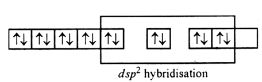
CN– will cause pairing of electrons. It is diamagnetic in nature due to the unpaired electron.
(ii) [Ni(Cl4)]2–
In case of [NiCl4] 2−, Cl− ion is a weak field ligand. Therefore, it does not lead to the pairing of unpaired 3d electrons. Therefore, it undergoes sp3 hybridization. Since there are 2 unpaired electrons in this case, it is paramagnetic in nature.
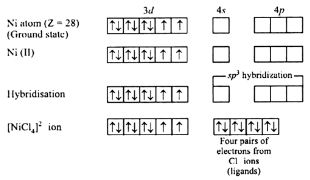
34.
(c) Aromatic primary amines cannot be prepared by the Gabriel phthalimide synthesis because aryl halides do not undergo nucleophilic substitution reaction with the anion formed by phthalimide. Thus, (A) is correct but (R) is incorrect
35.
(b) Ethane-1, 2-diamine is a neutral ligand as it carries no charge. Oxidation number of Co in the complex ion is +3. Both (A) and (R) are correct but (R) is not the correct explanation of (A).
36.
37.
(i) (c): Spectrochemical series:
\((\mathrm{I}^{-}<\mathrm{Br}^{-}<\mathrm{SCN}^{-}<\mathrm{Cl}^{-}<\mathrm{S}^{2-}<\mathrm{F}^{-}<\mathrm{OH}^{-}<\mathrm{C}_{2} \mathrm{O}_{4}^{2-}<\mathrm{O}^{2-}< \mathrm{H}_{2} \mathrm{O}<\mathrm{NCS}^{-}<\mathrm{EDTA}^{4-}<\mathrm{NH}_{3}\)(ii) (b)
(iii) (a) : When Δo > P, the electrons paired up in the t2g level rather than going to the eg level, so
when Δo> P : \(t_{2 g}^{4} e_{g}^{0}\)
and Δo < P : \(t_{2 g}^{3} e_{g}^{1}\)
(iv) (d): Fe2+: 3d6 ⇒\(t_{2 g}^{4} e_{g}^{2}\)
(Since, F- is a weak field ligand)
Hence four unpaired electrons are present.
Magnetic moment (μ)\(=\sqrt{n(n+2)}=\sqrt{4(4+2)}=4.9 \mathrm{~B} \cdot \mathrm{M}\)
38.
(i) (d): It involves sp3 d2 hybridisation and not d2sp3.
(ii) (d) : [Co(NH3)6]3+ is d2sp3 hybridised with all electrons paired hence, it is diamagnetic and inner
orbital complex.
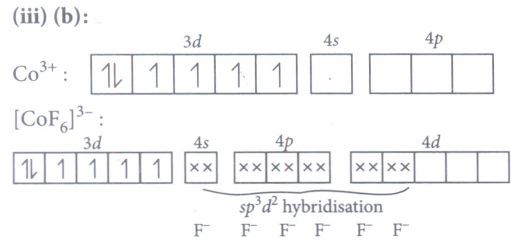
(iv) (c): Inner orbital complexes are formed with strong ligands as they force electrons to pair up and hence the complex will be either diamagnetic or will have less number of unpaired electrons.

12th Standard CBSE Syllabus & Materials
12th Standard CBSE
CBSE 12th Computer Science Python Revision Tour I - New Previous year Question Papers Study Material - QB365 Set A
NEW12th Standard CBSE
CBSE 12th Business Studies Planning Important Questions And Answers Study Material - QB365 Set A
NEW12th Standard CBSE
CBSE 12th Business Studies Business Environment Important Questions And Answers Study Material - QB365 Set A
NEW12th Standard CBSE
CBSE 12th Business Studies Principles of Management Important Questions And Answers Study Material - QB365 Set A



NCERT Books

Syllabus

Exam Pattern

Sample Question Papers

Previous year Question Papers

Important Notes

MCQ Practice test

NCERT Exemplers

Case study Questions

Image Based Questions

Passage based Questions

HOT Questions

Value Based Questions

Model Questions Papers
NCERT ( Book Back ) Questions

Assertion and Reason
Important Questions And Answers

CBSE 12th Standard CBSE Subjects
CBSE Standards