
 100% FREE ACCESS
12th Standard CBSE Syllabus & Materials
12th Standard CBSE
CBSE 12th Economics Government Budget and the Economy Previous year Question Papers Study Material - QB365 Set A
NEW12th Standard CBSE
CBSE 12th Computer Science Interface Python with MySQL - New Previous year Question Papers Study Material - QB365 Set A
NEW12th Standard CBSE
CBSE 12th Computer Science Database Concept - New Previous year Question Papers Study Material - QB365 Set A
NEW12th Standard CBSE
CBSE 12th Computer Science Data Communication - New Previous year Question Papers Study Material - QB365 Set A
NEW12th Standard CBSE
CBSE 12th Computer Science Data Structures - New Previous year Question Papers Study Material - QB365 Set A
NEW12th Standard CBSE
CBSE 12th Computer Science Functions - New Previous year Question Papers Study Material - QB365 Set A

Published on: 02/11/2025
Download CBSE Class 12th Standard CBSE Chemistry question papers, sample papers, important questions, and previous year solved papers in PDF format. Get free study materials, NCERT solutions, and exam preparation resources for Class 12th Standard CBSE Chemistry
Questions + Answers key
Take MCQ Chemistry Test
1.
Give name of oil soluble vitamin which is powerful antioxidant. Give its one natural source also.
2.
Give reasons for the following :
(i) Amino acids have high melting points and are soluble in water.
(ii) What is meant by the secondary structure of proteins ?
3.
What is the relationship between specific conductance and equivalent conductance ?
4.
Why fluorine cannot be obtained by electrolysis of aqueous HF solution, through it is a good conductor of electricity ?
5.
A solution of Ni(NO3)2 is electrolysed between platinum electrodes using a current of 5 amperes for 20 minutes. What mass of Ni is deposited at the cathode?
6.
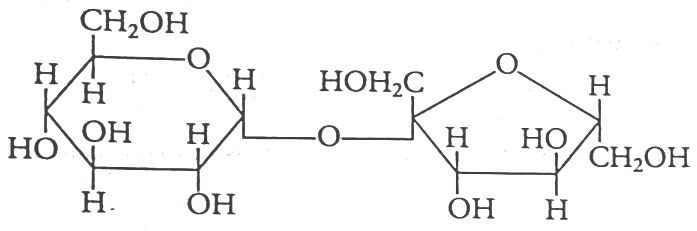
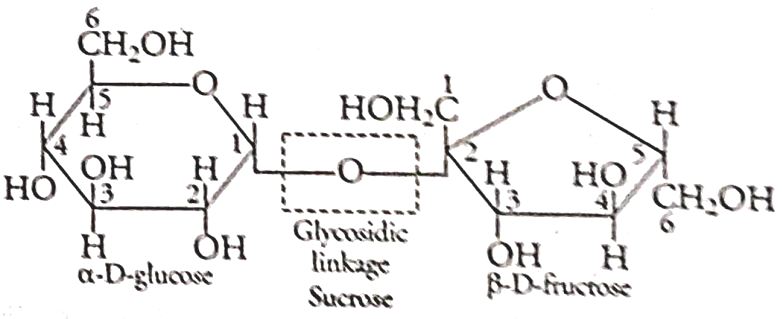
Label the glucose and fructose units in the following disaccharide and identify anomeric carbons atoms in these units. Is the sugar reducing in nature? Explain.
7.
How much time is required for 1.5 g Ag to deposit when 1.50 A current is passed through an electrolytic cell containing AgNO a solution with inert electrodes?
8.
Crude copper containing Fe and Ag as contaminations was subjected to electro refining by using a current of 175 A for 6.434 min. The mass of anode was found to decrease by 22.260 g, while that of cathode was increased by 22.011 g. Estimate the % of copper, iron and silver in crude copper.
9.
How do you explain the amphoteric behaviour of amino acids ?
10.
Amino acids may be acidic, alkaline or neutral. How does this happen? What are essential and non-essential amino acids? Name one of each type.
11.
Match the following columns.
| Column I | Column II | |
| A. | Amino acids | 1. Protein |
| B. | Thymine | 2. Nucleic acid |
| C. | Insulin | 3. DNA |
| D. | hosphodiester linkage | 4. Zwitter ion |
| E. | Uracil |
| A | B | C | D |
| 1 | 4 | 3 | 2 |
| A | B | C | D |
| 4 | 3 | 1 | 2 |
| A | B | C | D |
| 4 | 4 | 1 | 2 |
| A | B | C | D |
| 1 | 3 | 4 | 2 |
12.
The \(\alpha\)- and \(\beta\)-glucose are
isomers of D( +) glucose and L( -) glucose respectively.
diastereomers of glucose
anomers of glucose
isomers which differ in the configuration of C-2.
13.
The number if disulphide linkages present in insulin are
4
3
2
1
14.
Proteins can be classified into two types on the basis of their molecular shape, i.e.,fibrous proteins and globular proteins. Examples of globular proteins are :
Insulin
Keratin
Cellulose
Glycogen
15.
The reduction potential of hydrogen half cell will be negative if :
p (H2) = 1 atm and [H+] = 1.0 M
p (H2) = 2 atm and [H+] = 1.0 M
p (H2) = 2 atm and [H+] = 2.0 M
p (H2) = 1 atm and [H+] = 2.0 M
16.
A current is passed through two cells connected in series. The first cell contains X (NO3)3 (aq) and the second cell contains Y (NO3)2 (aq). The relative atomic masses of X and Y are in the ratio 1 : 2. What is the ratio of the liberated mass of X to that of Y ?
3 : 2
1 : 2
1 : 3
3 : 1
2 : 1
17.
Consider figure and answer the questions (i) to (vi) given below.
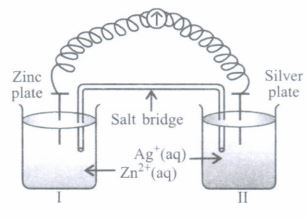
(i) Redraw the diagram to show the direction of electron flow.
(ii) Is silver plate the anode or cathode?
(iii) What will happen if salt bridge is removed?
(iv) When will the cell stop functioning?
(v) How will concentration of Zn2+ ions and Ag+ ions be affected when the cell functions?
(vi) How will the concentration of Zn2+ ions and Ag+ ions be affected after the cell becomes ''dead'?
18.
(a) State Faraday's first law of electrolysis. How much charge in terms of Faraday's is required for the reduction of 1 mole of Cu2+ to Cu.
(b) Calculate emf of the following cell at 298 K.
Mg(s) IMg2+(0.1 M) II Cu2+(0.01) I Cu(s)
Given, E0cell = +2.71 V,
1F = 96500 C mol-1
19.
Glucose and fructose give the same osazone ? Explain.
20.
Living system are made up of complex molecules called Biomolecules. Carbohydrate, proteins, enzymes, nucleic acids, lipids, hormones ATP, DNA and RNA play an important role in our daily life. Carbohydrates provide us energy. Protein help in growth and maintenance of body. Nucleic acids, RNA helps in protein synthesis, DNA helps in transfer of genetic characteristics. Fat are source of energy and protect our vital organs.
(a) Why are carbohydrates optically active?
(b) Name two acidic amino acids.
(c) Name a protein which has quarternary structure.
(d) What are products of hydrolysis of fats?
(e) What is role of glycerol in shaving creams?
1.
Vitamin E is oil soluble. One of its richest source is almond oil (Badam Rogan).
2.
(i) \(\alpha \) -Amino acids contain both an acidic carboxyl group and a basic amino group. These two groups neutralize each other. As a result, \(\alpha \)-amino acids largely exist as dipolar ions or zwitterions.
\(N{ H }_{ 2 }-CH-COOH\rightleftharpoons \overset { + }{ N{ H }_{ 3 } } -CH-{ COO }^{ - }\\ \quad \quad \quad \quad |\quad \quad \quad \quad \quad \quad \quad \quad \quad \quad \quad \quad |\\ \quad \quad \quad \quad R\quad \quad \quad \quad \quad \quad \quad \quad \quad \quad \quad R\\ \quad \quad \quad \quad \quad \quad \quad \quad \quad \quad \quad \quad \quad \quad \quad Zwitterion\)
Due to dipole-dipole interactions, the molecules of \(\alpha \)-amino acids are held together by strong forces of attraction and hence amino acids have high melting points. Further, due to strong interactions between the +ve and -ve poles of \(\alpha \)-amino acids with polar water molecules, \(\alpha \)-amino acids are moderately soluble in water.
(ii) Secondary structure of proteins refers to the conformation or the shape which the polypeptide chains assume as a result of H-bonding. There are two types of secondary structures of proteins. These are \(\alpha \)-helix and \(\beta \) pleated sheet structure.
3.
\(\wedge_{e q}=\frac{k \times 1000}{N},\) where k is specific conductance in S cm-1, N is normality in g eq, L-1, ∧eq is in S cm2 (g eq)-1.\(\)
4.
H2O has higher oxidation potential than F- ions. Hence, in aqueous solution, as compared to F- ions, H2O is more easily oxidized to give O2 gas. Therefore, F2 cannot be obtained by electrolysis of aqueous HF solution.
5.
\({ Ni }^{ 2+ }+{ 2e }^{ - }\longrightarrow Ni\quad Eq.wt.=\frac { At.wt }{ valency } =\frac { 58.9 }{ 2 } ,Z=\frac { Eq.wt }{ 96500 } =\frac { 58.9 }{ 2\times 96500 }\)
\(m=Z\times I\times t=\frac { 58.9 }{ 2\times 96500 } \times 5\times 20\times 60s=1.83g\)
6.
C-1 of glucose unit and C-2 of fructose unit are anomeric carbon atoms in the given disaccharide. The disaccharide is non-reducing sugar because -OH groups attached to anomeric carbon atoms are involved in the formation of glycosidic bond.
7.
Ag +e− → Ag
Quantity of charge required to deposit 108g of silver = 96500C
∴ Quantity of charge required to deposit 1.50g of silver = 96500/108 x 1.50 =1340.28C
t = Q/I
∴Time taken = 1340.28/1.50
= 893.52 s
8.
% of Cu, Fe, Ag are 98.88, 0.831, 0.289 respectively.
9.
Amino acids contain an acidic (carboxyl group) and a basic (amino) group within the same molecule. In aqueous solution, they neutralize each other. The carboxyl group loses a proton while the amino group accepts it. As a result, a dipolar or zwitterion is formed.
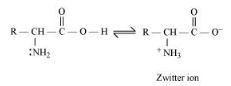
In zwitterionic form, a-amino acids show amphoteric behavior as they react with both acids and bases.
In the acidic medium, \({ COO }^{ - }\) ion of the zwitterion accepts a proton to form the cation (I) while in the basic medium, \(\overset { + }{ { NH }_{ 3 } } \)ion loses a proton to form the anion (II).
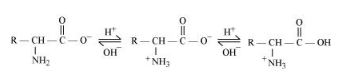
Thus, \(\overset { + }{ { NH }_{ 3 } } \)group acts as the acid while \({ COO }^{ - }\)group acts as the base.
10.
Amino acids may be acidic, basic or neutral depending upon the relative number of amino and carboxyl groups present in the molecule. Equal number of amino and carboxyl groups makes it neutral, more number of amino than carboxyl groups makes it basic and more carboxylic groups as compared to amino groups makes it acidic.
Essential Amino Acids: Amino acids which can't be created in our body but can only be received from proper food or diet are called Essential Amino Acids. Examples- Histidine, Isoleucine, Lysine.
Non- essential amino acids: Amino acids which can be created in our body itself are Non- essential amino acids. Examples-alanine, arginine, asparagine, aspartic acid. Examples- Histidine, Isoleucine, Lysine.
11.
(b)
| A | B | C | D |
| 4 | 3 | 1 | 2 |
12.
(c)
anomers of glucose
13.
(b)
3
14.
(d)
Glycogen
15.
(b)
p (H2) = 2 atm and [H+] = 1.0 M
16.
(c)
1 : 3
17.
(i) Electrons move from Zn to Ag (See figure).
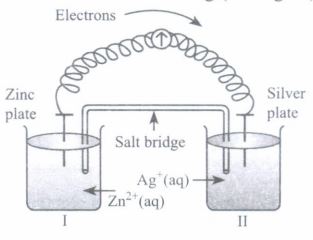
(ii) Ag acts as cathode.
(iii) Cell will stop working.
(iv) When Ecell = 0
(v) The concentration of Zn2+ ions will increase and conc. of Ag+ will decrease.
(vi) When Ecell = 0, equilibrium is reached and cone. of Zn2+ and Ag+ ions will not change.
18.
(a) Faraday's first law of electrolysis It states that the amount of chemical reaction occurring at an electrode by passing current is proportional to the quantity of electricity passed through the electrolyte. Charge required for the reduction of 1 mole of Cu2+ to Cu = 2F
(b) \(Cu^{ 2+ }Mg\rightarrow Mg^{ 2+ }+Cu\)
Given, EO Cell = +271 V
By using Nernst equation,
\(E_{ cell }=E^{ 0 }_{ cell }-\frac { 0.059 }{ n } log\frac { Mg^{ 2+ } }{ Cu^{ 2+ } } \)
Here, n = 2 and E0 cell = + 2.71 V
\(\therefore E_{ cell }=2.71-\frac { 0.059 }{ 2 } log\frac { 0.1 }{ 0.01 } \)
\(=2.71-\frac { 0.059 }{ 2 } log10\)
= 2.71- 0.0295
\([\therefore \) log10 = 1]
= 2.68 V
19.
During osazone formation, the reaction occurs only at CI and C2 while rest of the molecule remains intact. Since glucose and fructose differ from each other only in the arrangement of atoms at CI and C2, therefore, they. give the same osazone.
20.
(a) It is because they contain 'Chiral' carbon atoms.
(b) Aspartic acid and Glutamic acid.
(c) Haemoglobin
(d) Glycerol and fatty acids
(e) Glycerol is hygroscopic in nature, therefore, keep the skin moist.

12th Standard CBSE Syllabus & Materials
12th Standard CBSE
CBSE 12th Computer Science Python Revision Tour I - New Previous year Question Papers Study Material - QB365 Set A
NEW12th Standard CBSE
CBSE 12th Business Studies Planning Important Questions And Answers Study Material - QB365 Set A
NEW12th Standard CBSE
CBSE 12th Business Studies Business Environment Important Questions And Answers Study Material - QB365 Set A
NEW12th Standard CBSE
CBSE 12th Business Studies Principles of Management Important Questions And Answers Study Material - QB365 Set A



NCERT Books

Syllabus

Exam Pattern

Sample Question Papers

Previous year Question Papers

Important Notes

MCQ Practice test

NCERT Exemplers

Case study Questions

Image Based Questions

Passage based Questions

HOT Questions

Value Based Questions

Model Questions Papers
NCERT ( Book Back ) Questions

Assertion and Reason
Important Questions And Answers

CBSE 12th Standard CBSE Subjects
CBSE Standards