100% FREE ACCESS
12th Standard CBSE Syllabus & Materials
12th Standard CBSE
CBSE 12th Economics Government Budget and the Economy Previous year Question Papers Study Material - QB365 Set A
NEW12th Standard CBSE
CBSE 12th Computer Science Interface Python with MySQL - New Previous year Question Papers Study Material - QB365 Set A
NEW12th Standard CBSE
CBSE 12th Computer Science Database Concept - New Previous year Question Papers Study Material - QB365 Set A
NEW12th Standard CBSE
CBSE 12th Computer Science Data Communication - New Previous year Question Papers Study Material - QB365 Set A
NEW12th Standard CBSE
CBSE 12th Computer Science Data Structures - New Previous year Question Papers Study Material - QB365 Set A
NEW12th Standard CBSE
CBSE 12th Computer Science Functions - New Previous year Question Papers Study Material - QB365 Set A
Published on: 02/11/2025
Download CBSE Class 12th Standard CBSE Chemistry question papers, sample papers, important questions, and previous year solved papers in PDF format. Get free study materials, NCERT solutions, and exam preparation resources for Class 12th Standard CBSE Chemistry
Questions + Answers key
Take MCQ Chemistry Test
1.
Write a test to differentiate betweem pentan - 2 - one and pentan - 3 - one.
2.
Racemic mixture is optically inactive. Give reason.
3.
What is the structural difference between HDP and LDP ? How does the structure account for different behaviour and nature, hence the use of a polymer ?
4.
Why is paracetamol preferred over aspirin?
5.
Name the four bases present in DNA. Which one of these is not present in RNA?
6.
Suggest a possible reason for the following observations:
(i) The order of reactivity of haloalkanes is RI > RCI > RBr.
(ii) Neopentyl chloride (CH3)3CCH2CI does not follow SN2 mechanism.
(iii) Ethers have low boiling points.
7.
Structures of glyine and alanine are given
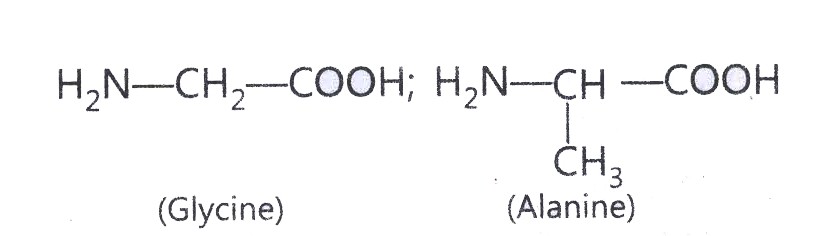
Show the peptide linkage in glycylalanine.
8.
Why should one always use purest monomer' in free radical polymerisation ?
9.
Give two chemical tests to distinguish between phenol and ethanol.
10.
An aromatic compound 'A' (Molecular formula C8H8O) gives positive 2, 4-DNP test. It gives a yellow precipitates of compound 'B' on treatments with iodine and sodium hydroxide solution. Compound 'A' does not give Tollen's or Fehling's test. On drastic oxidation with potassium permanganate it forms a carboxylic acid 'C' (Molecular formula C7HO)6O2), which is also formed along with the yellow compound in the above reaction. Identify A, B and C write all the reacitons involved.
11.
Complete each sythesis by giving missing starting material, reagent or products.
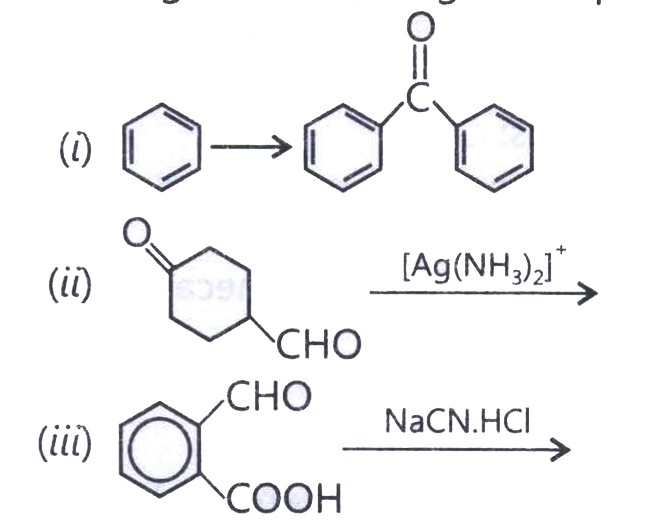
12.
How do antiseptics differ from disinfectants? Give one example of each.
13.
Define the following, giving one example of each:
(i) Zwitter ion
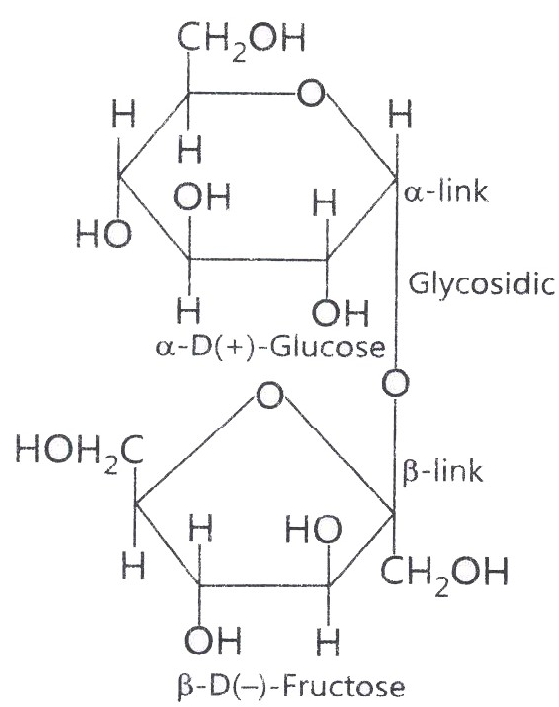
(ii) Glycosidic linkage
14.
The leakage of the vapors of a highly poisonous gas in Union Carbide India Ltd in Bhopal about 30 years ago was one of the dreadful disaster which people of bhopal had faced Thousands lost their lives and many more get crippled for rest of their lives.
(i) What is the chemical name of the poisonous vapours?
(ii) How it can be synthesized in the laboratory?
(iii) How did it damage human system?
(iv) As a student of chemistry what remedial measures do you suggest?
15.
Glucose and fructose give the same osazone ? Explain.
16.
An organic compound (A) on treatment with CHCl3 and KOH gives two compounds B and C.Both B and C give the same product (D) when distilled with zinc dust.Oxidation of D gives E having molecular formula C7H6O2.The sodium salt of E on heating with soda-lime gives F which may also be obtained by distilling A with zinc dust.Identify A to F
17.
An organic compound (A) having molecular formula, C2H4O reduces Tollens' reagent. Two moles of (A) react with AI(OC2H5)3 to yield C4H8O2 (B) which reacts with NH3 to give C2H6O (C) and C2H5NO (D). Identify A,B,C and D.
18.
Benzene on reaction with HOCI in presence of an acid produces organic compound (A), (A) on treatment with NaNH2/liq. NH3 furnishes another organic compound (B). (B) on treatment with HBF4 affords an organic compound (C) wich on heating with NaNO2 gives organic compound (D). Identify (A), (B), (C) and (D).
19.
What is meant by the following terms ? Give an example of the reaction in each case.
(i) Cyanohydrin
(ii) Acetal
(iii) Semicarbazone
(iv) Aldol
(v) Hemiacetal
(vi) Oxime
(vii) Ketal
(vii) Imine
(ix) 2,4-DNP-derivative
(x) Schiff’s base
20.
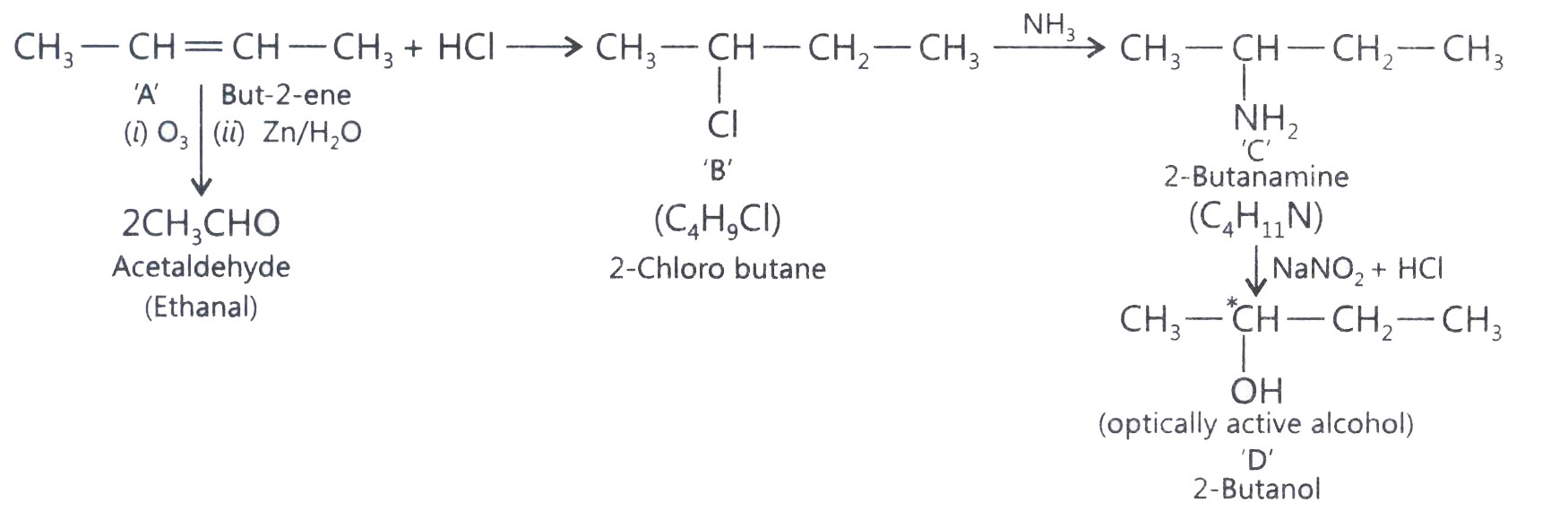
A hydrocarbon 'A' (C4H8) on reaction with HCI gives a compound 'B' , (C4H11N). On reacting with NaNO2 and HCI followed by treatment with water, compound 'C'. Ozonolysis of 'A' gives 2 moles of acetaldehyde. Identify compounds 'A' to 'D' . Explain the reactions involved.
21.
Compounds with antiseptic properties are ....... .
CHCI3
CHI3
Boric acid
0.3 ppm aqueous solution of CI2
22.
The hormone which controls the processes of burning of fast, proteins and carbohydrates and liberates energy in the body is
thyroxine
adrenaline
insulin
cortisone
23.
Which of the following amines cannot be prepared by Gabriel's synthesis
Butylamine
Isopropylamine
2-Phenylethylamine
N-Methylbenzylamine
24.
Which of the following polymers,need atleast one diene monomer for their preparation?
Dacron
Buna-S
Neoprene
Novolac
25.
Consider the reaction :
RCHO + NH2NH2 \(\longrightarrow\) RCH = N __ NH2
What short of reaction is it?
Electrophilic addition - elimination reaction
Free radical addition - elimination reaction
Free radical addition - elimination reaction
Nucleophilic addition - elimination reaction
26.
Haloalkanes contain halogen atom (s) attached to the sp3 hybridised carbon atom of an alkyl group. Identify haloalkane from the following compounds.
2-Bromopentane
Vinyl chloride (Chloroethene)
2-Chloroacetophenone
Trichloromethane
27.
Which of the following orders of acid strength is correct?
CHOH > ROH > HOH > HC \(\equiv \) CH
C6H5OH > HOH > ROH > HC \(\equiv \) CH
C6H5OH > HOH > HC \(\equiv \) CH > ROH
C6H5OH > HC > \(\equiv \) CH > HOH > ROH
28.
An aqueous solution of formaldehyde in water is sold under the name ----------
29.
Primary, secondary and tertiary alcohols can be distinguished by...............................test.
1.
Pentan-2-one is a methyl ketone (i.e., contains the grouping CH3CO) and hence undergoes Iodoform test on treatment with I2/ NaOH to give yellow ppt. of iodoform. In contrast, pentan-3-one is not a methyl ketone and hence does not give yellow ppt. of CHI3 on treatment with I2/ NaOH.
.png)
2.
A 50 : 50 mixture of two enantiomers of any optically active compound is called a racemic mixture. It is always optically inactive since rotation caused by the molecules of one enantiomer. For example, an equimolar mixture of (+)-2 bromobutane and (-) -2- bromobutane is called a racemic mixture.
3.
|
HDP |
LDP |
|
1.It consists of linear molecules and has high density |
1. It consists of branched chain structure and has low |
|
2. It is chemically inert and more tougher and harder. |
2. It is chemically inert and tough but flexible and a poor conductor of electricity. |
|
3. It is used for manufacturing buckets dustbins, bottles, pipes, etc. |
3.It is used as insulator of electric wires and manufacture of squeeze bottles, tops and flexible pipes. |
4.
Aspirin gets hydrolysed to form salicylic acid which may damage cell walls whereas paracetamol does not harm the cell walls. Secondly, aspirin cannot be given to ulcer patients.
5.
DNA contains, Adenine, Thymine, Guanine and Cytosine.
Thymine is not present in RNA. Instead of Thymine RNA contains Uracil.
6.
(i) It is because of lower bond dissociation energy in the case of \({ R }^{ \_ \_ \_ }{ I }\) than \({ R }^{ \_ \_ \_ }{ Cl }\). \({ R }^{ \_ \_ \_ }{ Cl }\) is more polar than \({ R }^{ \_ \_ \_ }{ Br }\) , therefore, more reactive.
(ii) It is because it forms stable carbocation, therefore , follows SN 1 mechanism.

(iii) Ethers are not associated with H-bonding and have weak van der Waal's forces of attraction, hence they have low boiling point.
7.

8.
It is because even the traces of certain impurities, which can act as chain transfer agent (or inhibitor can interfere with the original polymerisation chain reaction. Hence, monomers should be free from all impurities, particularly inhibitors (or chain tranfer agents) like CC 4,CBr 4, amines, phenols, quinones etc .
9.
The following tests are used to distinguish between phenol and ethanol:
(i) Bromine water test. When phenol is treated with bromine water, it gives pale yellow precipitate of 2, 4, 6-tribromophenol.
Ethanol does not give this test.
(ii) FeCl3 test. With FeCI3, phenol gives characteristic purple, violet or red colouration while ethanol does not give any colour.
10.
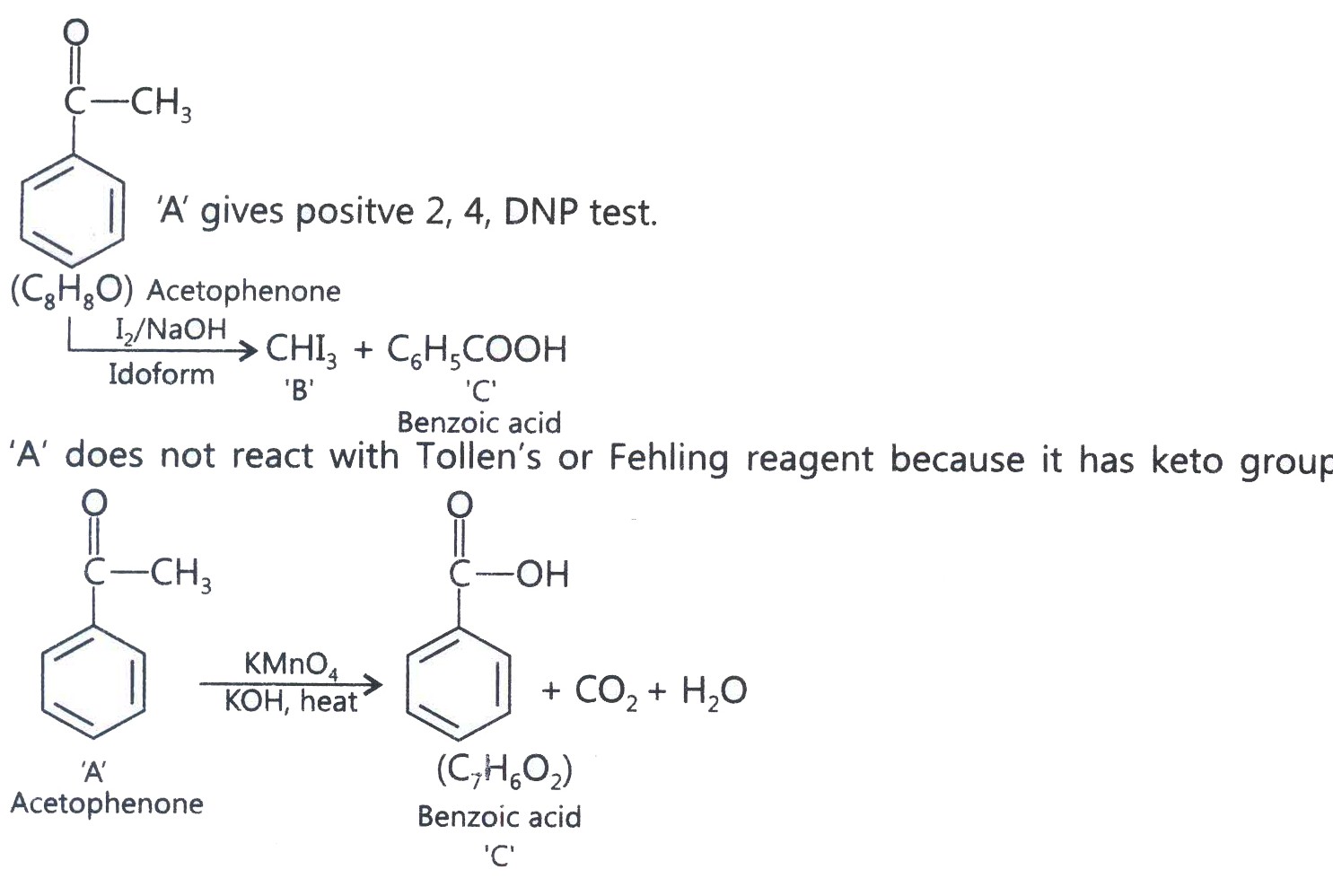
11.

12.
Antiseptics: These are chemicals which kill or prevent the growth of micro-organisms. They are applied to living tissues.
Disinfectants: They kill microorganisms but are not safe for contact with living tissues. 0.2% solution of phenol is antiseptic. 2% solution of phenol is disinfectant.
13.
(i)The ion whose one end is positively charged and other end is negatively charged is called Zwitter ion, e.g.,
\({ H }_{ 2 }N-CH_{ 2 }-COOH\rightleftharpoons { H }_{ 3 }^{ \oplus }N-CH_{ 2 }-COO^{ - }\)
(ii) Glycosidic Linkage: The oxide linkage between monosachharide units in oligo and polysachharide is called glycosidic linkage, e.g.
14.
(i) Chemical name of the poisonous vapours is methyl isocynate(MIC)
(ii) It can be prepared by heating methyl amine and phosgene.
(iii) The compound is highly reactive towards group like hydroxyl,amino, thio etc which are present in enzymes , proteins , carbohydrates , cellular fluids like water present in human system. It destroys the lung tissues and causes acute breathing problems It is also absorbed by the skin and causes its destruction.
(iv) The factories where such chemicals are produced must be installed away from the cities and villages, preferably in remote areas. Proper training must be given to the factories and inspections must be carried out from time to time to ensure that everything is in order.
15.
During osazone formation, the reaction occurs only at CI and C2 while rest of the molecule remains intact. Since glucose and fructose differ from each other only in the arrangement of atoms at CI and C2, therefore, they. give the same osazone.
16.
(i) Since compound (A) on treatment with CHCI3 and KOH (i.e., Reimer-Tiemann reaction), gives two products Band C, therefore, A must be phenol and Band C must be o-hydroxybenzaldehyde and P: hydroxybenzaldehyde respectively or vice-versa.
(ii) Since both Band C on distillation with Zn dust give the same compound (D), therefore, D must be benzaldehyde.
(iii) Since oxidation of D gives E with M.F. C7R602, therefore, E must be benzoic acid.
(iv) Since sodium salt of E, i.e.benzoic acid upon heating with soda-lime gives compound (F), therefore.
(F) must be benzene. Zn dust distillation of A would also give benzene (F).
17.
(i) Since compound (A) with M.F. C2H4O reduces Tollens' reagent, it must be an aldehyde, i.e., acetaldehyde (CH3HO).
\(\underset{Acetaldehyde}{CH_3CHO}+\underset{Tollens\ reagent}{2[Ag(NH_3)_2]^+}+3OH^-\longrightarrow CH_3COO^-+2Ag\downarrow+4NH_3+2H_2O\)
(ii) In presence of Al(OC2H5)3 aldehydes undergo Tischenko reaction to give esters. Thus, when two moles of acetaldehyde (CH3CHO) react in presence of AI(OC2H5)3 ethyl acetate (B) with M.F. C4H8O2 is produced
\(\underset{Acetaldehyde(A)\\(Two\ moles)}{CH_3CHO+OHCCH_3}\xrightarrow[(Tischenko reaction)]{Al(OC_2H_5)_3}\underset{Ethyl\ acetate\\ M/F.\ C_4H_8O_2}{CH_3COOCH_2CH_3}\)
(iii) The structure of ethyl acetate (B) is confirmed by the observation that on treatment with NH3, it gives one molecule of an alcohol, i.e., ethyl alcohol, CH3CH2OH (C) and one molecule of an amide, i.e., acetamide, CH3CONH2(D)
\(\underset{Ethyl\ acetate(B)}{CH_3COOCH_2CH_3}\xrightarrow{NH_3}\underset{Ethyl alcohol (C)\\ M.F. C_2H_6O}{CH_3CH_2OH}+\underset{Acetamide (D)\\ M.F. C_2H_5NO}{CH_3CONH_2}\)
18.
(i) HOCI in presence of an acid generates the reactive electrophile, chloronium ion «r, which attacks benzene to give chlorobenzene (A).
(ii) Chlorobenzene (A) on treatment with NaNH2/liq. NH3 undergaes-dehydrohalogenation via benzyne to afford aniline (B).
(iii) Aniline (B) on treatment with HBF4 forms the corresponding salt anilinium tetrafluoroborate (C) which on heating with NaNO2 undergoes Balz-Schiemann reaction through the intermedium formation of benzenediazonium tetrafluoroborate to afford fluorobenzene (D).
19.
(i) Cyanohydrin:
Cyanohydrins are organic compounds having the formula RR“²C(OH)CN, where R and R“² can be alkyl or aryl groups.
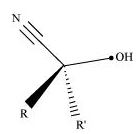
Aldehydes and ketones react with hydrogen cyanide (HCN) in the presence of excess sodium cyanide (NaCN) as a catalyst to field cyanohydrin. These reactions are known as cyanohydrin reactions.
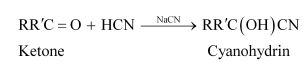
Cyanohydrins are useful synthetic intermediates.
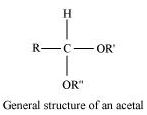
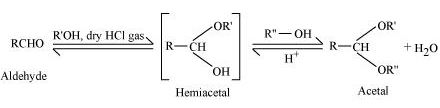
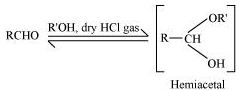
When aldehydes are treated with two equivalents of a monohydric alcohol in the presence of dry HCl gas, hemiacetals are produced that further react with one more molecule of alcohol to yield acetal.
(iii) Semicarbarbazone:
Semicarbazones are derivatives of aldehydes and ketones produced by the condensation reaction between a ketone or aldehyde and semicarbazide.
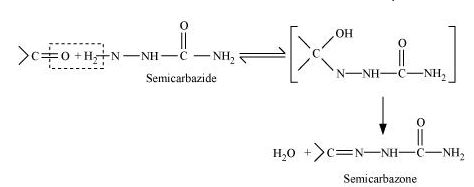
Semicarbazones are useful for identification and characterization of aldehydes and ketones.
(iv) Aldol:
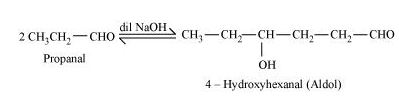
A Ã�²–hydroxy aldehyde or ketone is known as an aldol. It is produced by the condensation reaction of two molecules of the same or one molecule each of two different aldehydes or ketones in the presence of a base.
(v) Hemiacetal:
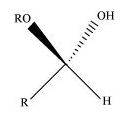
Hemiacetals are α - alkoxyalcohols
General structure of a hemiacetal
Aldehyde reacts with one molecule of a monohydric alcohol in the presence of dry HCl gas.
(vi) Oxime:
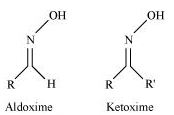
Oximes are a class of organic compounds having the general formula RR“²CNOH, where R is an organic side chain and R“² is either hydrogen or an organic side chain. If R“² is H, then it is known as aldoxime and if R“² is an organic side chain, it is known as ketoxime.
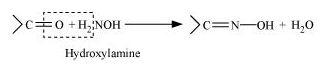
On treatment with hydroxylamine in a weakly acidic medium, aldehydes or ketones form oximes.
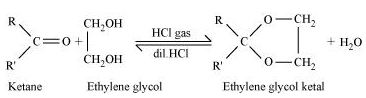
(vii) Ketal:
Ketals are gem - dialkoxyalkanes in which two alkoxy groups are present on the same carbon atom within the chain. The other two bonds of the carbon atom are connected to two alkyl groups.
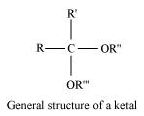
Ketones react with ethylene glycol in the presence of dry HCl gas to give a cyclic product known as ethylene glycol ketals.
(viii) Imine:
Imines are chemical compounds containing a carbon nitrogen double bond.
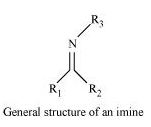
Imines are produced when aldehydes and ketones react with ammonia and its derivatives.

(ix) 2, 4 - DNP - derivative:
2, 4 - dinitrophenylhydragones are 2, 4 - DNP - derivatives, which are produced when aldehydes or ketones react with 2, 4 - dinitrophenylhydrazine in a weakly acidic medium.
To identify and characterize aldehydes and ketones, 2, 4 - DNP derivatives are used.
(x) Schiff's base:
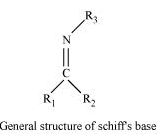
Schiff's base (or azomethine) is a chemical compound containing a carbon-nitrogen double bond with the nitrogen atom connected to an
aryl or alkyl group-but not hydrogen. They have the general formula R1R2C = NR3. Hence, it is an imine.
It is named after a scientist, Hugo Schiff.

Aldehydes and ketones on treatment with primary aliphatic or aromatic amines in the presence of trace of an acid yields a Schiff's base.
20.
21.
(b)
CHI3
22.
(c)
insulin
23.
N-Methylebenzylamine (CH3NHCH2C6H5) being a \({ 2 }^{ \circ }\) amine cannot be prepared by Gabriel's synthesis.
24.
(c)
Neoprene
25.
(d)
Nucleophilic addition - elimination reaction
26.
(a)
2-Bromopentane
27.
(b)
C6H5OH > HOH > ROH > HC \(\equiv \) CH
28.
()
formalin
29.
()
Lucas or Victor-Meyer's test

12th Standard CBSE Syllabus & Materials
12th Standard CBSE
CBSE 12th Computer Science Python Revision Tour I - New Previous year Question Papers Study Material - QB365 Set A
NEW12th Standard CBSE
CBSE 12th Business Studies Planning Important Questions And Answers Study Material - QB365 Set A
NEW12th Standard CBSE
CBSE 12th Business Studies Business Environment Important Questions And Answers Study Material - QB365 Set A
NEW12th Standard CBSE
CBSE 12th Business Studies Principles of Management Important Questions And Answers Study Material - QB365 Set A



NCERT Books

Syllabus

Exam Pattern

Sample Question Papers

Previous year Question Papers

Important Notes

MCQ Practice test

NCERT Exemplers

Case study Questions

Image Based Questions

Passage based Questions

HOT Questions

Value Based Questions

Model Questions Papers
NCERT ( Book Back ) Questions

Assertion and Reason
Important Questions And Answers

CBSE 12th Standard CBSE Subjects
CBSE Standards