
 100% FREE ACCESS
12th Standard CBSE Syllabus & Materials
12th Standard CBSE
CBSE 12th Economics Government Budget and the Economy Previous year Question Papers Study Material - QB365 Set A
NEW12th Standard CBSE
CBSE 12th Computer Science Interface Python with MySQL - New Previous year Question Papers Study Material - QB365 Set A
NEW12th Standard CBSE
CBSE 12th Computer Science Database Concept - New Previous year Question Papers Study Material - QB365 Set A
NEW12th Standard CBSE
CBSE 12th Computer Science Data Communication - New Previous year Question Papers Study Material - QB365 Set A
NEW12th Standard CBSE
CBSE 12th Computer Science Data Structures - New Previous year Question Papers Study Material - QB365 Set A
NEW12th Standard CBSE
CBSE 12th Computer Science Functions - New Previous year Question Papers Study Material - QB365 Set A

Published on: 02/11/2025
Download CBSE Class 12th Standard CBSE Chemistry question papers, sample papers, important questions, and previous year solved papers in PDF format. Get free study materials, NCERT solutions, and exam preparation resources for Class 12th Standard CBSE Chemistry
Questions + Answers key
Take MCQ Chemistry Test
1.
Transition metals form alloys with other transition metals. Explain.
2.
What is known as activation energy? how is the activation energy affected by
(i) the use of a catalyst
(ii) a rise in temperature?
3.
The rate constant of a reaction is \(1.2\times { 10 }^{ -3 }L\ { mol }^{ -1 }\ { s }^{ -1 }\) . what is the order of the reaction?
4.
Define Raoult's law for binary solutions.
5.
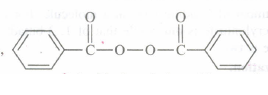
Write the name and structure of one of the common initiators used in free radical addition polymerization.
6.
Write the order of thermal stability of the hydrides of group 16 elements.
7.
Can \({ E }_{ cell }^{ 0 }\) and \({ \Delta }_{ r }{ G }^{ 0 }\) for cell reaction ever be equal to zero ?
8.
Name the electrophile produced in the reaction of benzene with benzoyl chloride in the presence of anhydrous AlCl3. Name the reaction also.
9.
The chemistry of the actinoid elements is not so smooth as that of the lanthanoids. Justify this statement by giving some examples from the oxidation state of these elements.
10.
A 100W and 110 V incandescent lamp is connected in series with an electrolytic cell containing CdSO4 solution. What mass of cadmium will be deposited at the cathode after 4 hrs of electricity?
11.
How are the two types of emulsions. different from one another ? Give suitable examples to justify the difference. State two applications of emulsions.
12.
45 g of ethylene glycol (C2H4O2) is mixed with 600 g of water. Calculate
(i) the freezing point depression and
(ii) the freezing point of the solution.
13.
Graphite is commonly used as an anode but not diamond. Give reason.
14.
0.052 g of glucose \(({ C }_{ 6 }{ H }_{ 12 }{ O }_{ 6 })\) has been dissolved in 80.2 g of water. Calculate
(i) the boiling point and
(ii) freezing point of the solution \((K_{ f }=1.86 \ K \ m^{ -1 }, \ K_{ b }=5.2 \ K \ m^{ -1 })\) .
15.
Why does bromination of aniline, even under very mild conditions, gives 2, 4, 6-tribromoaniline instantaneously?
16.
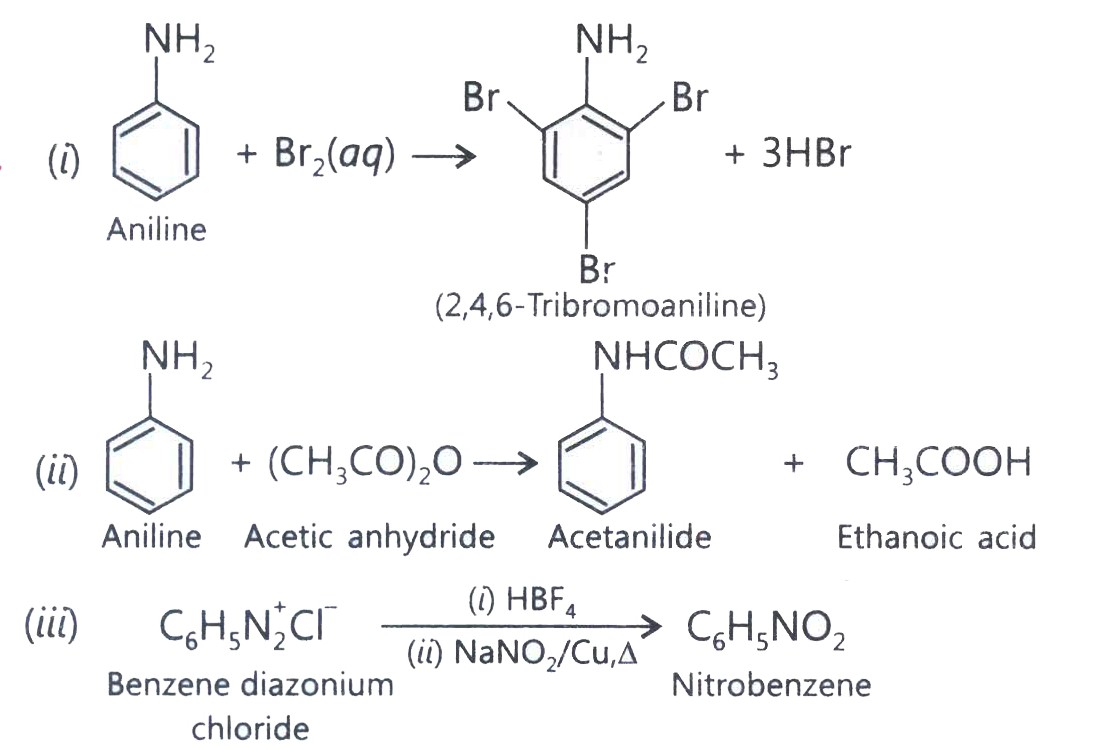
Complete the following reactions:
(i)\(C_6H_5NH_2+Br_2(aq)\rightarrow\)
(ii)\(C_6H_5NH_2+(CH_3CO)_2O\rightarrow\)
(iii)\(C_6H_5N_2Cl\overset { (i)HBF_{ 4 } }{ \underset { (ii)NaNO_{ 2 }/Cu,\Delta }{ \longrightarrow } } \)
17.
Write the formulae for the following coordination compounds:
(i) Tetraammineaquachloridocobalt (III) chloride
(ii) Potassium tetrahydroxozincate (II)
(iii) Potassium trioxalatoaluminate (III)
(iv) Dichloridobis (ethane-1, 2 diamine) - cobalt (III)
(v) Tetracarbonylnickel (0)
18.
How would you account for the following:
(i) H2S is more acidic than H2O.
(ii) The N-O bond in NO2- is shorter than the N-O bond in NO3-.
(iii) Both O2 and F2 stabilize high oxidation states but the ability of oxygen to stabilize the higher oxidation state exceeds that of fluorine.
19.
Tincture of iodine is
aqueous solution of I2
solution of I2 in aqueous KI
alcoholic solution of I2
aqueous solution of KI
20.
Anorganic compound A upon reacting with NH3 gives B. On heating, B gives C. C in presence of KOH reacts with Br2 to give CH3CH2NH2. A is
CH3CH2COOH
CH3COOH
CH3CH2CH2COOH
\({ CH }_{ 3 }-\underset { \underset { { CH }_{ 3 } }{ | } }{ CH } -COOH\)
21.
Ribose and 2-deoxyribose can be differentiated by
Fehling's solution
Tollen's reagent
Barfoed's reagent
Osazoe formation
22.
Which of the following are not thermosetting polymers?
Bakelite
Polystyrene
PVC
Melmac
23.
In chromite ore, the oxidation number of iron and chromium are respectively
+3, +2
+3, +6
+2, +6
+2, +3
24.
Which one of the following is not expected to undergo iodoform reaction?
Propan-2-ol
1-Phenylethanol
2-Butanol
Ethanol
Diphenylmethanol
25.
The product formed in Aldol condensation is
an alpha, beta unsaturated ester
a beta hydroxy acid
a beta hydroxyaldehyde or ketone
an alpha hydroxy aldehyde or ketone
26.
Toluene reacts with a halogen in the presence of iron (III) chloride giving ortho and para halo compounds. The reaction is
Electrophilic elimination reaction
Electrophilic substitution reaction
Free radical addition reaction
Nucleophilic substitution reaction
27.
Which one of the following complexes is not expected to exhibit isomerism?
[Ni(NH3)4(H2O)2]2+
[Pt(NH3)2Cl2]
[Ni(NH3)2Cl2]
[Ni(en)3]2+
28.
The decomposition of N2O5 in CCI4 at 318 K is studied by monitoring the concentration of N2O5 in the solution. Initially, the concentration of N2O5 is 2.4 mol L-1 and after 200 minutes, if is reduced to 2.4 mol L-1. what is the rate of production of NO2 during this period in mol L-1 min -1 ?
4\(\times 10 ^{-3 }\)
2\(\times 10 ^{-3 }\)
1\(\times 10 ^{-3 }\)
2\(\times 10 ^{-4}\)
5\(\times 10 ^{-3 }\)
29.
The salt which is least likely to be found in minerals
chloride
sulphate
sulphide
nitrate
30.
The element which forms oxides in all oxidation states +I to +V is
N
P
As
Sb
31.
Which of the following is true in respect of adsorption?
\(\triangle G<0,\triangle S>0,\triangle H<0\)
\(\triangle G<0,\triangle S<0,\triangle H<0\)
\(\triangle G>0,\triangle S>0,\triangle H<0\)
\(\triangle G<0,\triangle S<0,\triangle H>0\)
32.
Dry air is passed through a solution containing 10 g of the solute in 90 g of water and then through pure water. The loss in weight of solution is 2.5 g and that of pure solvent is 0.05 g. Calculate the molecular weight of the solute.
50
180
100
25
51
33.
Standard electrode potential of three metals X, Y and Z are -1.2 V, + 0.5 v and - 3.0 V respectively. The reducing power of these metals will be
X > Y > Z
Y > Z > X
Y > X > Z
Z > X > Y
34.
Just like human beings, plants also need various nutrients for their healthy growth. Iron is one of these. The deficiency of iron results in disorder known as iron chlorosis. It appears in the form of yellow leaves. It adversely affect the yield of fruits from citrus trees.
(i) In which oxidation state is iron generally present in the soil?
(ii) Why is iron hydroxide not assimilated in the soil?
(ill) Which complex of iron is readily absorbed by soil?
(iv) What can you suggest to stop the adverse effect of iron deficiency?
35.
(a) When 2.56 g of sulphur was dissolved in 100 g of CS2, the freezing point lowered by 0.383 K. Calculate the formula of sulphur (SX). (Kf for CS2 = 3.83 K kg mol-1, Atomic mass of sulphur = 32 g mol-1).
(b) Blood cells are isotonic with 0.9 % sodium chloride solution. What happens if we place blood cells in a solution containing;
(i) 1.2 % sodium chloride solution?
(ii) 0.4% sodium chloride solution?
36.
\({ NCI }_{ 3 }\) is readily hydrolysed while \({ NF }_{ 3 }\) does not.Explain
37.
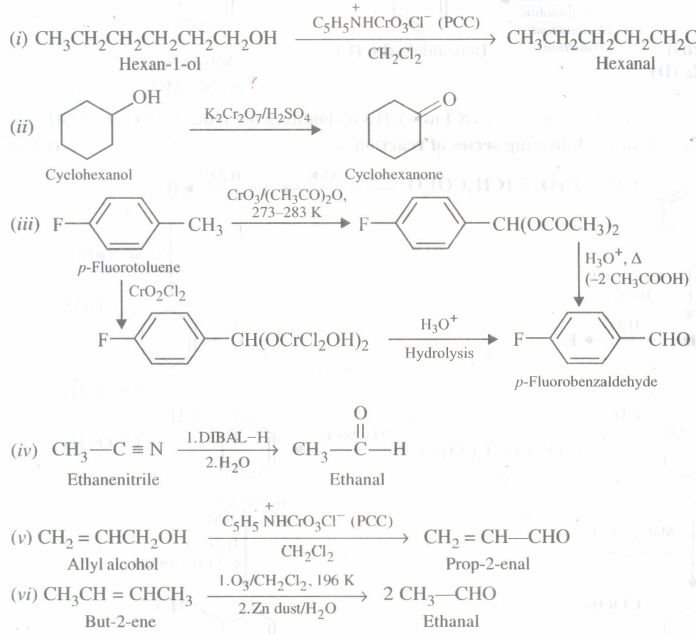
Give names of the reagents to bring about the following transformations
(i) Hexan-1-ol to hexanal,
(ii) Cyclohexanol to cyclohexanone
(iii) p-Fluorotoluene to p-fluorobenzaldehyde,
(iv) Ethanenitrile to ethanal.
(v) Allyl alcohol to propenal, and
(vi) But-2-ene to ethanal.
38.
PCl5 reacts with ethanol to form chloromethane. However, with phenol, it does not give chlorobenzene but gives triphenylphosphate. Explain.
39.
Illustrate with examples the limitations of Williamson synthesis for the preparation of certain type of ethers.
40.
Benzene on reaction with HOCI in presence of an acid produces organic compound (A), (A) on treatment with NaNH2/liq. NH3 furnishes another organic compound (B). (B) on treatment with HBF4 affords an organic compound (C) wich on heating with NaNO2 gives organic compound (D). Identify (A), (B), (C) and (D).
41.
Three iron sheets have been coated separately with three metals (A, B and C) whose standard electrode potentials are given below :
| Metal | A | B | C | Iron |
| E0value | - 0.46 | - 0.66 V | - 0.20 V | - 0.44 V |
Identify in which case rusting will take place faster when coating is damaged.
1.
Transition metals form a large variety of alloys. This is due to the fact that transition metals have almost similar sizes and therefore, the atoms of one metal can easily substitute the atoms of other metals in their lattices. When we cool the mixture solution of two or more transition metals, solid alloys are generally formed. For example, Mn dissolves in molten iron to form manganese steel. The alloys formed are hard, having high melting points. These are also resistant to corrosion in comparison to the parent metals. Tungsten is also used for preparing stainless steel.
2.
The excess energy (over and above the average energy of the' reactants) which must be supplied to the reactants to undergo chemical reaction is called activation energy. It is the difference between threshold energy and average energy of reactants.
Activation energy = Threshold energy - Average energy of reactants.
(i) Activation energy decreases by the use of a catalyst.
(ii) Activation energy decreases by rise in temperature.
3.
The reaction is of second order.
4.
Define Raoult's law for binary solutions may be defined as: at a given temperature, for a solution of two volatile liquids the partial vapour pressure of each component of the solution is equal to the product of the vapour pressure of the pure component and its mole fraction in solution. Thus,
\(P_A=P_A \quad{ }^{\circ} \times x_a \text { and } P_B=P_B \quad{ }^{\circ} \times x_B\)
5.
Benzoyl peroxide
6.
As the size of the element increases down the group, the E-H bond dissociation energy decreases and hence E-H bond breaks more easily. Thus, the thermal stability. of the hydrides of group 16 elements decreases down the group, i.e., \({ H }_{ 2 }O>{ H }_{ 2 }S>{ H }_{ 2 }Se>{ H }_{ 2 }Te>{ H }_{ 2 }Po.\)
7.
No (Ecell can be zero but not \({ E }_{ cell }^{ 0 }\) ). Further, \({ \Delta G }^{ 0 }=-nF{ E }_{ cell }^{ 0 }\) . As \({ E }_{ cell }^{ 0 }\neq 0\) ,therefore, \({ \Delta }_{ r }{ G }^{ 0 }\) also cannot be zero.
8.
Benzene, on reaction with benzoyl chloride gives benzophenone through an intermediate benzoylinium cation.
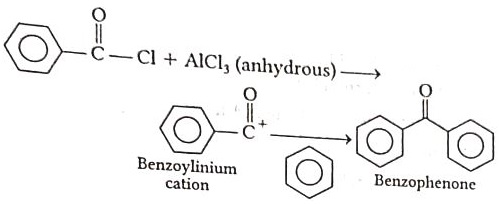
This is an example of Friedel-Crafts acylation reaction.
9.
Lanthanoids primarily show three oxidation states (+2, +3, +4). Among these oxidation states, +3 state is the most common. Lanthanoids display a limited number of oxidation states because the energy difference between 4f, 5d, and 6s orbitals is quite large. On the other hand, the energy difference between 5f, 6d, and 7s orbitals is very less. Hence, actinoids display a large number of oxidation states. For example, uranium and plutonium display +3, +4, +5, and +6 oxidation states while neptunium displays +3, +4, +5, and +7. The most common oxidation state in case of actinoids is also +3.
10.
Step I
Calculation of the quantity of charge passed:
We know that,
Watt = Ampere x Volt
Ampere =\(\frac { Watt }{ Volt } =\frac { 100 }{ 110 } \)
Now charge = Current x Time
=\(\left( \frac { 100 }{ 110 } amp \right) \times 4\times 60\times 60\)
= 13091 C
Step II
Calculation of mass of Cadmium deposited:
The cathodic reaction is
Cd2+(aq)+2e-\(\rightarrow\)Cd(s)
112.2g 2 x 96500C
2 x 96500 C of charge deposited Cd = 112.2 g
13091 C charge will deposite Cd
\(\frac { 112.2g }{ 2\times 96500C } \times 13091C\)
= 7.61g
11.
Two types of emulsions are as follows:
| Oil in Water | Water in Oil |
| In this type of emulsions, dispersed phase is oil and dispersion medium is water. e.g., Milk. |
In this type of emulsions, water acts as dispersed phase while the oil behaves as dispersion medium. e.g., Butter. |
Application of Emulsions:
(i) In medicine: The various pharmaceuticals and cosmetics are available in liquid form such as codliver oil etc., and some creams and ointment are emulsions of water in oil type.
(ii) Cleaning action of soap: This action is based on the formation of oil in water type emulsions
12.
Depression in freezing point is related to the molality, therefore, the molality of the solution with respect to ethylene glycol \(=\frac{\text { moles of ethylene glycol }}{\text { mass of water in kilogram }}\)
\(\text {Moles of ethylene glycol }=\frac{45 \mathrm{~g}}{62 \mathrm{~g} \mathrm{~mol}^{-1}}=0.73 \mathrm{~mol}\)
\(\text {Mass of water in } \mathrm{kg}=\frac{600 \mathrm{~g}}{1000 \mathrm{~g} \mathrm{~kg}^{-1}}=0.6 \mathrm{~kg}\)
\(\text {Hence molality of ethylene glycol }=\frac{0.73 \mathrm{~mol}}{0.60 \mathrm{~kg}}=1.2 \mathrm{~mol} \mathrm{~kg}^{-1}\)
Therefore freezing point depression,
ÄTf = 1.86 K kg mol–1 x 1.2 mol kg–1 = 2.2 K
Freezing point of the aqueous solution = 273.15 K – 2.2 K = 270.95 K
13.
Graphite is a good conductor of electricity due to the presence of free electrons within its layers. But in diamond, no free electrons are present and therefore, it is a bad conductor of electricity. Therefore, diamond is not used as an anode.
14.
Elevation in boiling point may be calculated from the relation,
\(\triangle { T }_{ b }=\frac { { K }_{ b }\times { \omega }_{ B }\times 1000 }{ M_{ B }\times \omega _{ A } } \)
\(\\ { \omega }_{ B }=0.052g,{ \omega }_{ A }=80.2g,{ K }_{ b }=5.2K{ m }^{ -1 },{ M }_{ B }=180\)
\(\therefore \triangle { T }_{ b }=\frac { 5.2\times 0.052\times 1000 }{ 180\times 80.2 } =0.0187\)
Boiling point of water = 373 K
Boiling point of solution = 373 + 0.0187 = 373.0187 = 373.02 K
Now, depression in freezing point,
\(\triangle { T }_{ f }=\frac { { K }_{ b }\times { \omega }_{ B }\times 1000 }{ M_{ B }\times \omega _{ A } } \)
\(\\ { \omega }_{ B }=0.052g,{ \omega }_{ A }=80.2g,{ K }_{ f }=1.86K{ m }^{ -1 },{ M }_{ B }=180\)
\(\therefore \triangle { T }_{ f }=\frac { 1.86\times 0.052\times 1000 }{ 180\times 80.2 } =0.067 \)
Freezing point of water = 273 K
Freezing point of solution = 273 - 0.067 = 272.933K.
15.
Due to strong electron-donating effect of the -NH2 group, the electron density increases at the 0-, positions. Further, when aniline is treated with Br2 the Br+ attacks the benzene ring at o- and p-positions to form carbocation intermediates which are stabilized not only by the usual resonance of the Henzene ring. but also by the -NH2 group as shown below: In case of o-bromination, the carbocation intermediate is stabilized not only by usual resonating structure (I, III and IV) but is also stabilized by resonance structure (II) in which the lone pair of electrons on the N. atom interacts with the positively charged carbon of the ring. Similarly, in case of p-bromination, the carbocation is stabilized not only by the usual resonating structures (V, VI, and VIII) but is also stabilized by the resonance structure (VII) in which the lone pair of electrons on the N-atom interacts with the positively charged carbon of the ring. These additional resonating structures (II and VII) increase the stability of the carbocation to such an extent that bromination occurs instantaneously at the p- and two. o- positions giving 2, 4, 6-tribromoaniline.
16.
17.
(i) [Co(NH3)4(H2O)Cl]Cl2
(ii) K2[Zn(OH)4]
(iii) K3[Al(C2O4)3]
(iv) [CoCl2(en)2]+
(v) [Ni(CO)4]
18.
(i) Since size of S is more than that of 0, the distance between central atom and hydrogen atoms is more in \({ H }_{ 2 }S\) than in \({ H }_{ 2 }O\). Therefore, bond dissociation enthalpy of \({ H }_{ 2 }S\) is less and bond cleavage is more easy than in \({ H }_{ 2 }O\) . Therefore, \({ H }_{ 2 }S\) is more acidic than \({ H }_{ 2 }O\).
(ii) In the resonance structures of \({ NO }_{ 2 }^{ - }\), two bonds are sharing a double bond, while in \({ NO }_{ 3 }^{ - }\), three bonds4 are sharing a double bond.
As a result, the bond in \({ NO }_{ 2 }^{ - }\)will be shorter than in \({ NO }_{ 3 }^{ - }\) and therefore, N-O bond length in \({ NO }_{ 2 }^{ - }\) is shorter than N-O in \({ NO }_{ 3 }^{ - }\).
(iii)The larger tendency of oxygen to stabilise the higher oxidation state is because of the tendency of oxygen to form multiple bonds with metal.
19.
(c)
alcoholic solution of I2
20.
(a)
CH3CH2COOH
21.
(d)
Osazoe formation
22.
(c)
PVC
23.
(d)
+2, +3
24.
(e)
Diphenylmethanol
25.
(c)
a beta hydroxyaldehyde or ketone
26.
(b)
Electrophilic substitution reaction
27.
(c)
[Ni(NH3)2Cl2]
28.
(a)
4\(\times 10 ^{-3 }\)
29.
(d)
nitrate
30.
(a)
N
31.
(b)
\(\triangle G<0,\triangle S<0,\triangle H<0\)
32.
(c)
100
33.
(d)
Z > X > Y
34.
(i) Iron is present in + 3 oxidation state as Fe (III).
(ii) Iron hydroxide i.e., Fe(OH)3 is insoluble in water and is therefore, not assimilated in the soil.
(iii) Fe(III)-EDTA complex is readily absorbed by the soil as it is water soluble.
(iv) The addition of this complex compound in proper amount makes plants healthy and the yield of fruits gets increased. But its deficiency also affect adversely so we will provide Fe-EDTA complex.
35.
\(\Delta { T }_{ f }=\frac { { K }_{ f }{ W }_{ b }\times 1000 }{ { M }_{ b }\times { W }_{ a } } \)
\(0.383=\left( \frac { 3.83\times 2.56 }{ M\times 100 } \right) \times 1000\)
M = 256
S \(\times \) x = 256
32 \(\times \) x = 256
x = 8
(b) (i) If we place blood cells in solution containing 1.2% sodium chloride solution, they shrink.
(ii) It we place blood cells in solution containing 0.4% sodium chloride solution, they swell.
36.
In \({ NCI }_{ 3 }\) CI has vacant d-orbitals to accept the lone pair of electrons donated by oxygen atom of \({ H }_{ 2 }O\) molecules. But in \({ NF }_{ 3 }\), F does not have vacant d-orbitals. Therefore, \({ NCI }_{ 3 }\) undergoes hydrolysis but \({ NF }_{ 3 }\) does not.
\({ 2NCI }_{ 3 }+{ 3H }_{ 2 }\longrightarrow { NH }_{ 3 }+{ 3HOCI }\)
\({ NF }_{ 3 }+{ H }_{ 2 }O\longrightarrow \) No reaction
\(\)
37.
38.
To begin with both ethanol and phenol react with PCI5 to give the corresponding chlorophosphate esters.
Since in ethanol, C-O bond has only single bond character, therefore, nucleophilic attack by Cl- ion occurs easily on chlorophosphate ester (I) to give chloroethane. However, in case of phenol, C-O bond has some double bond character due to resonance and hence difficult to break. Instead nucleophilic attack by C6H5OH occurs twice on the chlorophosphate ester (II) to form intermediate (III). Further, nucleophilic attack by C6H5OH on III does not occur due to steric hindrance. Instead (III) undergoes hydrolysis by water to form triphenylphosphate.
39.
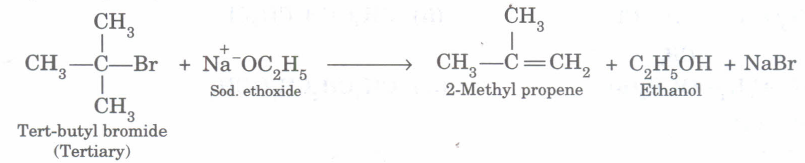
The main limitation of Williamson's synthesis is that for preparing unsymmetrical ethers, the halide used should preferably be primary because secondary and tertiary alkyl halides may form alkenes as major products due to elimination process. For 2° and 3° alkyl halide, elimination competes over substitution. If a 3° alkyl halide is used, an alkene is the only product and no ether is formed. For example, if we want to prepare ethyl tert-butyl ether, then we should take ethyl bromide and sodium tert-butoxide.

However, if we use tert-butyl bromide and sodium ethoxide as reactants, then the major products would be 2-methyl propene (iso-butylene) and ethanol.
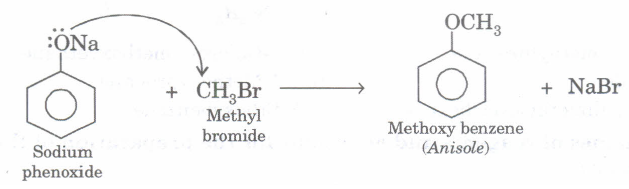
Similarly, alkyl aryl ethers (phenolic ethers) can be easily prepared by using sodium phenoxide and alkyl halides. For example,
However, aryl halide and sodium alkoxide cannot be used for preparing phenolic ethers because aryl halides are less reactive towards nucleophilic substitution reactions than alkyl halides.
40.
(i) HOCI in presence of an acid generates the reactive electrophile, chloronium ion «r, which attacks benzene to give chlorobenzene (A).
(ii) Chlorobenzene (A) on treatment with NaNH2/liq. NH3 undergaes-dehydrohalogenation via benzyne to afford aniline (B).
(iii) Aniline (B) on treatment with HBF4 forms the corresponding salt anilinium tetrafluoroborate (C) which on heating with NaNO2 undergoes Balz-Schiemann reaction through the intermedium formation of benzenediazonium tetrafluoroborate to afford fluorobenzene (D).
41.
Comparing oxidation potential of iron with those of metals A, B and C, iron has higher oxidation potential than C only. Hence, when coating of C is broken, rusting will become faster.

12th Standard CBSE Syllabus & Materials
12th Standard CBSE
CBSE 12th Computer Science Python Revision Tour I - New Previous year Question Papers Study Material - QB365 Set A
NEW12th Standard CBSE
CBSE 12th Business Studies Planning Important Questions And Answers Study Material - QB365 Set A
NEW12th Standard CBSE
CBSE 12th Business Studies Business Environment Important Questions And Answers Study Material - QB365 Set A
NEW12th Standard CBSE
CBSE 12th Business Studies Principles of Management Important Questions And Answers Study Material - QB365 Set A



NCERT Books

Syllabus

Exam Pattern

Sample Question Papers

Previous year Question Papers

Important Notes

MCQ Practice test

NCERT Exemplers

Case study Questions

Image Based Questions

Passage based Questions

HOT Questions

Value Based Questions

Model Questions Papers
NCERT ( Book Back ) Questions

Assertion and Reason
Important Questions And Answers

CBSE 12th Standard CBSE Subjects
CBSE Standards