 100% FREE ACCESS
12th Standard CBSE Syllabus & Materials
12th Standard CBSE
CBSE 12th Economics Government Budget and the Economy Previous year Question Papers Study Material - QB365 Set A
NEW12th Standard CBSE
CBSE 12th Computer Science Interface Python with MySQL - New Previous year Question Papers Study Material - QB365 Set A
NEW12th Standard CBSE
CBSE 12th Computer Science Database Concept - New Previous year Question Papers Study Material - QB365 Set A
NEW12th Standard CBSE
CBSE 12th Computer Science Data Communication - New Previous year Question Papers Study Material - QB365 Set A
NEW12th Standard CBSE
CBSE 12th Computer Science Data Structures - New Previous year Question Papers Study Material - QB365 Set A
NEW12th Standard CBSE
CBSE 12th Computer Science Functions - New Previous year Question Papers Study Material - QB365 Set A

Published on: 07/03/2026
Download CBSE Class 12th Standard CBSE Chemistry question papers, sample papers, important questions, and previous year solved papers in PDF format. Get free study materials, NCERT solutions, and exam preparation resources for Class 12th Standard CBSE Chemistry
Questions + Answers key
Take MCQ Chemistry Test
1.
Complete the following equations:
(i) \(2 \mathrm{MnO}_{4}^{-}+5 \mathrm{NO}_{2}^{-}+6 \mathrm{H}^{+} \longrightarrow\)
(ii) \(\mathrm{Cr}_{2} \mathrm{O}_{7}^{2-}+14 \mathrm{H}^{+}+6 e^{-} \longrightarrow\)
2.
What are interstitial compounds? Why are such compounds well known for transition metals?
3.
Out of the following two coordination entities which is chiral (optically active)?
(a) cis-[CrCl2(ox)2]3-
(b) trans-[CrCl2(ox)2]3-
4.
Use Hund’s rule to derive the electronic configuration of Ce3+ ion, and calculate its magnetic moment on the basis of ‘spin-only’ formula.
5.
Predict which of the following will be coloured in aqueous solution. Ti3+, V3+, Cu+, Sc3+, Mn2+, Fe3+ and Co2+. Give reason for each.
6.
Write the IUPAC name of Pt(NH3)3 (NO)CI2]Br2.
7.
Account for the following.
(i) Ti(IV) is more stable than the Ti (II) or Ti(III).
(ii) In case of transition elements, ions of the same charge in a given series show progressive decrease in radius with increasing atomic number.
(iii) Zinc is comparatively a soft metal, iron and chromium are typically hard.
8.
Give reasons:
(a) E0 value for Mn3+/Mn2+ couple is much more positive than that for Fe3+/Fe2+.
(b) Iron has higher enthalpy of atomisation than that of copper.
(c) Sc3+ is colourless in aqueous solution whereas Ti3+ is colured.
9.
(i) How is double salt different from a complex?
(ii) Write IUPAC name of the following:
(a) K3 [Fe (C2O4)3]
(b) [Pt (NH3)6]CI4
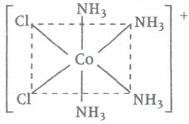
(iii) Draw the structure of cis-isomer of
[Co(NH3)4CI2]+
10.
For the complex \({ \left[ { NiCl }_{ 4 } \right] }^{ 2- }\), write
(i) the IUPAC name
(ii) the hybridization type.
(iii) the shape of the complex
(Atomic no.of Ni = 28)
11.
Specify the oxidation numbers of the metals in the following coordination entities:
(i) [Co(H2O) (CN) (en)2]2+
(ii) [PtCl4]2-
(iii) [Cr(NH3)3Cl3]
(iv) [CoBr2(en)2]+
(v) K3[Fe(CN)6]
12.
How would you account for the following?
(a) Of the d4 species, Cr2+ is strongly reducing while manganese (III) is strongly oxidising.
(b) Cobalt (II) is stable in aqueous solution but in the presence of complexing reagents, it is easily oxidised.
(c) The d1 configuration is very unstable in ions.
13.
How many ions are produced from the complex [Co(NH3)5Cl] Cl2 in solution?
4
2
3
5
14.
Transition elements have greater tendency to form complexes because
They have vacant d orbitals
They have large size
They have large charge/ size ratio
They have two electrons in their outermost shells
15.
The number of unpaired electrons in gaseous species of Mn3+. Cr3+ and V3+ respectively are ........ and most stable species is ......... .
4,3 and 2 and V3+ is most stable
3,3 and 2 and Cr3+ is most stable
4,3 and 2 and Cr3+ is most stable
3,3 and 3 and Mn3+ is most stable.
16.
The correct statement with respect to the complexes Ni(CO)4 and [Ni(CN)4]2- is
nickel is in the same oxidation state in both
both have tetrahedral geometry
have square planar and tetrahedral geometry respectively
have tetrahedral and square planar geometry respectively
UnAvailable Option
17.
Which is the strongest base among the following ?
La(OH)3
Lu(OH)3
Ce(OH)3
Yb(OH)3
18.
(a) Why is chemistry of actinoids complicated as compared to lanthanoids?
(b) Complete the following reaction and Justify that it is a disproportionation reaction:
3 MnO42-+4H+⟶ + -- + -- + 2H2O
(c) The given graph shows the trends in melting points of transition metals:
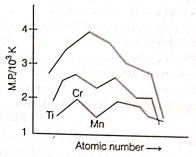
Explain the reason why Cr has highest melting point and manganese (Mn) a lower melting point.
19.
(i) Define:
(a) Metal carbonyls
(b) Chelate
(ii) (a) Give one chemical test as an evidence to show that [Co(NH3)5CI]SO4 and [Co(NH3)5(SO4)] Cl are ionisation isomers.
(b) [NiCl4]2- is paramagnetic while [Ni(CO4] is diamagnetic though both are tetrahedral. Why? (Atomic no. of Ni = 28)
(c) Write the electronic configuration of Fe(III) on the basis of crystal field theory when it forms an octahedral complex in the presence of (i) strong field ligand, and (ii) weak field ligand. (Atomic no. of Fe = 26)
20.
The elements of 3d transition series are given as:
8c Ti V Cr Mn Fe Co Ni Cu Zn
Answer the following:
(i) Write the element which shows maximum number of oxidation states. Give reason.
(ii) Which element has the highest melting point?
(iii) Which element shows only +3 oxidation state?
(iv) Which element is a strong oxidising agent in +3 oxidation state and why?
21.
Describe the preparation of potassium permanganate. How does the acidified permanganate solution react with
(i) iron(II) ions
(ii) SO2 and
(iii) oxalic acid?
Write the ionic equations for the reactions.
22.
Read the passage given below and answer the following questions:
Valence bond theory considers the bonding between the metal ion and the ligands as purely covalent. On the other hand, crystal field theory considers the metal-ligand bond to be ionic arising from electrostatic interaction between the metal ion and the ligands. In coordination compounds, the interaction between the ligand and the metal ion causes the five d-orbitals to split-up. This is called crystal field splitting and the energy difference between the two sets of energy level is called crystal field splitting energy. The crystal field splitting energy (Δo) depends upon the nature of the ligand. The actual configuration of complexes is divided by the relative values of Δo and P (pairing energy)
If Δo < P, then complex will be high spin.
If Δo > P, then complex will be low spin.
The following questions are multiple choice questions. Choose the most appropriate answer :
(i) Which of the following ligand has lowest Δo value?
| (a) CN- | (b) CO | (c) F- | (d) NH3 |
(ii) The crystal field splitting energy for octahedral (Δo) and tetrahedral (Δt) complex is related as
| (a) \( \Delta_{t}=\frac{1}{2} \Delta_{o}\) | (b) \(\Delta_{t}=\frac{4}{9} \Delta_{o}\) |
| (c) \(\Delta_{t}=\frac{3}{5} \Delta_{o}\) | (d) \(\Delta_{t}=\frac{2}{5} \Delta_{o}\) |
(iii) On the basis of crystal field theory, the electronic configuration of d4 in two situations: (i) Δo > P and (ii) Δo< P are
| (i) | (ii) |
| (a) \(t_{2 g}^{4} e_{g}^{0}\) | \(t_{2 g}^{3} e_{g}^{1}\) |
| (b) \(t_{2 g}^{3} e_{g}^{1}\) | \(t_{2 g}^{4} e_{g}^{0}\) |
| (c) \(t_{2 g}^{3} e_{g}^{1}\) | \(t_{2 g}^{3} e_{g}^{1}\) |
|
(d) \(t_{2 g}^{4} e_{g}^{0}\) |
\(t_{2 g}^{4} e_{g}^{0}\) |
(iv) Using crystal field theory, calculate magnetic moment of central metal ion of [FeF6]4-.
| (a) 1.79 B.M. | (b) 2.83 B.M. | (c) 3.85 B.M. | (d) 4.9 B.M. |
1.
(i) \(2 \mathrm{MnO}_{4}^{-}+5 \mathrm{NO}_{2}^{-}+6 \mathrm{H}^{+} \longrightarrow 2 \mathrm{Mn}^{2+}+5 \mathrm{NO}_{3}^{-}+3 \mathrm{H}_{2} \mathrm{O}\)
(ii) \(\mathrm{Cr}_{2} \mathrm{O}_{7}^{2-}+14 \mathrm{H}^{+}+6 e^{-} \longrightarrow 2 \mathrm{Cr}^{3+}+7 \mathrm{H}_{2} \mathrm{O}\)
2.
The crystal lattices of transition metals have vacant interstitial sites into which small sized nonmetal atoms (H, C, N, B) can easily fit, resulting in the formation of compounds known as interstitial compounds. These are usually non-stoichiometric and are neither typically ionic nor covalent. For example, TiC, Mn4H, Fe3H, TiH1.7"etc. They have chemical properties similar to that of the parent metal but different physical properties such as hardness, electrical conductivity, etc.
3.
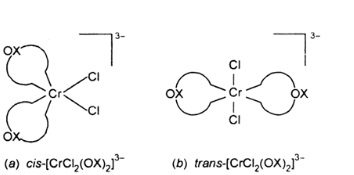
Out of the two, (a) cis - [CrCl2(ox)2]3- is chiral (optically active).
4.
Ce3+ has electronic configuration [Xe] 4f1.
Spin only formula:
Magnetic moment
\(\sqrt { 4S\left( S+1 \right) } -\sqrt { 4\times \frac { 1 }{ 2 } \left( \frac { 1 }{ 2 } +1 \right) } \)
\(\sqrt { 2\times \frac { 3 }{ 2 } } =\sqrt { 3 } \)
1.732 B.M
5.
Ti3+, V3+, Mn2+, Fe3+ and Co2+ are coloured due to presence of unpaired electrons, they can undergo d-d transitions others Cu+, Sc3+ are colourless due to absence of unpaired electrons.
6.
Triamminedichloridonitrosyl platinum (IV) bromide.
7.
(i) Electronic configuration of \(\mathrm{Ti}:[\mathrm{Ar}] 3 d^2 4 s^2\)
Electronic configuration of \(\mathrm{Ti}^{4+}\)is [Ar]. It is stable noble gas configuration.
Electronic configuration of \(\mathrm{Ti}^{2+}[\mathrm{Ar}] 3 d^2\)
Electronic configuration of \(\mathrm{Ti}^{3+}:[\mathrm{Ar}] 3 d^1\)
As \(\mathrm{Ti}^{4+}\) acquires nearest noble gas configuration on loss of 4 electrons, thus it is more stable than the \(\mathrm{Ti}^{3+}\) and \(\mathrm{Ti}^{2+}\),
(ii) In case of transition elements, ions of the same charge in a given series show progressive decrease in radius with increasing atomic number.
As with increase in atomic number, the new electron enters in d-orbitals and expected to increase in atomic size, but due to poor shielding effect of d-orbitals, the electrostatic attraction between nucleus and outermost orbital increases and hence, the ionic radii decreases.
(iii) Zinc is a soft metal as compared to iron and chromium because it has low enthalpy of atomisation (due to the absence of unpaired electron), whereas, iron and chromium have high enthalpy of atomisation (due to the presence of unpaired electrons), which account for their hardness.
8.
(a) Mn 2+ compounds are more stable due to half-filled d-orbitals. Fe2+compounds are comparatively less stable as they have six electrons in their orbitals. So, they tend to lose one electron from Fe2+and get stable 3d5 -configuration in Fe3+. Therefore, comparatively high positive value of E ° for Mn 3+/ Mn 2+indicates the stability of Mn 2+(d5) whereas comparatively low value for Fe3+/Fe2+ indicates the extra stability of Fe3+(d5 ).
(b) Energy required to convert metallic crystal into individual atom is enthalpy of atomisation. In transition row elements it first increases and reaches to maximum upto middle element and then decreases. This is because of strong inter atomic interaction due to unpaired electron. Greater the number of unpaired electron, stronger will be bonding and thus enthalpy of atomisation will also be more. Since iron has more unpaired electron than copper therefore its enthalpy of atomisation is more.
(c) The metal ions with partially or incomplete filled d-orbitals will be coloured in aqueous solution. While the metal ions having either empty or completely filled d-orbitals are colourless. The colour will be due to d-d transition of electrons. Thus, the outer electronic configuration of metal ions are Sc3+: 3do, Ti3+: 3d1 Hence, among the given ions, Ti3+ will exhibit colour in aqueous solution while Sc3+ will be colourless.
9.
Double salts dissociate completely into their constituent simple ions when dissolve in water, i.e they lose their identity in aqueous solution
e.g KCl.MgCl2.6H2O ⟶ K++Ma2++3Cl-+6H2O
While coordination compounds do not dissociate into simple ions, i.e. they retain their identity both in solid state and in aqueous solutions.
(ii) The IUPAC name of the following given complexes are:
(a) K3[Fe(C2O4)3]
Potassiumtrioxalatoferrate (III)
(b) [Pt(NH3)6]Cl4: Hexaammineplatinum (IV) chloride
(iii) The structure of cis-isomer of [Co(NH3))4Cl2]+ ion is.
10.
(i) Tetrachloridonickelate(II) ion
(ii) sp3 hybridisation
(iii) tetrahedral
The different between the two sets of energy levels when the five degenerate d-orbitals split in the presence of an electrical field of ligands is called crystal field splitting energy.In the octahedral field, it is represented as \({ \Delta }_{ 0 }\) .
Electronic configuration of d4
(i) When \({ \Delta }_{ 0 }>P;{ { t }_{ 2g } }^{ 4 }\)
(ii) \({ \Delta }_{ 0 }>P;{ { t }_{ 2g } }^{ 3 }{ { e }_{ g } }^{ 1 }\)
11.
(i) x + (0) + (-1) + (0) = + 2 or x = + 3
(ii) x - 4 = -2 or x = + 2
(iii) x + 0 + 3(-1) = 0 or x = + 3
(iv) x + 2(-1) + 0 = + 1 or x = + 3
(v) [Fe(CN)6]3-, x + 6(-1) = - 3 or x = + 3
12.
(a) E values for Cr3+/Cr2+is negative (- 0.41 V) and for Mn3+/Mn2+is positive (+1.57V).Thus, Cr2+ can undergo oxidation and, therefore, is reducing agent. On the other hand, Mn(III) can undergo reduction, and therefore, acts as an oxidizing agent.
(b) In the presence of complexing agents, cobalt gets oxidized from,+2 to +3 state because Co (III) is more stable than Co (II).
(c) After the loss of ns electrons, a d1 electron can easily be lost to give a stable configuration. Therefore, the elements having d1 configuration are either reducing or undergo disproportionation.
13.
(c)
3
14.
(a)
They have vacant d orbitals
15.
(c)
4,3 and 2 and Cr3+ is most stable
16.
(d)
have tetrahedral and square planar geometry respectively
17.
(a)
La(OH)3
18.
(a) Lanthanoids display a limited number of oxidation states because the energy difference between 4f, 5d, and 6s orbitals is quite large. On the other hand, the energy difference between 5f, 6d, and 7s orbitals is very less. Hence, actinoids display a large number of oxidation states.
(b) The complete ionic equation will be
\(3 \mathrm{MnO}_4^{2-}+4 \mathrm{H}^{+} \rightarrow \mathrm{MnO}_2+2 \mathrm{MnO}_4^{-}+2 \mathrm{H}_2 \mathrm{O}\)
\(\mathrm{MnO}_4^{2-}\) undergoes disproportionation reaction to give MnO2 and \(\mathrm{MnO}_4^{-}\)
(c) As a result, the elements of the chromium group have extremely high melting points. Manganese has a half-filled d-orbital configuration, which means that all of its electrons spin in the same direction. Mn has a lower melting point because it has fewer interatomic forces of attraction, which are easier to break.
19.
(i) (a) Metal carbonyls: Metal carbonyls are the compounds in which carbon monoxide (CO) acts as the ligand. The metal-carbon bond in metal carbonyls possesses both \(\sigma\) and \(\pi\) characters, e.g. N(CO)4[nickeltetracarbonyl]. Its IUPAC name is tetra carbonyl nickel(0).
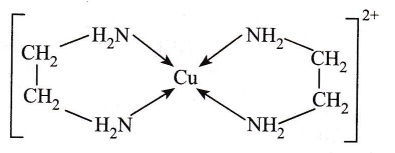
(b) Chelate: An inorganic metal complex in which there is a close ring of atoms caused by attachment of a ligand to a metal atom at two points. An example is the complex ion formed between ethylene diamine and cupric ion,[Cu(NH2CH2CH2NH2)2]2+.
(ii) (a) Add BaCl2 solution. [Co(NH3)]5Cl]SO4 will give white ppt. of BaSO4.
\(\left[\mathrm{Co}\left(\mathrm{NH}_{3}\right)_{5} \mathrm{Cl}\right] \mathrm{SO}_{4}+\mathrm{BaCl}_{2}(a q) \)\( \longrightarrow\left[\mathrm{Co}\left(\mathrm{NH}_{3}\right)_{5} \mathrm{Cl}\right] \mathrm{Cl}_{2}+\mathrm{BaSO}_{4} \downarrow \)
\(\text { (White ppt.) }\)
Add AgNO3(aq) solution [Co(NH3)5SO4] Cl will give white ppt. of AgCl.
\( {\left[\mathrm{Co}\left(\mathrm{NH}_{3}\right)_{5} \mathrm{SO}_{4}\right] \mathrm{Cl}+\mathrm{AgNO}_{3}(a q)} \) \(\longrightarrow \mathrm{AgCl}+\left[\mathrm{Co}\left(\mathrm{NH}_{3}\right)_{5} \mathrm{SO}_{4}\right] \mathrm{NO}_{3} \)
\(\text { (White ppt) }\)
(c) Fe3+ (4s03d5) In strong field \( \Delta_{0}>P t_{2 g}^{5} e g^{0} \)
In weak field \(\Delta_{0}
20.
(i) Mn shows the highest number of oxidation states because its valence shell electronic configuration is 3d54s2. As 3d and 4s are closer in energy, it has maximum number of electrons to lose or share. Hence, it shows all the oxidation states from +2 to + 7.
(ii) Chromium has highest melting point among all the given elements.
(iii) Scandium shows only +3 oxidation state
(iv) In the + 3 oxidation state, Mn is a strong oxidising agent because in Mn3+ ion, Mn exists in 3d4 configuration which is less stable and it can reduce to Mn2+ giving a more stable 3d5 configuration.Hence, it acts as a strong oxidising agent.
21.
Preparation of KMnO4 It is prepared by the fusion of pyrolusite ore (MnO2) with an alkali metal hydroxide and an oxidising agent like KNO3. Dark green K2MnO4 is obtained which on disproportionation in neutral or acidic solution gives potassium permanganate.
\(\underset{Pyrolusite}{2MnO_4}+4KOH+O_2⟶\underset{Potassium\ manahanate\\ ( Green\ mass)}{2KMnO_4}+2H_2O\)
The green mass can be extracted with water and then oxidized either electrolytically or by passing chlorine/ozone into the solution.
Electrolytic oxidation
\(K_{2} M n O_{4} \leftrightarrow 2 K^{+}+M n O_{4}^{2-}\)
\(H_{2} O \leftrightarrow H^{+}+O H^{-}\)
At anode, manganate ions are oxidized to permanganate ions.
\(M n O_{4}^{2-} \leftrightarrow M n O_{4}^{-}+e^{-}\)
Green Purple
Oxidation by chlorine
\(2 \mathrm{~K}_{2} \mathrm{MnO}_{4}+\mathrm{Cl}_{2} \rightarrow 2 \mathrm{KMnO}_{4}+2 \mathrm{KCl}\)
\(2 \mathrm{MnO}_{4}^{2-}+\mathrm{Cl}_{2} \rightarrow 2 \mathrm{MnO}_{4}^{-}+2 \mathrm{Cl}^{-}\)
Oxidation by ozone
\(2 \mathrm{~K}_{2} \mathrm{MnO}_{4}+\mathrm{O}_{3}+\mathrm{H}_{2} \mathrm{O} \rightarrow 2 \mathrm{KMnO}_{4}+2 \mathrm{KOH}+\mathrm{O}_{2}\)
\(2 \mathrm{MnO}_{4}^{2-}+\mathrm{O}_{3}+\mathrm{H}_{2} \mathrm{O} \rightarrow 2 \mathrm{MnO}_{4}^{2-}+2 \mathrm{OH}^{-}+\mathrm{O}_{2}\)
(i) Acidified KMnO4 solution oxidizes Fe (II) ions to Fe (III) ions i.e., ferrous ions to ferric ions.
\(\mathrm{MnO}_{4}^{-}+8 H^{+}+5 e^{-} \rightarrow \mathrm{Mn}^{2+}+4 \mathrm{H}_{2} \mathrm{O}\)
\(\left.F e^{2+} \rightarrow F e^{3+}+e^{-}\right] \times 5\)
------------------------------------------------------------------------------------
\(\mathrm{MnO}_{4}^{-}+5 \mathrm{Fe}^{2+}+8 \mathrm{H}^{+} \rightarrow \mathrm{Mn}^{2+}+5 \mathrm{Fe}^{3+}+4 \mathrm{H}_{2} \mathrm{O}\)
------------------------------------------------------------------------------------
(ii) Acidified potassium permanganate oxidizes SO2 to sulphuric acid.
\(\left.\mathrm{MnO}_{4}^{-}+6 \mathrm{H}^{+}+5 e^{-} \rightarrow \mathrm{Mn}^{2+}+3 \mathrm{H}_{2} \mathrm{O}\right] \times 2\)
\(\left.2 \mathrm{H}_{2} \mathrm{O}+2 \mathrm{SO}_{2}+\mathrm{O}_{2} \rightarrow 4 H^{+}+2 S O_{4}^{2-}+2 e^{-}\right] \times 5\)
-------------------------------------------------------------------------------------------------------
\(2 \mathrm{MnO}_{4}^{-}+10 \mathrm{SO}_{2}+5 \mathrm{O}_{2}+4 \mathrm{H}_{2} \mathrm{O} \rightarrow 2 \mathrm{Mn}^{2+}+10 \mathrm{SO}_{4}^{2-}+8 \mathrm{H}^{+}\)
-------------------------------------------------------------------------------------------------------
(iii) Acidified potassium permanganate oxidizes oxalic acid to carbon dioxide.
\(\left.\mathrm{MnO}_{4}^{-}+8 \mathrm{H}^{+} 5 e^{-} \rightarrow \mathrm{Mn}^{2-}+4 \mathrm{H}_{2} \mathrm{O}\right] \times 2\)
\(\left.\mathrm{C}_{2} \mathrm{O}_{4}^{2-} \rightarrow 2 \mathrm{CO}_{2}+2 e^{-}\right] \times 5\)
------------------------------------------------------------------------------------------------
\(2 \mathrm{MnO}_{4}^{-}+5 \mathrm{C}_{2} \mathrm{O}_{4}^{2-}+16 \mathrm{H}^{+} \rightarrow 2 \mathrm{Mn}^{2+}+10 \mathrm{CO}_{2}+8 \mathrm{H}_{2} \mathrm{O}\)
------------------------------------------------------------------------------------------------
22.
(i) (c): Spectrochemical series:
\((\mathrm{I}^{-}<\mathrm{Br}^{-}<\mathrm{SCN}^{-}<\mathrm{Cl}^{-}<\mathrm{S}^{2-}<\mathrm{F}^{-}<\mathrm{OH}^{-}<\mathrm{C}_{2} \mathrm{O}_{4}^{2-}<\mathrm{O}^{2-}< \mathrm{H}_{2} \mathrm{O}<\mathrm{NCS}^{-}<\mathrm{EDTA}^{4-}<\mathrm{NH}_{3}\)(ii) (b)
(iii) (a) : When Δo > P, the electrons paired up in the t2g level rather than going to the eg level, so
when Δo> P : \(t_{2 g}^{4} e_{g}^{0}\)
and Δo < P : \(t_{2 g}^{3} e_{g}^{1}\)
(iv) (d): Fe2+: 3d6 ⇒\(t_{2 g}^{4} e_{g}^{2}\)
(Since, F- is a weak field ligand)
Hence four unpaired electrons are present.
Magnetic moment (μ)\(=\sqrt{n(n+2)}=\sqrt{4(4+2)}=4.9 \mathrm{~B} \cdot \mathrm{M}\)

12th Standard CBSE Syllabus & Materials
12th Standard CBSE
CBSE 12th Computer Science Python Revision Tour I - New Previous year Question Papers Study Material - QB365 Set A
NEW12th Standard CBSE
CBSE 12th Business Studies Planning Important Questions And Answers Study Material - QB365 Set A
NEW12th Standard CBSE
CBSE 12th Business Studies Business Environment Important Questions And Answers Study Material - QB365 Set A
NEW12th Standard CBSE
CBSE 12th Business Studies Principles of Management Important Questions And Answers Study Material - QB365 Set A



NCERT Books

Syllabus

Exam Pattern

Sample Question Papers

Previous year Question Papers

Important Notes

MCQ Practice test

NCERT Exemplers

Case study Questions

Image Based Questions

Passage based Questions

HOT Questions

Value Based Questions

Model Questions Papers
NCERT ( Book Back ) Questions

Assertion and Reason
Important Questions And Answers

CBSE 12th Standard CBSE Subjects
CBSE Standards