
 100% FREE ACCESS
12th Standard CBSE Syllabus & Materials
12th Standard CBSE
CBSE 12th Economics Government Budget and the Economy Previous year Question Papers Study Material - QB365 Set A
NEW12th Standard CBSE
CBSE 12th Computer Science Interface Python with MySQL - New Previous year Question Papers Study Material - QB365 Set A
NEW12th Standard CBSE
CBSE 12th Computer Science Database Concept - New Previous year Question Papers Study Material - QB365 Set A
NEW12th Standard CBSE
CBSE 12th Computer Science Data Communication - New Previous year Question Papers Study Material - QB365 Set A
NEW12th Standard CBSE
CBSE 12th Computer Science Data Structures - New Previous year Question Papers Study Material - QB365 Set A
NEW12th Standard CBSE
CBSE 12th Computer Science Functions - New Previous year Question Papers Study Material - QB365 Set A

Published on: 07/03/2026
Download CBSE Class 12th Standard CBSE Chemistry question papers, sample papers, important questions, and previous year solved papers in PDF format. Get free study materials, NCERT solutions, and exam preparation resources for Class 12th Standard CBSE Chemistry
Questions + Answers key
Take MCQ Chemistry Test
1.
Give two physical properties of aUoy formed by transition metals.
2.
State reason for each of the following
(i) CO is stronger complexing reagent than NH3
(ii) The molecular shape of Ni(CO)4 is not the same as that of [Ni(CN)4]2-
3.
Give an example of ion is at ion isomerism.
4.
Which out of \(Lu(OH_{ 3 })\) and \(La(OH)_{ 3 }\) is more basic and why?
5.
Arrange the following is increasing order of their solubility in water
C6H5NH2, (C2H5)2NH, C2H5NH2
6.
Why do amines react as nucleophiles?
7.
Identify A, B and C in the following reactions.
\(\begin{equation} \text { (i) } \mathrm{CH}_{3} \mathrm{CH}_{2} \mathrm{Cl} \stackrel{\mathrm{KCN}}{\longrightarrow} A \stackrel{\mathrm{H}_{2} / \mathrm{Ni}}{\longrightarrow} B \stackrel{\mathrm{CH}_{3} \mathrm{COCl} / \text { Base }}{\longrightarrow} C \end{equation}\)
\(\begin{equation} \text { (ii) } \mathrm{C}_{6} \mathrm{H}_{5} \mathrm{~N}_{2}^{+} \mathrm{Cl}^{-} \stackrel{\mathrm{HBF}_{4}}{\longrightarrow} A \end{equation}\) \(\xrightarrow[{\triangle }]{NaNO2/Cu}\)B\(\begin{equation} \stackrel{\mathrm{Sn} / \mathrm{HCl}}{\longrightarrow} C \end{equation}\)
8.
The EO value in respect of electrodes of chromium (Z = 24), manganese (Z = 25) and iron (Z = 26) are Cr3+ /Cr2+ = - 0.4 V ; Mn3+ / Mn2+= : 1.5 V Fe3+ / Fe2+= + 0.8 V. On the basis of the above information, compare the feasibilities of further oxidation of their +2 oxidation state.
9.
(a) How would you account for the following?
(i) Highest fluoride of Mn is MnF4 whereas the highest oxide is Mn2O7.
(ii) Transition metals and their compounds show catalytic properties.
(b) Complete the following equation:
3MnO42- + 4H+ ⟶
10.
Write the IUPAC name and draw the structure of each of the following complex entities:
(i)
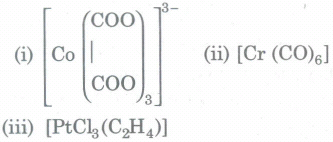
(ii) [PtCl3(C2H4)]Cl2
(Atomic no. of Cr = 25, Co = 27, Pt = 78)
11.
(i) What type of isomerism is shown by the complex [Cr(H2O)6]Cl3?
(ii) On the basis of crystal field theory, write the electronic configuration for d4 ion if \({ \triangle }_{ 0 }
(iii) Write the hybridization and shape of [CoF6]3- (Atomic number of Co = 27)
12.
Two isomeric compounds A and B having molecular formula C4H11N, both lose N2 on treatment with HNO2 and gives compound C and D respectively. C is resistant to oxidation but immediately responds to Lucas reagent, where as 'D' responds to Lucas reagent after 5 minutes and gives a positive iodoform test. Identify A and B.
13.
The formula of the complex dichloridobis (ethane-1, 2-diamine) platinum (IV) nitrate is
[PtCl2(en)2(NO3)2]
[PtCl2(en)2] (NO3)2
[PtCl2(en)2(NO3)] NO3
[Pt(en)2(NO3)2] Cl2
14.
How many ions are produced from the complex [Co(NH3)5Cl] Cl2 in solution?
4
2
3
5
15.
Name the gas that can readily decolourised by acidified KMnO4 solution.
SO2
NO2
P2O5
CO2
16.
CO is stronger ligand than Cl- because
CO is neutral molecule
CO has \(\pi\)-bond
CO is poisonous
CO is more reactive
17.
Which ofthe following lanthanoid ion is diamagnetic? (At No. of Ce = 58, Sm = 62, Eu = 63 Yb = 70)
Eu2+
Yb2+
Ce2+
Sm2+
18.
Consider the following figure.
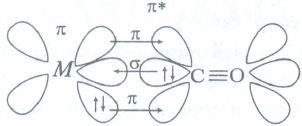
Which type of bond formed between metal and ligand?
synergic bond
σ-bond
ㅠ-bond
None of these
19.
In [Fe(CN)6] 4- and [Fe(CN)6]3- number of unpaired electrons is, respectively
4,5
0,1
5,4
1,2
20.
Transition elements have unique property that
they show variable oxidation state
these elements acts as catalyst
they form coloured compounds
All of the above
21.
Reduction of the metal centre in aqueous permanganate ion involves.
3 electrons in neutral medium
5 electrons in neutral medium
3 electrons in alkaline medium
5 electron in acidic medium
22.
Transition elements have greater tendency to form complexes because
They have vacant d orbitals
They have large size
They have large charge/ size ratio
They have two electrons in their outermost shells
23.
Pick out the correct statements from the following
1. Cobalt (III) is more stable in octahedral complexes.
2. Zinc forms coloured ions or complexes.
3. Most of the d - block elements and their compounds are ferromagnetic.
4. Osmium shows (VIII) oxidation state.
5. Cobalt (II) is more stable in octahedral complexes.
1 and 2
1 and 3
2 and 4
1 and 4
2 and 5
24.
Which one of the following is the correct increasing order of the magnitude of ionic radii of Ce3+, La3+, Pm3+ and Yb3+?
\({ Yb }^{ 3+ }<{ Pm }^{ 3+ }<{ La }^{ 3+ }<{ Ce }^{ 3+ }\)
\({ Yb }^{ 3+ }<{ Pm }^{ 3+ }<{ Ce }^{ 3+ }<{ La }^{ 3+ }\)
\({ Pm }^{ 3+ }<{ La }^{ 3+ }<{ Ce }^{ 3+ }<{ Yb }^{ 3+ }\)
\({ Ce }^{ 3+ }<{ Yb }^{ 3+ }<{ Pm }^{ 3+ }<{ La }^{ 3+ }\)
25.
Gadolinium belongs to 4 f series. Its atomic number is 64. Which of the following is the correct electronic configuration of gadolinium ?
[Xe]4 f 9 5 s 1
[Xe] 4 f 7 5 d1 6 s2
[Xe] 4 f 6 5 d2 6 s2
[Xe] 4 f 86 d2
26.
In which of the following ions, the colour is not due to d - d transition ?
\({ Ti(H }_{ 2 }{ O) }_{ 6 }^{ 3+ }\)
\({ CoF }_{ 6 }^{ 3- }\)
\({ CrO }_{ 4 }^{ 2- }\)
\([{ Cu(NH }_{ 3 })_{ 4 }]^{ 2+ }\)
27.
K2Cr2O7 reacts with NH4CI in presence of H2SO4. The product formed is
chromyl chlorate with green vapour
chromous chloride with white vapour
chromous chloride with blue vapour
chromyl chloride with deep red colour
28.
The colour of the light absorbed by an aqueous solution of CuSO4 is
orange - red
blue - green
yellow
violet
29.
Transition elements show magnetic moment due to spin and orbital motion of electrons. Which of the following metallic ions have almost same spin only magnetic moment ?
Co2+
Cr2+
Mn2+
Cr3+
30.
Although Zirconium belongs to 4d transition series and Hafnium to 5d transition series even then they show similar physical and chemical properties because ........... .
both belong to d - block
both have same number of electrons
both have similar atomic radius
both belong to the same group of the periodic table
31.
Highest oxidation state of manganese in fluoride is +4 (MnF4) but highest oxidation state in oxides is +7 (Mn2O7 ) because ............ .
fluorine is more electronegative than oxygen
fluorine does not possess d - orbitals
fluorine stabilise lower oxidation state
in covalent compounds, fluorine can form single bond only while oxygen forms double bond
32.
KMnO4 acts as an oxidising agent in acidic medium. The number of moles of KMnO4 that will be needed to react with one mole of sulphide ions in acidic solution is
\(\frac { 2 }{ 5 } \)
\(\frac { 3 }{ 5 } \)
\(\frac { 4 }{ 5 } \)
\(\frac { 1 }{ 5 } \)
33.
Which of the following reactions are disproportionation reactions?
\((i)\ { Cu }^{ + }\longrightarrow { Cu }^{ 2+ }+{ Cu }\)
\((ii)\ { 3MnO }_{ 4 }^{ - }+{ 4H }^{ + }\longrightarrow { 2MnO }_{ 4 }^{ - }+{ MnO }_{ 2 }+{ 2H }_{ 2 }O\)
\((iii)\ { 2KMnO }_{ 4 }\longrightarrow { K }_{ 2 }{ MnO }_{ 4 }+{ MnO }_{ 2 }+{ O }_{ 2 }\)
\((iv)\ { 2MnO }_{ 4 }^{ - }+{ 3Mn }^{ 2+ }+{ 2H }_{ 2 }O\longrightarrow { 5MnO }_{ 2 }+{ 4H }^{ + }\)
(i),(ii)
(i),(ii),(iii)
(ii),(iii),(iv)
(i),(iv)
34.
Generally transition elements form coloured salts due to the presence of unpaired electrons. Which of the following compounds will be coloured in solid state ?
Ag2SO4
CuF2
ZnF2
Cu2CI2
35.
The colour of the coordination compounds depends on the crystal field splitting. What will be the correct order of absorption of wavelength of light in the visible region for the complexes, [Co(NH3)6]3+, [Co(CN)6]3-, [Co(H2O)6]3+
[Co(CN)6]3- > [Co(NH3)6]3+ > [Co(H2O)6]3+
[Co(NH3)6]3+ > [Co(H2O)6]3+ > [Co(CN)6]3-
[Co(H2O)6]3+ > [Co(NH3)6]3+ > [Co(CN)6]3-
[Co(CN)6]3- > [Co(NH3)6]3+ > [Co(H2O)6]3+
36.
The compound Na2[Fe(CN)5NO] is called
sodium nitroprusside
sodium pentacyanonitrosonium ferrate (II)
sodium pentacyanonitrosylferrate (III)
sodium nitrosoferrocyanide
37.
In nitroprusside ion, iron and NO exist as Fe (II) and NO+ rather than Fe (III) and NO. These forms can be differentiated by
estimating the concentration of iron
measuring the concentration of CN-
measuring the solid state magnetic moment
thermally decomposing the compound
38.
When excess ammonia is added to CuSo4 solution, the deep blue complex obtained is
tetrahedral and paramagnetic
tetrahedral and diamagnetic
square planar and diamagnetic
square planar and paramagnetic
tetrahedral and ferromagnetic
39.
Which of the following complexes is used as an anti-cancer agent?
mer-[Co(NH3)3Cl3]
cis-[PtCl2(NH3)2]
cis-K2[PtCl2Br2]
Na2CoCl4
40.
How many EDTA (ethylenediaminetetraacetic acid) molecules are required to make an octahedral complex with a Ca2+ ion?
One
Two
Six
Three
41.
[Cr(H2O)6]Cl3 (at.no. of Cr = 24) has a magnetic moment of 3.83 B.M. The correct distribution of 3d electrons in the chromium of the complex is
\({ 3d }_{ xy }^{ 1 },{ 3d }_{ yz }^{ 1 },{ 3d }_{ xz }^{ 1 }\)
\({ 3d }_{ xy }^{ 1 },{ 3d }_{ yz }^{ 1 },{ 3d }_{ z ^2}^{ 1 }\)
\({ 3d }_{ (x^2-y^2)}^{ 1 },{ 3d }_{ z^2 }^{ 1 },{ 3d }_{ xz }^{ 1 }\)
\({ 3d }_{ xy}^{ 1 },{ 3d }_{ (x^2-y^2) }^{ 1 },{ 3d }_{ yz }^{ 1 }\)
42.
The hybridization involved in the complex [Ni(CN)4]2- is (At.No. of Ni=28)
d2sp2
d2sp3
dsp2
sp3
43.
The complex which has the highest magnetic moment among the following is
[CoF6]3-
[Co(NH3)6]3+
[Ni(NH3)4]2+
[Ni(CN)4]2-
[Fe(CN)6]4-
44.
The two isomers X and Y with the formula Cr(H2O)5ClBr2 were taken for experiment on depression in freezing point. It was found that one mole of X gave depression corresponding to 2 moles of particles and one mole of particles and one mole of Y gave depression due to 3 moles of particles. The structural formulae of X and Y respectively are
[Cr(H2O)5Cl]Br2, [Cr(H2O)4Br2]Cl. H2O
[Cr(H2O)5Cl]Br2, [Cr(H2O)3ClBr2] . 2H2O
[Cr(H2O)5Br]BrCl, [Cr(H2O)4ClBr]Br. H2O
[Cr(H2O)5Cl]Br2, [Cr(H2O)4ClBr]Br. H2O
[Cr(H2O)4Br2]Cl . H2O, [Cr(H2O)5Cl]Br2
45.
A solution containing 0.319 g of CrCl3.6 H2O was passed through a cation exchange resin and acid coming out of the cation exchange resin required 28.5 ml of 0.125 M NaOH. Determine correct formula of the complex [Mol.wt, of the complex = 266.5]
[Cr(H2O)6]Cl3
[Cr(H2O)5Cl]H2O.Cl2
[Cr(H2O)4Cl2]Cl.2 H2O
[Cr(H2O)3Cl3].3H2O
46.
Which of the following is not considered as an organometallic compound?
cis-platin
ferrocene
Zeise's salt
Grignard reagent
47.
The oxidation state of nickel in [Ni(CO)4] is
4
0
2
3
48.
The correct structure of Fe(CO)5 is
octahedral
terahedral
square pyramidal
trigonal bipyramidal
49.
Which of the following statement is correct? (CFSE= Crystal Field Splitting Energy)
Lower CFSE favours formation of low spin complex
Higher CFSE favours formation of high spin complex
A particular metal ion in a particular oxidation state can form either diamagnetic complexes only or paramagnetic complexes only.
t2g orbitals are three fold degenerate while eg orbitals are two fold degenerate
50.
Which of the following factor may be regarded as the main cause of lanthanide contraction ?
Poor shielding of one of the 4f - electrons by another in the subshell
Effective shielding of one of the 4f - electrons by another in the subshell
Poorer shielding of 5d electrons by 4f electrons
Greater shielding of 5d electrons by 4f electrons.
51.
KMnO4, oxidation number of Mn is
+ 2
+ 4
+ 6
+ 7
52.
Permanent magnets are generally made of alloys of
Fe
Co
Ni
Any one of these
1.
(i) They are usually hard.
(ii) They have often high melting points.
2.
(i) As CO is a good σ-sigma donor and a good \(\pi \) -acceptor ligand, there exists a back bonding in CO complexes in which CO accepts an appreciable amount of electron density from the filled d-orbitals of metal atom into their
empty \(\pi \) or \(\pi \)* orbitals. Whereas NH3 can form only \(\pi \)-bonds and no σ-bonds with metals, therefore CO is a better complexing reagent than NH3.
(ii) In Ni(CO)4 Ni has an oxidation state equal to zero and involves sp3-hybridisation hence possesses a tetrahedral shape. While in [Ni(CN)4]2- the oxidation state of Ni is +2 and it involves dsp2-hybridisation, hence, possesses a square planar structure.
3.
[Co(NH3)5Cl] SO4 and [Co(NH3)5(SO4)]Cl is an example of ionisation isomerism
4.
La(OH)3 is more basic than Lu(OH)3 As the size of the lanthanoid ions decreases from La3+ to Lu3+, the covalent character of the hydroxides increases (Fajan's rules). Hence, the basic strength decreases from La(OH)3 to Lu(OH)3.
5.
The extent of H-bonding and hence solubility in water decreases as the steric hindrance due to the size of alkyl/aryl groups increases. Thus, solubility increases in the order:
C6H5NH2<(C2H5)2NH
6.
It is due tp presence of lone pair of electronson nitrogen which they can donate and act as nucleophiles.
7.
\(\begin{equation} \begin{aligned} &\text { (i) } \mathrm{CH}_{3} \mathrm{CH}_{2} \mathrm{Cl} \stackrel{\mathrm{KCN}}{\longrightarrow} \mathrm{CH}_{3} \mathrm{CH}_{2} \mathrm{CN} \stackrel{\mathrm{H}_{2} / \mathrm{Ni}}{\longrightarrow}\\ &\mathrm{CH}_{3} \mathrm{CH}_{2} \mathrm{NH}_{2} \stackrel{\mathrm{CH}_{3} \mathrm{COCl} / \text { Base }}{\longrightarrow} \mathrm{CH}_{3} \mathrm{CH}_{2} \mathrm{CH}_{2} \mathrm{NHCOCH}_{3} \end{aligned} \end{equation}\)(A)
B C
\(\begin{equation} \text { (ii) } \mathrm{C}_{6} \mathrm{H}_{5} \mathrm{~N}_{2}^{+} \mathrm{Cl}^{-} \stackrel{\mathrm{HBF}_{4}}{\longrightarrow} \mathrm{C}_{6} \mathrm{H}_{5} \mathrm{~N}_{2}^{+} \mathrm{BF}_{4}^{-} \end{equation}\)\(\xrightarrow[{\triangle }]{NaNO2/Cu}\)
\(\begin{equation} \begin{array}{c} \mathrm{C}_{6} \mathrm{H}_{5} \mathrm{NO}_{2} \stackrel{\mathrm{Sn} / \mathrm{HCl}}{\longrightarrow} \mathrm{C}_{6} \mathrm{H}_{5} \mathrm{NH}_{2} \\ \end{array} \end{equation}\)
B C
8.
Order of stability of +2 oxidation state = Cr2+ < Fe2+ < Mn 2+
9.
(a) (i) Transition metals show variable oxidation states, therefore, they and their compounds act as catalyst.
(ii) Oxygen can form double bond, therefore, it can form Mn2O7 , whereas 'F' cannot form double bonds, so, it can form MnF4 .
(b) \(3 \mathrm{MnO}_{4}^{2-}+4 \mathrm{H}^{+} \longrightarrow \mathrm{MnO}_{2}+2 \mathrm{MnO}_{4}^{-}+2 \mathrm{H}_{2} \mathrm{O}\)
10.
(i)
s.png)
IUPAC name Trioxalatocobaltate (III) ion
Structure
s.png)
(ii) [Cr (CO)6]
IUPAC name Hexacarbonylchromium
Structure
s.png)
(iii) [PtCI3(C2H4)]
IUPAC name: Trichloridoetheneplatinum
Structure
s.png)
11.
(i) Hydration isomerism
(ii) Electronic configuration is \({ t }_{ 2g }^{ 4 }\) or by diagram.
(ill) Hybridization is sp3d2 and shape is octahedral.
12.
s.jpg)
13.
(a)
[PtCl2(en)2(NO3)2]
14.
(c)
3
15.
(a)
SO2
16.
(b)
CO has \(\pi\)-bond
17.
(b)
Yb2+
18.
(a)
synergic bond
19.
(b)
0,1
20.
(d)
All of the above
21.
(a)
3 electrons in neutral medium
22.
(a)
They have vacant d orbitals
23.
(d)
1 and 4
24.
(b)
\({ Yb }^{ 3+ }<{ Pm }^{ 3+ }<{ Ce }^{ 3+ }<{ La }^{ 3+ }\)
25.
(b)
[Xe] 4 f 7 5 d1 6 s2
26.
(c)
\({ CrO }_{ 4 }^{ 2- }\)
27.
(d)
chromyl chloride with deep red colour
28.
(a)
orange - red
29.
(d)
Cr3+
30.
(c)
both have similar atomic radius
31.
(d)
in covalent compounds, fluorine can form single bond only while oxygen forms double bond
32.
(a)
\(\frac { 2 }{ 5 } \)
33.
(a)
(i),(ii)
34.
(b)
CuF2
35.
(c)
[Co(H2O)6]3+ > [Co(NH3)6]3+ > [Co(CN)6]3-
36.
(a)
sodium nitroprusside
37.
(c)
measuring the solid state magnetic moment
38.
(d)
square planar and paramagnetic
39.
(b)
cis-[PtCl2(NH3)2]
40.
(a)
One
41.
(a)
\({ 3d }_{ xy }^{ 1 },{ 3d }_{ yz }^{ 1 },{ 3d }_{ xz }^{ 1 }\)
42.
(c)
dsp2
43.
(a)
[CoF6]3-
44.
(e)
[Cr(H2O)4Br2]Cl . H2O, [Cr(H2O)5Cl]Br2
45.
(a)
[Cr(H2O)6]Cl3
46.
(b)
ferrocene
47.
(b)
0
48.
(c)
square pyramidal
49.
(d)
t2g orbitals are three fold degenerate while eg orbitals are two fold degenerate
50.
(a)
Poor shielding of one of the 4f - electrons by another in the subshell
51.
(d)
+ 7
52.
(d)
Any one of these

12th Standard CBSE Syllabus & Materials
12th Standard CBSE
CBSE 12th Computer Science Python Revision Tour I - New Previous year Question Papers Study Material - QB365 Set A
NEW12th Standard CBSE
CBSE 12th Business Studies Planning Important Questions And Answers Study Material - QB365 Set A
NEW12th Standard CBSE
CBSE 12th Business Studies Business Environment Important Questions And Answers Study Material - QB365 Set A
NEW12th Standard CBSE
CBSE 12th Business Studies Principles of Management Important Questions And Answers Study Material - QB365 Set A



NCERT Books

Syllabus

Exam Pattern

Sample Question Papers

Previous year Question Papers

Important Notes

MCQ Practice test

NCERT Exemplers

Case study Questions

Image Based Questions

Passage based Questions

HOT Questions

Value Based Questions

Model Questions Papers
NCERT ( Book Back ) Questions

Assertion and Reason
Important Questions And Answers

CBSE 12th Standard CBSE Subjects
CBSE Standards