
 100% FREE ACCESS
12th Standard CBSE Syllabus & Materials
12th Standard CBSE
CBSE 12th Economics Government Budget and the Economy Previous year Question Papers Study Material - QB365 Set A
NEW12th Standard CBSE
CBSE 12th Computer Science Interface Python with MySQL - New Previous year Question Papers Study Material - QB365 Set A
NEW12th Standard CBSE
CBSE 12th Computer Science Database Concept - New Previous year Question Papers Study Material - QB365 Set A
NEW12th Standard CBSE
CBSE 12th Computer Science Data Communication - New Previous year Question Papers Study Material - QB365 Set A
NEW12th Standard CBSE
CBSE 12th Computer Science Data Structures - New Previous year Question Papers Study Material - QB365 Set A
NEW12th Standard CBSE
CBSE 12th Computer Science Functions - New Previous year Question Papers Study Material - QB365 Set A

Published on: 07/03/2026
Download CBSE Class 12th Standard CBSE Chemistry question papers, sample papers, important questions, and previous year solved papers in PDF format. Get free study materials, NCERT solutions, and exam preparation resources for Class 12th Standard CBSE Chemistry
Questions + Answers key
Take MCQ Chemistry Test
1.
2.


3.
4.
5.
Read the passage given below and answer the following questions:
Pentose and hexose undergo intramolecular hemiacetal or hemiketal formation due to combination of the -OH group with the carbonyl group. The actual structure is either of five or six membered ring containing an oxygen atom. In the free state all pentoses and hexoses exist in pyranose form (resembling pyran). However, in the combined state some of them exist as five membered cyclic structures, called furanose (resembling furan).
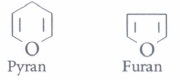
The cyclic structure of glucose is represented by Haworth structure:
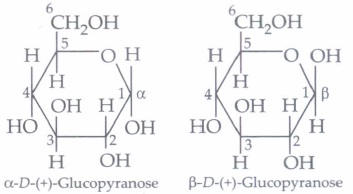
\(\alpha \) and \(\beta\) -D-glucose have different configuration at anomeric (C-l) carbon atom, hence are called anomers and the C-l carbon atom is called anomeric carbon (glycosidic carbon).
The six membered cyclic structure of glucose is called pyranose structure.
The following questions are multiple choice questions. Choose the most appropriate answer:
(i) \(\alpha\) -D(+)-glucose and \(\beta\) -D( +)glucose are
| (a) enantiomers | (b) conformers | (c) epimers | (d) anomers |
(ii) The following carbohydrate is
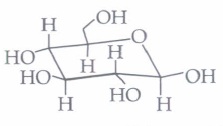
| (a) a ketohexose | (b) an aldohexose |
| (c) an \(\alpha \)-furanose | (d) an \(\alpha \)-pyranose |
(iii) In the following structure,
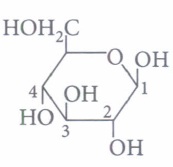
anomeric carbon is
| (a) C-l | (b) C-2 | (c) C-3 | (d) C-4 |
(iv) The term anomers of glucose refers to
| (a) isomers of glucose that differ in configurations at carbons one and four (C-l and C-4) |
| (b) a mixture of (D)-glucose and (L)-glucose |
| (c) enantiomers of glucose |
| (d) isomers of glucose that differ in configuration at carbon one (C-l). |
6.
Read the passage given below and answer the following questions:
When the mixture contains the three amine salts (1°, 2° and 3°) along with quaternary salt, it is distilled with KOH solution. The three amines distill, leaving the quaternary salt unchanged in the solution. Then the mixture of amines is separated by fractional distillation, Hinsbergs method and Hoffmann's method.
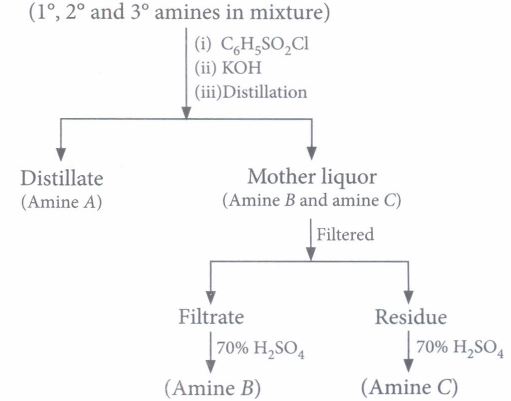
The following questions are multiple choice questions. Choose the most appropriate answer:
(i) Hinsberg reagent is
| (a) aliphatic sulphonyl chloride | (b) phthalamide |
| (c) aromatic sulphonyl chloride | (d) anhydrous ZnCl2 + conc. HCl. |
(ii) Primary amine with Hinsberg's reagent forms
| (a) N-alkyl benzene sulphonamide soluble in KOH solution |
| (b) N-alkyl benzene sulphonamide insoluble in KOH solution |
| (c) N, N-dialkyl benzene sulphonamide soluble in KOH solution |
| (d) N, N-dialkyl benzene sulphonamide insoluble in KOH solution. |
(iii) To separate amines in a mixture Hoffmann's method is used. The Hoffmann's reagent is
| (a) benzenesulphonyl chloride | (b) diethyloxalate |
| (c) benzeneisocyanide | (d) p-toulenesulphonic acid. |
(iv) 3o amines with Hinsberg's reagent give
| (a) no reaction | (b) product which is same as that of 10 amine |
| (c) product which is same as that of 2° amine | (d) products which is a quaternary salt. |
7.
Read the passage given below and answer the following questions :
When an aldehyde with no a-hydrogen reacts with concentrated aqueous NaOH, half the aldehyde is converted to carboxylic acid salt and other half is converted to an alcohol. In other words, half of the reactant is oxidized
and other half is reduced. This reaction is known as Cannizzaro reaction
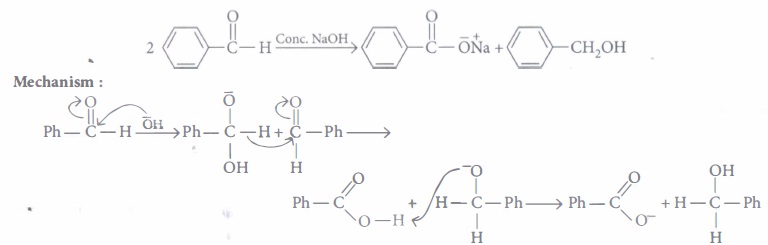
The following questions are multiple choice questions. Choose the most appropriate answer :
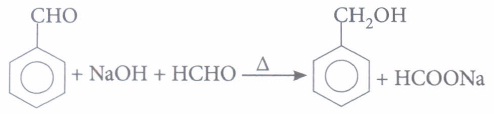
(i) A mixture of benzaldehyde and formaldehyde on heating with aqueous NaOH solution gives
| (a) benzyl alcohol and sodium formate | (b) sodium benzoate and methyl alcohol |
| (c) sodium benzoate and sodium formate | (d) benzyl alcohol and methyl alcohol. |
(ii) Which of the following compounds will undergo Cannizzaro reaction?
| (a) CH3CHO | (b) CH3COCH3 |
| (c) C6H5CHO | (d) C6H5CH2CHO |
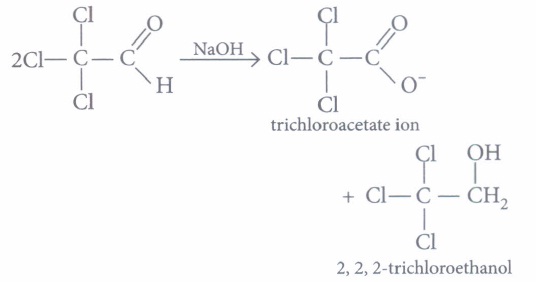
(iii) Trichloroacetaldehyde is subjected to Cannizzaro's reaction by using NaOH. The mixture of the products contains sodium trichloroacetate ion and another compound. The other compounds is
| (a) 2, 2, 2-trichloroethanol | (b) trichloromethanol |
| (c) 2, 2, 2-trichloropropanol | (d) chloroform |
(iv) Which of the following reaction will not result in the formation of carbon-carbon bonds?
| (a) Cannizzaro reaction | (b) Wurtz reaction |
| (c) Reimer- Tiemann reaction | (d) Friedel-Crafts acylation |
8.
Read the passage given below and answer the following questions:
Haloarenes are less reactive than haloalkanes. The low reactivity of haloarenes can be attributed to
(i) resonance effect
(ii) Sp2 hybridisation of C - X bond
(iii) polarity of C - X bond
(iv) instability of phenyl cation (formed by self-ionisation ofhaloarene)
(v) repulsion between the electron rich attacking nucleophiles and electron rich arenes.
Reactivity of haloarenes can be increased or decreased by the presence of certain groups at certain positions for example, nitro (-NO2) group at olp positions increases the reactivity of haloarenes towards nucleophilc substitution reactions.
The following questions are multiple choice questions. Choose the most appropriate answer:
(i) Aryl halides are less reactive towards nucleophilic substitution reaction as compared to alkyl halides due to
| (a) the formation ofless stable carbonium ion | (b) resonance stabilisation |
| (c) larger carbon-halogen bond | (d) inductive effect. |
(ii) Which of the following aryl halides is the most reactive towards nucleophilic substitution?
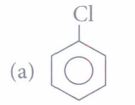 |
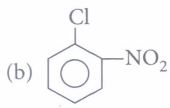 |
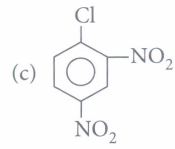 |
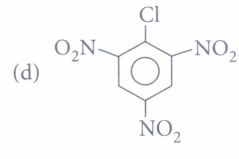 |
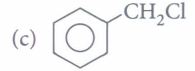
(iii) Which one of the following will react fastest with aqueous NaOH?
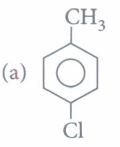 |
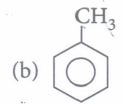 |
 |
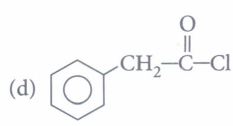 |
The reactivity of the compounds (i) MeBr, (ii) PhCH2Br, (iii) MeCI, (iv) p- MeOC6H4Br decreases as
| (a) (i) > (ii) >(iii) > (iv) | (b) (iv) > (ii) >(i) > (iii) |
| (c) (iv) > (iii) >(i) > (ii) | (d) (ii) > (i) > (iii) > (iv) |
9.
Read the passage given below and answer the following questions:
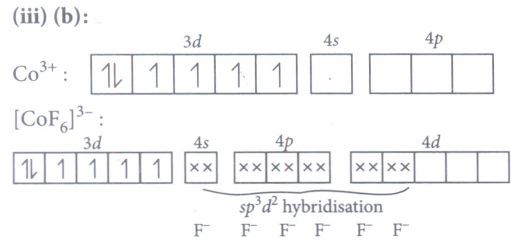
To explain bonding in coordination compounds various theories were proposed. One of the important theory was valence bond theory. According to that, the central metal ion in the complex makes available a number of empty orbitals for the formation ofcoordination bonds with suitable ligands. The appropriate atomic orbitals of the metal hybridise to give a set of equivalent orbitals of definite geometry. The d-orbitals involved in the hybridisation may be either inner d-orbitals i.e., (n - 1) d or outer d-orbitals i.e., nd. For example, CO3+ forms both inner orbital and outer orbital complexes, with ammonia it forms [Co(NH3)6]3+ and with fluorine it forms [CoF6]3- complex ion.
The following questions are multiple choice questions. Choose the most appropriate answer:
(i) Which of the following is not true for [CoF6]3- ?
| (a) It is paramagnetic. | (b) It has coordination number of 6. |
| (c) It is outer orbital complex. | (d) It involves d2sp3 hybridisation. |
Which of the following is true for [Co(NH3)6]3+ ?
| (a) It is an octahedral, dimagnetic and outer orbital complex. |
| (b) It is an octahedral, paramagnetic and outer orbital complex. |
| (c) It is an octahedral, paramagnetic and inner orbital complex. |
| (d) It is an octahedral, dimagnetic and inner orbital complex. |
(iii) The paramagnetism of [CoF6]3- is due to
| (a) 3 electrons | (b) 4 electrons | (c) 2 electrons | (d) 2 electrons |
(iv) Which of the following is an inner orbital or low spin complex?
| (a) \(\left[\mathrm{Ni}\left(\mathrm{H}_{2} \mathrm{O}\right)_{6}\right]^{3+}\) | (b)\(\left[\mathrm{FeF}_{6}\right]^{3-}\) | (c) \(\left[\mathrm{Co}(\mathrm{CN})_{6}\right]^{3-}\) | (d) \(\left[\mathrm{NiCl}_{4}\right]^{2-}\) |
10.
Read the passage given below and answer the following questions:
The concentration of potassium ions inside a biological cell is at least twenty times higher than the outside. The resulting potential difference across the cell is important in several processes such as transmission of nerve impulses and maintaining the ion balance. A simple model for such a concentration cell involving a metal M is M(s) | M+(aq.; 0.05 molar) || M+(aq; 1 molar) |M(s).
The following questions are multiple choice questions. Choose the most appropriate answer:
(i) For the above cell,
| (a) \(E_{\text {cell }}<0 ; \Delta G>0\) | (b) \(E_{\text {cell }}>0 ; \Delta G<0\) | (c) \(E_{\text {cell }}<0 ; \Delta G^{\circ}>0\) | (d) \(E_{\text {cell }}>0 ; \Delta G^{\circ}<0\) |
(ii) The value of equilibrium constant for a feasible cell reaction is
| (a) < 1 | (b) = 1 | (c) > 1 | (d) zero |
(iii) What is the emf ofthe cell when the cell reaction attains equilibrium?
| (a) 1 | (b) 0 | (c) > 1 | (d) < 1 |
(iv) The potential of an electrode change with change in
| (a) concentration of ions in solution | (b) position of electrodes |
| (c) voltage of the cell | (d) all of these |
1.
2.

3.
4.
5.
(i) (d): \(\alpha \)-D-(+)-glucose and \(\beta \) -D-(+)-glucose differ in configuration at C1 (U., anomeric or glycosidic carbon) and hence are called anomers.
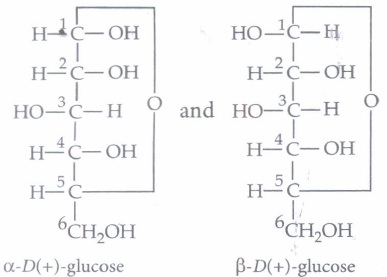
(ii) (b): This structure is an example of pyranose and aldohexose. Here, the carbohydrate's structure is of the \(\beta \) -pyranose form.
(iii) (a) : C-1 is the anomeric carbon.
(iv) (d): Anomers are cyclic monosaccharides or glycosides that are epimers, differing from each other in the configuration at C-1, if they are aldoses or in the configuration at C- 2 if they are ketoses.
6.
(i) (c)
(ii) (a): A primary amine forms N-alkylbenzene sulphonamidewhich because ofthe presence of an acidic hydrogen on the N-atom dissolves in aqueous KOH.
(iii) (b)
(iv) (a): Tertiary amine does not contain a replaceable hydrogen on the nitrogen atom. So, 3o amine does not react with Hinsberg's reagent.
7.
(i) (a): It is an example of cross Cannizzaro reaction where aromatic aldehyde gets reduced to alcohol and aliphatic aldehyde gets oxidised to its sodium salt (both aldehydes must not contain any \(\alpha\)-hydrogen).
(ii) (c)
(iii) (a): The Cannizzaro product of given reaction yields 2, 2, 2-trichloroethanol.
(iv) (a): C-C bond is not formed in Cannizzaro reaction while other reactions result in the formation of C-C bond.
8.
(i) (b)
(ii) (d): When in aryl halides the electron withdrawing groups are attached at ortho and para positions to the chlorine atom then the removal of chlorine atom as CI- ion becomes easy, therefore, 2,4,6- trinitro chlorobenzene is the most reactive among given aryl halides.
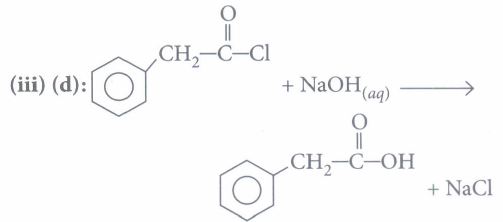
(d) : The order of reactivity follows the sequence: benzyl halides> alkyl halides> aryl halides. Out of chlorides and bromides, bromides are more reactive. Therefore, the correct order of reactivity is PhCH2Br(ii) > MeBr(i) > MeCI(iii) >p-MeOC6H4Br (iv).
9.
(i) (d): It involves sp3 d2 hybridisation and not d2sp3.
(ii) (d) : [Co(NH3)6]3+ is d2sp3 hybridised with all electrons paired hence, it is diamagnetic and inner
orbital complex.
(iv) (c): Inner orbital complexes are formed with strong ligands as they force electrons to pair up and hence the complex will be either diamagnetic or will have less number of unpaired electrons.
10.
(i) (b) : \(\begin{array}{l} M \longrightarrow M^{+}+e^{-} \\ (1 \cdot M)(0.05 M) \end{array}\)
For concentration cell, \(E_{\text {cell }}=-\frac{0.059}{1} \log \frac{0.05}{1}\)
\(E_{\text {cell }}=-\frac{0.059}{1} \log \left(5 \times 10^{-2}\right)\)
\(E_{\text {cell }}=-\frac{0.059}{1}[(-2)+\log 5]-0.059(-2+0.698)\)
= -0.059(-1.302) = 0.0768
\(\Delta G=-n F E_{\text {cell }}\)
If Ecell is positive, \(\Delta G\) is negative.
(ii) (c) : \(K=\operatorname{antilog}\left(\frac{n E^{\circ}}{0.0591}\right)\)
For feasible cell, Eo is positive, hence from the above equation K > 1 for a feasible cell reaction.
(iii) (b)
(iv) (a)

12th Standard CBSE Syllabus & Materials
12th Standard CBSE
CBSE 12th Computer Science Python Revision Tour I - New Previous year Question Papers Study Material - QB365 Set A
NEW12th Standard CBSE
CBSE 12th Business Studies Planning Important Questions And Answers Study Material - QB365 Set A
NEW12th Standard CBSE
CBSE 12th Business Studies Business Environment Important Questions And Answers Study Material - QB365 Set A
NEW12th Standard CBSE
CBSE 12th Business Studies Principles of Management Important Questions And Answers Study Material - QB365 Set A



NCERT Books

Syllabus

Exam Pattern

Sample Question Papers

Previous year Question Papers

Important Notes

MCQ Practice test

NCERT Exemplers

Case study Questions

Image Based Questions

Passage based Questions

HOT Questions

Value Based Questions

Model Questions Papers
NCERT ( Book Back ) Questions

Assertion and Reason
Important Questions And Answers

CBSE 12th Standard CBSE Subjects
CBSE Standards