
 100% FREE ACCESS
12th Standard CBSE Syllabus & Materials
12th Standard CBSE
CBSE 12th Economics Government Budget and the Economy Previous year Question Papers Study Material - QB365 Set A
NEW12th Standard CBSE
CBSE 12th Computer Science Interface Python with MySQL - New Previous year Question Papers Study Material - QB365 Set A
NEW12th Standard CBSE
CBSE 12th Computer Science Database Concept - New Previous year Question Papers Study Material - QB365 Set A
NEW12th Standard CBSE
CBSE 12th Computer Science Data Communication - New Previous year Question Papers Study Material - QB365 Set A
NEW12th Standard CBSE
CBSE 12th Computer Science Data Structures - New Previous year Question Papers Study Material - QB365 Set A
NEW12th Standard CBSE
CBSE 12th Computer Science Functions - New Previous year Question Papers Study Material - QB365 Set A

Published on: 02/11/2025
Download CBSE Class 12th Standard CBSE Maths question papers, sample papers, important questions, and previous year solved papers in PDF format. Get free study materials, NCERT solutions, and exam preparation resources for Class 12th Standard CBSE Maths
Questions + Answers key
Take MCQ Maths Test
1.
Find \(\int \frac{d x}{\sqrt{3-2 x-x^2}}\)
2.
Find the area of the region enclosed between the two circles \(x^{2}+y^{2}=4 \text { and }(x-2)^{2}+y^{2}=4\).
3.
Prove that: \(\int _{ 0 }^{ \pi /4 }{ (\sqrt { \tan { x } } +\sqrt { \cot { x } } ) } dx=\sqrt { 2 } \frac { \pi }{ 2 } .\)
4.
Find the area of the region bounded by the parabola y = x2 and \(y=\left| x \right| \)
5.
Evaluate the integral: \(\int {sin^6\ x+cos^6\ x\over sin^2\ x\ cos^2\ x}dx\)
6.
Evaluate the integral: \(\int sin^3\ x\ cos^3\ x\ dx.\)
7.
Write the anti-derivative of \(\left(3 \sqrt{x}+\frac{1}{\sqrt{x}}\right)\)
8.
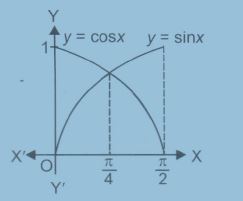
Write an expression for finding the area bounded by the curves y = sin x and y = cos x, between x = 0,\(x=\frac{\pi}{2}\) and the x-axis
9.
Find the area of the region bounded by y =-1, \(y=2, x=y^{3} \text { and } x=0\)
10.
Draw a rough sketch of the curve \(y=\sqrt{x-1}\) the interval [1,5]. Find the area under the curve and the lines x = 1 and x = 5.
11.
Evaluate thefollowing integral
\(\int\left(3 \operatorname{cosec}^{2} x-5 x+\sin x\right) d x\)
12.
\(\int { sin^{ 2 }x } dx\)
13.
Evaluate \(\int_{-\pi}^\pi(\cos a x-\sin b x)^2 d x\)
14.
Solve the following LPP graphically.
Maximise Z = 60x + 40y
subject to the constraints
\(\begin{aligned}
x+2 y \leq 12
\end{aligned}\)
\(\begin{aligned}
2 x+y \leq 12
\end{aligned}\)
\(\begin{aligned}
4 x+5 y \geq 20 \text { and } x, y \geq 0
\end{aligned}\)
15.
Find the area of the region bounded by the curve 4x2 + y2 = 36 using integration.
16.
Using integration, fmd the area of the region in the first quadrant enclosed by the x-axis, the line y = x and the circle x2 + y2 = 32
17.
Evaluate the following integral.
\(\int_{0}^{\pi / 2} \frac{x \sin x \cos x}{\sin ^{4} x+\cos ^{4} x} d x\)
18.
Evaluate : \(\int { \frac { { x }^{ 2 }+x+1 }{ (x+2)({ x }^{ 2 }+1) } } dx\)
19.
The objective function Z = ax + by of an LPP if its maximum value 42 at (4, 6) and minimum value 19 at (3, 2). Which of the following is true?
a = 9 and b = 1
a = 5 and b = 2
a = 3 and b = 5
a = 5 and b = 3
20.
The area of the smaller region between the ellipse \(\frac{x^{2}}{a^{2}}+\frac{y^{2}}{b^{2}}=1 \text { and the line } \frac{x}{a}+\frac{y}{b}=1\) in first quadrant is
\(\frac{1}{2} a b\)
\(\frac{1}{2} \pi a b\)
\(\pi a b\)
\(\frac{a b}{4}(\pi-2)\)
21.
The area bounded by the y -axis. y cos x and y = sin x, \(0 \leq x \leq \frac{\pi}{2} \text { is }\)
\(\sqrt{2}\)
\(\sqrt{2} +1\)
\(\sqrt{2}-1\)
\(2\sqrt{2}-1\)
22.
The area of the region bounded by the curve \(y=\sin x\) between \(0 \text { and } 2 \pi\)
2 sq. units
4 sq. units
3 sq. units
1 sq. unit
23.
Let \(f(x)=\frac{\sin ^{2} \pi x}{1+\pi^{x}} . \text { Then } \int[f(x)+f(-x)] d x\) is equal to
0
x + C
\(\frac{x}{2}-\frac{\sin 2 \pi x}{4 \pi}+C\)
\(\frac{x}{2}-\frac{\cos \pi x}{2 \pi}+C\)
24.
If \(f(a+b-x)=f(x)\),then \(\int_{a}^{b} x f(x) d x\) is equal to
\(\frac{a+b}{2} \int_{a}^{b} f(b-x) d x\)
\(\frac{a+b}{2} \int_{a}^{b} f(b+x) d x\)
\(\frac{b-a}{2} \int_{a}^{b} f(x) d x\)
\(\frac{a+b}{2} \int_{a}^{b} f(x) d x\)
25.
\(\int_{0}^{2 / 3} \frac{1}{4+9 x^{2}} d x\) is equal to
\(\frac{\pi}{6}\)
\(\frac{\pi}{12}\)
\(\frac{\pi}{24}\)
\(\frac{\pi}{4}\)
26.
\(\int e^{x}\left\{f(x)+f^{\prime}(x)\right\} d x\) is equal to
\(e^{x} f(x)+C\)
\(e^{x}+f(x)+C\)
\(2 e^{x} f(x)+C\)
\(e^{x}-f(x)+C\)
27.
The feasible solution of a L.P.P. belongs to
First and second quadrant
Second quadrant
Only first quadrant
First and third quadrant
28.
If \(\int { \frac { 1 }{ \sqrt { 4-{ 9x }^{ 2 } } } dx } =\frac { 1 }{ 3 } { sin }^{ -1 }(ax)+C\), then value of a is
2
4
\(\frac32\)
\(\frac23\)
1.
Let \(I=\int \frac{d x}{\sqrt{3-2 x-x^2}}\)
\(\therefore I =\int \frac{d x}{\sqrt{3-\left(2 x+x^2\right)}} \)
\(=\int \frac{d x}{\sqrt{3-\left(1+2 x+x^2-1\right)}}\)
\(=\int \frac{d x}{\sqrt{3-\left[(x+1)^2-1\right]}}\)
\(=\int \frac{d x}{\sqrt{3-(x+1)^2+1}}\)
\(\Rightarrow \quad I=\int \frac{d x}{\sqrt{4-(x+1)^2}}\)
\(\text { Let }(x+1)=t \Rightarrow d x=d t\)
\(\therefore \quad I=\int \frac{d t}{\sqrt{4-t^2}}=\int \frac{d t}{\sqrt{(2)^2-t^2}}\)
\(\Rightarrow I=\sin ^{-1}\left(\frac{t}{2}\right)+C\)
\( {\left[\because \int \frac{d x}{\sqrt{a^2-x^2}}=\sin ^{-1}\left(\frac{x}{a}\right)+C\right]} \)
\(\therefore \quad I=\sin ^{-1}\left(\frac{x+1}{2}\right)+C\) \([\because t=x+1]\)
2.
We have two circles
\(x^{2}+y^{2}=4\) ... (i)
whose centre is origin and radius is 2;
and \((x-2)^{2}+y^{2}=4\)
whose centre is (2, 0) and radius is 2
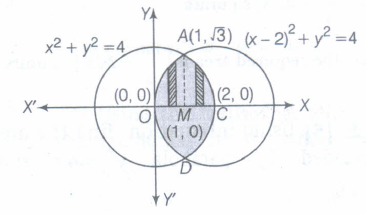
Here, region enclosed between two circles is OACDO,
which is symmetrical about X-axis
Now, from (i) and (ii), we get
\( (x-2)^{2}+y^{2}=x^{2}+y^{2} \)
\(\Rightarrow x^{2}+4-4 x+y^{2}=x^{2}+y^{2} \)
\(\Rightarrow 4-4 x=0 \Rightarrow x=1 \)
From (i), we get
\(y^{2}=4-x^{2}=4-1=3 \Rightarrow y=\pm \sqrt{3}\)
So, the points of intersection are \(A(1, \sqrt{3}) \text { and } D(1,-\sqrt{3})\) .
Here, we will draw two vertical strips [one for circle (i) and other for circle (ii)].
\(\therefore\) Required area = Area of region OACDO
= 2 x Area of region OACO
= 2 [Area of region OAMO + Area of region AMCA]
\(=2\left[\int_{0}^{1} y(\text { circle }(\mathrm{ii})) d x+\int_{1}^{2} y(\text { circle }(\mathrm{i})) d x\right]\)
\(=2\left[\int_{0}^{1} \sqrt{4-(x-2)^{2}} d x+\int_{1}^{2} \sqrt{4-x^{2}} d x\right]\)
\(\left[\begin{array}{l} \text { from Eq. }(\mathrm{i}), y^{2}=4-x^{2} \Rightarrow y=\sqrt{4-x^{2}} \\ \text { and from Eq. (ii), } y^{2}=4-(x-2)^{2} \\ \Rightarrow y=\sqrt{4-(x-2)^{2}} \end{array}\right]\)
\( =2\left[\frac{(x-2)}{2} \sqrt{4-(x-2)^{2}}+\frac{4}{2} \sin ^{-1}\left(\frac{x-2}{2}\right)\right]_{0}^{1} +2\left[\frac{x}{2} \sqrt{4-x^{2}}+\frac{4}{2} \sin ^{-1} \frac{x}{2}\right]_{1}^{2} \)
\( =\left[(x-2) \sqrt{4-(x-2)^{2}}\right.\left.+4 \sin ^{-1}\left(\frac{x-2}{2}\right)\right]_{0}^{1} +\left[x \sqrt{4-x^{2}}+4 \sin ^{-1} \frac{x}{2}\right]_{1}^{2} \)
\( =\left[\left\{-\sqrt{3}+4 \sin ^{-1}\left(\frac{-1}{2}\right)\right\}-0-4 \sin ^{-1}(-1)\right] +\left[0+4 \sin ^{-1} 1-\sqrt{3}-4 \sin ^{-1} \frac{1}{2}\right] \)
\(=\left[\left\{-\sqrt{3}-4 \times \frac{\pi}{6}\right\}+4 \times \frac{\pi}{2}\right]+\left[4 \times \frac{\pi}{2}-\sqrt{3}-4 \times \frac{\pi}{6}\right]\)
\(=\left(-\sqrt{3}-\frac{2 \pi}{3}+2 \pi\right)+\left(2 \pi-\sqrt{3}-\frac{2 \pi}{3}\right)\)
\(=\left(\frac{8 \pi}{3}-2 \sqrt{3}\right) \text { sq units }\)
Hence, the required area is \(\left(\frac{8 \pi}{3}-2 \sqrt{3}\right) \text { sq units }\)
3.
Let \(\int _{ 0 }^{ \pi /4 }{ (\sqrt { \tan { x } } +\sqrt { \cot { x } } ) } dx\)
\(=\int _{ 0 }^{ \pi /4 }{ \frac { \tan { x+1 } }{ \sqrt { \tan { x } } } } dx\)
\(Put \sqrt { \tan { x } } =t\ i.e. \tan { x } x={ t }^{ 2 }\)
so that \(\sec ^{ 2 }{ x } dx=2t\ dt \Rightarrow dx=\frac { 2t }{ 1+{ t }^{ 4 } } dt.\)
When \(x=0, t=0.\) When \(x=\frac { \pi }{ 4 } ,t=1.\)
\(\therefore I= \int _{ 0 }^{ 1 }{ \frac { { t }^{ 2 }+1 }{ t } } .\frac { 2t }{ 1+{ t }^{ 4 } } dt\)
\(=2\int _{ 0 }^{ 1 }{ \frac { { t }^{ 2 }+1 }{ { t }^{ 4 }+1 } } dx=2\int _{ 0 }^{ 1 }{ \frac { 1+1/{ t }^{ 2 } }{ { t }^{ 2 }+1/{ t }^{ 2 } } } dt\)
\(Put\ t-\frac { 1 }{ t } =y\) so that \(\left( 1+\frac { 1 }{ { t }^{ 2 } } \right) dt=dy.\)
Also \({ t }^{ 2 }-2+\frac { 1 }{ { t }^{ 2 } } ={ y }^{ 2 } \Rightarrow { t }^{ 2 }+\frac { 1 }{ { t }^{ 2 } } ={ y }^{ 2 }+2\)
\(\therefore I=2\int _{ t=0 }^{ 1 }{ \frac { dy }{ { y }^{ 2 }+2 } } \)
\(=\frac { 2 }{ \sqrt { 2 } } { \left[ \tan ^{ -1 }{ \frac { y }{ \sqrt { 2 } } } \right] }_{ t=0 }^{ 1 }\)
\(=\sqrt { 2 } { \left[ \tan ^{ -1 }{ \frac { 1 }{ \sqrt { 2 } } } \left( t-\frac { 1 }{ t } \right) \right] }_{ 0 }^{ 1 }\)
\(=\sqrt { 2 } \left[ \tan ^{ -1 }{ (0) } -\tan ^{ -1 }{ (-\infty ) } \right] \)
\(=\sqrt { 2 } \left[ \tan ^{ -1 }{ (-\infty ) } \right] =\sqrt { 2 } .\frac { \pi }{ 2 } .\)
4.
The given parabola is x2 = y
This is an upward parabola with vertex (0, 0)
y = IxI represents the st. lines:
y = x and y = -x
y = x meets (1) at O (0, 0) and A (1, 1)
y = -x meets (1) at O (0, 0) and A (-1, 1)
Therefore, Required area = 2 (Shaded area in first quadrant)
\(=2\left( \overset { 1 }{ \underset { 0 }{ \int { } } } xdx-\overset { 1 }{ \underset { 0 }{ \int { } } } { x }^{ 2 }dx \right) \)
\(=2\left( \left[ \frac { { x }^{ 2 } }{ 2 } \right] _{ 0 }^{ 1 }-\left[ \frac { { x }^{ 3 } }{ 3 } \right] _{ 0 }^{ 1 } \right) \)
\(=2\left( \left( \frac { 1 }{ 2 } -0 \right) -\left( \frac { 1 }{ 3 } -0 \right) \right) =2\left( \frac { 1 }{ 2 } -\frac { 1 }{ 3 } \right) \)
\(=2\left( \frac { 1 }{ 6 } \right) =\frac { 1 }{ 3 } sq.unit.\)
5.
\(tan\ x-cot\ x-3x+c\)
6.
\(= {sin^4\ x\over4}-{sin^6\ x\over 6}+c\)
7.
Anti-derivative of \(\left(3 \sqrt{x}+\frac{1}{\sqrt{x}}\right)\)
\(=\int\left(3 \sqrt{x}+\frac{1}{\sqrt{x}}\right) d x=3 \int \sqrt{x} d x+\int \frac{1}{\sqrt{x}} d x\)
\(=3\left(\frac{x^{(1 / 2)+1}}{(1 / 2)+1}\right)+\left[\frac{x^{(-1 / 2)+1}}{(-1 / 2)+1}\right]+C\)
\(=2\left(x^{3 / 2}+x^{1 / 2}\right)+C\)
8.
9.
\(\text { Required area }=\int_{0}^{2} y^{3} d x+\left|\int_{-1}^{0} y^{3} d x\right|
\)

\(= \frac{17}{4} \text { sq units }
\)
10.
\(\frac{16}{3} \text { sq units }\)
11.
Let \(I =\int\left(3 \operatorname{cosec}^{2} x-5 x+\sin x\right) d x
\)
\(=3 \int \operatorname{cosec}^{2} x d x-5 \int x d x+\int \sin x d x
\)
\(=3(-\cot x)-\frac{5 x^{2}}{2}-\cos x+C
\)
\(=-3 \cot x-\frac{5 x^{2}}{2}-\cos x+C\)
12.
\(\int { sin^{ 2 }x } dx=\int { \left( \frac { 1-cos2x }{ 2 } \right) dx } \)
\([\therefore cos2x=1-2sin^{ 2 }x]\)
\(=\frac { 1 }{ 2 } \int { dx } -\frac { 1 }{ 2 } \int { cos2x } dx\)
\(=\frac { 1 }{ 2 } x-\frac { 1 }{ 4 } sin2x+C\)
13.
Let \(I=\int_{-\pi}^\pi(\cos a x-\sin b x)^2 d x\)
\(=\int_{-\pi}^\pi\left(\cos ^2 a x+\sin ^2 b x-2 \cos a x \sin b x\right) d x \)
\(=\int_{-\pi}^\pi\left(\cos ^2 a x+\sin ^2 b x\right) d x-2 \int_{-\pi}^\pi \cos a x \sin b x d x \)
\(=I_1-I_2\)
Now consider,
\(I_1= \int_{-\pi}^\pi\left(\cos ^2 a x+\sin ^2 b x\right) d x \) [be an even function]
\(= 2 \int_0^\pi\left(\cos ^2 a x+\sin ^2 b x\right) d x\)
\(\left[\because \int_{-a}^a f(x) d x=2 \int_0^a f(x) d x, \text { if } f(x) \text { is even }\right]\)
\(=2 \int_0^\pi\left(\frac{1+\cos 2 a x}{2}+\frac{1-\cos 2 b x}{2}\right) d x\)
\(=\int_0^\pi(1+\cos 2 a x+1-\cos 2 b x) d x =\int_0^\pi(2+\cos 2 a x-\cos 2 b x) d x\)
\( =\left(2 x+\frac{\sin 2 a x}{2 a}-\frac{\sin 2 b x}{2 b}\right)_0^\pi\)
\(=\left(2 \pi+\frac{\sin 2 a \pi}{2 a}-\frac{\sin 2 b \pi}{2 b}\right)-0\)
\(=2 \pi+\frac{\sin 2 a \pi}{2 a}-\frac{\sin 2 b \pi}{2 b}\)
and \(I_2=2 \int_{-\pi}^\pi(\cos a x \sin b x) d x\) [be an odd function]
\(=0\left[\begin{array}{cc}
\because \int_{-a}^a f(x) d x=2 \int_0^a f(x) d x \text {, if } f(x) \text { is even } \\
0, \text { if } f(x) \text { is odd }
\end{array}\right]\)
\(\therefore I=I_1-I_2=2 \pi+\frac{\sin 2 a \pi}{2 a}-\frac{\sin 2 b \pi}{2 b}\)
14.
We have, maximise, Z = 60x + 40y ...(i)
Subject to the constraints, x + 2y \(\leq 12\) ...(ii)
\(\begin{aligned}
2 x+y & \leq 12
\end{aligned}\) ...(iii)
\(\begin{aligned}
4 x+5 y & \geq 20
\end{aligned}\) ...(iv)
and \(\begin{aligned}
x, y & \geq 0
\end{aligned}\) ...(v)
Table for line x + 2y = 12 is
| x | 0 | 12 |
| y | 6 | 0 |
So, the line x + 2y = 12 is passing through the points (0, 6) and (12, 0).
On putting (0,0) in the inequality \(x+2 y \leq 12\) we get \(0+2(0) \leq 12 \Rightarrow 0 \leq 12\), which is true
So,the half plane is towards the origin.
Table for line 2x + y = 12 is
| x | 0 | 6 |
| y | 12 | 0 |
So, the line 2x + y = 12 is passing through the points (0, 12) and (6, 0).
On putting (0, 0) in the inequality \(2 x+y \leq 12\) we get
\(2(0)+0 \leq 12 \Rightarrow 0 \leq 12\) , which is true.
So, the half plane is towards the origin.
Table for line 4x + 5y = 20 is
| x | 0 | 5 |
| y | 4 | 0 |
So, the line 4x + 5y = 20 is passing through the points (0,4) and (5, 0).
On putting (0, 0) in the inequality \(4 x+5 y \geq 20\), we get 4(0) + 5(0) \(\geq\) 20 \(\Rightarrow\) 0 > 20 which is not true.
So, the half plane is away from the origin.
Also, x, y \(\geq\) 0
So, the region lies in Ist quadrant.
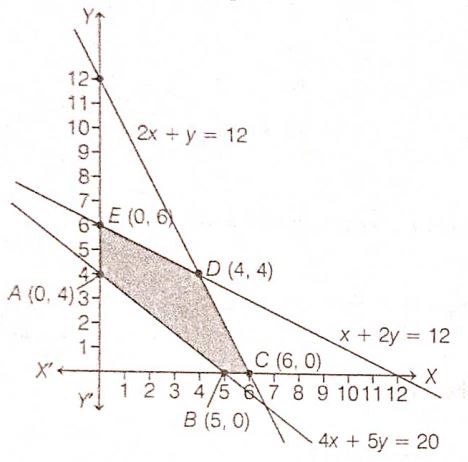
On solving Eqs. x + 2y = 12 and 2x + y = 12, we get D(4, 4)
Clearly, the feasible region is ABCDEA.
The corner points of the feasible region are A(0, 4), B(5, 0), C(6, 0), D(4, 4) and E(0, 6).
The value of Z at corner points are given below.
| Corner points | Z = 60x + 40y |
| A(0, 4) | Z = 60 \(\times\)0 + 40 \(\times\) 4 = 160 |
| B(5, 0) | Z = 60 \(\times\) 5 + 40\(\times\)0 = 300 |
| C(6, 0) | Z = 60 \(\times\) 6 + 40 \(\times\) 0 = 360 |
| D(4, 4) | Z = 60 \(\times\) 4 + 40 \(\times\) 4 = 400 (Maximum) |
| E(0, 6) | Z = 60 \(\times\) 0 + 40 \(\times\) 6 = 240 |
The maximum value of Z is 400 at D(4, 4).
15.
Given curve is 4x2 + y2 = 36
\(\begin{array}{ll} \therefore & \frac{4 x^2}{36}+\frac{y^2}{36}=1 \end{array}\)
\(\begin{array}{ll} \therefore & \frac{x^2}{9}+\frac{y^2}{36}=1 \end{array}\) ...(i)
We know that the standard equation of ellipse is
\(\frac{x^2}{a^2}+\frac{y^2}{b^2}=1\) ...(ii)
On comparing Eqs. (i) and (ii), we get
a2 = 9 and b2 = 36
\(\Rightarrow\) a = 3 and b = 6
Here, we see that a < b, so the vertical ellipse will be formed.
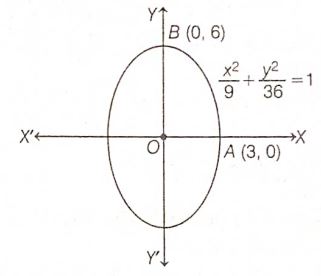
Now, required area = 4(Area of region OAB in first quadrant)
\(\begin{aligned} =4\left|\int_0^3 y d x\right| \end{aligned}\)
\(\begin{aligned} =\left|4 \int_0^3 2 \sqrt{9-x^2} d x\right| \end{aligned}\)
\(\begin{aligned} \left[\because \frac{y^2}{36}=1-\frac{x^2}{9} \Rightarrow y=2 \sqrt{9-x^2}\right] \end{aligned}\)
\(\begin{aligned} =8 \int_0^3 \sqrt{9-x^2} d x \end{aligned}\)
\(\begin{aligned} =8\left|\left[\frac{x}{2} \sqrt{9-x^2}+\frac{9}{2} \sin ^{-1}\left(\frac{x}{3}\right)\right]_0^3\right| \end{aligned}\)
\(\left[\because \sqrt{a^2-x^2} d x=\frac{x}{2} \sqrt{a^2-x^2}+\frac{a^2}{2} \sin ^{-1}\left(\frac{x}{a}\right)\right]\)
\(=8\left\{\left[\frac{3}{2} \sqrt{9-9}+\frac{9}{2} \sin ^{-1} \frac{3}{3}-0-\frac{9}{2} \sin ^{-1} 0\right]\right\}\)
\(\begin{aligned} =8\left|\left[0+\frac{9}{2} \times \frac{\pi}{2}-0\right]\right| \end{aligned}\)
\(\begin{aligned} =8 \times \frac{9 \pi}{4} \end{aligned}\)
\(=18 \pi\)
Hence, the required area is 18\(\pi\) sq units.
16.
Given, the circle \(x^{2}+y^{2}=32\)
and the line y = x
Let us find the point of intersection of Eqs. (i) and (ii
On substituting y = x in Eq. (i), we get
\(x^{2}+x^{2}=32\)
\(\Rightarrow 2 x^{2}=32\)
\(\Rightarrow x^{2}=16 \Rightarrow x=\pm 4\)
Thus, the points of intersection are \(\begin{array}{c} (4,4) \text { and }(-4,-4) {[\because y=x]} \end{array}\)
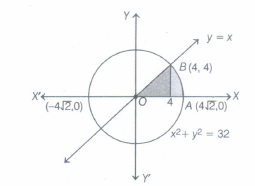
Clearly, the required area
= Area of shaded region OABO
\( =\int_{0}^{4} y(\text { line }) d x+\int_{4}^{4 \sqrt{2}} y(\text { circle }) d x\)
\(=\int_{0}^{4} x d x+\int_{4}^{4 \sqrt{2}} \sqrt{32-x^{2}} d x\)
\(\left[\because x^{2}+y^{2}=32 \Rightarrow y=\pm \sqrt{32-x^{2}} \text { and } y>0\right]\)
\(=\left[\frac{x^{2}}{2}\right]_{0}^{4}+\int_{4}^{4 \sqrt{2}} \sqrt{(4 \sqrt{2})^{2}-x^{2}} d x \)
\(=\frac{1}{2}[16-0]+\frac{1}{2}\left[x \sqrt{(4 \sqrt{2})^{2}-x^{2}}+(4 \sqrt{2})^{2} \sin ^{-1}\left(\frac{x}{4 \sqrt{2}}\right)\right]_{4}^{4 \sqrt{2}}\)
\(=8+\frac{1}{2}\left[\left(0+32 \sin ^{-1}(1)\right)-\left(4 \sqrt{32-16}+32 \sin ^{-1}\left(\frac{1}{\sqrt{2}}\right)\right)\right]\)
\(=8+\frac{1}{2}\left[32 \sin ^{-1}(1)-16-32 \sin ^{-1}\left(\frac{1}{\sqrt{2}}\right)\right]\)
\(=8+\frac{1}{2}\left[32 \cdot \frac{\pi}{2}-16-32 \cdot \frac{\pi}{4}\right]\)
\(=8+\frac{1}{2}[16 \pi-16-8 \pi]=8+\frac{1}{2}[8 \pi-16]=8+4 \pi-8\)
\(=4 \pi \text { sq units }\)
17.
Let \(I=\int_{0}^{\pi / 2} \frac{x \sin x \cos x}{\sin ^{4} x+\cos ^{4} x} d x\)
Using \(\int_{0}^{a} f(x) d x=\int_{0}^{a} f(a-x) d x\) we get
\(I=\int_{0}^{\pi / 2} \frac{\left(\frac{\pi}{2}-x\right) \sin \left(\frac{\pi}{2}-x\right) \cos \left(\frac{\pi}{2}-x\right)}{\sin ^{4}\left(\frac{\pi}{2}-x\right)+\cos ^{4}\left(\frac{\pi}{2}-x\right)} d x\)
\(\Rightarrow I=\int_{0}^{\pi / 2} \frac{\left(\frac{\pi}{2}-x\right) \cos x \sin x}{\cos ^{4} x+\sin ^{4} x} d x\)
\(\left[\because \cos \left(\frac{\pi}{2}-\theta\right)=\sin \theta \text { and } \sin \left(\frac{\pi}{2}-\theta\right)=\cos \theta\right]\)
On adding Eqs. (i) and (ii), we get
\(2 I=\frac{\pi}{2} \int_{0}^{\pi / 2} \frac{\cos x \sin x}{\sin ^{4} x+\cos ^{4} x} d x\)
\(\Rightarrow I=\frac{\pi}{4} \int_{0}^{\pi / 2} \frac{\sin x \cos x}{\left(\sin ^{2} x\right)^{2}+\left(1-\sin ^{2} x\right)^{2}} d x\) \(\left[\because \cos ^{2} \theta=1-\sin ^{2} \theta\right]\)
Now, put \(\sin ^{2} x=t \Rightarrow 2 \sin x \cos x d x=d t\)
\(\Rightarrow \sin x \cos x d x=\frac{d t}{2}\)
Lower limit When \(x=0, \text { then } t=\sin ^{2} 0=0\)
Upper limit When \(x=\frac{\pi}{2}, \text { then } t=\sin ^{2} \frac{\pi}{2}=1\)
Now, \(I=\frac{\pi}{4} \int_{0}^{1} \frac{1}{t^{2}+(1-t)^{2}} \frac{d t}{2}\)
\(\Rightarrow I=\frac{\pi}{8} \int_{0}^{1} \frac{1}{t^{2}+\left(1+t^{2}-2 t\right)} d t\)
\(\Rightarrow I=\frac{\pi}{8} \int_{0}^{1} \frac{1}{2 t^{2}-2 t+1} d t \Rightarrow I=\frac{\pi}{16} \int_{0}^{1} \frac{1}{t^{2}-t+\frac{1}{2}} d\)
\(\Rightarrow I=\frac{\pi}{16} \int_{0}^{1} \frac{1}{t^{2}-t+\left(\frac{1}{2}\right)^{2}-\left(\frac{1}{2}\right)^{2}+\frac{1}{2}} d t\)
18.
\(I=\int { \frac { { x }^{ 2 }+x+1 }{ (x+2)({ x }^{ 2 }+1) } } dx\)
\(=\int { \left[ \frac { A }{ (x+2) } +\frac { Bx+C }{ ({ x }^{ 2 }+1) } \right] dx } \)
\(\Rightarrow A{ x }^{ 2 }+A+B{ x }^{ 2 }+2Bx+Cx+2C\)
\(=x+{ x }^{ 2 }+1\)
\(A+B=1\)
\(2B+C=1\)
\(A+2C=1\)
\(A=3/5,\)
\(B=2/5,\)
and \(C=1/5\)
\(\therefore I=\int { \left[ \frac { 3 }{ 5(x+2) } +\frac { \frac { 2 }{ 5 } x+\frac { 1 }{ 5 } }{ ({ x }^{ 2 }+1 } \right] dx } \)
\(=\frac { 1 }{ 5 } \int { \left[ \frac { 3 }{ (x+2) } +\frac { 2x+1 }{ ({ x }^{ 2 }+1) } \right] } dx\)
\(=\frac { 1 }{ 5 } \left[ \int { \frac { 3 }{ (x+2) } } dx+\int { \frac { 2x+1 }{ ({ x }^{ 2 }+1) } dx+\int { \frac { 1 }{ ({ x }^{ 2 }+1) } dx } } \right] \)
\({ I }_{ 1 }=\frac { 1 }{ 5 } \int { \frac { 3 }{ (x+2) } } dx\)
\(=\frac { 3 }{ 5 } log(x+2)+{ C }_{ 1 }\)
\({ I }_{ 2 }=\frac { 1 }{ 5 } \int { \frac { 2x }{ ({ x }^{ 2 }+1) } } dx\)
Let \({ x }^{ 2 }+1=t,\Rightarrow 2xdx=dt\)
\(=\frac { 1 }{ 5 } \int { \frac { dt }{ t } =\frac { 1 }{ 5 } logt } \)
\(=\frac { 1 }{ 5 } log(1+{ x }^{ 2 })+{ C }_{ 2 }\)
\({ I }_{ 3 }=\frac { 1 }{ 5 } \int { \frac { 1 }{ { x }^{ 2 }+1 } dx } \)
\(=\frac { 1 }{ 5 } tan^{ -1 }x+{ C }_{ 3 }\)
\(\therefore I=\frac { 1 }{ 5 } \left[ 3log(x+2)+log(1+{ x }^{ 2 })+tan^{ -1 }x \right] +C\)
19.
(c)
a = 3 and b = 5
20.
(d)
\(\frac{a b}{4}(\pi-2)\)
21.
(d)
\(2\sqrt{2}-1\)
22.
(b)
4 sq. units
23.
24.
(d)
\(\frac{a+b}{2} \int_{a}^{b} f(x) d x\)
25.
(d)
\(\frac{\pi}{4}\)
26.
(a)
\(e^{x} f(x)+C\)
27.
(c)
Only first quadrant
28.
As \(\int { \frac { 1 }{ \sqrt { 4-{ 9x }^{ 2 } } } dx } \)
\(=\frac { 1 }{ 3 } \int { \frac { 1 }{ \sqrt { { \left( \frac { 2 }{ 3 } \right) }^{ 2 }-{ x }^{ 2 } } } dx } \)
\(=\frac { 1 }{ 3 } \int { \frac { 1 }{ \sqrt { { \left( \frac { 2 }{ 3 } \right) }^{ 2 }-{ x }^{ 2 } } } dx } \)
⇒ a = \(\frac32\)

12th Standard CBSE Syllabus & Materials
12th Standard CBSE
CBSE 12th Computer Science Python Revision Tour I - New Previous year Question Papers Study Material - QB365 Set A
NEW12th Standard CBSE
CBSE 12th Business Studies Planning Important Questions And Answers Study Material - QB365 Set A
NEW12th Standard CBSE
CBSE 12th Business Studies Business Environment Important Questions And Answers Study Material - QB365 Set A
NEW12th Standard CBSE
CBSE 12th Business Studies Principles of Management Important Questions And Answers Study Material - QB365 Set A



NCERT Books

Syllabus

Exam Pattern

Sample Question Papers

Previous year Question Papers

Important Notes

MCQ Practice test

NCERT Exemplers

Case study Questions

Image Based Questions

Passage based Questions

HOT Questions

Value Based Questions

Model Questions Papers
NCERT ( Book Back ) Questions

Assertion and Reason
Important Questions And Answers

CBSE 12th Standard CBSE Subjects
CBSE Standards