 100% FREE ACCESS
12th Standard CBSE Syllabus & Materials
12th Standard CBSE
CBSE 12th Economics Government Budget and the Economy Previous year Question Papers Study Material - QB365 Set A
NEW12th Standard CBSE
CBSE 12th Computer Science Interface Python with MySQL - New Previous year Question Papers Study Material - QB365 Set A
NEW12th Standard CBSE
CBSE 12th Computer Science Database Concept - New Previous year Question Papers Study Material - QB365 Set A
NEW12th Standard CBSE
CBSE 12th Computer Science Data Communication - New Previous year Question Papers Study Material - QB365 Set A
NEW12th Standard CBSE
CBSE 12th Computer Science Data Structures - New Previous year Question Papers Study Material - QB365 Set A
NEW12th Standard CBSE
CBSE 12th Computer Science Functions - New Previous year Question Papers Study Material - QB365 Set A

Published on: 02/11/2025
Download CBSE Class 12th Standard CBSE Maths question papers, sample papers, important questions, and previous year solved papers in PDF format. Get free study materials, NCERT solutions, and exam preparation resources for Class 12th Standard CBSE Maths
Questions + Answers key
Take MCQ Maths Test
1.
Minimise Z = X + 2y, subject to constraints \(2 x+y \geq 3, x+2 y \geq 6\) and \(x, y \geq 0\) .
(i) Show that the minimum of Z occurs at more than two points.
(ii) Also, check whether the point P(5, 2) lies inside the shaded portion, if it lies inside the shaded region, then find the distance between the origin and point.
2.
Determine graphically the minimum value of the objective function
Z = – 50x + 20y
subject to constraints
\(2 x-y \geq-5,\)
\(3 x+y \geq 3\)
\(2 x-3 y \leq 12\)
\(x \geq 0, y \geq 0\).
3.
Solve the following linear programming problem graphically.
Maximise \(Z=-x+2 y\) subject to the constraints :
\(4 x+y \geq 80, x+5 y \geq 115,3 x+2 y \leq 150, x \geq 0, y \geq 0\)
4.
Solve the following Linear Programming Problem graphically:
Maximize Z = 3x + 4y subject to the constraints:
\(x+y\le 4,\)
\(x\ge 0 \ \text {and} \)
\(y\ge 0.\)
5.
Maximize, if possible: Z = 3x + 2y subject to the constraints:
\(x-y\le 1,x+y\ge 3,x\ge 0,y\ge 0\).
6.
Solve the following linear programming problem graphically:
Minimise Z = 200 x + 500 y
subject to the constraints
\(x+2y\ge 10,\)
\(3x+4y\le 24,\)
\(x\ge 0,y\ge 0.\)
7.
Find the maximum value of the objective function Z = 3x + 4y
Subject to constraints
\(x+y \leq 4 ; x \geq 0 \text { and } y \geq 0\)
8.
Find the minimum and maximum values of the objective function.
Z = 3x + 9y
Subject to constraints
\(\begin{aligned} x+3 y \leq 60, x+y \geq 10, x \leq y \end{aligned}\)
and \(\begin{aligned} x \geq 0, y \geq 0 \end{aligned}\)
9.
Solve the following LPP graphically.
Maximise Z = 60x + 40y
subject to the constraints
\(\begin{aligned}
x+2 y \leq 12
\end{aligned}\)
\(\begin{aligned}
2 x+y \leq 12
\end{aligned}\)
\(\begin{aligned}
4 x+5 y \geq 20 \text { and } x, y \geq 0
\end{aligned}\)
10.
Find graphically, the maximum value of Z = 2x + 5y, subject to constraints given below: 2x + 4y \(\le \) 8 \(\Rightarrow\) x + 2y \(\le \) 4
3x + y \(\le \) 6
x + y \(\le \) 4
x \(\\ \ge \) 0, y \(\\ \ge \) 0
11.
The feasible region of a linear programming problem is shown in the figure below:
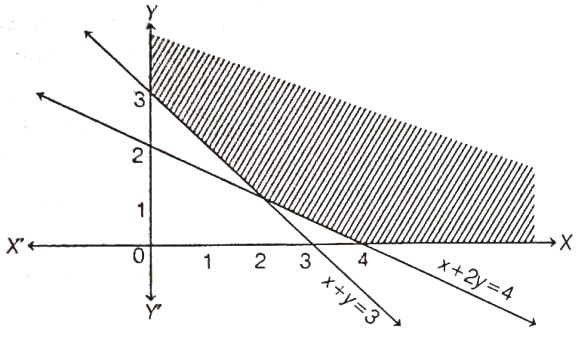
Which of the following are the possible constraints?
\(x+2 y \geq 4, x+y \leq 3, x \geq 0, y \geq 0\)
\(x+2 y \leq 4, x+y \leq 3, x \geq 0, y \geq 0\)
\(x+2 y \geq 4, x+y \geq 3, x \geq 0, y \geq 0\)
\(x+2 y \geq 4, x+y \geq 3, x \leq 0, y \leq 0\)
12.
The variables x and y in a linear programming problem are called
decision variables
linear variables
optimal variables
None of these
13.
Every point of feasible region is called a ……… to the problem.
Simple solution
Normal solution
Difficult solution
Feasible solution
14.
Let Z = ax + by is a linear objective function. Variables x and y are called ……… variables.
Independent
Continuous
Decision
Dependent
15.
The common region determined by all the constraints including non-negative constraints x, y ≥ 0 of a linear programming problem is called the ………
Bounded region
Simple region
Infeasible region
Feasible region
16.
Of all the points of the feasible region, for maximum or minimum of objective function, the point lies
inside the feasible region
at the boundary line of the feasible region
vertex point of the boundary of the feasible region
none of these
17.
Corner points of the feasible region for an LPP are (0, 3), (5, 0), (6, 8), (0, 8). Let Z = 4x - 6y be the objective function.
Based on the above information, answer the following questions.
(i) The minimum value of Z occurs at
| (a) (6, 8) | (b) (5, 0) | (c) (0, 3) | (d) (0, 8) |
(ii) Maximum value of Z occurs at
| (a) (5, 0) | (b) (0, 8) | (c) (0, 3) | (d) (6, 8) |
(iii) Maximum of Z - Minimumof Z =
| (a) 58 | (b) 68 | (c) 78 | (d) 88 |
(iv) The corner points of the feasible region determined by the system of linear inequalities are
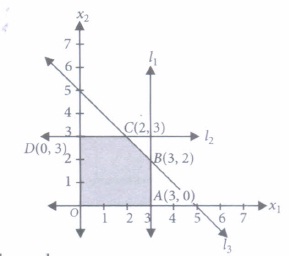
| (a) (0, 0), (-3, 0), (3, 2), (2, 3) | (b) (3, 0), (3, 2), (2, 3), (0, -3) | (c) (0, 0), (3, 0), (3, 2), (2, 3), (0, 3) | (d) None of these |
(v) The feasible solution of LPP belongs to
| (a) first and second quadrant | (b) first and third quadrant | (c) only second quadrant | (d) only first quadrant |
1.
Our problem is to minimise Z = x + 2y ...(i)
subject to constraints,
\(2 x+y \geq 3\) ...(ii)
\(x+2 y \geq 6\) ...(iii)
and \(x \geq 0, y \geq 0\) ...(iv)
Table for line 2x + y = 3 is
\(x \geq 0, y \geq 0\)
Table for line 2x + y = 3 is
\(\begin{array}{c|c|c} \hline x & 0 & 3 / 2 \\ \hline y & 3 & 0 \\ \hline \end{array}\)
So, line passes through the points (0, 3) and \(\left(\frac{3}{2}, 0\right)\) .
On putting (0, 0) in the inequality \(2 x+y \geq 3\) we get
\(2 \times 0+0 \geq 3\)
\(\Rightarrow 0 \geq 3\), which is not true
So, the half plane is away from the origin
Table for line x + 2y = 6 is
\(\begin{array}{c|c|c} \hline x & 0 & 6 \\ \hline y & 3 & 0 \\ \hline \end{array}\)
So, line passes through the points (0, 3) and (6, 0).
On putting (0, 0) in the inequality \(x+2 y \geq 6\) ,we get
\(0+2 \times 0 \geq 6\)
\(\Rightarrow 0 \geq 6\), which is not true.
So, the half plane is away from the origin.
Also,\(x \geq 0 \text { and } y \geq 0\), so the region lies in the I quadrant
The intersection point of the lines x + 2y = 6 and \(2 x+y=3\) B(0, 3).
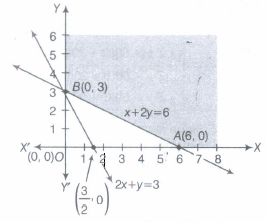
The corner points of the feasible region are A(6, 0) and B(0, 3).
The values of Z at the corner points are given below
As the feasible region is unbounded, therefore 6 mayor may not be the minimum value of Z. For this we draw a dotted graph of the inequality x + 2y.
< 6 and check whether the resulting half plane has points in common with a feasible region or not.
It can be seen that the feasible region has no common point with x + 2y < 6. Therefore, the minimum value of Z is 6. Thus,
the minimum value of Z occurs at more than 2 points. [The value of Z is minimum at every point on the line segment AB]
Let \(f(x, y)=x+2 y-6\)
At point \(P(5,2), f(5,2)=5+2 \times 2-6=3>0\)
Hence, point lies inside the shaded region.
Now, distance between 0 and P
\(=\sqrt{(5-0)^{2}+(2-0)^{2}}=\sqrt{25+4}=\sqrt{29}=5.39\)
2.
First of all, let us graph the feasible region of the system of inequalities (2) to (5). The feasible region (shaded). Observe that the feasible region is unbounded.
We now evaluate Z at the corner points.
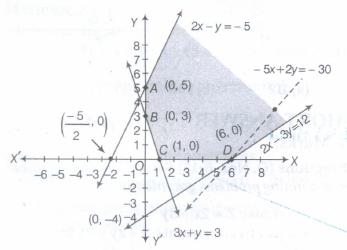
| Corner Point | Z = – 50x + 20y |
| (0, 5) | 100 |
| (0, 3) | 60 |
| (1, 0) | –50 |
| (6, 0) | – 300 (smallest) |
From this table, we find that – 300 is the smallest value of Z at the corner point (6, 0). Can we say that minimum value of Z is – 300? Note that if the region would have been bounded, this smallest value of Z is the minimum value of Z (Theorem 2). But here we see that the feasible region is unbounded. Therefore, – 300 may or may not be the minimum value of Z. To decide this issue, we graph the inequality
– 50x + 20y < – 300 (see Step 3(ii) of corner Point Method.)
i.e., – 5x + 2y < – 30
and check whether the resulting open half plane has points in common with feasible region or not. If it has common points, then –300 will not be the minimum value of Z.
Otherwise, –300 will be the minimum value of Z.
It has common points. Therefore, Z = –50 x + 20 y has no minimum value subject to the given constraints.
In the above example, can you say whether z = – 50 x + 20 y has the maximum value 100 at (0, 5)? For this, check whether the graph of – 50 x + 20 y > 100 has points in common with the feasible region.
3.
Our problem is to maximise Z = - x + 2Y ...(i)
subject to constraints,
\(x \geq 3\) ...(ii)
\(x+y \geq 5\) ...(iii)
\(x+2 y \geq 6\) ...(iv)
Table for line x + y = 5 is
\(\begin{array}{c|c|c} \hline x & 0 & 5 \\ \hline y & 5 & 0 \\ \hline \end{array}\)
So, the line passes through the points (0, 5) and (5, 0).
On putting (0, 0) in the inequality \(x+y \geq 5\), we get
\(0+0 \geq 5\)
\(\Rightarrow 0 \geq 5\), which is not true.
So, the half plane is away from the origin .
Table for line \(x+2 y=6\) is
\(\begin{array}{c|c|c} \hline x & 0 & 6 \\ \hline y & 3 & 0 \\ \hline \end{array}\)
So, the line passes through the points (0,3) and (6,0).
On putting (0, 0) in the inequality \(x+2 y \geq 6\), we get
\(0+2 \times 0 \geq 6\)
\(\Rightarrow 0 \geq 6\) which is not true.
So, the half plane is away from the origin
Also,\(x \geq 3\), so the region is away from the orgin.
Since \(x \geq 0, y \geq 0\)
So, the region lies in the I quadrant. The points of intersection of lines x = 3 and x + y = 5 is C(3, 2) and lines x + 2y = 6 and x + y = 5 is B(4, 1). It can be seen that the feasible region is unbounded.
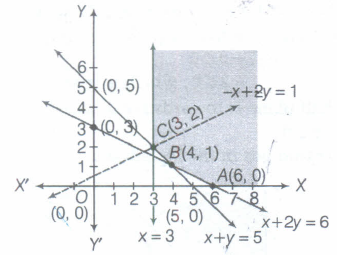
The corner points of the feasible region are A(6, 0), B(4, 1) and C(3, 2).
The values of Z at corner points are given below
\(\begin{array}{c|c} \hline \text { Corner points } & z=-x+2 y \\ \hline A(6,0) & Z=-6+2 \times 0=-6 \\ B(4,1) & Z=-4+2 \times 1=-2 \\ C(3,2) & Z=-3+2 \times 2=1 \\ \hline \end{array}\)
As the feasible region is unbounded, therefore Z = 1 may or may not be the maximum value. For this, we draw the graph of the inequality \(-x+2 y>1\) and check whether the resulting half plane has points in common with the feasible region or not. The feasible region have points in common with the \(-x+2 y>1.\) Therefore, Z = 1 is not the maximum value.
Hence, Z has no maximum value.
4.
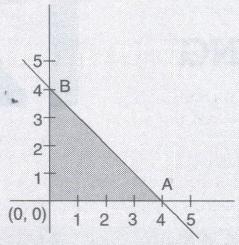
The feasible region determined by the constraints, x + y ≤ 4, x ≥ 0, y ≥ 0, is as follows.
The corner points of the feasible region are O (0, 0), A (4, 0), and B (0, 4). The values of Z at these points are as follows.
| Corner point | Z = 3x + 4y | |
| O(0, 0) | 0 | |
| A(4, 0) | 12 | |
| B(0, 4) |
16 |
→ Maximum |
Therefore, the maximum value of Z is 16 at the point B (0, 4).
5.
The system of constraints is:
\(x-y\le 1\) ..(1)
\(x+y\ge 3\)...(2)
and \(x\ge 0,y\ge 0\)...(3)
The shaded region in the following figure is the feasible region determined by (1)-(3).
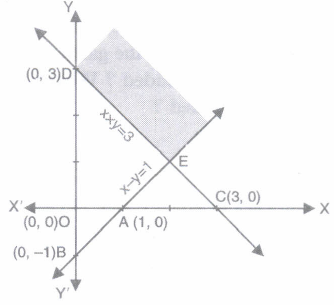
It is observed that feasible region is not bounded.
Hence, the max value of Z is not finite.
6.
The shaded region is the feasible region ABC determined by the system of constraints (2) to (4), which is bounded. The coordinates of corner points
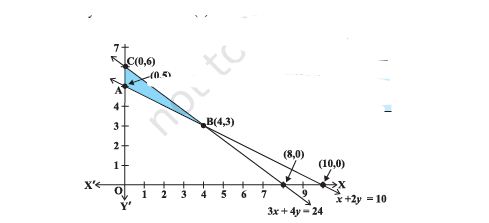
A, B and C are (0,5), (4,3) and (0,6) respectively. Now we evaluate Z = 200x + 500y at these points.
Hence, minimum value of Z is 2300 attained at the point (4, 3)
| Corner Point | Corresponding Value of Z |
| B : (0,5) | 2500 |
| D : (0,6) | 3000 |
| E : (4,3) | 2300 (Minimum) |
7.
Our problem is to maximise
Z = 3x + 4y ...(i)
Subject to the constraints are
\(\begin{aligned} x+y & \leq 4 \end{aligned}\) ...(ii)
\(\begin{aligned} x & \geq 0, y \geq 0 \end{aligned}\) ...(iii)
Table for the line x + y = 4 is
| x | 0 | 4 |
| y | 4 | 0 |
On putting (0, 0) in the inequality x+ y \(\leq\) 4, we have
0 + 0 \(\leq\) 4
\(\Rightarrow\) 0 \(\leq\) 4 (which is true)
So, the half plane is towards the origin
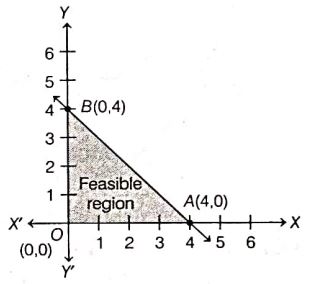
So, the feasible region lies in the Ist quadrant.
\(\therefore\) Feasible region is OABO.
The corner points of the feasible region are O(0, 0), A(4, 0) and B(0, 4). The values of Z at these points are as follows
| Corner points | Value of Z = 3x + 4y |
| O(0, 0) | 0 |
| A(4, 0) | 12 |
| B(0, 4) | 16 (Maximum) |
Therefore, the maximum value of Z is 16 at the point B(0, 4).
8.
Given that,
Minimise and Maximise Z = 3x + 9y ...(i)
Subject to the constraints are
\(\begin{aligned} x+3 y & \leq 60 \end{aligned}\) ...(ii)
\(\begin{aligned} x+y & \geq 10 \end{aligned}\) ...(iii)
\(\begin{aligned} x & \leq y \end{aligned}\) ...(iv)
\(\begin{aligned} x \geq 0, y & \geq 0 \end{aligned}\) ...(v)
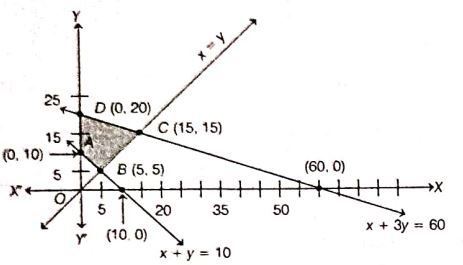
First of all,let us plot the graph of the feasible region of the system of linear inequalities (ii) to (v). The feasible region ABCDA is shown in the figure.
Note That the region is bounded. The coordinates of the corner points A, B, C and D are (0, 10), (5, 5), (15, 15) and (0, 20), respectively.
| Corner points | Corresponding value of Z = 3x + 9y |
| A (0, 10) | 90 |
| B(5, 5) | 60 (Minimum) |
| C(15, 15) | 180 (Maximum) Multiple optimal solutions) |
| D(0, 20) | 180 |
We, now find the minimum and maximum value of Z. From the table, we find that the minimum value of Z is 60 at the point B(5, 5) of the feasible region.
The maximum value of Z on the feasible region occurs at the two corner points C (15, 15) and D (0, 20) and it is 180 in each case.
Remark Observe that in the above example, the problem has multiple optimal solutions at the corner points C and D, i.e. the both points produce same maximum value 180.
In such cases, you can see that every point on the line segment CD joining the two corner points C and D also give the same maximum value. Same is also true in the case, if the two points produce same minimum value.
9.
We have, maximise, Z = 60x + 40y ...(i)
Subject to the constraints, x + 2y \(\leq 12\) ...(ii)
\(\begin{aligned}
2 x+y & \leq 12
\end{aligned}\) ...(iii)
\(\begin{aligned}
4 x+5 y & \geq 20
\end{aligned}\) ...(iv)
and \(\begin{aligned}
x, y & \geq 0
\end{aligned}\) ...(v)
Table for line x + 2y = 12 is
| x | 0 | 12 |
| y | 6 | 0 |
So, the line x + 2y = 12 is passing through the points (0, 6) and (12, 0).
On putting (0,0) in the inequality \(x+2 y \leq 12\) we get \(0+2(0) \leq 12 \Rightarrow 0 \leq 12\), which is true
So,the half plane is towards the origin.
Table for line 2x + y = 12 is
| x | 0 | 6 |
| y | 12 | 0 |
So, the line 2x + y = 12 is passing through the points (0, 12) and (6, 0).
On putting (0, 0) in the inequality \(2 x+y \leq 12\) we get
\(2(0)+0 \leq 12 \Rightarrow 0 \leq 12\) , which is true.
So, the half plane is towards the origin.
Table for line 4x + 5y = 20 is
| x | 0 | 5 |
| y | 4 | 0 |
So, the line 4x + 5y = 20 is passing through the points (0,4) and (5, 0).
On putting (0, 0) in the inequality \(4 x+5 y \geq 20\), we get 4(0) + 5(0) \(\geq\) 20 \(\Rightarrow\) 0 > 20 which is not true.
So, the half plane is away from the origin.
Also, x, y \(\geq\) 0
So, the region lies in Ist quadrant.
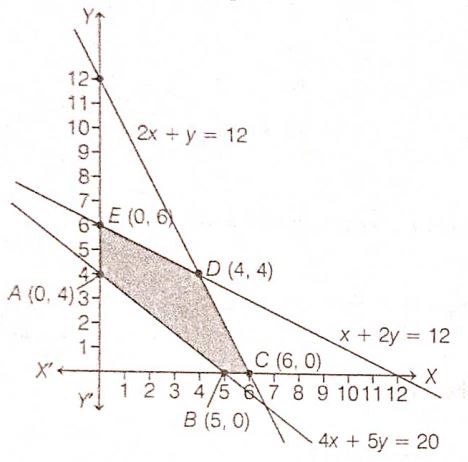
On solving Eqs. x + 2y = 12 and 2x + y = 12, we get D(4, 4)
Clearly, the feasible region is ABCDEA.
The corner points of the feasible region are A(0, 4), B(5, 0), C(6, 0), D(4, 4) and E(0, 6).
The value of Z at corner points are given below.
| Corner points | Z = 60x + 40y |
| A(0, 4) | Z = 60 \(\times\)0 + 40 \(\times\) 4 = 160 |
| B(5, 0) | Z = 60 \(\times\) 5 + 40\(\times\)0 = 300 |
| C(6, 0) | Z = 60 \(\times\) 6 + 40 \(\times\) 0 = 360 |
| D(4, 4) | Z = 60 \(\times\) 4 + 40 \(\times\) 4 = 400 (Maximum) |
| E(0, 6) | Z = 60 \(\times\) 0 + 40 \(\times\) 6 = 240 |
The maximum value of Z is 400 at D(4, 4).
10.
Given inequations are
\(2 x+4 y \leq 8 \text { or } \ x+2 y \leq 4 \)
\(3 x+y \leq 6, x+y \leq 4, \ x \geq 0, \ y \geq 0
\)
Maximise Z = 2x + 5y on plotting the graph of the inequations we notice shaded portion as feasible solution
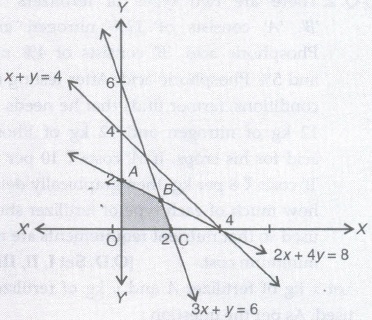
Possible points for maximum Z are A(2, 0),\(B\left(\frac{8}{5}, \frac{6}{5}\right)\) C (0,2)
| Points | Z= 2x + 5y | Values |
| A(2,0) | 4 + 0 | 4 |
| \(B\left(\frac{8}{5}, \frac{6}{5}\right)\) | \(\frac{16}{5}+\frac{30}{5}\) | \(\frac{46}{5}=9 \frac{1}{5}\) |
| C(0,2) | 0 + 10 | 10 \(\leftarrow\) Maximum |
Z is maximum at qo, 2), i.e. x = 0, y = 2, maximum value = 10
11.
(c)
\(x+2 y \geq 4, x+y \geq 3, x \geq 0, y \geq 0\)
12.
(a)
decision variables
13.
(d)
Feasible solution
14.
(c)
Decision
15.
(d)
Feasible region
16.
(c)
vertex point of the boundary of the feasible region
17.
Construct the following table of values of objective function
| Corner Points | Value of Z = 4x - 6y |
| (0,3) | 4 x 0 - 6 x 3 = -18 |
| (5,0) | 4 x 5 - 6 x 0 = 20 |
| (6,8) | 4 x 6 - 6 x 8 = -24 |
| (0,8) | 4 x 0 - 6 x 8 = -48 |
(i) (d): Minimum value of Z is -48 which occurs at (0,8).
(ii) (a): Maximumvalue of Z is 20, which occurs at (5,0).
(iii) (b): Maximum of Z - Minimum of Z
= 20 - (-48) = 20 + 48 = 68
(iv) (c): The corner points of the feasible region are O(0,0), A(3, 0), B(3, 2), C(2, 3), D(0, 3).
(v) (d)

12th Standard CBSE Syllabus & Materials
12th Standard CBSE
CBSE 12th Computer Science Python Revision Tour I - New Previous year Question Papers Study Material - QB365 Set A
NEW12th Standard CBSE
CBSE 12th Business Studies Planning Important Questions And Answers Study Material - QB365 Set A
NEW12th Standard CBSE
CBSE 12th Business Studies Business Environment Important Questions And Answers Study Material - QB365 Set A
NEW12th Standard CBSE
CBSE 12th Business Studies Principles of Management Important Questions And Answers Study Material - QB365 Set A



NCERT Books

Syllabus

Exam Pattern

Sample Question Papers

Previous year Question Papers

Important Notes

MCQ Practice test

NCERT Exemplers

Case study Questions

Image Based Questions

Passage based Questions

HOT Questions

Value Based Questions

Model Questions Papers
NCERT ( Book Back ) Questions

Assertion and Reason
Important Questions And Answers

CBSE 12th Standard CBSE Subjects
CBSE Standards