
 100% FREE ACCESS
12th Standard CBSE Syllabus & Materials
12th Standard CBSE
CBSE 12th Economics Government Budget and the Economy Previous year Question Papers Study Material - QB365 Set A
NEW12th Standard CBSE
CBSE 12th Computer Science Interface Python with MySQL - New Previous year Question Papers Study Material - QB365 Set A
NEW12th Standard CBSE
CBSE 12th Computer Science Database Concept - New Previous year Question Papers Study Material - QB365 Set A
NEW12th Standard CBSE
CBSE 12th Computer Science Data Communication - New Previous year Question Papers Study Material - QB365 Set A
NEW12th Standard CBSE
CBSE 12th Computer Science Data Structures - New Previous year Question Papers Study Material - QB365 Set A
NEW12th Standard CBSE
CBSE 12th Computer Science Functions - New Previous year Question Papers Study Material - QB365 Set A

Published on: 02/11/2025
Download CBSE Class 12th Standard CBSE Maths question papers, sample papers, important questions, and previous year solved papers in PDF format. Get free study materials, NCERT solutions, and exam preparation resources for Class 12th Standard CBSE Maths
Questions + Answers key
Take MCQ Maths Test
1.
If \(\vec{a}=\hat{i}+\hat{j}+\hat{k}, \vec{b}=2 \hat{i}-\hat{j}+3 \hat{k}\) and \(\vec{c}=\hat{i}-2 \hat{j}+\hat{k}\), find a unit vector parallel to the vector \(2 \vec{a}-\vec{b}+3 \vec{c}\)
2.
Determine graphically the minimum value of the objective function
Z = – 50x + 20y
subject to constraints
\(2 x-y \geq-5,\)
\(3 x+y \geq 3\)
\(2 x-3 y \leq 12\)
\(x \geq 0, y \geq 0\).
3.
Solve the following Linear Programming Problems graphically:
Maximise Z = 5x + 3y
subject to 3x + 5y ≤ 15, 5x + 2y ≤ 10, x ≥ 0, y ≥ 0
4.
Show that the vectors \(\overset { \wedge }{ 2i } -\overset { \wedge }{ j } +\overset { \wedge }{ k } ,\overset { \wedge }{ i } -\overset { \wedge }{ 3j } -\overset { \wedge }{ 5k } \quad and\quad \overset { \wedge }{ 3i } -\overset { \wedge }{ 4j } -\overset { \wedge }{ 4k } \) from vector of a right-angled triangle
5.
Show that the points A(\(-2\hat i+3\hat j+5\hat k\)), B(\(\hat i+2\hat j+3\hat k\)) and \(C(7\hat i-\hat k)\) are collinear.
6.
If \(\overrightarrow { a } =\hat { i } -\hat { j } +7\hat { k } \) and \(\overrightarrow { b } =5\hat { i } -\hat { j } +\lambda \hat { k } \) then find the value of \(\lambda\) so that the vectors \(\overrightarrow { a } +\overrightarrow { b } \ and\ \overrightarrow { a } -\overrightarrow { b } \) are orthogonal.
7.
A firm has to transport atleast 1200 packages daily using large vans which carry 200 packages each and small vans which can take 80 packages each. The cost for engaging each large van is Rs.400 and each small van is Rs. 200. Not more than Rs. 3000 is to be spent daily on the job and the number of large vans cannot exceed the number of small vans. Formulate this problem as an LPP given that the objective is to minimise cost.
8.
Find the angle between the planes 7x + 2y + 6z = 15 and 3x-y + 10z = 17.
9.
Show that the line through the points (0, 3, 2), (3, 5, 6) is perpendicular of the line through the points (1, - 1, 2) and (3,4, - 2).
10.
If two vectors \(\overset\rightarrow a\) and \(\overset\rightarrow b\) are such that \(\left| \overset { \rightarrow }{ a } \right| =3,\left| \overset { \rightarrow }{ b } \right| =1\)and \(\overset\rightarrow a.\overset\rightarrow b=2\). Find \((2\overset\rightarrow a-3\overset\rightarrow b).(3 \overset\rightarrow a+\overset\rightarrow b).\)
11.
If \(\left|\overset\rightarrow a+\overset\rightarrow b \right| =60,\left|\overset\rightarrow a-\overset\rightarrow b \right|=40\)and \(\left| \overset\rightarrow a \right| =22,\) then find \(\left| \overset\rightarrow b \right| \).
12.
Find the position vector of c which divides the line segment joining A & B whose position vectors are \(3\overset\rightarrow a+\overset\rightarrow b\)and \(\overset\rightarrow a-3\overset\rightarrow b\) internally in the ratio 2:3.
13.
If \(\vec{a}=\hat{i}+2 \hat{j}+3 \hat{k} \text { and } \vec{b}=2 \hat{i}+4 \hat{j}-5 \hat{k}\) represent two adjacent sides of a parallelogram, find unit vectors parallel to the diagonals of the parallelogram.
14.
Find the shortest distance between the lines
\(\vec{r}=3 \hat{i}+2 \hat{j}-4 \hat{k}+\lambda(\hat{i}+2 \hat{j}+2 \hat{k})\)
and \(\vec{r}=5 \hat{i}-2 \hat{j}+\mu(3 \hat{i}+2 \hat{j}+6 \hat{k})\)
If the lines intersect, find their point of intersection.
15.
A farmer welfare society has 50 hectare of land to grow two crops a and b. The profit from crops a and b per hectare are estimated as Rs. 10,000 and Rs. 9,500 respectively. To control weeds, a liquid herbicide has to be used for crops a and b at rates of 20 litre and 10 litre per hectare, further not more than 800 litre of herbicide should be used in order to protect fish and wildlife using a pond which collects drainage from this land. How much land should be allocated to each crop so as to maximise the total profit of the society? What value do you see in it?
16.
Find graphically, the maximum value of Z = 2x + 5y, subject to constraints given below: 2x + 4y \(\le \) 8 \(\Rightarrow\) x + 2y \(\le \) 4
3x + y \(\le \) 6
x + y \(\le \) 4
x \(\\ \ge \) 0, y \(\\ \ge \) 0
17.
Find the distance of the point \(3\hat { i } -2\hat { j } +\hat { k } \) from the plane 3x + y - z + 2 = 0 measured parallel to the line \(\frac { x-1 }{ 2 } =\frac { y+2 }{ -3 } =\frac { z-1 }{ 1 } \) . Also, find the foot of the . Also, find the foot of the perpendicular from the given point upon the given plane.
18.
How many of the following points satisfy the inequality 2x – 3y > -5?
(1, 1), (-1, 1), (1, -1), (-1, -1), (-2, 1), (2, -1), (-1, 2) and (-2, -1)
2
4
6
5
19.
Problems which seek to maximise or, minimise profit or, cost form a general class of problems called ………
Simple problems
Difficult problems
Non-linear problems
Optimisation problems
20.
If a line makes angles 45°, 150°, 135°, with x, y and z-axes respectively, find its direction cosines.
\(\frac { 1 }{ \sqrt { 2 } } ,-\frac { \sqrt { 3 } }{ 2 } ,\frac { 1 }{ \sqrt { 2 } } \)
\(\frac { 1 }{ \sqrt { 2 } } ,\frac { \sqrt { 3 } }{ 2 } ,\frac { 1 }{ \sqrt { 2 } } \)
\(\frac { 1 }{ \sqrt { 2 } } ,-\frac { 1 }{ 2 } ,-\frac { \sqrt { 3 } }{ \sqrt { 2 } } \)
\(\frac { 1 }{ \sqrt { 2 } } ,\frac { \sqrt { 3 } }{ 2 } ,-\frac { 1 }{ \sqrt { 2 } } \)
21.
Distance of plane \(\overrightarrow { r } .(2\widehat { i } +3\widehat { j } -6\widehat { k } )+2=0\) from origin is
2
14
\(\frac27\)
-\(\frac27\)
22.
If \(\vec { a } \) and \(\vec { b } \) are unit vectors, then what is the angle between \(\vec { a } \) and \(\vec { b } \) for \(\sqrt { 3 } \vec { a } -\vec { b } \) to be a unit vector?
30°
45°
60°
90°
23.
Consider the following diagram, where the forces in the cable are given.
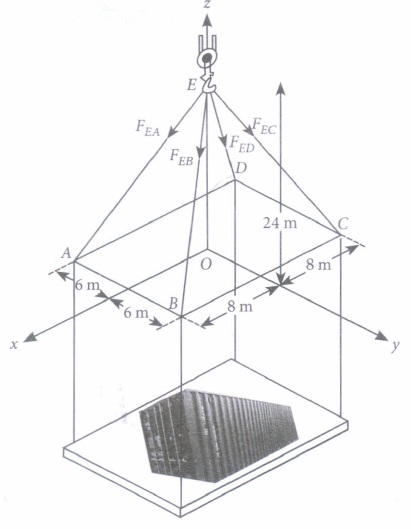
Based on the above information, answer the following questions.
(i) The cartesian equation of line along EA is
| \((a) \ \frac{x}{-4}=\frac{y}{3}=\frac{z}{12}\) | \((b) \ \frac{x}{-4}=\frac{y}{3}=\frac{z-24}{12}\) | \((c) \ \frac{x}{-3}=\frac{y}{4}=\frac{z-12}{12}\) | \((d) \ \frac{x}{3}=\frac{y}{4}=\frac{z-24}{12}\) |
(ii) The vector \(\overline{E D}\) is
| (a) \(8 \hat{i}-6 \hat{j}+24 \hat{k}\) | (b) \(-8 \hat{i}-6 \hat{j}+24 \hat{k}\) | (c) \(-8 \hat{i}-6 \hat{j}-24 \hat{k}\) | (d) \(8 \hat{i}+6 \hat{j}+24 \hat{k}\) |
(iii) The length of the cable EB is
| (a) 24 units | (b) 26 units | (c) 27 units | (d) 25 units |
(iv) The length of cable EC is equal to the length of
| (a) EA | (b) EB | (c) ED | (d) All of these |
(v) The sum of all vectors along the cables is
| (a) \(96 \hat{i}\) | (b) \(96 \hat{j}\) | (c) \(-96 \hat{k}\) | (d) \(96 \hat{k}\) |
24.
Geetika's house is situated at Shalimar Bagh at point 0, for going to Aloks house she first travels 8 km by bus in the East. Here at point A, a hospital is situated. From Hospital, Geetika takes an auto and goes 6 km in the North, here at point B school is situated. From school, she travels by bus to reach Aloks house which is at 30° East, 6 km from point B.
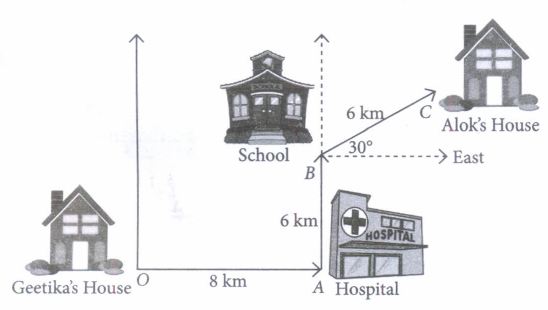
Based on the above information, answer the following questions.
(i) What is the vector distance between Geetikas house and school ?
| (a) \(8 \hat{i}-6 \hat{j}\) | (b) \(8 \hat{i}+6 \hat{j}\) | (c) \(8 \hat{i}\) | (d) \(6 \hat{j}\) |
(ii) How much distance Geetika travels to reach school?
| (a) 14 km | (b) 15 km | (c) 16 km | (d) 17 km |
(iii) What is the vector distance from school to Alok's house ?
| (a) \(\sqrt{3} \hat{i}+\hat{j}\) | (b) \(3 \sqrt{3} \hat{i}+3 \hat{j}\) | (c) \(6 \hat{i}\) | (d) \(6 \hat{j}\) |
(iv) What is the vector distance from Geetikas house to Alok's house?
| (a) \((8+3 \sqrt{3}) \hat{i}+9 \hat{j}\) | (b) \( 4\hat{i}+6 \hat{j}\) | (c) \(15 \hat{i}\) | (d) \(16 \hat{j}\) |
(v) What is the total distance travelled by Geetika from her house to Alok's house?
| (a) 19 km | (b) 20 km | (c) 21 km | (d) 22 km |
25.
Assertion (A) The lines \(\vec{r}=\overrightarrow{a_1}+\lambda \overrightarrow{b_1} \text { and } \vec{r}=\vec{a}_1+\mu \overrightarrow{b_2}\) are perpendicular, when \(\overrightarrow{b_1} \cdot \overrightarrow{b_2}=0\).
Reason (R) The angle \(\theta\) between the lines \(\vec{r}=\vec{a}_1+\lambda \vec{b}_1 \text { and } \vec{r}=\vec{b}_2+\mu \overrightarrow{b_2}\) is given by \(\cos \theta=\frac{\overrightarrow{b_1} \cdot \overrightarrow{b_2}}{\left|\overrightarrow{b_1}\right|\left|\overrightarrow{b_2}\right|}\)
(a) Both (A) and (R) are correct and (R) is the correct explanation of (A).
(b) Both (A) and (R) are correct but (R) is not the correct explanation of (A).
(c) (A) is correct but (R) is incorrect.
(d) Both (A) and (R) are incorrect.
26.
Assertion: \(\bar{a}\) = i + pj + 2k and \(\bar{b}\) = 2i + 3j + qk are parallel vectors if p = \(\frac{3}{2}\), q = 4
Reason: If \(\vec{a}\)= a1 \(\hat{i}\)+a2 \(\hat{j}\) + a3 \(\hat{k}\) and \(\vec{b}\) = b1\(\hat{i}\)+b2\(\hat{j}\)+b3 \(\hat{k}\) are parallel \(\frac{a_{1}}{b_{1}}=\frac{a_{2}}{b_{2}}=\frac{a_{3}}{b_{3}}\)
(a) Assertion is correct, Reason is correct; Reason is a correct explanation for assertion.
(b) Assertion is correct, Reason is correct; Reason is not a correct explanation for Assertion
(c) Assertion is correct, Reason is incorrect
(d) Assertion is incorrect, Reason is correct.
1.
\(\frac{3}{\sqrt{22}} \hat{i}-\frac{3}{\sqrt{22}} \hat{j}+\frac{2}{\sqrt{22}} \hat{k}\)
2.
First of all, let us graph the feasible region of the system of inequalities (2) to (5). The feasible region (shaded). Observe that the feasible region is unbounded.
We now evaluate Z at the corner points.
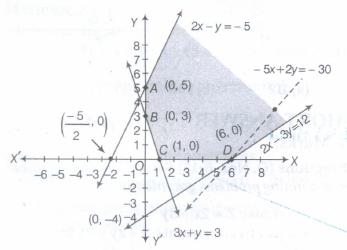
| Corner Point | Z = – 50x + 20y |
| (0, 5) | 100 |
| (0, 3) | 60 |
| (1, 0) | –50 |
| (6, 0) | – 300 (smallest) |
From this table, we find that – 300 is the smallest value of Z at the corner point (6, 0). Can we say that minimum value of Z is – 300? Note that if the region would have been bounded, this smallest value of Z is the minimum value of Z (Theorem 2). But here we see that the feasible region is unbounded. Therefore, – 300 may or may not be the minimum value of Z. To decide this issue, we graph the inequality
– 50x + 20y < – 300 (see Step 3(ii) of corner Point Method.)
i.e., – 5x + 2y < – 30
and check whether the resulting open half plane has points in common with feasible region or not. If it has common points, then –300 will not be the minimum value of Z.
Otherwise, –300 will be the minimum value of Z.
It has common points. Therefore, Z = –50 x + 20 y has no minimum value subject to the given constraints.
In the above example, can you say whether z = – 50 x + 20 y has the maximum value 100 at (0, 5)? For this, check whether the graph of – 50 x + 20 y > 100 has points in common with the feasible region.
3.
The feasible region determined by the system of constraints, 3x + 5y ≤ 15, 5x + 2y ≤ 10, x ≥ 0, and y ≥ 0, are as follows.
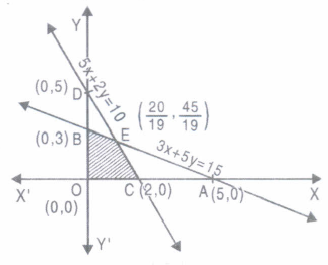
The corner points of the feasible region are O (0, 0), A (2, 0), B (0, 3), and C\(\left( \frac { 20 }{ 19 } ,\frac { 45 }{ 19 } \right) \)
The values of Z at these corner points are as follows.
Corner Point |
Corresponding Value of Z |
| C : (2,0) | 10 |
| E : \(\left( \frac { 20 }{ 19 } ,\frac { 45 }{ 19 } \right) \) | \(\frac { 235 }{ 19 } \) (Maximum) |
| B : (0,3) | 9 |
| O : (0,0) | 0 |
Therefore, the maximum value of Z is \(\frac { 235 }{ 19 } \) at \(\left( \frac { 20 }{ 19 } ,\frac { 45 }{ 19 } \right) \).
4.
Let the position vectors of vertices A,B and C be \(\overset { \wedge }{ 2i } -\overset { \wedge }{ j } +\overset { \wedge }{ k } ,\overset { \wedge }{ i } -\overset { \wedge }{ 3j } -\overset { \wedge }{ 5k } \quad and\quad \overset { \wedge }{ 3i } -\overset { \wedge }{ 4j } -\overset { \wedge }{ 4k } \) respectively
\(\therefore \overset { \rightarrow }{ AB } =\overset { \rightarrow }{ OB } -\overset { \rightarrow }{ OA }\)
\(= \left( \overset { \wedge }{ i } -\overset { \wedge }{ 3j } -\overset { \wedge }{ 5k } \right) -\left( \overset { \wedge }{ 2i } -\overset { \wedge }{ j } +\overset { \wedge }{ k } \right)\)
\(=\overset { \wedge }{ -i } -\overset { \wedge }{ 2j } -\overset { \wedge }{ 6k } \)
\( \therefore AB=\overset { \rightarrow }{ |AB| } \)
\(=\sqrt { { (-1) }^{ 2 }+{ (-2) }^{ 2 }+{ (-6) }^{ 2 } } \)
\(=\sqrt { 1+4+36 } =\sqrt { 41 } \)
\(\overset { \rightarrow }{ BC } =\overset { \rightarrow }{ OC } -\overset { \rightarrow }{ OB } \)
\(=\left( \overset { \wedge }{ 3i } -\overset { \wedge }{ 3j } -\overset { \wedge }{ 4k } \right) -\left( \overset { \wedge }{ i } -\overset { \wedge }{ 3j } -\overset { \wedge }{ 5k } \right) \)
\(=\overset { \wedge }{ 2i } -\overset { \wedge }{ j } +\overset { \wedge }{ k } \)
\(\therefore\) \(BC=\overset { \rightarrow }{ |BC| } =\sqrt { { 2 }^{ 2 }+{ (-1) }^{ 2 }+{ 1 }^{ 2 } } \)
\(=\sqrt { 4+1+1 } \quad \sqrt { 6 } \)
and \(\overset { \rightarrow }{ AC } =\overset { \rightarrow }{ OC } -\overset { \rightarrow }{ OA } \)
\(=\left( \overset { \wedge }{ 3i } -\overset { \wedge }{ 3j } -\overset { \wedge }{ 4k } \right) -\left( \overset { \wedge }{ 2i } -\overset { \wedge }{ j } +\overset { \wedge }{ k } \right) \)
\(=\overset { \wedge }{ i } -\overset { \wedge }{ 3j } -\overset { \wedge }{ 5k } \)
\(\therefore \quad AC=\overset { \rightarrow }{ |AC| } =\sqrt { { 1 }^{ 2 }+{ (-3) }^{ 2 }+{ (-5) }^{ 2 } } \)
\(=\sqrt { 1+9+25 } =\sqrt { 35 } \)
Now \({ BC }^{ 2 }+{ AC }^{ 2 }=6+35=35=41=AB\)
Hence \(\triangle\)ABC is a right angled triangle.
5.
Given, points are \(A(-2 \hat{i}+3 \hat{j}+5 \hat{k}), B(\hat{i}+2 \hat{j}+3 \hat{k})\) and \(C(7 \hat{i}-\hat{k})\).
Here, \(\overrightarrow{A B}=\vec{b}-\vec{a}=(\hat{i}+2 \hat{j}+3 \hat{k})-(-2 \hat{i}+3 \hat{j}+5 \hat{k})\)
\(=3 \hat{i}-\hat{j}-2 \hat{k}\)
and \(\begin{aligned}
\overrightarrow{B C} & =\vec{c}-\vec{b}=(7 \hat{i}-\hat{k})-(\hat{i}+2 \hat{j}+3 \hat{k})
\end{aligned}\)
\(\begin{aligned}
=6 \hat{i}-2 \hat{j}-4 \hat{k}=2(3 \hat{i}-\hat{j}-2 \hat{k})
\end{aligned}\)
Since, \(\overrightarrow{A B}=\lambda \overrightarrow{B C},\) where \(\lambda=2\)
So, the given points are collinear.
6.
Given, \(\vec{a}=\hat{i}-\hat{j}+7 \hat{k} \text { and } \vec{b}=5 \hat{i}-\hat{j}+\lambda \hat{k}\)
Now, \(\vec{a}+\vec{b}=6 \hat{i}-2 \hat{j}+(7+\lambda) \hat{k}\)
and \(\vec{a}-\vec{b}=-4 \hat{i}+(7-\lambda) \hat{k}\)
\(\because(\vec{a}+\vec{b}) \text { and }(\vec{a}-\vec{b})\) are orthogonal.
\(\begin{aligned}
\therefore & (\vec{a}+\vec{b}) \cdot(\vec{a}-\vec{b}) =0
\end{aligned}\)
\(\begin{aligned}
\Rightarrow & {[6 \hat{i}-2 \hat{j}+(7+\lambda) \hat{k}] \cdot[-4 \hat{i}+(7-\lambda) \hat{k}] } =0
\end{aligned}\)
\(\begin{aligned}
\Rightarrow & -24+49-\lambda^2 =0
\end{aligned}\)
\(\begin{aligned}
\Rightarrow & \lambda^2 =25
\end{aligned}\)
\(\begin{aligned}
\Rightarrow & \lambda = \pm 5
\end{aligned}\)
7.
Let the number of large vans = x
and number of small vans = y
Minimise cost z = 400x + 200y
subject to constraints
\(200 x+80 y \geq 1200 \text { or } 5 x+2 y \geq 30\) ,
\(400 x+200 y \leq 3000 \text { or } 2 x+y \leq 15\)
\(x
8.
\(cos\theta =\left| \frac { a_{ 1 }a_{ 2 }+b_{ 1 }b_{ 2 }+c_{ 1 }c_{ 2 } }{ \sqrt { { a }_{ 1 }^{ 2 }+b_{ 1 }^{ 2 }+{ c }_{ 1 }^{ 2 } } \sqrt { { a }_{ 2 }^{ 2 }+b_{ 2 }^{ 2 }+c_{ 2 }^{ 2 } } } \right| \)
\(a_{ 1 }=7,b_{ 1 }=2,c_{ 1 }=6\)
\(a_{ 2 }=3,b_{ 2 }=-1,c_{ 2 }=-10\)
\(cos\theta =\left| \frac { 7\times 3+2\times -1+6\times -10 }{ \sqrt { 49+4+36 } \sqrt { 9+1+100 } } \right| \)
\(=\left| \frac { 21-2-60 }{ \sqrt { 89 } \sqrt { 110 } } \right| \)
\(cos\theta =\frac { 41 }{ \sqrt { 9790 } } \)
\(\Rightarrow \theta =cos^{ -1 }\left( \frac { 41 }{ \sqrt { 9790 } } \right) \)
9.
Let A(0, 3, 2), B(3, 5, 6)
Direction ratios of AB(a, b, c) are (3 - 0), (5 - 3), (6 - 2)
\((a_{ 1 },b_{ 1 },c_{ 1 })\) = (3, 2, 4)
Let C(1, - 1, 2), 0(3, 4, - 2)
Direction ratios of CD \((a_{ 2 },b_{ 2 },c_{ 2 })\) are (3 - 1), (4 + 1) (-2,2) \((a_{ 2 },b_{ 2 },c_{ 2 })\) are (2,56,-4)
When two lines are perpendicular if
\(a_{ 1 },a_{ 2 }+b_{ 1 },b_{ 2 },+c_{ 1 },c_{ 2 }=0\)
\(\Rightarrow 3\times 2+2\times 5+4\times -4=0\)
\(\Rightarrow 6+10-16=0\)
\(\Rightarrow 16-16=0\)
\(\therefore AB\bot to\quad CD\)
10.
\((2\overset\rightarrow a-3\overset\rightarrow b).(3 \overset\rightarrow a+\overset\rightarrow b).=6\overset\rightarrow a.\overset\rightarrow a+2\overset\rightarrow a.\overset\rightarrow b-9\overset\rightarrow b.\overset\rightarrow a-3\overset\rightarrow b.\overset\rightarrow b\)
\(=6\left| \overset { \rightarrow }{ a } \right| ^{ 2}-(\overset\rightarrow a.\overset\rightarrow b)-3\left| \overset { \rightarrow }{ b } \right| ^{ 2}\)
\(=6(3)^{ 2}-7(2)-3(1)^{2 }\)
= 6(9) - 14 - 3
= 54 - 17 = 37
11.
\(\left|\overset\rightarrow a+\overset\rightarrow b \right|^{ 2 } +\left|\overset\rightarrow a-\overset\rightarrow b \right|^{ 2 }=2{(\left| \overset\rightarrow a \right| ^{2 }+\left|\overset\rightarrow b \right| ^{ 2 })}\)
\(\Rightarrow\left| \overset\rightarrow b \right| ^{ 2 }=2,116\)
\(\Rightarrow\left| \overset\rightarrow b \right| =46\)
12.
Positive vector of \(C=\frac{2(\overset\rightarrow a-3\overset\rightarrow b)+3(2\overset\rightarrow a+\overset\rightarrow b)}{2+3}\)
\(=\frac{2\overset\rightarrow a-6\overset\rightarrow b+6\overset\rightarrow a+3\overset\rightarrow b}{5}\)
Position vector of \(C=\frac{8\overset\rightarrow a-3\overset\rightarrow b}{5}\)
13.
We have, \(\vec{a}=\hat{i}+2 \hat{\jmath}+3 \hat{k} \text { and } \vec{b}=2 \hat{i}+4 \hat{\jmath}-5 \hat{k}\)
So, the diagonals of the parallelogram whose adjacent sides are \(\vec{a} \text { and } \vec{b}\) are given by
\(\begin{aligned}
\vec{p} & =\vec{a}+\vec{b} \text { and } \vec{q}=\vec{a}-\vec{b}
\end{aligned}\)
Now, \(\begin{aligned}
\vec{p} & =(\hat{i}+2 \hat{j}+3 \hat{k})+(2 \hat{i}+4 \hat{j}-5 \hat{k})
\end{aligned}\)
\(\begin{aligned}
=3 \hat{i}+6 \hat{j}-2 \hat{k}
\end{aligned}\)
and \(\begin{aligned}
\vec{q} & =(\hat{i}+2 \hat{j}+3 \hat{k})-(2 \hat{i}+4 \hat{j}-5 \hat{k})
\end{aligned}\)
\(\begin{aligned}
=-\hat{i}-2 \hat{j}+8 \hat{k}
\end{aligned}\)
\(\begin{aligned}
\therefore \quad \hat{p} & =\frac{\vec{p}}{|\vec{p}|}=\frac{3 \hat{i}+6 \hat{j}-2 \hat{k}}{\sqrt{9+36+4}}
\end{aligned}\)
\(\begin{aligned}
=\frac{3 \hat{i}+6 \hat{j}-2 \hat{k}}{7}=\frac{3}{7} \hat{i}+\frac{6}{7} \hat{j}-\frac{2}{7} \hat{k}
\end{aligned}\)
and \(\begin{aligned}
\hat{q} & =\frac{\vec{q}}{|\vec{q}|}=\frac{-\hat{i}-2 \hat{j}+8 \hat{k}}{\sqrt{1+4+64}}=\frac{-\hat{i}-2 \hat{j}+8 \hat{k}}{\sqrt{69}}
\end{aligned}\)
\(\begin{aligned}
=\frac{-1}{\sqrt{69}} \hat{i}-\frac{2}{\sqrt{69}} \hat{j}+\frac{8}{\sqrt{69}} \hat{k}
\end{aligned}\)
14.
The vector equations of given lines are
\(\begin{aligned}
\vec{r}=3 \hat{i}+2 \hat{j}-4 \hat{k}+\lambda(\hat{i}+2 \hat{j}+2 \hat{k})
\end{aligned}\)
and \(\begin{aligned}
\vec{r}=5 \hat{i}-2 \hat{j}+\mu(3 \hat{i}+2 \hat{j}+6 \hat{k})
\end{aligned}\)
On comparing them with \(\vec{r}=\overrightarrow{a_1}+\lambda \overrightarrow{b_1}\) and \(\vec{r}=\overrightarrow{a_2}+\mu \overrightarrow{b_2}\), we get
\(\overrightarrow{a_1}=3 \hat{i}+2 \hat{j}-4 \hat{k}, \overrightarrow{a_2}=5 \hat{i}-2 \hat{j}, \vec{b}_1=\hat{i}+2 \hat{j}+2 \hat{k}\)
and \(\vec{b}_2=3 \hat{i}+2 \hat{j}+6 \hat{k}\)
\(\therefore \quad \overrightarrow{a_2}-\overrightarrow{a_1}=(5 \hat{i}-2 \hat{j})-(3 \hat{i}+2 \hat{j}-4 \hat{k})\)
\(=2 \hat{i}-4 \hat{j}+4 \hat{k}\)
\(\begin{aligned}
\therefore \quad \vec{b}_1 \times \vec{b}_2 & =\left|\begin{array}{lll}
\hat{i} & \hat{j} & \hat{k} \\
1 & 2 & 2 \\
3 & 2 & 6
\end{array}\right|
\end{aligned}\)
\(\begin{aligned}
=\hat{i}(12-4)-\hat{j}(6-6)+\hat{k}(2-6)
\end{aligned}\)
\(\begin{aligned}
=8 \hat{i}-4 \hat{k}
\end{aligned}\)
\(\therefore\left(\vec{a}_2-\vec{a}_1\right) \cdot\left(\vec{b}_1 \times \vec{b}_2\right)=(2 \hat{i}-4 \hat{j}+4 \hat{k}) \cdot(8 \hat{i}-4 \hat{k})\)
= 16 + 0 - 16 = 0
\(\therefore\) The lines are intersecting and the shortest distance between the lines is 0.
Now, the position vectors of arbitrary points on the given lines are \((3+\lambda) \hat{i}+(2+2 \lambda) \hat{j}+(-4+2 \lambda) \hat{k}\) and \((5+3 \mu) \hat{i}+(-2+2 \mu) \hat{j}+6 \mu \hat{k}\), respectively.
Since, lines intersect then they have a common point.
\(\therefore \begin{aligned}
3+\lambda & =5+3 \mu
\end{aligned}\) ...(i)
\(\begin{aligned}
2+2 \lambda & =-2+2 \mu
\end{aligned}\) ...(ii)
\(\begin{aligned}
-4+2 \lambda & =6 \mu
\end{aligned}\) ...(iii)
On solving Eqs. (i) and (ii), we get
\(\lambda=-4 \text { and } \mu=-2\)
\(\therefore\) Point of intersection is (3 - 4, 2 - 8, -4 - 8)
i.e. (-1, -6, -12).
15.
Let land allocated to crop a = x hectare
Let land allocated to crop b = y hectare
Obviously, x \(\ge \) 0, y \(\ge \) 0
Profit per hectare on a = Rs. 10,000
Profit per hectare on b = Rs. 9,500
Total profit = 10,00x + 9,500y
To maximise: Z=10,000x + 9,500y
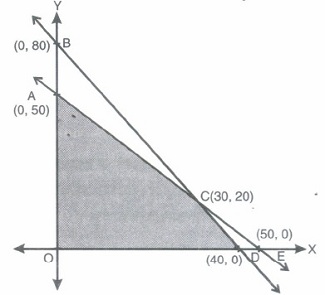
Given: x + y \(\le \) 50 (related to land) ...(i)
20x + 10y \(\le \) 800 (related to herbicide)
\(\Rightarrow\) 2x + y\(\le \) 80..(ii)
x \(\ge \) 0, y\(\ge \) 0
Calculate value on O, A, C, D and note,
At point O(0, 0),
Z = 0
At point A(00, 50),
Z = 0 + 9500 \(\times\)50
= Rs. 4,75,000
At point D(40, 0),
Z = Rs. 4,00,000
At point C(30, 20),
Z = Rs. 4,90,000,
Which is maximum i.e., society will get maximum profit of Rs. 4,90,000 by allocationg 30 hectare to crop a and 20 hectare to crop b.
Value: Awareness would increase the profit of farmers.
16.
Given inequations are
\(2 x+4 y \leq 8 \text { or } \ x+2 y \leq 4 \)
\(3 x+y \leq 6, x+y \leq 4, \ x \geq 0, \ y \geq 0
\)
Maximise Z = 2x + 5y on plotting the graph of the inequations we notice shaded portion as feasible solution
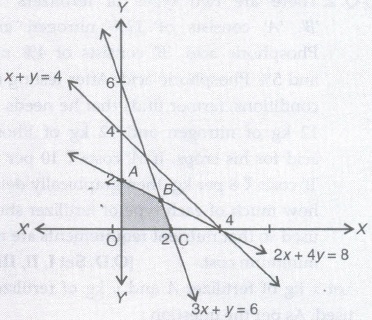
Possible points for maximum Z are A(2, 0),\(B\left(\frac{8}{5}, \frac{6}{5}\right)\) C (0,2)
| Points | Z= 2x + 5y | Values |
| A(2,0) | 4 + 0 | 4 |
| \(B\left(\frac{8}{5}, \frac{6}{5}\right)\) | \(\frac{16}{5}+\frac{30}{5}\) | \(\frac{46}{5}=9 \frac{1}{5}\) |
| C(0,2) | 0 + 10 | 10 \(\leftarrow\) Maximum |
Z is maximum at qo, 2), i.e. x = 0, y = 2, maximum value = 10
17.
The equation of the line passing through point (3, -2, 1) and parallel to the given line is \(\frac { x-3 }{ 2 } =\frac { y+2 }{ -3 } =\frac { z-1 }{ 1 } =\lambda\)
Any point on this line, we have (2\(\lambda \)+3, -3\(\lambda \)-2, \(\lambda \)+1)
If it lies on the plane, we have 3(2\(\lambda \)+3)-3\(\lambda \)-2-\(\lambda \)-1+2 = 0
\(\Rightarrow \lambda =-4\)
Hence, the point common to the plane and the line is (-5, 10, -3).
Hence the required distance = \(\sqrt { { \left( 3+5 \right) }^{ 2 }+{ \left( -2-10 \right) }^{ 2 }+{ { \left( 1+3 \right) } }^{ 2 } } =4\sqrt { 14 } units\)
The equation of the line passing through (3, -2, 1) and perpendicular to the plane is \(\frac { x-3 }{ 3 } =\frac { y+2 }{ 1 } =\frac { z-1 }{ -1 } =\mu\)
Any point on it is (3\(\mu\)+3, \(\mu\)-2, -\(\mu\) +1)
If it lies on the plane, we get 3(3\(\mu\)+3)+\(\mu\) -2+ \(\mu\)-1+2 = 0
\(\Rightarrow\) \(\mu=\frac{8}{11}\)
The required foot of the perpendicular is \(\left( \frac { 9 }{ 11 } ,\ \frac { -30 }{ 11 } ,\ \frac { 19 }{ 11 } \right) \).
18.
(d)
5
19.
(d)
Optimisation problems
20.
(b)
\(\frac { 1 }{ \sqrt { 2 } } ,\frac { \sqrt { 3 } }{ 2 } ,\frac { 1 }{ \sqrt { 2 } } \)
21.
As normal form of plane is
\(\overrightarrow { r } .(-\frac { 2 }{ 7 } \widehat { i } -\frac { 3 }{ 7 } \widehat { j } +\frac { 9 }{ 7 } \widehat { k } )\) = \(\frac27\)
∴ distance = \(\frac27\)
∴ p = \(\frac27\)
22.
As \({ \left| \sqrt { 3 } \vec { a } -\vec { b } \right| }^{ 2 }=({ \sqrt { 3 } \vec { a } -\vec { b } ) }^{ 2 }\)
\(=3\vec { { a }^{ 2 } } +\vec { { b }^{ 2 } } -2\sqrt { 3 } \vec { a } .\vec { b } \)
\(1=3+1-2\sqrt { 3 } \vec { a } .\vec { b } \)
\(\Rightarrow \vec { a } .\vec { b } =\frac { \sqrt { 3 } }{ 2 } \)
\(\therefore cos\theta =\frac { \vec { a } .\vec { b } }{ |\vec { b } ||\vec { b } | } =\frac { \sqrt { 3 } }{ 2 } \)\(\Rightarrow \theta ={ 30 }^{ 0 }\)
23.
(i) (b): Clearly, the coordinates of A are (8, -6, 0) and that of E are (0, 0, 24).
Also, cartesian equation of line along EA is given by
\(\frac{x-0}{8-0}=\frac{y-0}{-6-0}=\frac{z-24}{0-24}\)
\(\Rightarrow \frac{x}{8}=\frac{y}{-6}=\frac{z-24}{-24} \Rightarrow \frac{x}{-4}=\frac{y}{3}=\frac{z-24}{12}\)
(ii) (c): Clearly, the coordinates of Dare (-8, -6, 0) and that of E are (0, 0, 24)
\(\therefore \text { Vector } \overline{E D} \text { is }(-8-0) \hat{i}+(-6-0) \hat{j}+(0-24) \hat{k} \ \text { i.e., }-8 \hat{i}-6 \hat{i}-24 \hat{k}
\)
(iii) (b): Since, the coordinates of Bare (8, 6, 0) and that of E are (0, 0, 24), therefore length of cable
\(E B=\sqrt{(8-0)^{2}+(6-0)^{2}+(0-24)^{2}}
\)
\(=\sqrt{64+36+576}=\sqrt{676}=26 \text { units }\)
(iv) (d): Since, the coordinates of Care (-8,6,0) therefore length of cable EC = \(\sqrt{(-8-0)^{2}+(6-0)^{2}+(0-24)^{2}}\)
\(=\sqrt{64+36+576}=\sqrt{676}=26 \mathrm{units}\)
Similarly, length of cable EA = ED = 26 units.
(v) (c): Sum of all vectors along the cables
\(=\overrightarrow{E A}+\overrightarrow{E B}+\overrightarrow{E C}+\overline{E D}\)
\(
=(8 \hat{i}-6 \hat{j}-24 \hat{k})+(8 \hat{i}+6 \hat{j}-24 \hat{k})+(-8 \hat{i}+6 \hat{j}-24 \hat{k})+(-8 \hat{i}-6 \hat{j}-24 \hat{k})
\)
\(=-96 \hat{k}\)
24.
(i) (b) : We have, \(\overrightarrow{O A}=8 \hat{i} \text { and } \overrightarrow{A B}=6 \hat{j}\)
\(\therefore \overrightarrow{O B}=\overrightarrow{O A}+\overrightarrow{A B}=8 \hat{i}+6 \hat{j}\)
(ii) (a) : To reach school Geetika travels
=(8+6) km=14km
(iii) (b): Vector distance from school to Alok's house
\( =6 \cos 30^{\circ} \hat{i}+6 \sin 30^{\circ} \hat{j} \)
\(=6 \times \frac{\sqrt{3}}{2} \hat{i}+6 \times \frac{1}{2} \hat{j}=3 \sqrt{3} \hat{i}+3 \hat{j}\)
(iv) (a): Vector distance from Geetika's house to
Alok'shouse =\(8 \hat{i}+6 \hat{j}+3 \sqrt{3} \hat{i}+3 \hat{j}=(8+3 \sqrt{3}) \hat{i}+9 \hat{j}\)
(v) (b): Total distance travelled by Geetika from her house to Alok's house = (8 + 6 + 6) km = 20 km.
25.
(a) Assertion The given lines are \(\vec{r}=\vec{a}_1+\lambda \overrightarrow{b_1}\) and \(\vec{r}=\vec{a}_2+\lambda \vec{b}_2\)
Let \(\theta\) be the angle between these lines
\(\therefore \cos \theta=\frac{\vec{b}_1 \cdot \vec{b}_2}{\left|\vec{b}_1\right|| \vec{b}_2 \mid}\)
When \(\overrightarrow{b_1} \cdot \overrightarrow{b_2}=0\)
Then, \(\cos \theta=\frac{0}{\left|\vec{b}_1\right|\left|\vec{b}_2\right|}=0\)
\(\Rightarrow \quad \cos \theta=\cos \frac{\pi}{2} \Rightarrow \theta=\frac{\pi}{2}\)
Hence, the given lines are perpendicular.
Both Assertion and Reason are true and Reason is a correct explanation of Assertion.
26.
(b) Assertion is correct, Reason is correct; Reason is not a correct explanation for Assertion

12th Standard CBSE Syllabus & Materials
12th Standard CBSE
CBSE 12th Computer Science Python Revision Tour I - New Previous year Question Papers Study Material - QB365 Set A
NEW12th Standard CBSE
CBSE 12th Business Studies Planning Important Questions And Answers Study Material - QB365 Set A
NEW12th Standard CBSE
CBSE 12th Business Studies Business Environment Important Questions And Answers Study Material - QB365 Set A
NEW12th Standard CBSE
CBSE 12th Business Studies Principles of Management Important Questions And Answers Study Material - QB365 Set A



NCERT Books

Syllabus

Exam Pattern

Sample Question Papers

Previous year Question Papers

Important Notes

MCQ Practice test

NCERT Exemplers

Case study Questions

Image Based Questions

Passage based Questions

HOT Questions

Value Based Questions

Model Questions Papers
NCERT ( Book Back ) Questions

Assertion and Reason
Important Questions And Answers

CBSE 12th Standard CBSE Subjects
CBSE Standards