
 100% FREE ACCESS
12th Standard CBSE Syllabus & Materials
12th Standard CBSE
CBSE 12th Economics Government Budget and the Economy Previous year Question Papers Study Material - QB365 Set A
NEW12th Standard CBSE
CBSE 12th Computer Science Interface Python with MySQL - New Previous year Question Papers Study Material - QB365 Set A
NEW12th Standard CBSE
CBSE 12th Computer Science Database Concept - New Previous year Question Papers Study Material - QB365 Set A
NEW12th Standard CBSE
CBSE 12th Computer Science Data Communication - New Previous year Question Papers Study Material - QB365 Set A
NEW12th Standard CBSE
CBSE 12th Computer Science Data Structures - New Previous year Question Papers Study Material - QB365 Set A
NEW12th Standard CBSE
CBSE 12th Computer Science Functions - New Previous year Question Papers Study Material - QB365 Set A

Published on: 20/08/2026
Download CBSE Class 12th Standard CBSE Maths question papers, sample papers, important questions, and previous year solved papers in PDF format. Get free study materials, NCERT solutions, and exam preparation resources for Class 12th Standard CBSE Maths
Questions + Answers key
Take MCQ Maths Test
1.
A and B are independent events such that \(P(A \cap \bar{B})=\frac{1}{4} \text { and } P(\bar{A} \cap B)=\frac{1}{6}\). Find P(A) and P(B).
2.
Find the equation of the line which intersects the lines \(\frac{x+2}{1}=\frac{y-3}{2}=\frac{z+1}{4} \text { and } \frac{x-1}{2}=\frac{y-2}{3}=\frac{z-3}{4}\) and passes through the point (1, 1, 1).
3.
A box contains 4 orange and 4 green balls, another box contains 3 orange and 5 green balls, one of the two box is selected at random and a ball is drawn from the box, which is found to be orange. Find the probability that the ball is drawn from the first box.
4.
Determine graphically the minimum value of the objective function
Z = – 50x + 20y
subject to constraints
\(2 x-y \geq-5,\)
\(3 x+y \geq 3\)
\(2 x-3 y \leq 12\)
\(x \geq 0, y \geq 0\).
5.
Using vectors, find the area of triangle with vertices \(A(1,1,2), B(2,3,5) \text { and } C(1,5,6)\)
6.
Find the position vector of a point C which divides the line segment joining A and B, whose position vectors are \(2 \vec{a}+\vec{b} \text { and } \vec{a}-3 \vec{b}\) externally in the ratio 1: 2. Also, show that A is the mid-point of the line segment BC.
7.
Find a vector of magnitude 5 units and parallel to the resultant of \(\vec{a}=2 \hat{i}+3 \hat{j}-3 \hat{k}\) and \(\vec{b}=\hat{i}-2 \hat{j}+3 \hat{k}\).
8.
Find the points on the line \(\frac { x+2 }{ 3 } =\frac { y+1 }{ 2 } =\frac { z-3 }{ 2 } \) at a distance of 5 units from the point P(1, 3, 3).
9.
The probability that it will rain on any particular day is 50%. Find the probability that it rains only on first 4 days of the week.
10.
Find the vector equation of the line passing through the point A(1, 2,-1)and parallel to the line 5x-25 = 14-7y = 35z.
11.
Find \(\vec{a} \cdot(\vec{b} \times \vec{c}), \text { if } \vec{a}=2 \hat{i}+\hat{j}+3 \hat{k}, \vec{b}=-\hat{i}+2 \hat{j}+\hat{k}\) and \(\vec{c}=3 \hat{i}+\hat{j}+2 \hat{k}\) .
12.
Find the projection of the vector \(\hat{i}+3 \hat{j}+7 \hat{k}\) on the vector \(2 \hat{i}-3 \hat{j}+6 \hat{k}\).
13.
Write the value of \(\lambda\) ,so that the vectors \(\vec{a}=2 \hat{i}+\lambda \hat{j}+\hat{k} \text { and } \vec{b}=\hat{i}-2 \hat{j}+3 \hat{k}\) are perpendicular to each other.
14.
If P(E) = \(\frac { 6 }{ 11 } \), P(F) = \(\frac { 5 }{ 11 } \) and P(E \(\cup\)F) = \(\frac { 7 }{ 11 } \) then find (a) P(E/F), (b) P(F/E)
15.
Using direction ratios, show that the points (2, 3, 4), (-1, -2, 1) and (5, 8, 7) are collinear.
16.
Find the vector \(\vec{p}\)which is perpendicular to both \(\vec{\alpha}=4 \hat{i}+5 \hat{j}-\hat{k} \text { and } \vec{\beta}=\hat{i}-4 \hat{j}+5 \hat{k} \text { and } \vec{p} \cdot \vec{q}=21\), where \(\vec{q}=3 \hat{i}+\hat{j}-\hat{k}\).
17.
Find the shortest distance between the lines
\(\vec{r}=3 \hat{i}+2 \hat{j}-4 \hat{k}+\lambda(\hat{i}+2 \hat{j}+2 \hat{k})\)
and \(\vec{r}=5 \hat{i}-2 \hat{j}+\mu(3 \hat{i}+2 \hat{j}+6 \hat{k})\)
If the lines intersect, find their point of intersection.
18.
Find the image of the point (2, -1, 5) in the line \(\frac{x-11}{10}=\frac{y+2}{-4}=\frac{z+8}{-11}\)
19.
A card from a pack of 52 playing cards is lost. From the remaining cards of the pack, three cards are drawn at random (without replacement) and are found to be all spades. Find the probability of the lost card being a spade.
20.
A bag I contains 5 red and 4 white balls and a bag II contains 3 red and 3 white balls. Two balls are transferred from the bag I to the bag II and then one ball is drawn from bag II. If the ball drawn from the bag II is red, then find the probability that one red ball and one white ball are transferred from the bag I to the bag II.
21.
If A and B are two events such that P(A) =0.2, P(B) =0.4 and P(A U B) = 0.5, then value of P(A /B) is?
0.1
0.25
0.5
0.08
22.
The value of \(\lambda\), for which two vectors \(2 \hat{i}-\hat{j}+2 \hat{k}\) and \(3 \hat{i}+\lambda \hat{j}+\hat{k}\) are perpendicular is
2
4
6
8
23.
A bag A contains 3 white, 2 red balls and a bag B contains 4 white and 5 red balls. One ball is drawn at random from one of the bags and is found to be red, then the probability that it was drawn from bag B is
\(\frac{27}{43}\)
\(\frac{20}{43}\)
\(\frac{25}{43}\)
none of these
24.
A bag contains 5 red, 6 blue and 4 black balls. Three balls are drawn from the bag. Then the probability that none of them is red, is
\(\frac{24}{91}\)
\(\frac{2}{91}\)
\(\frac{6}{35}\)
none of these
25.
Intercept cut by the plane 2x - y + 2z + 7 = 0 on the x-axis is
2
\(\frac{7}{2}\)
\(-\frac{7}{2}\)
-2
26.
The position vectors of opposite vertices of a parallelogram are \(2 \vec{a}+3 \vec{b} \text { and } \vec{a}-2 \vec{b} .\) Then position vector of the point of intersection of diagonals is
\(3 \vec{a}+\vec{b}\)
\(\frac{\vec{a}+5 \vec{b}}{2}\)
\(\frac{3 \vec{a}+\vec{b}}{2}\)
none of these
27.
\(\text { If } \vec{a}+\vec{b}+\vec{c}=\overrightarrow{0} \text { then }\)
\(\vec{a} \times \vec{b}=\vec{b} \times \vec{c}=\vec{c} \times \vec{a}\)
\(\vec{a}+\vec{b}=\vec{b}+\vec{c}=\vec{c}+\vec{a}\)
\(\vec{a}, \vec{b}, \vec{c} \text { are non-coplanar }\)
none of these
28.
If three mutually independent events are A, B andC, then
\(P(A \cap B)=P(A) \cdot P(B) ; P(A \cap C)=P(A) \cdot P(C)\)
\(P(B \cap C)=P(B) \cdot P(C)\)
\(P(A \cap B \cap C)=P(A) \cdot P(B) \cdot P(C)\)
All of the above
29.
Which of the term is not used in a linear programming problem?
Optimal solution
Feasible solution
Concave region
Objective function
30.
If \(\vec{r} \cdot \vec{a}=0, \vec{r} \cdot \vec{b}=0 \text { and } \vec{r} \cdot \vec{c}=0\) for some non-zero vector \(\vec{r}\) then the value of \([\vec{a} \vec{b} \vec{c}]\) is
0
3
\(\frac{3}{2}\)
1
31.
If \(\theta\) is the angle between two vectors \(\vec{a} \text { and } \vec{b}\), then \(\vec{a} \cdot \vec{b} \geq 0\) only when
\(<\theta<\frac{\pi}{2}\)
\(0 \leq \theta \leq \frac{\pi}{2}\)
\(0<\theta<\pi\)
\(0 \leq \theta \leq \pi\)
32.
The common region determined by all the constraints including non-negative constraints x, y ≥ 0 of a linear programming problem is called the ………
Bounded region
Simple region
Infeasible region
Feasible region
33.
Find the equation of the set of points which are equidistant from the points (1, 2 , 3) and (3, 2, -1)
x + 2z = 0
y + 2z = 0
x – 2y = 0
x – 2z = 0
34.
If a line makes angles 45°, 150°, 135°, with x, y and z-axes respectively, find its direction cosines.
\(\frac { 1 }{ \sqrt { 2 } } ,-\frac { \sqrt { 3 } }{ 2 } ,\frac { 1 }{ \sqrt { 2 } } \)
\(\frac { 1 }{ \sqrt { 2 } } ,\frac { \sqrt { 3 } }{ 2 } ,\frac { 1 }{ \sqrt { 2 } } \)
\(\frac { 1 }{ \sqrt { 2 } } ,-\frac { 1 }{ 2 } ,-\frac { \sqrt { 3 } }{ \sqrt { 2 } } \)
\(\frac { 1 }{ \sqrt { 2 } } ,\frac { \sqrt { 3 } }{ 2 } ,-\frac { 1 }{ \sqrt { 2 } } \)
35.
The direction cosines of the line equally inclined with the axes are:
1, 1, 1
1/\(\sqrt3\), 1/\(\sqrt3\), 1/\(\sqrt3\)
1, 0, 0
1/3, 1/3, 1/3
36.
Three planes, viz the XY Plane, XZ Plane and the YZ Plane divide the space into eight parts. Each part is called an OCTANT. What is the relation between these three planes
They form the angles α, β & γ with each other
Any two must be perpendicular to each other
All three are mutually perpendicular
no relation between these three planes
37.
If P(A ∩ B) = 70% and P(B) = 85%, then P(A/B) is equal to
\(\frac{14}{17}\)
\(\frac{17}{20}\)
\(\frac78\)
\(\frac18\)
38.
Feasible region is the set of points which satisfy
the objective functions
some of the given constraints
all of the given constraints
none of these
39.
A departmental store sends bills to charge its customers once a month. Past experience shows that 70% of its customers pay their first month bill in time. The store also found that the customer who pays the bill in time has the probability of 0.8 of paying in time next month and the customer who doesn't pay in time has the probability of 0.4 of paying in time the next month.
Based on the above information, answer the following questions.
(i) Let E1 and E2, respectively denote the event of customer paying or not paying the first month bill in time.
Find P(E1), P(E2).
(ii) Let A denotes the event of customer paying second month's bill in time, then find P\(\left(\frac{A}{E_1}\right)\) and \(P\left(\frac{A}{E_2}\right)\).
(iii) Find the probability of customer paying second month's bill in time.
Or
(ii) Find the probability of customer paying first month's bill in time, if it is found that customer has paid the second month's bill in time.
40.
The equation of motion of a rocket are: x = 2t, y = -4t, z = 4t, where the time 't' is given in seconds, and the distance measured is in kilometres.
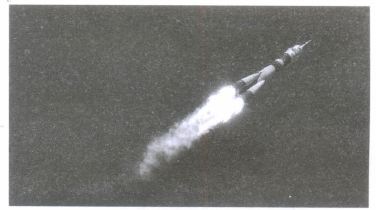
Based on the above information, answer the following questions.
(i) What is the path of the rocket?
| (a) Straight line | (b) Circle | (c) Parabola | (d) none of these |
(ii) Which of the following points lie on the path of the rocket?
| (a) (0, 1, 2) | (b) (1, -2, 2) | (c) (2, -2, 2) | (d) none of these |
(iii) At what distance will the rocket be from the starting point (0, 0, 0) in 10 seconds?
| (a) 40 km | (b) 60 km | (c) 30 km | (d) 80 km |
(iv) If the position of rocket at certain instant of time is (3, -6, 6), then what will be the height of the rocket from the ground, which is along the xy-plane?
| (a) 3km | (b) 2km | (c) 4km | (d) 6km |
(v) At certain instant of time, if the rocket is above sea level, where equation of surface of sea is given by 3x - y + 4z = 2 and position of rocket at that instant of time is (1, -2,2), then the image of position of rocket in the sea is
| (a) \(\left(\frac{20}{13}, \frac{15}{13}, \frac{18}{13}\right)\) | (b) \(\left(\frac{-20}{13}, \frac{-15}{13}, \frac{-18}{13}\right)\) | (c) \(\left(\frac{20}{13}, \frac{-15}{13}, \frac{18}{13}\right)\) | (d) none of these |
41.
Deepa rides her car at 25 km/hr, She has to spend Rs. 2 per km on diesel and if she rides it at a faster speed of 40 km/hr, the diesel cost increases to Rs. 5 per km. She has Rs. 100 to spend on diesel. Let she travels x kms with speed 25 km/hr and y kms with speed 40 km/hr. The feasible region for the LPP is shown below:
Based on the above information, answer the following questions
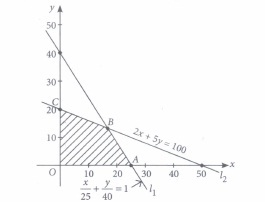
Based on the above information, answer the following questions.
(i) What is the point of intersection of line l1 and l2,
| \(\text { (a) }\left(\frac{40}{3}, \frac{50}{3}\right)\) | \(\text { (b) }\left(\frac{50}{3}, \frac{40}{3}\right)\) | \(\text { (c) }\left(\frac{-50}{3}, \frac{40}{3}\right)\) | \(\text { (d) }\left(\frac{-50}{3}, \frac{-40}{3}\right)\) |
(ii) The corner points of the feasible region shown in above graph are
| \(\text { (a) }(0,25),(20,0),\left(\frac{40}{3}, \frac{50}{3}\right)\) | \(\text { (b) }(0,0),(25,0),(0,20)\) | \(\text { (c) }(0,0),\left(\frac{40}{3}, \frac{50}{3}\right),(0,20)\) | \(\text { (d) }(0,0),(25,0),\left(\frac{50}{3}, \frac{40}{3}\right),(0,20)\) |
(iii) If Z = x + y be the objective function and max Z = 30. The maximum value occurs at point
| \(\text { (a) }\left(\frac{50}{3}, \frac{40}{3}\right)\) | (b) (0, 0) | (c) (25, 0) | (d) (0, 20) |
(iv) If Z = 6x - 9y be the objective function, then maximum value of Z is
| (a) -20 | (b) 150 | (c) 180 | (d) 20 |
(v) If Z = 6x + 3y be the objective function, then what is the minimum value of Z?
| (a) 120 | (b) 130 | (c) 0 | (d) 150 |
42.
Assertion (A) Two coins are tossed simultaneously. The probability of getting two heads, if it is known that at least one head comes up, is \(\frac{1}{3}\).
Reason (R) Let E and F be two events with a random experiment, then \(P(F / E)=\frac{P(E \cap F)}{P(E)} \text {. }\)
(a) Both Assertion and Reason are correct and Reason is the correct explanation of Assertion.
(b) Both Assertion and Reason are correct but Reason is not the correct explanation of Assertion.
(c) Assetion is correct but Reason is incorrect.
(d) Both Assertion and Reason are incorrect.
43.
Assertion: In \(\Delta\)ABC, \(\overline{AB}+\overline{BC}+\overline{CA}=0.\)
Reason: If \(\overline{OA}\) = \(\overline{a}\), \(\overline{OB}\) = \(\overline{b}\), then \(\overline{AB}\) = \(\overline{a}\)+ \(\overline{b}\) (triangle law of addition)
(a) Assertion is correct, Reason is correct; Reason is a correct explanation for assertion.
(b) Assertion is correct, Reason is correct; Reason is not a correct explanation for Assertion
(c) Assertion is correct, Reason is incorrect
(d) Assertion is incorrect, Reason is correct.
1.
Given, A and B are two independent events such that
\(P(A \cap \bar{B})=\frac{1}{4} \text { and } P(\bar{A} \cap B)=\frac{1}{6}\)
Now, \(P(A \cap \bar{B})=\frac{1}{4}\)
\(\begin{aligned}
\Rightarrow \quad P(A) \cdot P(\bar{B})=\frac{1}{4}
\end{aligned}\)
\(\begin{aligned}
\Rightarrow \quad P(A)[1-P(B)]=\frac{1}{4} \quad[\because P(B)+P(\bar{B})=1]
\end{aligned}\)
\(\Rightarrow P(A)-P(A) P \cdot(B)=\frac{1}{4}\) ...(i)
and \(P(\bar{A} \cap B)=\frac{1}{6} \Rightarrow P(\bar{A}) \cdot P(B)=\frac{1}{6}\)
\(\begin{aligned}
\Rightarrow \quad[1-P(A)] P(B)=\frac{1}{6}
\end{aligned}\)
\(\begin{aligned}
\Rightarrow \quad P(B)-P(A) P(B)=\frac{1}{6}
\end{aligned}\) ...(ii)
On subtracting Eq. (ii) from Eq.(i), we get
\(P(A)-P(B)=\frac{1}{4}-\frac{1}{6} \Rightarrow P(A)=\frac{1}{12}+P(B)\)
Now, on substituting this value in Eq. (ii), we get
\(\begin{aligned}
P(B)-\left(\frac{1}{12}+P(B)\right) P(B)=\frac{1}{6}
\end{aligned}\)
Let \(\begin{aligned}
\Rightarrow 12 x-x-12 x^2=2 \Rightarrow 12 x^2-11 x+2=0
\end{aligned}\)
\(\begin{aligned}
\Rightarrow 12 x^2-8 x-3 x+2=0
\end{aligned}\)
\(\begin{aligned}
\Rightarrow \quad(4 x-1)(3 x-2)=0
\end{aligned}\)
\(\begin{aligned}
\Rightarrow x=\frac{1}{4} \text { or } x=\frac{2}{3} \Rightarrow P(B)=\frac{1}{4} \text { or } P(B)=\frac{2}{3}
\end{aligned}\) [put x = P(B)]
Now, if P(B) = \(\frac{1}{4}\), then
\(P(A)=\frac{1}{12}+\frac{1}{4}=\frac{1+3}{12}=\frac{4}{12}=\frac{1}{3}\)
and if P(B) = \(\frac{2}{3}\), then \(P(A)=\frac{1}{12}+\frac{2}{3}=\frac{1+8}{12}=\frac{9}{12}=\frac{3}{4}\)
2.
We have, the following equations of lines
\(\begin{aligned} \frac{x+2}{1}=\frac{y-3}{2}=\frac{z+1}{4} \end{aligned}\)
and \(\frac{x-1}{2}=\frac{y-2}{3}=\frac{z-3}{4} \)
Let \(\frac{x+2}{1}=\frac{y-3}{2}=\frac{z+1}{4}=\lambda\)
Thus, the general point on the first line is
\((\lambda-2,2 \lambda+3,4 \lambda-1)\)
Again, let \(\frac{x-1}{2}=\frac{y-2}{3}=\frac{z-3}{4}=\mu\)
Thus, the general point on the second line is
\((2 \mu+1,3 \mu+2,4 \mu+3)\)
Now, the direction ratios of the required line are
\((\lambda-3,2 \lambda+2,4 \lambda-2)\)
Direction ratios of the same line may be
\(\begin{aligned} (2 \mu, 3 \mu+1,4 \mu+2) \end{aligned}\)
\(\begin{aligned} \therefore & \frac{\lambda-3}{2 \mu}=\frac{2 \lambda+2}{3 \mu+1}=\frac{4 \lambda-2}{4 \mu+2} \end{aligned}\) ...(i)
Let \(\frac{\lambda-3}{2 \mu}=\frac{2 \lambda+2}{3 \mu+1}=\frac{2 \lambda-1}{2 \mu+1}=k\)
\(\begin{aligned} \Rightarrow \quad \lambda-3=2 \mu k, 2 \lambda+2=(3 \mu+1) k \end{aligned}\),
\(\begin{aligned} \text { and } 2 \lambda-1=(2 \mu+1) k \end{aligned}\)
\(\Rightarrow \quad \frac{\lambda-3}{2}=\mu k, 2 \lambda+2=3 \times \frac{\lambda-3}{2}+k\)
and \(\begin{aligned} 2 \lambda-1 & =\lambda-3+k \end{aligned}\)
\(\begin{aligned} \Rightarrow k & =\frac{4 \lambda+4-3 \lambda+9}{2} \end{aligned}\)
and \(k=2 \lambda-1-\lambda+3\)
\(\begin{array}{ll} \Rightarrow & k=\frac{\lambda+13}{2} \text { and } k=\lambda+2 \\ \end{array}\)
\(\begin{array}{ll} \therefore & \frac{\lambda+13}{2}=\lambda+2 \\ \end{array}\)
\(\begin{array}{ll} \Rightarrow & 13+\lambda=2 \lambda+4 \Rightarrow \lambda=9 \end{array}\)
\(\begin{array}{ll} \Rightarrow & k=\lambda+2=9+2=11 \end{array}\)
\(\because \mu k=\frac{\lambda-3}{2} \Rightarrow \mu(11)=\frac{9-3}{2} \Rightarrow \mu=\frac{6}{22}=\frac{3}{11}\)
Now, the direction ratios of the required line are (6, 20, 34) or (3, 10, 17).
Hence, the equation of the required line is given by \(\frac{x-1}{3}=\frac{y-1}{10}=\frac{z-1}{17}\)
3.
Let EI = event of selecting box
and E 2 = event of selecting box II
Let A = event of drawing an orange ball.
Now, \(P\left(E_{1}\right)=\frac{1}{2} \text { and } P\left(E_{2}\right)=\frac{1}{2}\)
Now, P(A / E1) = Probability of selecting an orange ball from box I
\(=\frac{4}{8}=\frac{1}{2}\)
\([\because \text { total balls }=8 \text { and orange balls }=4]\)
and P(A / E2) = Probability of selecting an orange ball from box II
= \(\frac{3}{8}\) [\(\therefore\) total balls = 8 and orange balls = 3]
Now, P(E1 / A) = Probability that drawn ball is from the first box
\(=\frac{P\left(E_{1}\right) \cdot P\left(A / E_{1}\right)}{P\left(E_{1}\right) \cdot P\left(A / E_{1}\right)+P\left(E_{2}\right) \cdot P\left(A / E_{2}\right)}\)
\(=\frac{\frac{1}{2} \times \frac{1}{2}}{\left(\frac{1}{2} \times \frac{1}{2}\right)+\left(\frac{1}{2} \times \frac{3}{8}\right)}=\frac{\frac{1}{4}}{\frac{1}{4}+\frac{3}{16}}\)
\(=\frac{\frac{1 / 4}{4+3}}{16}=\frac{1}{4} \times \frac{16}{7}=\frac{4}{7}\)
Hence, the probability that the ball is drawn from the first box is \(\frac{4}{7}\) .
4.
First of all, let us graph the feasible region of the system of inequalities (2) to (5). The feasible region (shaded). Observe that the feasible region is unbounded.
We now evaluate Z at the corner points.
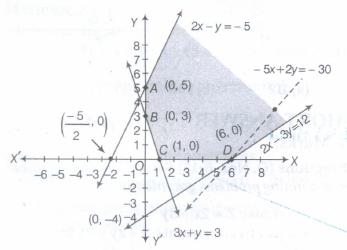
| Corner Point | Z = – 50x + 20y |
| (0, 5) | 100 |
| (0, 3) | 60 |
| (1, 0) | –50 |
| (6, 0) | – 300 (smallest) |
From this table, we find that – 300 is the smallest value of Z at the corner point (6, 0). Can we say that minimum value of Z is – 300? Note that if the region would have been bounded, this smallest value of Z is the minimum value of Z (Theorem 2). But here we see that the feasible region is unbounded. Therefore, – 300 may or may not be the minimum value of Z. To decide this issue, we graph the inequality
– 50x + 20y < – 300 (see Step 3(ii) of corner Point Method.)
i.e., – 5x + 2y < – 30
and check whether the resulting open half plane has points in common with feasible region or not. If it has common points, then –300 will not be the minimum value of Z.
Otherwise, –300 will be the minimum value of Z.
It has common points. Therefore, Z = –50 x + 20 y has no minimum value subject to the given constraints.
In the above example, can you say whether z = – 50 x + 20 y has the maximum value 100 at (0, 5)? For this, check whether the graph of – 50 x + 20 y > 100 has points in common with the feasible region.
5.
= \(2 \sqrt{3} \text { sq units }\)
6.
Given, \(\overrightarrow{O A}=2 \vec{a}+\vec{b} \text { and } \overrightarrow{O B}=\vec{a}-3 \vec{b}\)
Also, it is given that C is the point which divides the line joining A and B externally in the ratio 1: 2.
Then by using section formula of external division, we get
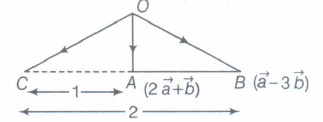
\(\overrightarrow{O C}=\frac{2 \overrightarrow{O A}-\overrightarrow{O B}}{2-1}\)
\(\Rightarrow \overrightarrow{O C}=\frac{2(\overrightarrow{2 a}+\vec{b})-1(\vec{a}-3 \vec{b})}{1} \quad[\text { from Eq }\)
\(=4 \vec{a}+2 \vec{b}-\vec{a}+3 \vec{b}=3 \vec{a}+5 \vec{b}\)
i.e. to show \(\overrightarrow{O A}=\frac{\overrightarrow{O B}+\overrightarrow{O C}}{2}\)
Consider, \(\frac{\overrightarrow{O B}+\overrightarrow{O C}}{2}=\frac{\vec{a}-3 \vec{b}+3 \vec{a}+5 \vec{b}}{2}\)
[from Equation (i) and (ii)]
\(=\frac{4 \vec{a}+2 \vec{b}}{2}=2 \vec{a}+\vec{b}=\overrightarrow{O A} \quad[\text { from Eq. }(i)]\)
Thus, \(\frac{\overrightarrow{O B}+\overrightarrow{O C}}{2}=\overrightarrow{O A}\)
Hence, A is mid-point of line segment BC.
7.
\(\text { Required vector }=\frac{5(\vec{a}+\vec{b})}{|\vec{a}+\vec{b}|}\)
\(=\frac{15}{\sqrt{10}} \hat{i}+\frac{5}{\sqrt{10}} \hat{j}\)
8.
Given line is \( \frac{x+2}{3}=\frac{y+1}{2}=\frac{z-3}{2}=\lambda\)
General point on the line is \( R(3 \lambda-2,2 \lambda-1,2 \lambda+3)\)
Distance of point R from P( 1, 3, 3) is 5 units.
\(\sqrt { ({ 3\lambda -2-1) }^{ 2 }+({ 2\lambda +3-3) }^{ 2 }+({ 2\lambda +3-3) }^{ 2 } } =5\)
\(\Rightarrow { (3\lambda -3) }^{ 2 }+{ (2\lambda -4) }^{ 2 }+{ (2\lambda ) }^{ 2 }=25\Rightarrow \lambda =0,2\)
Substituting in (i), we get point as R(-2, -1, 3) or R(4, 3, 7).
9.
Let E be the event that it will rain on any particular day.
\(\therefore P(E)=50 \%=\frac{1}{2} \Rightarrow P(\bar{E})=1-P(E)=1-\frac{1}{2}=\frac{1}{2}\)
\(\therefore\) Required probability
\(\begin{aligned}
=P(E) \cdot P(E) \cdot P(E) \cdot P(E) \cdot P(\bar{E}) \cdot P(\bar{E}) \cdot P(\bar{E})
\end{aligned}\)
\(\begin{aligned}
=(P(E))^4(P(\bar{E}))^3
\end{aligned}\)
\(\begin{aligned}
=\left(\frac{1}{2}\right)^4\left(\frac{1}{2}\right)^3=\left(\frac{1}{2}\right)^7
\end{aligned}\)
10.
Given, line is \(5 x-25=14-7 y=35 z\)
\(\Rightarrow \frac{x-5}{1 / 5}=\frac{2-y}{1 / 7}=\frac{z}{1 / 35} \Rightarrow \frac{x-5}{1 / 5}=\frac{y-2}{-1 / 7}=\frac{z}{1 / 35}\)
\(\Rightarrow \frac{x-5}{7}=\frac{y-2}{-5}=\frac{z-0}{1}\) ...(i)
Hence, parallel vector of given line i.e.
\(\vec{b}=7 \hat{i}-5 \hat{j}+\hat{k}\)
Since, required line is parallel to given line (i).
\(\Rightarrow \vec{b}=7 \hat{i}-5 \hat{j}+\hat{k}\) will also be parallel vector of required line which passes through A(1, 2, -1).
\(\therefore\) The required vector equation of line is
\(\vec{r}=(\hat{i}+2 \hat{j}-\hat{k})+\lambda(7 \hat{i}-5 \hat{j}+\hat{k})\)
11.
-10
12.
= 5
13.
Given vectors are \(\vec{a}=2 \hat{i}+\lambda \hat{j}+\hat{k} \text { and } \vec{b}=\hat{i}-2 \hat{j}+3 \hat{k} \).
Since, the vectors are perpendicular
\(\therefore \vec{a} \cdot \vec{b}=0 \)
\(\Rightarrow (2 \hat{i}+\lambda \hat{j}+\hat{k}) \cdot(\hat{i}-2 \hat{j}+3 \hat{k})=0 \)
\(\Rightarrow 2-2 \lambda+3=0 \)
\(\therefore \lambda=5 / 2 \)
14.
P(E\(\cap\)F) = P(E) + P(F) - P(E\(\cup\)F)
\(=\frac { 6 }{ 11 } +\frac { 5 }{ 11 } -\frac { 7 }{ 11 } \)
\(=\frac { 4 }{ 11 } \)
(a) \(P(E/F)=\frac { P(E\cap F) }{ P(F) } \)
\(=\frac { \frac { 4 }{ 11 } }{ \frac { 5 }{ 11 } } =\frac { 4 }{ 5 } \)
(b) P(E/E) = \(\frac { P(E\cap F) }{ P(E) } \)
\(=\frac { \frac { 4 }{ 11 } }{ \frac { 6 }{ 11 } } =\frac { 4 }{ 6 } \)
\(=\frac { 2 }{ 3 } \)
15.
Let points be A(2, 3, 4), B(- 1, - 2, 1) and C(5, 8, 7)
Direction ratios or AB are 2 + 1, 3 + 2, 4 - 1, i.e. 3, 5, 3;
Direction ratios of Be are 5 + 1, 8 + 2, 7 - 1, i.e. 3,5,3
As \(\frac{3}{3}=\frac{5}{5}=\frac{3}{3}\)
⇒ AB is parallel to BC, B is common.
Hence, A, B, C are collinear.
16.
Given, \(\vec{\alpha}=4 \hat{i}+5 \hat{j}-\hat{k}, \vec{\beta}=\hat{i}-4 \hat{j}+5 \hat{k}\)
and \(\vec{q}=3 \hat{i}+\hat{j}-\hat{k}\)
Also, vector \(\vec{p}\) is perpendicular to \(\alpha\) and \(\beta\).
Then, \(\vec{p}=\lambda(\vec{\alpha} \times \vec{\beta})\) ...(i)
Now, \(\vec{\alpha} \times \vec{\beta}=\left|\begin{array}{ccc}
\hat{i} & \hat{j} & \hat{k} \\
4 & 5 & -1 \\
1 & -4 & 5
\end{array}\right|\)
\(\begin{aligned}
=\hat{i}(25-4)-\hat{j}(20+1)+\hat{k}(-16-5)
\end{aligned}\)
\(\begin{aligned}
=\hat{i}(21)-\hat{j}(21)+\hat{k}(-21)
\end{aligned}\)
\(\Rightarrow \quad \vec{\alpha} \times \vec{\beta}=21 \hat{i}-21 \hat{j}-21 \hat{k}\)
So, \(\vec{p}=21 \lambda \hat{i}-21 \lambda \hat{j}-21 \lambda \hat{k}\) [from Eq. (i)] ...(ii)
Also, given that \(\vec{p} \cdot \vec{q}=21\)
\(\begin{aligned}
\therefore \quad(21 \lambda \hat{i}-21 \lambda \hat{j}-21 \lambda \hat{k}) \cdot(3 \hat{i}+\hat{j}-\hat{k})=21
\end{aligned}\)
\(\begin{aligned}
\Rightarrow \quad 63 \lambda-21 \lambda+21 \lambda=21
\end{aligned}\)
\(\begin{aligned}
\Rightarrow \quad 63 \lambda=21
\end{aligned}\)
\(\begin{aligned}
\Rightarrow \quad \lambda=1 / 3
\end{aligned}\)
On putting \(\lambda=\frac{1}{3}\) in Eq. (ii), we get
\(\vec{p}=21 \times \frac{1}{3} \hat{i}-21 \times \frac{1}{3} \hat{j}-21 \times \frac{1}{3} \hat{k}\)
\(\therefore \quad \vec{p}=7 \hat{i}-7 \hat{j}-7 \hat{k}\)
which is the required vector.
17.
The vector equations of given lines are
\(\begin{aligned}
\vec{r}=3 \hat{i}+2 \hat{j}-4 \hat{k}+\lambda(\hat{i}+2 \hat{j}+2 \hat{k})
\end{aligned}\)
and \(\begin{aligned}
\vec{r}=5 \hat{i}-2 \hat{j}+\mu(3 \hat{i}+2 \hat{j}+6 \hat{k})
\end{aligned}\)
On comparing them with \(\vec{r}=\overrightarrow{a_1}+\lambda \overrightarrow{b_1}\) and \(\vec{r}=\overrightarrow{a_2}+\mu \overrightarrow{b_2}\), we get
\(\overrightarrow{a_1}=3 \hat{i}+2 \hat{j}-4 \hat{k}, \overrightarrow{a_2}=5 \hat{i}-2 \hat{j}, \vec{b}_1=\hat{i}+2 \hat{j}+2 \hat{k}\)
and \(\vec{b}_2=3 \hat{i}+2 \hat{j}+6 \hat{k}\)
\(\therefore \quad \overrightarrow{a_2}-\overrightarrow{a_1}=(5 \hat{i}-2 \hat{j})-(3 \hat{i}+2 \hat{j}-4 \hat{k})\)
\(=2 \hat{i}-4 \hat{j}+4 \hat{k}\)
\(\begin{aligned}
\therefore \quad \vec{b}_1 \times \vec{b}_2 & =\left|\begin{array}{lll}
\hat{i} & \hat{j} & \hat{k} \\
1 & 2 & 2 \\
3 & 2 & 6
\end{array}\right|
\end{aligned}\)
\(\begin{aligned}
=\hat{i}(12-4)-\hat{j}(6-6)+\hat{k}(2-6)
\end{aligned}\)
\(\begin{aligned}
=8 \hat{i}-4 \hat{k}
\end{aligned}\)
\(\therefore\left(\vec{a}_2-\vec{a}_1\right) \cdot\left(\vec{b}_1 \times \vec{b}_2\right)=(2 \hat{i}-4 \hat{j}+4 \hat{k}) \cdot(8 \hat{i}-4 \hat{k})\)
= 16 + 0 - 16 = 0
\(\therefore\) The lines are intersecting and the shortest distance between the lines is 0.
Now, the position vectors of arbitrary points on the given lines are \((3+\lambda) \hat{i}+(2+2 \lambda) \hat{j}+(-4+2 \lambda) \hat{k}\) and \((5+3 \mu) \hat{i}+(-2+2 \mu) \hat{j}+6 \mu \hat{k}\), respectively.
Since, lines intersect then they have a common point.
\(\therefore \begin{aligned}
3+\lambda & =5+3 \mu
\end{aligned}\) ...(i)
\(\begin{aligned}
2+2 \lambda & =-2+2 \mu
\end{aligned}\) ...(ii)
\(\begin{aligned}
-4+2 \lambda & =6 \mu
\end{aligned}\) ...(iii)
On solving Eqs. (i) and (ii), we get
\(\lambda=-4 \text { and } \mu=-2\)
\(\therefore\) Point of intersection is (3 - 4, 2 - 8, -4 - 8)
i.e. (-1, -6, -12).
18.
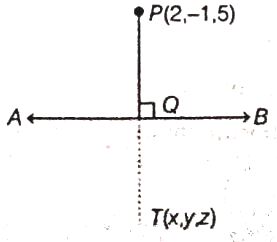
Let T be the image of the point P(2, -1, 5). Q is the foot of perpendicular drawn from point P on the line AB.
Given, equation of line AB is
\(\frac{x-11}{10}=\frac{y+2}{-4}=\frac{z+8}{-11}\) ...(i)
Let \(\frac{x-11}{10}=\frac{y+2}{-4}=\frac{z+8}{-11}=\lambda\) (say)
\(\Rightarrow \quad x=10 \lambda+11, y=-4 \lambda-2\)
and \(z=-11 \lambda-8\)
Then, coordinates of Q are
\(=(10 \lambda+11,-4 \lambda-2,-11 \lambda-8)\) ....(ii)
Now, DR's of line PQ
\(\begin{aligned}
=10 \lambda+11-2-4 \lambda-2+1,-11 \lambda-8-5
\end{aligned}\)
\(\begin{aligned}
=10 \lambda+9,-4 \lambda-1,-11 \lambda-13
\end{aligned}\)
Since, line \(P Q \perp A B\)
\(\therefore\) a1a2 + b1b2 + c1c2 = 0
where \(a_1=10 \lambda+9, b_1=-4 \lambda-1, c_1=-11 \lambda-13\)
and a2 = 10, b2 = -4, c2 = -11
\(\begin{aligned}
\therefore(10 \lambda+9)(10)+(-4 \lambda-1)( & -4) +(-11 \lambda-13)(-11)=0
\end{aligned}\)
\(\begin{aligned}
\Rightarrow & & 100 \lambda+90+16 \lambda+4+121 \lambda+143 & =0
\end{aligned}\)
\(\begin{aligned}
\Rightarrow & & 237 \lambda+237 & =0
\end{aligned}\)
\(\begin{aligned}
\Rightarrow & & \lambda & =-1
\end{aligned}\)
On putting \(\lambda\) = - 1 in Eq. (ii), we get
Q = (10(-1)+11), -4(-1)-2, -11(-1)-8)
=(-10+11, 4-2, 11-8)
= (1, 2, 3)
Let image of a point P be T(x, y, z).
Then, Q will be the mid-point of PT.
By using mid-point formula
Q = Mid-point of P(2, -1,5) and T(x, y, z).
\(=\left(\frac{x+2}{2}, \frac{y-1}{2}, \frac{z+5}{2}\right)\)
But Q = (1, 2, 3)
\(\therefore\left(\frac{x+2}{2}, \frac{y-1}{2}, \frac{z+5}{2}\right)=(1,2,3)\)
On equating corresponding coordinates, we get
\(\begin{aligned}
\frac{x+2}{2} & =1, \frac{y-1}{2}=2, \frac{z+5}{2}=3
\end{aligned}\)
\(\begin{aligned}
\Rightarrow & \quad x =2-2, y=4+1, z=6-5
\end{aligned}\)
\(\therefore\) x = 0, y = 5, z = 1
\(\therefore\) Coordinates of T = (x, y, z) = (0, 5, 1)
Hence, the coordinate image of point P(2, -1, 5) is T(0, 5, 1).
19.
Let, E1: Event that lost card is a spade
E2: Event that lost card is a not spade
A: Event that three spades are drawn without replacement from 51 cards
\(P({ E }_{ 1 })=\frac { 13 }{ 52 } =\frac { 1 }{ 4 } ,\quad P({ E }_{ 2 })=1-\frac { 1 }{ 4 } =\frac { 3 }{ 4 } \)
\(P(A/{ E }_{ 1 })=\frac { { 12 }_{ C_{ 3 } } }{ { 51 }_{ { C }_{ 3 } } } ,\quad P(A/{ E }_{ 2 })=\frac { 13_{ { C }_{ 3 } } }{ { 51 }_{ { C }_{ 3 } } } \)
\(P({ E }_{ 1 }/A)=\frac { \frac { 1 }{ 4 } .\frac { { 12 }_{ C_{ 3 } } }{ { 51 }_{ { C }_{ 3 } } } }{ \frac { 1 }{ 4 } .\frac { { 12 }_{ C_{ 3 } } }{ { 51 }_{ { C }_{ 3 } } } +\frac { 3 }{ 4 } .\frac { { 12 }_{ C_{ 3 } } }{ { 51 }_{ { C }_{ 3 } } } } \)
\(=\frac { 10 }{ 49 } \)
20.
Let, E1: Two white balls are transferred
E2: Two red balls are transferred
E3: One red and one white ball are transferred.
A: The ball drawn from the bag II is red.
\(P({ E }_{ 1 })=\frac { { 4 }_{ C_{ 2 } } }{ { 9 }_{ { c }_{ 2 } } } =\frac { 4\times 3 }{ 9\times 8 } =\frac { 1 }{ 6 } \)
\({ P({ E } }_{ 2 })=\frac { { 5 }_{ C_{ 2 } } }{ { 9 }_{ C_{ 2 } } } =\frac { 4\times 3 }{ 9\times 8 } =\frac { 5 }{ 18 } \)
\(P(E_{ 3 })=\frac { { 5 }_{ { C }_{ 1 } }\times { 4 }_{ C_{ 1 } } }{ { 9 }_{ C_{ 2 } } } =\frac { 4\times 5\times 2 }{ 9\times 8 } =\frac { 5 }{ 9 } \)
\(P(A/{ E }_{ 1 })=\frac { 3 }{ 8 } ,P(A/{ E }_{ 2 })=\frac { 5 }{ 8 } ,\)
\(P(A/{ E }_{ 3 })=\frac { 4 }{ 8 } \)
The required probability, P(E3/A), by Bayes' Theorem
\(=\frac { P({ E }_{ 3 }).P(A/{ E }_{ 3 }) }{ P({ E }_{ 1 }).P(A/{ E }_{ 1 })+P({ E }_{ 2 }).P(A/{ E }_{ 2 })+P({ E }_{ 3 }).P(A/{ E }_{ 3 }) } \)
\(=\frac { \frac { 5 }{ 9 } \times \frac { 4 }{ 8 } }{ \frac { 1 }{ 6 } \times \frac { 3 }{ 8 } +\frac { 5 }{ 18 } \times \frac { 5 }{ 8 } +\frac { 5 }{ 9 } \times \frac { 4 }{ 8 } } \)
\(=\frac { 20 }{ 37 } \)
21.
(b)
0.25
22.
(d)
8
23.
(c)
\(\frac{25}{43}\)
24.
(a)
\(\frac{24}{91}\)
25.
26.
(c)
\(\frac{3 \vec{a}+\vec{b}}{2}\)
27.
(a)
\(\vec{a} \times \vec{b}=\vec{b} \times \vec{c}=\vec{c} \times \vec{a}\)
28.
(d)
All of the above
29.
(c)
Concave region
30.
(a)
0
31.
32.
(d)
Feasible region
33.
(b)
y + 2z = 0
34.
(b)
\(\frac { 1 }{ \sqrt { 2 } } ,\frac { \sqrt { 3 } }{ 2 } ,\frac { 1 }{ \sqrt { 2 } } \)
35.
(b)
1/\(\sqrt3\), 1/\(\sqrt3\), 1/\(\sqrt3\)
36.
(c)
All three are mutually perpendicular
37.
As P(A/B) = \(\frac { P(A\cap B) }{ P(B) } \)
= \(\frac{70}{100}\times \frac{100}{85}=\frac{14}{17}\)
38.
(c)
all of the given constraints
39.
Given, 70% customers pay their first month bill in time, therefore, the customers who do not pay bill in time is 30%.
(i) Let E1 and E2, denote the event of customer paying or not paying the fìrst month bill in time, respectively.
Then, P(E1) = 70% = 0.7
and P(E2) = 30% = 0.3
(ii) Given that the probability of customers who pays the bill in time next month is 0.8 and who does not pay in time is 0.4.
Let A denotes the event of customer paying second month's bill in time.
\(\therefore P\left(\frac{A}{E_1}\right)=P\) (customer paying second month bill in time when they pay first month bill)
= 0.8
and \(P\left(\frac{A}{E_2}\right)=P\) (customer paying second month bill in time when they do not pay first month bill in time)
= 0.4
(ii) The probability of customer paying second month's bill in time = 0.7 \(\times\) 0.8 = 0.56
Or
The probability of customer paying first month's bill in time, if it is found that customer has paid the second month's bill in time is \(P\left(\frac{E_1}{A}\right)\)
\(\begin{aligned}
P\left(\frac{E_1}{A}\right) & =\frac{P\left(E_1\right) \cdot P\left(\frac{A}{E_1}\right)}{P\left(E_1\right) \cdot P\left(\frac{A}{E_1}\right)+P\left(E_2\right) \cdot P\left(\frac{A}{E_2}\right)}
\end{aligned}\)
\(\begin{aligned}
=\frac{0.7 \times 0.8}{0.7 \times 0.8+0.3 \times 0.4}
\end{aligned}\)
\(\begin{aligned}
=\frac{0.56}{0.56+0.12}=\frac{0.56}{0.68}
\end{aligned}\)
= 0.824
40.
(i) (a): Eliminating 't' from the given equations, we get equation of path as, \(\frac{x}{2}=\frac{y}{-4}=\frac{z}{4} \text { or } \frac{x}{1}=\frac{y}{-2}=\frac{z}{2}\).
Thus, the path of the rocket represents a straight line.
(ii).(b) : Since, only (1, -2, 2) satisfy the equation of path of rocket therefore (1, -2, 2) lie on the path of rocket.
(iii) (b): For t = 10 sec, we have x = 20,y = -40, z = 40
Now, required distance = \(\sqrt{x^{2}+y^{2}+z^{2}}\)
\(=\sqrt{20^{2}+(-40)^{2}+(40)^{2}}=\sqrt{400+1600+1600}\)
\(=\sqrt{3600}=60 \mathrm{~km}\)
(iv) (d) : Clearly, height of rocket from the ground = z-coordinate of given position = 6 km
(v) (b) : Let Q be the image of point P(1, -2, 2) in the plane 3x - y + 4z = 2. Then, equation of PQ is
\(\frac{x-1}{3}=\frac{y+2}{-1}=\frac{z-2}{4}\)
Let the coordinates of Q be (3r +1, -r - 2, 4r + 2).
Let R be the mid -point of PQ. Then, coordinates of R are
\(\left(\frac{3 r+2}{2}, \frac{-r-4}{2}, \frac{4 r+4}{2}\right) \text { or }\left(\frac{3}{2} r+1, \frac{-r}{2}-2,2 r+2\right)\)
Since, R lies on 3x - y + 4z = 2.
\( \therefore \quad 3\left(\frac{3}{2} r+1\right)-\left(\frac{-r}{2}-2\right)+4(2 r+2)=2 \)
\(\Rightarrow \frac{9 r}{2}+3+\frac{r}{2}+2+8 r+8=2 \\ \)
\(\Rightarrow 13 r+13=2 \Rightarrow r=\frac{-11}{13}\)
Hence, the coordinates of Q are
\(\left(\frac{-33}{13}+1, \frac{11}{13}-2, \frac{-44}{13}+2\right) \text { i.e., }\left(\frac{-20}{13}, \frac{-15}{13}, \frac{-18}{13}\right)\)
41.
(i) (b): Let B(x, y) be the point of intersection of the given lines
2x + 5y = 100 ....(i)
and \(\frac{x}{25}+\frac{y}{40}=1 \Rightarrow 8 x+5 y=20\)...(ii)
Solving (i) and (ii), we get
\(x=\frac{50}{3}, y=\frac{40}{3}\)
ஃ The point of intersection \(B(x, y)=\left(\frac{50}{3}, \frac{40}{3}\right)\)
(ii) (d): The corner points of the feasible region shown in the given graph are
\((0,0), A(25,0), B\left(\frac{50}{3}, \frac{40}{3}\right), C(0,20)\)
(iii) (a): Here Z = x + y
| Corner Points | Value of Z = x + y |
| (0,0) | 0 |
| (25,0) | 25 |
| \(\left(\frac{50}{3}, \frac{40}{3}\right)\) | 30 ⇠ Maximum |
| (0,20) | 20 |
Thus, max Z = 30 occurs at point \(\left(\frac{50}{3}, \frac{40}{3}\right)\)
(iv) (b):
| Corner Points | Value of Z = 6x - 9y |
| (0,0) | 0 |
| (25,0) | 150 ⇠ Maximum |
| \(\left(\frac{50}{3}, \frac{40}{3}\right)\) | -20 |
| (0,20) | -180 |
(v) (c):
| Corner Points | Value of Z = 6x + 3y |
| (0,0) | 0 ⇠ Maximum |
| (25,0) | 150 |
| \(\left(\frac{50}{3}, \frac{40}{3}\right)\) | 140 |
| (0,20) | 60 |
42.
(a) If two coins are tossed simultaneously, then sample space is given by
S = {(H, H), (H, T), (T, H), (T, T)}
Now, let A be the event of getting two heads.
\(\therefore \quad P(A)=\frac{1}{4}\)
and B be the event of getting atleast one head.
\(\therefore \quad P(B)=\frac{3}{4}\)
Thus, \(P\left(\frac{A}{B}\right)=\frac{P(A \cap B)}{P(B)}=\frac{1 / 4}{3 / 4}=\frac{1}{4} \times \frac{4}{3}=\frac{1}{3}\)
Hence, Assertion is true.
Reason is also true.
43.
(d) Assertion is incorrect, Reason is correct.

12th Standard CBSE Syllabus & Materials
12th Standard CBSE
CBSE 12th Computer Science Python Revision Tour I - New Previous year Question Papers Study Material - QB365 Set A
NEW12th Standard CBSE
CBSE 12th Business Studies Planning Important Questions And Answers Study Material - QB365 Set A
NEW12th Standard CBSE
CBSE 12th Business Studies Business Environment Important Questions And Answers Study Material - QB365 Set A
NEW12th Standard CBSE
CBSE 12th Business Studies Principles of Management Important Questions And Answers Study Material - QB365 Set A



NCERT Books

Syllabus

Exam Pattern

Sample Question Papers

Previous year Question Papers

Important Notes

MCQ Practice test

NCERT Exemplers

Case study Questions

Image Based Questions

Passage based Questions

HOT Questions

Value Based Questions

Model Questions Papers
NCERT ( Book Back ) Questions

Assertion and Reason
Important Questions And Answers

CBSE 12th Standard CBSE Subjects
CBSE Standards