
 100% FREE ACCESS
12th Standard CBSE Syllabus & Materials
12th Standard CBSE
CBSE 12th Economics Government Budget and the Economy Previous year Question Papers Study Material - QB365 Set A
NEW12th Standard CBSE
CBSE 12th Computer Science Interface Python with MySQL - New Previous year Question Papers Study Material - QB365 Set A
NEW12th Standard CBSE
CBSE 12th Computer Science Database Concept - New Previous year Question Papers Study Material - QB365 Set A
NEW12th Standard CBSE
CBSE 12th Computer Science Data Communication - New Previous year Question Papers Study Material - QB365 Set A
NEW12th Standard CBSE
CBSE 12th Computer Science Data Structures - New Previous year Question Papers Study Material - QB365 Set A
NEW12th Standard CBSE
CBSE 12th Computer Science Functions - New Previous year Question Papers Study Material - QB365 Set A

Published on: 07/03/2026
Download CBSE Class 12th Standard CBSE Physics question papers, sample papers, important questions, and previous year solved papers in PDF format. Get free study materials, NCERT solutions, and exam preparation resources for Class 12th Standard CBSE Physics
Questions + Answers key
Take MCQ Physics Test
1.
A voltage signal is described by \(V =V_0 \text { for } 0 \leq t \leq \frac{T}{2} =0 \text { for } \frac{T}{2} \leq t \leq T\) for a cycle. Its rms value is
\(\frac{V_0}{\sqrt{2}}\)
\(V_0\)
\(\frac{V_0}{2}\)
\(\sqrt{2} V_0\)
2.
When an alternating voltage E - E0, sinot is applied to a circuit, a current \(I=I_0 \sin \left(\omega t+\frac{\pi}{2}\right)\), sincov flows through it. The average power dissipated in the circuit is
\(E_{\mathrm{rms}} \cdot I_{\mathrm{rms}}\)
\(E_0 I_0\)
\(\frac{E_0 I_0}{\sqrt{2}}\)
zero
3.
A circuit is connected to an AC source of variable frequency. As, the frequency of the source isincreased, the current first increases and then decreases. Which of the following combination of elements is likely to comprise the circuit?
L, C and R
L and C
L and R
R and C
4.
The impedance of a series L-C-R circuit is
\(R+X_L+X_C\)
\(\sqrt{\frac{1}{X_C^2}+\frac{1}{X_L^2}+R^2}\)
\(\sqrt{X_L^2-X_C^2+R^2}\)
\(\sqrt{R^2+\left(X_L-X_C\right)^2}\)
5.
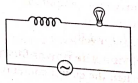
An iron cored coil is connected in series with an electric bulb with an AC source as shown in figure. When iron piece is taken out of the coil, the brightness of the bulb will
decrease
increase
remain unaffected
fluctuate
6.
A 300Ω resistor and a capacitor of (25/π) µF are connected in series to a 200 V-50 Hz AC source. The current in the circuit is
0.1 A
0.4 A
0.6 A
0.8 A
7.
A 15Ω resistor, an 80 mH inductor and a capacitor of capacitance Care connected in series with a 50 Hz AC source. If the source voltage and current in the circuit are in phase, then the value of capacitance is
100 µF
127 µF
142 µF
160 µF
8.
The voltage across a resistor, an inductor and a capacitor connected in series to an AC source are 20 V, 15 V and 30 V, respectively. The resultant voltage in the circuit is
5V
20 V
25 V
65 V
9.
In a circuit, the phase difference between the alternating current and the source voltage is π/ 2 Which of the following cannot be the element(s) of the circuit?
Only C
Only L
L and R
L or C
10.
An AC source V = 282 sin (100 t) volt is connected across a 1 \(\mu\)F capacitor. The rms value of current in the circuit will be (take, \(\sqrt{2}\) =1.41)
10 mA
20 mA
40 mA
80 mA
11.
A conductor of 10\(\Omega \) is connected across 6V ideal source. The power supplied by the sources to the conductor is
1.8 W
2.4 W
3.6 W
7.2 W
12.
Which of the following statements about a series LCR circuit connected to an AC source is correct?
If the frequency of the source is incresed, the impedance of the circuit first decreases and then increases.
If the net reactance (Xt= XC) of circuit becomes equal to its resistance, then the current leads the voltage \(45^{\circ}\)
At resonance more the voltage drop across the inductor is than that across the capacitor.
At resonance, the voltage drop across the capacitor is more than that across the inductor.
13.
An AC voltage V = Vosin\(\omega\)t is applicd to a series combination of a resistor R and an element X. The instantancous current in the circuit is \(I=I_0 \sin \left(\omega t+\frac{\pi}{4}\right)\) . Then, which of the following is correct?
X is a capacitor and X C = \(\sqrt2\)R
X is a inductor and X L = R
X is a inductor and X L =\(\sqrt2\) R
X is a capacitor X C = R
14.
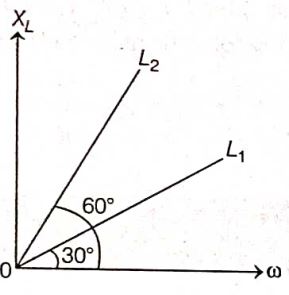
Figure shows the variation of inductive reactance XL,of two ideal inductors of inductances L1 and L2, with angular frequency \(\omega\) The value of \(\frac{L_1}{L_2}\)is
\(\sqrt{3}\)
\(\frac{1}{\sqrt{3}}\)
3
\(\frac{1}{3}\)
15.
Reciprocal of impedance is
susceptance
conductance
admittance
transconductance
16.
The reactance of a capacitor C is X. If both the frequency and capacitance be doubled, then new reactance will be
X
2X
4X
\(\frac{X}{4}\)
17.
A coil of self-inductance L is connected in series with a bulb B and an ac source. Brightness of the bulb decreases when
frequency of the ac source is decreased.
number of turns in the coil is reduced
a capacitance of reactance XC = XL in included
an iron rod is inserted in the coil
18.
What is the value of inductance L for which the current is maximum in a series LCR-circuit with C = 10 μF and ω = 1000 S-1?
100 mH
1 mH
10 mH
cannot be calculated unless R is known
19.
A transformer is used to light a 100 W and 110 V lamp from a 220 V mains. If the main current is 0.5A, the efficiency of the transformer is approximately
30%
50%
90%
10%
20.
In a series, LCR-circuit, resonant frequency depends on
\(\frac{L}{C} \)
\(\sqrt{L C} \)
\(\frac{1}{\sqrt{L C}} \)
\(\sqrt{\frac{L}{C}}\)
21.
In an a.c. generator, a coil with N turns, all of the same area A and total resistance R, rotates with frequency ω in a magnetic field B the maximum value of emf generated in the coil is
NABR
NABω
NABRω
NAB
22.
The core of any transformer is laminated so as to
reduce the energy loss due to eddy currents
make it light weight
make it robust and strong
increase the secondary voltage
23.
In an ac circuit the voltage applied is ε = ε0 sin wt. The resulting current in the circuit is I = I0 sin (ωt - π/2). The power consumption in the circuit is given by
\( P=\sqrt{2} \varepsilon_{0} I_{0} \)
\( P=\frac{\varepsilon_{0} I_{0}}{\sqrt{2}}\)
\(\boldsymbol{P}=\mathbf{0} \)
\( P=\frac{\varepsilon_{0} I_{0}}{2} \)
24.
An ac circuit has a resistance of 12 ohm and an impedance of 15 ohm. The power factor of the circuit will be
0.8
0.4
0.125
1.25
25.
In an LCR-series ac circuit, the voltage across each of the component L, C and R is 50 V. The voltage across the LC-combination will be
50 V
\(50 \sqrt{2} \mathrm{~V}\)
100 V
zero
26.
The phase difference between the alternating current and emf is π/2. Which of the following cannot be the constituent of the circuit?
C alone
L alone
L and C
R and L
27.
As the frequency of an ac circuit increases, the current first increases and then decreases. What combination of circuit elements is most likely to comprise the circuit?
Inductor and capacitor.
Resistor and inductor
Resistor and capacitor.
Inductor only.
28.
The phenomenon of resonance is common among systems that have a tendency
to oscillate at a' particular frequency
to get maximum amplitude
Both (a) and (b)
Neither (a) nor (b)
29.
In R-L-C series circuit with C = 1.00 nF two values of R are
(i) R = 100 \(\Omega\)and
(ii) R = 200 \(\Omega\) For the source applied with Vm = 100 V. Resonant frequency is
1 x 10³ rad/s
1 x 10⁶ rad/s
1.56 x 10⁶ rad/s
1.75 x 10³ rad/s
30.
The value of power factor is maximum in an alternating circuit, when circuit consists
only inductive
only capacitive
only L- C
only resistive
31.
In an AC circuit, the instantaneous values of emf and current are e = 200 sin (314) t V and I = sin (314t + \(\pi /3\)) A. The average power consumed is
200 W
100 W
50 W
25 W
32.
A 60 W load is connected to the secondary of a transformer whose primary draws line voltage of 220 V. If a current of 0.54 A flows in the load, then what is the current in the primary coil?
2.7 A
0.27 A
1.65 A
2.85 A
33.
In a series L-C-R circuit, the capacitance Cis changed to 4C. To keep the resonant frequency same, the inductance must be changed by
2L
L/2
4L
L/4
34.
A 15.0 \(\mu\)F capacitor is connected to a 220 V,50 Hz source. The capacitive reactance is
220 \(\Omega\)
215 \(\Omega\)
212 \(\Omega\)
204 \(\Omega\)
35.
The amplitude of the oscillating current in the a pure capacitive AC circuit is, if V = Vm capacitance = C.
\(\omega\)CVm
2\(\omega\)CVm
\(\frac{\omega C V_{m}}{4}\)
\(\frac{3 \omega C V_{m}}{2}\)
36.
Current I across the capacitor in a purely capacitive AC circuit is
im sin (\(\omega\)t + \(\pi\)/4)
im sin (\(\omega\)t + \(\pi\)/2)
im cos (\(\omega\)t + \(\pi\)/4)
im cos (\(\omega\)t + \(\pi\)/2)
37.
A pure inductor of 25.0 mH is connected to a source of 220 V. Find the inductive reactance if the frequency of the source is 50 Hz.
785 \(\Omega\)
6.50 \(\Omega\)
7.85 \(\Omega\)
8.75 \(\Omega\)
38.
The inductive reactance is directly proportional to the
inductance
frequency of the current
Both (a) and (b)
amplitude of current
39.
A resistance of 20 \(\Omega \) is connected to a source of an alternating potential, V = 220 sin (100\(\pi\)t). The time taken by current to change from its peak value to rms value is
0.2 s
0.25 s
25 x 10-3 s
2.5 x 10⁻³ s
40.
Voltage and current in an ACcircuit are given by
v = 5 sin (100 \(\pi\)t - \(\pi\)/6) and I = 4 sin (l00 \(\pi\)t + \(\pi\)/6)
voltage leads the current by 30\(\unicode{xb0} \)
current leads the voltage by 30\(\unicode{xb0} \)
current leads the voltage by 60\(\unicode{xb0} \)
voltage leads the current by 60\(\unicode{xb0} \)
41.
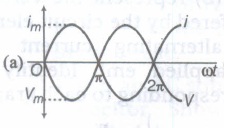
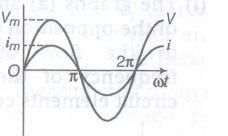
Which of the following graphs shows, in a pure resistor, the voltage and current are in phase?
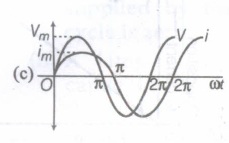
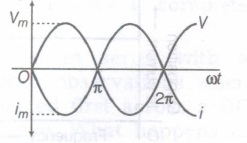
42.
When a voltage measuring device is connected to AC mains, the meter shows the steady input voltage of 220 V. This means
input voltage cannot be AC voltage, but a DC voltage
maximum input voltage is 220 V
the meter reads not Ybut < V2 > and is calibrated to read \(\sqrt{<{V}^{2}>}\)
the pointer of the meter is stuck by some mechanical defect
43.
A 50Hz AC current of crest value 1A flows through the primary of a transformer. If the mutual inductance between the primary and secondary be 0.5 H, the creast voltage induced in the secondary is
75 V
150 V
100 V
none of these
44.
When an AC voltage of 220V is applied to the capacitor C
the maximum voltage between plates is 220V
the current is in phase with he applied voltage
The charge on the plates is in phase with the applied voltage
power delivered to the capacitor is zero
45.
Electrical energy is transmitted over large distances at high alternating voltages. Which of the following statements is (are) correct?
For a given power level, there is a lower current
Lower current implies less power loss
Transmission lines can be made thinner
It is easy to reduce the voltage at he receiveing end using step-down transformers
46.
In an alternating current circuit consisting of elements in series, the current increases on increasing the frequency of supply. Which of the following elements are likely to constitute the circuit?
Only resistor
Resistor and an inductor
Resistor and a capacitor
Only a capacitor
47.
The output of a step-down transformer is measured to be 24V when connected to a 12 watt light blub. The value of the peak current is
\(1/\sqrt { 2 } A\)
\(\sqrt { 2 } A\)
2 A
\(2\sqrt { 2 } A\)
48.
An induced of reactance 1 and a resistor of 2 are connected in series to the terminals of a 6V(rms) a.c. source. The power dissipated in the circuit is
8 W
12 W
14.4 W
18 W
49.
Which of the following combinations should be selected for better tuning of an LCR circuit used for communication?
R = 20\(\Omega \), L = 1.5H, C = 35\(\mu\)F
R = 25\(\Omega \), L = 2.5H, C = 45\(\mu\)F
R = 15\(\Omega \), L = 3.5H, C = 30\(\mu\)F
R = 25\(\Omega \), L = 1.5H, C = 45\(\mu\)F
50.
To reduce the reasonant frequency in an LCR series circuit with a generator
the generator frequency should be reduced
another capacitor should be added in parallel to the first
the iron core of the inductor should be removed
dielectric in the capacitor should be removed
51.
An alternating current generator has an internal resistance Rg and an internal reactance Xg. It is used to supply power to a passive load consisting of a resistance Rg and a reactance XL. For maximum power to be delivered from the generator to the load, the value of XL is equal to
zero
Xg
-Xg
Rg
52.
Out of the following, choose the wrong statement :
A transformer cannot work on d.c.
A transformer cannot change the frequency of a.c.
A transformer can produce a.c. power
In a transformer, when a.c. voltage is raised n times, the alternating current reduces to 1/n time.
53.
A battery of 12V is connected to primary of a transformer with turns ratio ns/np= 10. Voltage across secondary would by
120 V
1.3 V
12 V
Zero
54.
The efficiency of d.c.motor id given by \(\eta \) =
\(\frac { back \ e.m.f. }{ applied \ e.m.f. } \)
\(\frac { applied \ e.m.f }{ back \ e.m.f. } \)
\(back \ e.m.f.\ \times \ applied \ e.m.f.\)
none of the above
55.
The form factor of an a.c. generated is given by
\(\frac { { I }_{ av } }{ { I }_{ 0 } } \)
\(\frac { { I }_{ 0 } }{ { I }_{ av } } \)
\(\frac { { I }_{ av } }{ { I }_{ v } } \)
\(\frac { { I }_{ v } }{ { I }_{ av } } \)
56.
The power factor of an a.c. circuit is given by cos \(\phi \)=
\(\frac { R }{ Z } \)
\(\frac { Z }{ R } \)
\(\frac { R }{ { X }_{ L } } \)
\(\frac { R }{ { X }_{ C } } \)
57.
Q factor of resonance is given by
\(\frac { 1 }{ R } \sqrt { \frac { L }{ C } } \)
\(\frac { 1 }{ R } \sqrt { \frac { C }{ L } } \)
\(\frac { 1 }{ L } \sqrt { \frac { R }{ C } } \)
\(\frac { 1 }{ C } \sqrt { \frac { L }{ R } } \)
58.
The alternating current from a source is represented by I = 0.5 sin 314t. The frequency of a.c. is
314 Hz
100 Hz
50 Hz
zero
59.
The average value of a.c. voltage E = E0 sin \(\omega\)t over the time interval t = 0 to t = \(\pi /\omega \) is
\(-2{ E }_{ 0 }/\pi \)
\({ E }_{ 0 }/\pi \)
\(\frac { 2{ E }_{ 0 } }{ \pi } \)
zero
60.
The peak value of 220 V a.c. is
220V
\(\frac { 220 }{ \sqrt { 2 } } V\)
440V
\(220\sqrt { 2 } V\)
61.
62.
63.
64.
65.
66.
67.
68.
69.
(a) Assertion is correct, reason is correct; reason is a correct explanation for assertion.
(b) Assertion is correct, reason is correct; reason is not a correct explanation for assertion
(c) Assertion is correct, reason is incorrect
(d) Assertion is incorrect, reason is correct.
70.
Assertion (A) : In a series R-L-C circuit, the voltages across resistor, inductor and capacitor are BV, 16V and 10V, respectively. The resultant emf in the circuit is 10 V.
Reason (R) : Resultant emf of the circuit is given by the relation. \(E=\sqrt{V_R^2+\left(V_L-V_C\right)^2}\)
(a) Both Assertion and Reason are true and Reason is the correct explanation of Assertion.
(b) Both Assertion and Reason are true but Reason is not the correct explanation of Assertion.
(c) Assertion is true but Reason is false.
(d) Assertion is false but Reason is true.
71.
Assertion (A) : If XC > XL, φ is positive and the circuit is predominantly capacitive. The current in the circuit leads the source voltage.
Reason (R) : If XC < XL, φ is negative and the circuit is predominantly inductive, the current in the circuit lags the source voltage.
(a) Both Assertion and Reason are true and Reason is the correct explanation of Assertion.
(b) Both Assertion and Reason are true but Reason is not the correct explanation of Assertion.
(c) Assertion is true but Reason is false.
(d) Assertion is false but Reason is true.
72.
Assertion (A) : Phasors V and I for the case of a resistor are in the same direction.
Reason (R) : The phase angle between the voltage and the current is zero.
(a) Both Assertion and Reason are true and Reason is the correct explanation of Assertion.
(b) Both Assertion and Reason are true but Reason is not the correct explanation of Assertion.
(c) Assertion is true but Reason is false.
(d) Assertion is false but Reason is true.
73.
Assertion (A) : Soft iron is used as a core of transformer.
Reason (R) : Area of hysteresis loop for soft iron is small.
Codes:
(a) Both A and R are true and R is the correct explanation of A
(b) Both A and R are true but R is NOT the correct explanation of A
(c) A is true but R is false
(d) A is false and R is also false
74.
Assertion (A) : A transformer cannot work on D.C supply.
Reason (R) : D.C changes neither in magnitude nor in direction.
Codes:
(a) Both A and R are true and R is the correct explanation of A
(b) Both A and R are true but R is NOT the correct explanation of A
(c) A is true but R is false
(d) A is false and R is also false
75.
Assertion (A) : An electric lamp connected in series with a variable capacitor and A.C source, its brightness increases with increase in capacitance.
Reason (R) : Capacitive reactance decreases with increase in capacitance of capacitor.
Codes:
(a) Both A and R are true and R is the correct explanation of A
(b) Both A and R are true but R is NOT the correct explanation of A
(c) A is true but R is false
(d) A is false and R is also false
76.
Assertion (A) : Long distance transmission of A.C is carried out at extremely high voltage.
Reason (R) : For large distance, voltage has to be large.
Codes:
(a) Both A and R are true and R is the correct explanation of A
(b) Both A and R are true but R is NOT the correct explanation of A
(c) A is true but R is false
(d) A is false and R is also false
77.
Assertion (A) : At resonance, LCR series circuit have a maximum current.
Reason (R) : At resonance, in LCR series circuit, the current and e.m.f are in phase with each other.
Codes:
(a) Both A and R are true and R is the correct explanation of A
(b) Both A and R are true but R is NOT the correct explanation of A
(c) A is true but R is false
(d) A is false and R is also false
1.
(a)
\(\frac{V_0}{\sqrt{2}}\)
2.
(d)
zero
3.
(a)
L, C and R
4.
(d)
\(\sqrt{R^2+\left(X_L-X_C\right)^2}\)
5.
(b)
increase
6.
(b)
0.4 A
7.
(b)
127 µF
8.
(c)
25 V
9.
(c)
L and R
10.
(b)
20 mA
11.
(c)
3.6 W
12.
(a)
If the frequency of the source is incresed, the impedance of the circuit first decreases and then increases.
13.
(c)
X is a inductor and X L =\(\sqrt2\) R
14.
(d)
\(\frac{1}{3}\)
15.
(c)
admittance
16.
(d)
\(\frac{X}{4}\)
17.
(d)
an iron rod is inserted in the coil
18.
(a)
100 mH
19.
(c)
90%
20.
(c)
\(\frac{1}{\sqrt{L C}} \)
21.
(b)
NABω
22.
(a)
reduce the energy loss due to eddy currents
23.
(c)
\(\boldsymbol{P}=\mathbf{0} \)
24.
(a)
0.8
25.
(d)
zero
26.
(c)
L and C
27.
(a)
Inductor and capacitor.
28.
(a)
to oscillate at a' particular frequency
29.
(a)
1 x 10³ rad/s
30.
(d)
only resistive
31.
(c)
50 W
32.
(b)
0.27 A
33.
(d)
L/4
34.
(c)
212 \(\Omega\)
35.
(a)
\(\omega\)CVm
36.
(b)
im sin (\(\omega\)t + \(\pi\)/2)
37.
(c)
7.85 \(\Omega\)
38.
(c)
Both (a) and (b)
39.
(d)
2.5 x 10⁻³ s
40.
(c)
current leads the voltage by 60\(\unicode{xb0} \)
41.
(b)
42.
(c)
the meter reads not Ybut < V2 > and is calibrated to read \(\sqrt{<{V}^{2}>}\)
43.
(c)
100 V
44.
(c)
The charge on the plates is in phase with the applied voltage
45.
(a)
For a given power level, there is a lower current
46.
(c)
Resistor and a capacitor
47.
(a)
\(1/\sqrt { 2 } A\)
48.
(c)
14.4 W
49.
(c)
R = 15\(\Omega \), L = 3.5H, C = 30\(\mu\)F
50.
(b)
another capacitor should be added in parallel to the first
51.
(c)
-Xg
52.
(c)
A transformer can produce a.c. power
53.
(d)
Zero
54.
(a)
\(\frac { back \ e.m.f. }{ applied \ e.m.f. } \)
55.
(d)
\(\frac { { I }_{ v } }{ { I }_{ av } } \)
56.
(a)
\(\frac { R }{ Z } \)
57.
(a)
\(\frac { 1 }{ R } \sqrt { \frac { L }{ C } } \)
58.
(c)
50 Hz
59.
(c)
\(\frac { 2{ E }_{ 0 } }{ \pi } \)
60.
(d)
\(220\sqrt { 2 } V\)
61.
62.
63.
64.
65.
66.
67.
68.
69.
70.
(a) Both Assertion and Reason are true and Reason is the correct explanation of Assertion
The resultant emf in the L-C-R circuit is given by
\(\Rightarrow E=\sqrt{V_R^2+\left(V_L-V_C\right)^2} \)
\(\Rightarrow E=\sqrt{(8)^2+(16-10)^2} \)
\(\Rightarrow E=\sqrt{64+36} \)
\(\Rightarrow E=10 \mathrm{~V}\)
71.
(b) Both Assertion and Reason are true but Reason is not the correct explanation of Assertion.
72.
(a) Both Assertion and Reason are true and Reason is the correct explanation of Assertion.
73.
(a): The alternating current flowing through the coils, magnetises and demagnetises the iron core again and again over complete cycles. During each cycle of magnetisation, some energy is lost due to hysteresis, the energy lost during a cycle of magnetisation being equal to area of hysteresis loop (in magnitude). Energy loss can be reduce by selecting the material core, which has narrow hysteresis loop, that is why soft iron core is used.
74.
(a): Transformer works on the principle of mutual induction i.e., if two coils are inductively coupled and when current or magnetic flux is changed through one of the two coils, then induced e.m.f. is produced in the other coil. So whenever there is change in current or magnetic flux, only then e.m.f. is induced. But in case of D.C. current or voltage, e.m.f. is not induced because it remain constant throughout and never changes its direction and magnitude. Therefore transformer cannot work when D.C. is applied.
75.
(a): Capacitive reactance \(X_{C}=\frac{1}{\omega C}\) When capacitance C increases, the capacitive reactance decreases. Due to decrease in its values, the current in the circuit will increase \(\left(I=\frac{\dot{E}}{\sqrt{R^{2}+X_{C}^{2}}}\right)\) and hence brightness of source (or electric lamp) will also increases.
76.
(c): The transmission is done at high voltage due to which current through the wire is reduced By reduction in current corresponding dissipation of energy is also reduced \(\left(\text { as } H \propto I^{2} R\right)\) If transmissioh is done at low voltage then we have to use thick wire-in order to reduce the dissipation of energy. This increase the cost of transmission lines wires. In order to reduce both energy dissipation and cost of transmission wire, transmission is done at high voltage by using step-up transformers.
77.
(b): At resonance \(X_{L}=X_{C} \text { or } \omega L=\frac{1}{\omega C}\) Because of this impedance of LCR series circuit become equal to resistance of circuit \(\left(Z=\sqrt{R^{2}+\left(X_{L}-X_{C}\right)^{2}}\right)\).
Therefore from \(I=\frac{E}{Z}=\frac{E}{R},\) at resonance, current in LCR series circuit is maximum. Correspondingly phase angle is also equal to zero. Therefore emf and current are in phase in LCR series circuit.

12th Standard CBSE Syllabus & Materials
12th Standard CBSE
CBSE 12th Computer Science Python Revision Tour I - New Previous year Question Papers Study Material - QB365 Set A
NEW12th Standard CBSE
CBSE 12th Business Studies Planning Important Questions And Answers Study Material - QB365 Set A
NEW12th Standard CBSE
CBSE 12th Business Studies Business Environment Important Questions And Answers Study Material - QB365 Set A
NEW12th Standard CBSE
CBSE 12th Business Studies Principles of Management Important Questions And Answers Study Material - QB365 Set A



NCERT Books

Syllabus

Exam Pattern

Sample Question Papers

Previous year Question Papers

Important Notes

MCQ Practice test

NCERT Exemplers

Case study Questions

Image Based Questions

Passage based Questions

HOT Questions

Value Based Questions

Model Questions Papers
NCERT ( Book Back ) Questions

Assertion and Reason
Important Questions And Answers

CBSE 12th Standard CBSE Subjects
CBSE Standards