100% FREE ACCESS
12th Standard CBSE Syllabus & Materials
12th Standard CBSE
CBSE 12th Economics Government Budget and the Economy Previous year Question Papers Study Material - QB365 Set A
NEW12th Standard CBSE
CBSE 12th Computer Science Interface Python with MySQL - New Previous year Question Papers Study Material - QB365 Set A
NEW12th Standard CBSE
CBSE 12th Computer Science Database Concept - New Previous year Question Papers Study Material - QB365 Set A
NEW12th Standard CBSE
CBSE 12th Computer Science Data Communication - New Previous year Question Papers Study Material - QB365 Set A
NEW12th Standard CBSE
CBSE 12th Computer Science Data Structures - New Previous year Question Papers Study Material - QB365 Set A
NEW12th Standard CBSE
CBSE 12th Computer Science Functions - New Previous year Question Papers Study Material - QB365 Set A

Published on: 02/11/2025
Download CBSE Class 12th Standard CBSE Physics question papers, sample papers, important questions, and previous year solved papers in PDF format. Get free study materials, NCERT solutions, and exam preparation resources for Class 12th Standard CBSE Physics
Questions + Answers key
Take MCQ Physics Test
1.
At atomic power nuclear reactor can deliver 300 MW. The energy released due to fission of each nucleus of uranium atoms U238 is 170 MeV. What will be the number of atoms fissioned per hour?
2.
A transisitor has a current gain of 50.If the collector resistance 5 k\(\Omega \)and the input resistance is 1k\(\Omega \). Calculate the output voltage if input voltage is 0.01 V.
3.
The current gain in common emitter amplifier is 59.If the emitter current is 6.0 mA,find,(i) base current (ii)collector current.
4.
For an amplitude modulated wave, the maximum amplitude is found to be 10 V, while the minimum amplitude is 2 V. What is the modulation index, \(\mu\) .What would be the value of ) if the minimum amplitude is zero volt?
5.
A beam of light of wavelength 600 nm from a distant source falls on a single slit 1.00 mm wide and the resulting diffraction pattern is observed on a screen 2m away. What is the distance between the first dark fringes of either side of the central fringe.
6.
A radioactive nucleus has a decay constant, \(\lambda =0.3465(day)^{ -1 }\) How long would it take the nucleus to decay to 75% of its initial amount?
7.
A modulating signal is a square wave as shown in the figure.
The carrier wave is given by c(T) = 2 sin (8\(\pi \) t) volt.
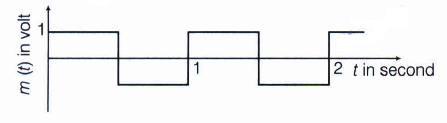
(i) Sketch the amplitude modulated waveform
(ii) What is the modulation index?
8.
A pure semiconductor germanium or silicon,free of every impurity is called intrinsic semiconductor, At room temperature, a pure semiconductor has a very small number of current carriers (electrons and holes).Hence,its conductivity is low.
When the impurity atoms of valence five or three are doped in a pure semiconductor,we get respectively \(n-\) type or \(p-\) type extrinsic semiconductor.In case of a doped semiconductor.\({ n }_{ e }n_{ h }={ n }_{ i }^{ 2 };\)when \({ n }_{ e }\) and \(n_{ h }\) are the number density of electrons and holes respectively and \({ n }_{ i }\) is the number density of intrinsic charge carriers in a pure semiconductor. The conductivity of extrinsic semiconductor is much higher than that that of intrinsic semiconductor.
Read the above passage and answer the following question:
(i) Name two materials to be doped in pure semiconductor of silicon to get (a) \(p-\)type semiconductor (b) \(n-\)type semiconductor
(ii) What do you learn from the above study?
9.
The mean lives of a radioactive substance are 1620 years and 405 years for \(\alpha -emission \ and \ \beta -emission\)respectively. Find out the time during which three-fourth of a sample will decay if it is decaying both by \(\alpha -emission \ and \ \beta -emission\) simultaneously.
10.
The wavelength of light from the spectral emission line of sodium is 589nm. Find the kinetic energy at which (a) an electron (b) a neutron, would have the same de-Broglie wavelength.\(h=6.63\times { 10 }^{ -34 }Js;1eV=1.6\times { 10 }^{ -19 }J;{ m }_{ e }=9.1\times { 10 }^{ -31 }kg;\)
11.
A sinusoidal carrier voltage of frequency 1200 kHz is amplitude modulated by a sinusoidal voltage of frequency 20 kHz. The maximum and minimum modulated carrier amplitudes of 110 V and 90 V are produced. Calculate the frequency of lower and upper side bands, unmodulated carrier amplitude, modulation index and amplitude of each side band.
12.
If 10% of the energy supplied to an incandescent light bulb is radiated as visible light, how many visible light photons are emitted by 200-watt bulb? Assume wavelength of all visible photons to be \(5000\overset { \circ }{ A } \)Given \(h=6.63\times { 10 }^{ -34 }Js\)
13.
Consider an electron in front of metallic surface at a distance d (treated as an infinite plane surface). Assume the force of attraction by the plate is given as \(\frac { 1 }{ 4 } \frac { { q }^{ 2 } }{ 4\pi { e }_{ 0 }{ d }^{ 2 } } \)
Calculate work in taking the charge to an infinite distance from the plate. Taking d = 0.1 nm, find the work done in electron volts. [Such a force law is not valid for d < 0.1 nm].
14.
In a common emitter (CE) amplifier having a voltage gain G, the transistor used has transconductance 0.03 mho and current gain 25. If the above transistor is replaced with another one with transconductance 0.02 mho and current gain 20, the voltage gain will be:
\(\frac { 5 }{ 4 } \ G\)
\(\frac { 2 }{ 3 } \ G\)
1.5 G
\(\frac { 1 }{ 3 } \ G\)
15.
The input resistance of a silicon transistor is 100 ohm. Base current is changed by 40 \(\mu A\)which results in a change in collector current by 2 mA. This transistor is used as a common emitter amplifier with a load resistance of 4 \(k\Omega \) The voltage gain of the amplifier is:
2000
3000
4000
1000
16.
Photoelectric effect supports the quantum nature of light because
there is minimum frequency of light below which no photoelectrons are emitted
the maximum K.E. of photoelectrons emitted depends only on the frequency of the incident light and on its intensity
even when metal surface is faintly illuminated, the photoelectrons leave the surface immediately
electric charge of photoelectron is quantised
17.
In a compound microscope, the distance between objective lens and eye lens is
fixed
variable
infinite
1 metre
18.
For a normal eye, distance of near point from the eye is
\(\infty \)
25 cm
25 m
none of these
19.
If the kinetic energy of the particle is increased to 16 times, the percentage change in the de-Broglie wavelength of the particle is
25%
75%
60%
50%
20.
The wavelength range of SHF (super high frequency) waves is
1 m to 10 m
1 cm to 10 cm
1 m to 1 km
10 m to 100 m
21.
Which of the following is not an electromagnetic wave?
X-rays
UV rays
sound waves
radio waves
22.
Samples of two radioactive nuclides A and B are taken. \({ \lambda }_{ A } \ and \ { \lambda }_{ B }\) are the disintegration constants of A and B respectively. In which of the following cases, the two samples can simultaneously have the same decay rate at any time?
initial rate of decay of A is twice the initial rate of decay of B and \({ \lambda }_{ A }={ \lambda }_{ B }\)
Initial rate of decay of A is twice the initial rate of decay of B and \({ \lambda }_{ A }>{ \lambda }_{ B }\)
Initial rate of decay of B is twice the initial rate of decay of A and \({ \lambda }_{ A }>{ \lambda }_{ B }\)
Initial rate of decay of B is same as the rate of decay of A at t = 2h and \({ \lambda }_{ B }={ \lambda }_{ A }\)
23.
A set of atoms in an excited state decays
in general to any of the states with lower energy
into a lower state only when excited by an external electric field
all together simultaneously into a lower state
to emit protons only when they collide.
24.
The figure given below shows the block diagram of a generalized communication system. Identify the element labelled 'X' and write its function.

25.
What is the range of values of modulation index of an AM wave?
26.
Explain with the help of a circuit diagram, the working of a p-n junction diode as a half-wave rectifier.
27.
An electron is revolving around the nucleus with a constant speed of 2.2 x 10⁸ m/s. Find the de Broglie wavelength associated with it.
28.
What is the range of frequencies used for TV transmission?What is common between these waves and light waves?
29.
Why does a soap bubble show beautiful colours, when illuminated by white light?
30.
What is a solar cell?
31.
The short wavelength limits of Lyman, Paschen and Balmer series in the hydrogen spectrum are denoted by \({ \lambda }_{ L },{ \lambda }_{ P }\), and \({ \lambda }_{ B }\) respectively.Arrange these wavelengths in increasing order.
32.
Name the series of hydrogen spectrum which lies in the visible region of electromagnetic spectrum?
1.
As, we know that
\(power=\frac { energy }{ time } =300\times { 10 }^{ 6 }W=3\times { 10 }^{ 8 }J/s\)
\( 170 \ MeV \ =170\times { 10 }^{ 6 }\times 1.6\times { 10 }^{ -19 }=27.2\times { 10 }^{ -12 }J\)
Number of atoms fissioned per second
\(=\frac { 3\times { 10 }^{ 8 } }{ 2.72\times { 10 }^{ -12 } } =\frac { 3\times { 10 }^{ 20 } }{ 27.2 } \)
Number of atoms fissioned per hour
\(=\frac { 3\times { 10 }^{ 20 }\times 3600 }{ 2.72 } =\frac { 3\times 36 }{ 27.2 } \times { 10 }^{ 22 }=4\times { 10 }^{ 22 }m\)
2.
Here, \(\beta \) = 50, \({ R }_{ 0 }=5\times10^{ 3 }\Omega \);
\(R_{ i }=10^{ 3 }\Omega ;V_{ 1 }=0.01 \ V\)
\({ A }_{ V }=\frac { { V }_{ 0 } }{ { V }_{ 1 } } =\beta .\frac { { R }_{ 0 } }{ { R }_{ i } } \)
or \({ V }_{ 0 }=\beta .\frac { R_{ 0 }\times{ V }_{ i } }{ { R }_{ i } } =50\times\frac { 50\times10^{ 3 }\times0.01 }{ 10^{ 3 } } =2.5 \ V\)
3.
Here,\(\beta =59,{ I }_{ e }=6.0\quad mA\)
\(\beta =\frac { { I }_{ c } }{ { I }_{ b } } =\frac { { I }_{ e }-{ I }_{ b } }{ { I }_{ b } } =\frac { { I }_{ e } }{ { I }_{ b } } =-1\)
\( \therefore \ 59=\frac { 6 }{ { I }_{ b } } -1 \ or \ \frac { 6 }{ { I }_{ b } } =60 \ or \ { I }_{ b }=\frac { 6 }{ 60 } =0.1 \ mA\)
\( { I }_{ c }={ I }_{ e }-{ I }_{ b }=6.0-0.1=5.9\ mA\)
4.
Maximum amplitude, Amax = 10 V
Minimum amplitude, Amin = 2 V
Modulation index μ, is given by the relation:
\(\mu=\frac{A_{\max }-A_{\min }}{A_{\max }+A_{\min }}\)
\(=\frac{10-2}{10+2}=\frac{8}{12}=0.67\)
if A_"min" = 0
Then \(\mu=\frac{A_{\max }}{A_{\max }}=\frac{10}{10}=1\)
5.
Position of minima due to diffraction at a single slit is given by
\( a\sin { \theta =n\lambda } \)
\( \therefore \ \sin { \theta } =\frac { n\lambda }{ a } =\frac { 1\times600\times{ 10 }^{ -9 } }{ 1.0\times{ 10 }^{ -3 } } \)
\( =6\times{ 10 }^{ -4 }m\)
\(For \ small\theta ,\ \sin { \theta } \simeq \ \theta =6\times{ 10 }^{ -4 } \ radian \)
Let y be the distance of first minima on either side of central maxima, then
\( \theta =\frac { y }{ D } \)
\(or \ y=\theta D=6\times{ 10 }^{ -4 }\times2=12\times{ 10 }^{ -4 }m \)
So the distance between first dark fringes on either side of central maxima is
\(2y=2\times12\times{ 10 }^{ -4 }=24\times{ 10 }^{ -4 }m=2.4mm\)
6.
\(N={ N }_{ 0 }{ e }^{ -\lambda t }\)
\(\frac { 3 }{ 4 } { N }_{ 0 }={ N }_{ 0 }{ e }^{ -(0.3465)^{ t }}\) =(\(\because N\)75% of N0)1/2 \(N=\frac { 3 }{ 4 } { N }_{ 0 }\)
\({ e }^{ (0.3465)t }=\frac { 4 }{ 3 } \)
\(0.3465\times t={ log }_{ e }(4/3)\)
\(=2.303[log4-log3]\)
\(=2.303[0.6020-0.4771]\)
\(=2.303\times 0.1249\)
\(t=\frac { 2.303\times 0.1249 }{ 0.3465 } \)
\( \therefore \ t=0.83days \ or \ 19.92\ hours\)
7.
Given, the equation of carrier wave,
c(t) = 1 sin (8\(\pi \) t) ..........(i)
(i) According to the figure,
Amplitude of modulating signal,
Am = 1 V
Amplitude of carrier wave,
AC =2
Tm = 1 s
From Eq.(i), we get
\({ \omega }_{ m }=\frac { 2\pi }{ { T }_{ m } } =\frac { 2\pi }{ 1 } =2\pi \ rad/s\) ....(ii)
c(t) = 2 sin (8 \(\pi \) t)
So, \({ \omega }_{ c }=4{ \omega }m_{ }\)
From Eq. (ii) , we get
So, \({ \omega }_{ c }=4{ \omega }_{ m }\)
Amplitude of modulated wave,
A = Am + Ac
= 1 + 2= 3 V
The sketch of the amplitude modulated waveform is shown below:
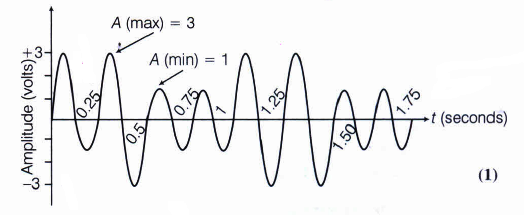
For carrier signal, \({ \omega }\) = 8 \(\pi \)
\(T=\frac { 2\pi }{ \omega } =\frac { 2\pi }{ 8\pi } =\frac { 1 }{ 4 } =0.25s\)
(ii) Modulation index, \(m=\frac{A_{m}}{A_{c}}=\frac{1}{2}=0.5\)
8.
(i) (a) The doping of pure silicon with boron or aluminium will give us \(p-\)type semiconductor
(b) The doping of pure silicon with arsenic or phosphorous will give us \(n-\)type semiconductor.
(ii) From the above study, we find that to get better output current ,pure semiconductor has to be adopted with suitable (impurity) atoms.Similarly,in day to day life,the appearence of right kind of persons(leaders) in society can improve their lot.
9.
\(Here, \ { \tau }_{ \alpha }=1620years,{ \tau }_{ \beta }=405years\)
\( t=?N={ N }_{ 0 }-\frac { 3 }{ 4 } { N }_{ 0 }=\frac { { N }_{ 0 } }{ 4 } \)
\( If \ { \lambda }_{ \alpha }and{ \lambda }_{ \beta }are \ decay \ constants \ for \ alpha \ and \ beta \ emission \ respectively,\)
\( then \ { \lambda }_{ \alpha }=\frac { 1 }{ { \tau }_{ \alpha } } =\frac { 1 }{ 1620 } { yr }^{ -1 }\)
\(and \ { \lambda }_{ \beta }=\frac { 1 }{ { \tau }_{ \beta } } =\frac { 1 }{ 405 } { yr }^{ -1 }\)
\(Total \ decay \ constant \ \lambda ={ \lambda }_{ \alpha }+{ \lambda }_{ \beta }\)
\( =\frac { 1 }{ 1620 } +\frac { 1 }{ 405 } =\frac { 1+4 }{ 1620 } =\frac { 1 }{ 324 } { yr }^{ -1 }\)
\( from \ N={ N }_{ 0 }{ e }^{ -\lambda t }; \ \frac { 1 }{ 4 } { N }_{ 0 }={ N }_{ 0 }{ e }^{ -\lambda t }\)
\(t=\frac { { log }_{ e }4 }{ \lambda } =\frac { 1.386 }{ sfrac { 1 }{ 324 } } yr=449.1yr\)
10.
Wavelength of light of a sodium line, λ = 589 nm = 589 x 10−9 m
Mass of an electron, me= 9.1 x 10⁻³¹ kg
Mass of a neutron, mn= `1.66 x 10⁻²⁷ kg
Planck’s constant, h = 6.6 x 10⁻³⁴ Js
(a) For the kinetic energy K, of an electron accelerating with a velocity v, we have the relation:
\(K=\frac{1}{2} m_{e} v^{2}\)
We have the relation for de Broglie wavelength as:
\(\lambda=\frac{h}{m_{e} v}\)
\(\therefore v^{2}=\frac{h^{2}}{\lambda^{2} m_{e}^{2}}\)
Substituting equation (2) in equation (1), we get the relation:
\(K=\frac{1}{2} \frac{m_{e} h^{2}}{\lambda^{2} m e_{e}^{2}}=\frac{h^{2}}{2 \lambda^{2} m_{e}}\)
\(=\frac{\left(6.6 \times 10^{-34}\right)^{2}}{2 \times\left(589 \times x 10^{-9}\right)^{2} \times 9.1 \times 10^{-31}}\)
\(= 6.9 \times 10^{-25} J\)
\(=\frac{6.9 \times 10^{-25}}{1.6 \times 10^{-19}}=4.31 \times 10^{-6} \mathrm{eV}=4.31 \mu \mathrm{eV}\)
Hence, the kinetic energy of the electron is 6.9 x 10⁻²⁵ J or 4.31 μeV.
(b) Using equation (3), we can write the relation for the kinetic energy of the neutron as:
\(\frac{h^{2}}{2 \lambda^{2} m_{n}}\)
\(=\frac{\left(6.6 \times 10^{-34}\right)^{2}}{2 \times\left(589 \times 10^{-9}\right)^{2} \times 1.66 \times 10^{-27}}\)
\(=3.78 \times 10^{-28} J\)
\(=\frac{3.78 \times 10^{-28}}{1.6 \times 10^{-19}}=2.36 \times 10^{-9} e V=2.36 \neq V\)
Hence, the kinetic energy of the neutron is 3.78 x 10⁻²⁸ J or 2.36 neV.
11.
Here, vc = 1200 kHz
vm = 20 kHz
Lower side band frequency = vc - vm
= 1200 - 20 = 1180 kHz
Upper side band frequency = vc + vm
= 1200 + 20 = 1220 kHz
Unmodulated carrier amplitude
\({ A }_{ C }=\frac { { A }_{ max }+{ A }_{ min } }{ 2 } =\frac { 110+90 }{ 2 } =100V\)
Modulation index (\(\mu\))
\(\mu =\frac { { A }_{ max }-{ A }_{ min } }{ { A }_{ max }+{ A }_{ min } } =\frac { 110-90 }{ 110+90 } =0.1\)
Amplitude of each side band
\(=\frac { \mu { A }_{ c } }{ 2 } =\frac { 0.1\times 100 }{ 2 } =5V\)
12.
\(Here,\lambda =5000\overset { \circ }{ A } =5\times { 10 }^{ -7 }m;\)
Energy of one photon,
\(E=\frac { hc }{ \lambda } =\frac { \left( 6.63\times { 10 }^{ -34 } \right) \left( 3\times { 10 }^{ 8 } \right) }{ 5\times { 10 }^{ -7 } } =3.96\times { 10 }^{ -19 }J\)
A 200 W bulb supplies 200 J of energy per second.Energy emitted by lamp per second as visible light,
\({ E }_{ 1 }=200\times \frac { 10 }{ 100 } =20J{ s }^{ -1 }\)
Number of photons emitted per second as visible light.
\(N=\frac { { E }_{ 1 } }{ E } =\frac { 20 }{ 3.96\times { 10 }^{ -19 } } =5.05\times { 10 }^{ 19 }\)
13.
Force of attraction by the plate on the electron if it is at a distance X is given by
\(\frac { 1 }{ 4 } \frac { { q }^{ 2 } }{ 4\pi { e }_{ 0 }{ x }^{ 2 } } \)
Total W > D in taking the electron from x=d to x=\(\alpha \) will be
\(w=\int { F.dx } =\frac { 1 }{ 4 } .\frac { { q }^{ 2 } }{ 4\pi e_{ 0 } } \int _{ d }^{ \alpha }{ } \frac { 1 }{ { x }^{ 2 } } dx\)
\(=\frac { 9\times{ 10 }^{ 9 }(1.6\times{ 10 }^{ -19 })^{ 2 } }{ 4\times{ 10 }^{ -10 } } J\)
\(=\frac { 9\times{ 10 }^{ 9 }(1.6)^{ 2 }\times{ 10 }^{ -38 } }{ 4\times{ 10 }^{ 10 }\times1.6\times{ 10 }^{ -19 } } eV\)
\(=\frac { 1.6\times9 }{ 4 } =3.6\quad eV\)
14.
15.
(a)
2000
16.
(a)
there is minimum frequency of light below which no photoelectrons are emitted
17.
(a)
fixed
18.
(b)
25 cm
19.
(b)
75%
20.
(b)
1 cm to 10 cm
21.
(c)
sound waves
22.
(b)
Initial rate of decay of A is twice the initial rate of decay of B and \({ \lambda }_{ A }>{ \lambda }_{ B }\)
23.
(a)
in general to any of the states with lower energy
24.
()
X: Channel
It connects the transmitter to the receiver.
25.
()
Modulation index of an AM wave lies between 0 and 1
26.
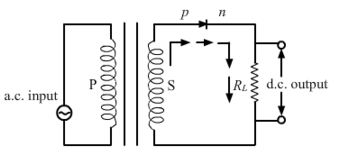
Working:
During one-half of the input AC, the diode is forward biased and a current flows through RL. During the other half of the input AC, the diode is reverse biased and no current flows through the load RL. Hence, the given AC input is rectified.
.png)
27.
\(\lambda =\frac { h }{ mv }\)
\(=\frac { 6.63\times { 10 }^{ -34 } }{ 9.1\times { 10 }^{ -31 }\times 2.2\times { 10 }^{ 8 } }\)
\(=3.31\times { 10 }^{ -12 }m\)
28.
Range of frequency used for TV transmission is 54 MHz to 890 MHz (VHF and UHF).These waves and light waves are electromagnetic waves.The ionosphere is unable to reflect back these waves to earth.
29.
Light waves reflected from outer and inner surface of soap bubble interfere. For different wavelengths, conditions for constructive interference are satisfied at different positions. That is why beautiful colours are seen.
30.
It is a p-n junction device which converts solar energy into electrical energy.
31.
As \(\frac { 1 }{ \lambda } \propto \left( \frac { 1 }{ { n }_{ 1 }^{ 2 } } -\frac { 1 }{ { n }_{ 2 }^{ 2 } } \right) \)
\(\frac { 1 }{ \lambda } \propto \frac { 1 }{ { n }_{ 1 }^{ 2 } } \ (\because { n }_{ 2 }=\infty )\)
For Lyman series \({ n }_{ 1 }=1\)
For Balmer series \({ n }_{ 1 }=2\)
For Paschen series\({ n }_{ 1 }=3\)
\(\therefore { \lambda }_{ L }<{ \lambda }_{ B }<{ \lambda }_{ P }.\)
32.
Balmer series lies in the visible region.

12th Standard CBSE Syllabus & Materials
12th Standard CBSE
CBSE 12th Computer Science Python Revision Tour I - New Previous year Question Papers Study Material - QB365 Set A
NEW12th Standard CBSE
CBSE 12th Business Studies Planning Important Questions And Answers Study Material - QB365 Set A
NEW12th Standard CBSE
CBSE 12th Business Studies Business Environment Important Questions And Answers Study Material - QB365 Set A
NEW12th Standard CBSE
CBSE 12th Business Studies Principles of Management Important Questions And Answers Study Material - QB365 Set A



NCERT Books

Syllabus

Exam Pattern

Sample Question Papers

Previous year Question Papers

Important Notes

MCQ Practice test

NCERT Exemplers

Case study Questions

Image Based Questions

Passage based Questions

HOT Questions

Value Based Questions

Model Questions Papers
NCERT ( Book Back ) Questions

Assertion and Reason
Important Questions And Answers

CBSE 12th Standard CBSE Subjects
CBSE Standards