 100% FREE ACCESS
12th Standard CBSE Syllabus & Materials
12th Standard CBSE
CBSE 12th Economics Government Budget and the Economy Previous year Question Papers Study Material - QB365 Set A
NEW12th Standard CBSE
CBSE 12th Computer Science Interface Python with MySQL - New Previous year Question Papers Study Material - QB365 Set A
NEW12th Standard CBSE
CBSE 12th Computer Science Database Concept - New Previous year Question Papers Study Material - QB365 Set A
NEW12th Standard CBSE
CBSE 12th Computer Science Data Communication - New Previous year Question Papers Study Material - QB365 Set A
NEW12th Standard CBSE
CBSE 12th Computer Science Data Structures - New Previous year Question Papers Study Material - QB365 Set A
NEW12th Standard CBSE
CBSE 12th Computer Science Functions - New Previous year Question Papers Study Material - QB365 Set A

Published on: 02/11/2025
Download CBSE Class 12th Standard CBSE Physics question papers, sample papers, important questions, and previous year solved papers in PDF format. Get free study materials, NCERT solutions, and exam preparation resources for Class 12th Standard CBSE Physics
Questions + Answers key
Take MCQ Physics Test
1.
(i) Draw a schematic arrangement of Geiger-Marsden experiment showing the scattering of a-particles by a thin foil of gold. Why is it that most of the a-particles go right through the foil and only a small fraction gets scattered at large angles?
Draw the trajectory of the a-particle in the coulomb field of a nucleus. What is the Significance of impact parameter and what information can be obtained regarding the size of the nucleus?
(ii) Estimate the distance of closest approach to the nucleus (Z = 80) if a 7.7 MeV a-particle before it comes momentarily to rest and reverses its direction.
2.
Draw the plot of binding energy per nucleon (BE/A) as a function of mass number A. Write two important conclusions that can be drawn regarding the nature of nuclear force.
Use this graph to explain the release of energy in both the processes of nuclear fusion and fission.
Write the basic nuclear process of neutron undergoing p-decay. Why is the detection of neutrinos found very difficult?
3.
For the past some time.Arti has been observing some erratic body movement, unsteadiness and lack of aoordination in the activities of hersister Radha, who also used to complain of serve headache occasionally.Aarti suggested to her parents to get a medical check-up of Radha. The doctor throughly examined Radha and diagnosed that she has a brain tumour
(a) What,according to you,are the value displayed by Arti?
(b) How can radioisotopes help a doctor to diagnose brain tumour?
4.
(a) Define the terms
(i) half life (\({ T }_{ 1/2 }\)) and
(ii) average life (\(\tau \)). Find their relationships with the decay constant ( \(\lambda \))
(b) A radioactive nucleus has a decay constant, \(\lambda\) = 0.3465 (day)-1. How long would it take the nucleus to decay to 75% of its initial amount?
5.
On the basis of Bohr's theory of H-atom, total energy of electron in a stationary orbit is given by the relation
Where, n is the number of orbits. It is clear that total energy of electron in a stationary orbit is negative which implies that electron is bound to the nucleus and is not free to leave it. The value of negative energy decreases as n increases.
Read the above p[assagr and answer the following questions:
(i) What is the total energy of electron in ground state of hydrogen atom? What does it indicate?
(ii) Why does energy required to remove an electron is smaller when atom is in any one excited state?
6.
Marie Curie and her teacher turned husband Pierre Curie worked hard to extract radium chloride (RaCl2) from uranium ore. They succeeded in 192 after a long struggle. About 0.19 g of RaCl2 was extracted and its radioactivity was studied. They were awarded by the noble prize, which they shared it which they shared it which they shared it with Henri Becquerel.
Read the above passage and answer following questions:
(i) What are the values shown by Marie Curie and her husband?
(ii) What do you understand by radioactivity? How the half-life period is related to the disintegration constant?
(iii) How is average-life of radioactive element related to half-life?
7.
Natural radioactivity is a spontaneous and self disruptive activity exhibited by a number of heavy elements in nature. Thus a heavy element disintegrates by itself without being forced by any external agent to do so.
According to radioactive decay law, the number of atoms disintegrated per second (i.e., rate of disintegration of radioactive atoms) at any instant is directly proportional to the number of radioactive atoms actually present in the sample at that instant, i.e., \(-\frac { dN }{ dt } \propto N \ or \ R=-\frac { dN }{ dt } =\lambda N,\) where is \(\lambda \) decay constant.
Read the above passage and answer the following questions :
(i) The count rate from a radioactive sample containing \({ 10 }^{ 16 }\) atoms is \(4\times { 10 }^{ 16 }\) per second. What is the value of decay constant?
(ii) Name the three types of radiactive radiations. Which one of them is most penetrating?
(iii) What does radioactive decay law imply in day to day life?
8.
A nuclear reactor is a powerful device, wherein nuclear energy is utilised for peaceful purposes. It is based upon controlled nuclear chain reaction. The nuclear chain reaction is controlled by the use of control rods (of boron or cadmium) and moderators like heavy water, graphite, etc. The whole reactor is protected with concrete walls 2 to 2.5 metre thick, so that radiations emitted during nuclear reactions may not produce harmful effects.
Read the above passage and answer the following questions:
(i) Give any two merits of nuclear reactors.
(ii) What is radiactive waste?
(iii) Why do people often oppose the location site of a nuclear reactor? What do you suggest?
9.
In a Geiger-Marsden experiment, calculate energy of \(\alpha \ particle\)whose distance of closest approach to the nucleus of Z = 79 is \(2.8\times { 10 }^{ -14 }m\). How will the distance of closest approach be affected when the kinetic energy of the \(\alpha \ particle\)is doubled?
1.
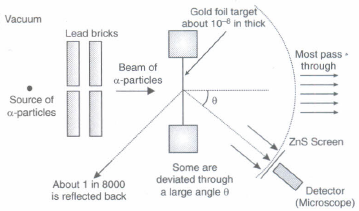
It gives an estimate of the size of nucleus.
(ii) K.E of the ∝-particle = potential energy Possessed by beam at distance of closest approach.
\(\frac { 1 }{ 2 } { mv }^{ 2 }=\frac { 1 }{ 4\pi { \varepsilon }_{ 0 } } .\frac { (2e)(Ze) }{ { r }_{ 0 } } \)
7.7 x 1.6 x 10-3 = \(\frac { 9\times { 10 }^{ 9 }\times 2\times 2.56\times { 10 }^{ -38 } }{ { r }_{ 0 } } \)
r0 = \(\frac { 9\times { 10 }^{ 9 }\times 2\times 2.56\times { 10 }^{ -38 } }{ 7.7\times 1.6\times { 10 }^{ -13 } } m\)
= 299 x 10-16 m
2.
While drawing the plot. we have to keep in mind that first binding energy will increase sharply and then it will be constant almost.
For plot of binding energy per nucleon as the function of mass number A
Following are the two conclusions that can be drawn regarding the nature of the nuclear force.
The force is attractive and strong enough to produce a binding energy of few MeV per nucleon.
The two important conclusions regarding the nature of nuclear force are given below.
(i) The nuclear force is attractive and sufficiently strong to produce a binding energy of a few MeV per nucleon.
(ii) The constancy of the binding energy in the wide range of mass number 30 < A < 170 indicate that nuclear force is a short-range force.
(b) (i) According to the binding energy curve, a very heavy nucleus (A > 170), has lower binding energy per nucleon compared to nuclei of middle mass number (30 < A < 170).
Thus, if a heavy nucleus breaks into two nuclei of mass number between 30 and 170, nucleons get more tightly bound. This implies energy would be released in the process. (nuclear fission)
(ii) When two light nuclei (A < 10) join to form a heavier nucleus, the binding energy per nucleon of fused heavier nucleus increases.
Again it indicates that energy would be released in the process (nuclear fusion).
(c) The basic nuclear process of neutron undergoing β-decay is given as
\(n \rightarrow p+e^{-}+\bar{v}\)
Here \(\bar{v}\) is antinutrino.
Neutrino and antineutrino both are neutral particles with very small (possibly, even zero) mass compared to the electrons. They have only weak interaction with other particles. Therefore, the detection of neutrinos is found very difficult.
3.
(a) Keen observer/helpful/concerned/responsible/respectful towards elders(Any two)
(b) The doctor can trace and observe,the difference between the moment of an appropriate through a normal brain and a brain having tumour in it.
4.
(a) Definition
(i) Half life: Time taken by a radioactive nuclei to reduce to half of the initial number of radio nuclei.
(ii)Average life: Ratio of total life time of all radioactive nuclei to the total number of nuclei in the sample.
Relation between half life and decay constant:
\({ T }_{ 1/2 }=\frac { 0.693 }{ \lambda } \)
Relation between average life and decay constant
\(\tau =\frac { 1 }{ \lambda } \)
(b) \(N={ N }_{ 0 }{ e }^{ -\lambda t }\)
\(\frac { 3 }{ 4 } { N }_{ 0 }={ N }_{ 0 }{ e }^{ -(0.3465)^{ t }\quad }\) = (\(\because N\)75% of N0)
\(N=\frac { 3 }{ 4 } { N }_{ 0 }\)
\({ e }^{ (0.3465)t }=\frac { 4 }{ 3 } \)
\(0.3465\times t={ log }_{ e }(4/3)\)
\(=2.303[log4-log3]\)
\(=2.303[0.6020-0.4771]\)
\( =2.303\times 0.1249\)
\( t=\frac { 2.303\times 0.1249 }{ 0.3465 } \)
\( \therefore \ t=0.83days\ or\ 19.92\ hours\)
5.
(i) The total energy of electron in ground state (n = 1) is
\({ E }_{ 1 }=-\cfrac { 13.6 }{ { 1 }^{ 2 } } eV=-13.6eV\)
It indicates that 13.6eV energy is needed to remove an electron from hydrogen atom in its ground state.
(ii) Energy in first excited state(n = 2) is
\({ E }_{ 2 }=-\cfrac { 13.6 }{ { 2 }^{ 2 } } eV=-3.4eV\)
It implies that energy needed to remove an electron from hydrogen atom in first excited state is 3.4eV, which is less than 13.6eV.
6.
(i) Values shown here are dedication, hard working nature, brilliance, true justification of the help when helped by another, honesty and gratitude.
(ii) The phenomenon of spontaneous emission of \(\alpha \) , \(\beta \) and \(\gamma \)-particles by the nuclide is known as radioactivity. Half-life period is related with the disintegration constant as,
\({ T }_{ 1/2 }=\frac { 0.693 }{ \lambda } \)
(iii) Average life of radioactive element,
\(\tau ={ 1.44T }_{ 1/2 }\)
7.
(i) Here, \(N={ 10 }^{ 16 } \ and \ \frac { dN }{ dt } =4\times { 10 }^{ 16 } \ per \ sec.\lambda =?\)
\(From \ \frac { dN }{ dt } =\lambda N\)
\( \lambda =\frac { dN/dt }{ dt } =\frac { 4\times { 10 }^{ 16 } }{ { 10 }^{ 16 } } =4\times { 10 }^{ 16 }{ sec }^{ -1 }\)
(ii) The three types of radiactive are radiations are : \(\alpha \)-rays; \(\beta \)-rays and \(\gamma \)-rays. Out of then, \(\alpha \)-rays have maximum penetrating power.
(ii) Radioactive decay law is the law of mass action, i.e., larger the available mass, greater is its rate of decay. The same applies in day to day life. Larger the population, greater is their decay rate, i.e., death rate, i.e., under given conditions, when number of people is large, the rate at which they die is also large. The reverse is also true.
8.
(i) Nuclear reactors are used in electric power generation. They are also used to produce radioactive isotopes which have applications in medicine, industry and agriculture.
(ii) Radioactive waste consists of fission products and transuranic elements such as plutonium and americium. This waste is extremely hazardous to all forms of life on earth.
(iii) People often oppose the location site of a nuclear reactor because any leakage of nuclear radiations can affect adversely miles of area surrounding it. Elaborate safety measures are needed not only for reactor operations, but also for handling and disposal of radioactive waste.
I would suggest that Government must take stringent safety measures and assure people of safeguards in the event of nuclear accidents. At the same time, people must also be educated accordingly.
9.
\(Here,\ { r }_{ 0 }=2.8\times { 10 }^{ -14 }m,Z=79,\)
\( E=?\)
\( From\quad E=\frac { 1 }{ { 4\pi \varepsilon }_{ 0 } } \frac { (Ze)(2e) }{ { r }_{ 0 } } \)
\(E=\frac { 1 }{ { 4\pi \varepsilon }_{ 0 } } \frac { { 2Ze }^{ 2 } }{ { r }_{ 0 } } =\frac { 9\times { 10 }^{ 9 }\times 2\times 79{ \left( 1.6\times { 10 }^{ -19 } \right) }^{ 2 } }{ 2.8\times { 10 }^{ -14 } }\)
\(=1.300\times { 10 }^{ -12 }J\)
\( =\frac { 1.300\times { 10 }^{ -12 } }{ 1.6\times { 10 }^{ -13 } } MeV=8.125MeV\)
\(As \ E \ is \ doubled,{ r }_{ 0 } \ becomes \ half\)
\( \frac { { r }_{ 0 } }{ 2 } =1.4\times { 10 }^{ -14 }m\)

12th Standard CBSE Syllabus & Materials
12th Standard CBSE
CBSE 12th Computer Science Python Revision Tour I - New Previous year Question Papers Study Material - QB365 Set A
NEW12th Standard CBSE
CBSE 12th Business Studies Planning Important Questions And Answers Study Material - QB365 Set A
NEW12th Standard CBSE
CBSE 12th Business Studies Business Environment Important Questions And Answers Study Material - QB365 Set A
NEW12th Standard CBSE
CBSE 12th Business Studies Principles of Management Important Questions And Answers Study Material - QB365 Set A



NCERT Books

Syllabus

Exam Pattern

Sample Question Papers

Previous year Question Papers

Important Notes

MCQ Practice test

NCERT Exemplers

Case study Questions

Image Based Questions

Passage based Questions

HOT Questions

Value Based Questions

Model Questions Papers
NCERT ( Book Back ) Questions

Assertion and Reason
Important Questions And Answers

CBSE 12th Standard CBSE Subjects
CBSE Standards