
 100% FREE ACCESS
12th Standard CBSE Syllabus & Materials
12th Standard CBSE
CBSE 12th Economics Government Budget and the Economy Previous year Question Papers Study Material - QB365 Set A
NEW12th Standard CBSE
CBSE 12th Computer Science Interface Python with MySQL - New Previous year Question Papers Study Material - QB365 Set A
NEW12th Standard CBSE
CBSE 12th Computer Science Database Concept - New Previous year Question Papers Study Material - QB365 Set A
NEW12th Standard CBSE
CBSE 12th Computer Science Data Communication - New Previous year Question Papers Study Material - QB365 Set A
NEW12th Standard CBSE
CBSE 12th Computer Science Data Structures - New Previous year Question Papers Study Material - QB365 Set A
NEW12th Standard CBSE
CBSE 12th Computer Science Functions - New Previous year Question Papers Study Material - QB365 Set A

Published on: 07/03/2026
Download CBSE Class 12th Standard CBSE Physics question papers, sample papers, important questions, and previous year solved papers in PDF format. Get free study materials, NCERT solutions, and exam preparation resources for Class 12th Standard CBSE Physics
Questions + Answers key
Take MCQ Physics Test
1.
Radioactivity is the phenomenon associated with
decay of nucleus.
production of radio waves.
transmission of radio waves
reception of radio waves.
2.
The transition of electron from n = 4, 5, 6, ....... to n = 3 corresponds to
Lyman series
Balmer series
Paschen series
Brackett series
3.
The energy of hydrogen atom in the nth orbit is En, then the energy in the nth orbit of single ionised helium atom is
\( \frac{E_{n}}{2} \)
\( 2 E_{n}\)
\(4 E_{n} \)
\(\frac{E_{n}}{4} \)
4.
In terms of Rydberg constant R, the wave number of the first Balmer line is
R
3R
\( \frac{5 R}{36} \)
\(\frac{8 R}{9}\)
5.
In a nuclear reactor, moderators slow down the neutrons which come out in a fission process. The moderator used have light nuclei. Heavy nuclei will not serve the purpose, because
they will break up
elastic collision of neutrons with heavy nuclei will not slow them down
the net weight of the reactor would be unbearably high
substances with heavy nuclei do not occur in liquid or gaseous state at room temperature
6.
The nuclear forces
are stronger, being roughly hundred times that of electromagnetic forces
have a short range dominant over a distance of about a few fermi
are central forces, independent of the spin of the nucleons
are independent of the nuclear charge.
7.
The mass number of a nucleus is :
always less than its atomic number
always more than its atomic number
sometimes equal to its atomic number
sometimes more than and sometimes equal to its atomic number
8.
In a hydrogen like atom, electron makes transition from an energy level with quantum number n to another with quantum number (n - 1). If n>>1, the frequency of radiation emitted is proportional to :
\(\frac { 1 }{ n } \)
\(\frac { 1 }{ { n }^{ 2 } } \)
\(\frac { 1 }{ { n }^{ 3/2 } } \)
\(\frac { 1 }{ { n }^{ 3 } } \)
9.
The radii of two nuclei with mass numbers 1 and 8 are in the ratio
1:8
8:1
1:2
2:1
10.
The ionisation potential of hydrogen atom is
-13.6 eV
13.6 eV
-13.6 V
13.6 V
11.
The ground state energy of electron in case of \(_{ 3 }{ { Li }^{ 7 } }\)is
13.6 eV
-13.6 eV
30.4 eV
-30.4 eV
12.
Two H atoms in the ground state collide inelastically. The maximum amount by which their combined kinetic energy is reduced is
10.20 eV
20.40 eV
13.6 eV
27.2 eV
13.
The binding energy of a H-atom, considering an electron moving around a fixed nuclei (proton), \(B=-\frac { { me }^{ 4 } }{ 8{ n }^{ 2 }{ \epsilon }_{ 0 }^{ 2 }{ h }^{ 2 } } \) is (m = electron mass). If one decides to work in a frame of reference where the electron is at rest, the proton would be moving around it. By similar arguments, the binding energy would be \(B=-\frac { { Me }^{ 4 } }{ 8{ n }^{ 2 }{ \epsilon }_{ 0 }^{ 2 }{ h }^{ 2 } } \left( M=proton \ mass \right) \) This last expression is not correct because
n would not be integral
Bohr-quantisation applies only to electron
the frame in which the electron is at rest is not inertial
the motion of the proton would not be in circular orbits, even approximately
14.
The Balmer series for the H-atom can be observed
if we measure the frequencies of light emitted when an excited atom falls to the ground state
if we measure the frequencies of light emitted due to transitions between excited states and the first excited state
in any transition in a H-atom
as a sequence of frequencies with the higher frequencies getting closely packed.
15.
For the ground state, the electron in the H-atom has an angular momentum =h, according to the simple Bohr model. Angular momentum is a vector and hence there will be infinitely many orbits with the vector pointing in all possible directions. In actuality, this is not true,
because only one of these would have a minimum energy
because only one of these would have a minimum energy
angular momentum must be in the direction of spin of electron
because electrons go arround only in horizontal obits.
16.
The simple Bohr model cannot be directly applied to calculate the energy levels of an atom with electrons. This because
of the electrons not being subjects to a central force
of the electrons colliding with each other
of screening effects
the force between the nucleus and an electron will no longer be given by Coulomb's law
17.
Write the necessary condition required for fusion reaction.
18.
Explain the processes of nuclear fission and nuclear fusion by using the plot of binding energy per nucleon (BE/ A) versus the mass number A.
19.
If Bohr’s quantisation postulate (angular momentum = nh/2\(\pi\)) is a basic law of nature, it should be equally valid for the case of planetary motion also. Why then do we never speak of quantisation of orbits of planets around the sun?
20.
Draw a plot of potential energy between a pair of nucleons as a function of their separation. Mark the regions where potential energy is (i) positive and (ii) negative.
21.
The mass of a H-atom is less than the sum of the masses of a proton and electron. Why is this?
22.
What is one electron volt?
23.
What should be minimum energy required by ground state electron in hydrogen atom so that three lines are obtained in its emission spectrum?
24.
(i) What is the nuclear density of \({ }_{90}^{228} \mathrm{Th}\)?
(ii) Is the nuclear density of an a-particle (\({ }_{2}^{4} \mathrm{He}\)) to be greater than, less than or equal to \({ }_{90}^{228} \mathrm{Th}\)? Explain.
(iii) Determine the nuclear density of an a-particle.
25.
(i) In H-atom, an electron undergoes transition from second excited state to the first excited state and then to the ground state. Identify the spectral series to which these transitions belong.
(ii) Find out the ratio of the wavelengths of the emitted radiations in the two cases.
26.
Obtain the relation N = N0e\(-\lambda t\) for a sample of radioactive material having decay constant \(\lambda\), where N is the number of nuclei present at instant t. Hence obtain the relation between decay constant \(\lambda\) and half life T1/2 of the sample.
27.
Identify the nature of the 'radioactive radiations', emitted in each step
of the 'decay chain' given below:
\(_{ Z }^{ A }{ X\rightarrow _{ Z-2 }^{ A-4 }{ Y } }\rightarrow _{ Z-2 }^{ A-4 }{ Y }\rightarrow _{ Z-1 }^{ A-4 }W\)
28.
A positronium atom is a bound state of an electron \(\left( { e }^{ - } \right) \) and its antiparticle, the positron \(\left( { e }^{ + } \right) \) revolving round their centre of mass. In which part of the em spectrum does the system radiate when it de-excites from its first excited state to the ground state?
29.
The Q value of a nuclear reaction \(A+b \rightarrow C+d\) is defined by \(Q=\left[m_{A}+m_{b}-m_{C}-m_{d}\right] c^{2}\) where the masses refer to the respective nuclei. Determine from the given data the Q-value of the following reactions and state whether the reactions are exothermic or endothermic.
\(\text { (i) }{ }_{1}^{1} \mathrm{H}+{ }_{1}^{3} \mathrm{H} \rightarrow{ }_{1}^{2} \mathrm{H}+{ }_{1}^{2} \mathrm{H}\)
\(\text { (ii) }{ }_{6}^{12} \mathrm{C}+{ }_{6}^{12} \mathrm{C} \rightarrow{ }_{10}^{20} \mathrm{Ne}+{ }_{2}^{4} \mathrm{He}\)
Atomic masses are given to be
\(m\left({ }_{1}^{2} \mathrm{H}\right)=2.014102 \mathrm{u}\)
\(m\left({ }_{1}^{3} \mathrm{H}\right)=3.016049 \mathrm{u}\)
\(m\left(\begin{array}{c} 12 \\ 6 \end{array} \mathrm{C}\right)=12.000000 \mathrm{u}\)
\(m\left(\begin{array}{l} 20 \\ 10 \end{array} \mathrm{Ne}\right)=19.992439 \mathrm{u}\)
30.
Obtain the binding energy of the nuclei \(\begin{array}{l} 26 \\ 56 \end{array} \text { Fe }\) and \(\begin{array}{l} 209 \\ 83 \end{array} \text { Bi }\)in units of MeV from the following data:
m (\(\begin{array}{l} 26 \\ 56 \end{array} \text { Fe }\) ) = 55.934939 u
m (\(\begin{array}{l} 209 \\ 83 \end{array} \text { Bi }\) ) = 208.980388 u
31.
Obtain the binding energy (in MeV) of a nitrogen nucleus \(\left(\begin{array}{c} 14 \\ 7 \end{array} \mathrm{~N}\right)\) given m \(\left(\begin{array}{c} 14 \\ 7 \end{array} \mathrm{~N}\right)\)=14.00307 u
32.
Using the Rydberg formula, calculate the wavelengths of the first four spectral lines in the Lyman series of the hydrogen spectrum.
33.
Niels Bohr introduced the atomic Hydrogen model in 1913. He described it as a positively charged nucleus, comprised of protons and neutrons, surrounded by a negatively charged electron cloud. In the model, electrons orbit the nucleus in atomic shells. The atom is held together by electrostatic forces between the positive nucleus and negative surroundings.
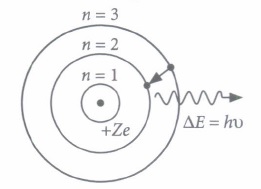
Bohr correctly proposed that the energy and radii of the orbits of electrons in atoms are quantized, with energy for transitions between orbits given by
\(\Delta E=h v=E_{i}-E_{f}\) Where \(\Delta E\) is the change in energy between the initial and final orbits and hv is the energy of an absorbed or emitted photon.
(i) In the Bohr model of the hydrogen atom, discrete radii and energy states result when an electron circles the atom in an integer number of
| (a) de Broglie wavelengths | (b) wave frequencies |
| (c) quantum numbers | (d) diffraction patterns. |
(ii) The angular speed of the electron in the nth orbit of Bohr's hydrogen atom is
| (a) directly proportional to n | (b) inversely proportional to \(\sqrt{n}\) |
| (c) inversely proportional to n2 | (d) inversely proportional to n3 |
(iii) When electron jumps from n = 4 level to n = 1 level, the angular momentum of electron changes by
| \(\text { (a) } \frac{h}{2 \pi}\) | \(\text { (b) } \frac{h}{\pi}\) | \(\text { (c) } \frac{3 h}{2 \pi}\) | \(\text { (d) } \frac{2 h}{\pi}\) |
(iv) The lowest Bohr orbit in hydrogen atom has
| (a) the maximum energy | (b) the least energy |
| (c) infinite energy | (d) zero energy |
(v) Which of the following postulates of the Bohr modelled to the quantization of energy of the hydrogen atom?
| (a) The electron goes around the nucleus in circular orbits. |
| (b) The angular momentum of the electron can only be an integral multiple of h/2\(\pi\) |
| (c) The magnitude of the linear momentum of the electron is quantized. |
| (d) Quantization of energy is itself a postulate of the Bohr model. |
34.
35.
36.
37.
Assertion (A) : The ratio for time taken for light emission from an atom to that for release of nuclear energy in fission is 1 : 100.
Reason (R) : Time taken for the light emission from an atom is of the order of 10-8 s.
Codes:
(a) Both A and R are true and R is the correct explanation of A
(b) Both A and R are true but R is NOT the correct explanation of A
(c) A is true but R is false
(d) A is false and R is also false
38.
Assertion (A) : Balmer series lies in the visible region of electromagnetic spectrum.
Reason (R): \(\frac{1}{\lambda}=R\left(\frac{1}{2^{2}}-\frac{1}{K^{2}}\right),, \text { where } K=3,4,5, \ldots\)
Codes:
(a) Both A and R are true and R is the correct explanation of A
(b) Both A and R are true but R is NOT the correct explanation of A
(c) A is true but R is false
(d) A is false and R is also false
39.
Assertion (A) : In He-Ne laser, population inversion takes place between energy levels of neon atoms.
Reason (R) : Helium atoms have a meta-stable energy level.
Codes:
(a) Both A and R are true and R is the correct explanation of A
(b) Both A and R are true but R is NOT the correct explanation of A
(c) A is true but R is false
(d) A is false and R is also false
40.
Assertion (A) : A tube light emits white light.
Reason (R) : Emission of light in a tube takes place at a very high temperature.
Codes:
(a) Both A and R are true and R is the correct explanation of A
(b) Both A and R are true but R is NOT the correct explanation of A
(c) A is true but R is false
(d) A is false and R is also false
1.
(a)
decay of nucleus.
2.
(c)
Paschen series
3.
(c)
\(4 E_{n} \)
4.
(c)
\( \frac{5 R}{36} \)
5.
(b)
elastic collision of neutrons with heavy nuclei will not slow them down
6.
(a)
are stronger, being roughly hundred times that of electromagnetic forces
7.
(c)
sometimes equal to its atomic number
8.
(d)
\(\frac { 1 }{ { n }^{ 3 } } \)
9.
(c)
1:2
10.
(d)
13.6 V
11.
(d)
-30.4 eV
12.
(a)
10.20 eV
13.
(c)
the frame in which the electron is at rest is not inertial
14.
(b)
if we measure the frequencies of light emitted due to transitions between excited states and the first excited state
15.
(a)
because only one of these would have a minimum energy
16.
(a)
of the electrons not being subjects to a central force
17.
(i) Nuclear fusion will occur when the kinetic energy of colliding nuclei is enough to overcome the strong electrostatic forces of repulsion between the protons. For this, high temperature is required.
(ii) The density of nuclei should also be very high to increase the number of collisions.
18.
From the given plot, we can conclude that, a very heavy nucleus A = 240 has lower Ebn compared to that of a nucleus with A = 120.Thus, if a nucleus A = 240 breaks into two A = 120 nuclei, nucleons get more tightly bound. Energy would be released in this process which is known as nuclear fission.
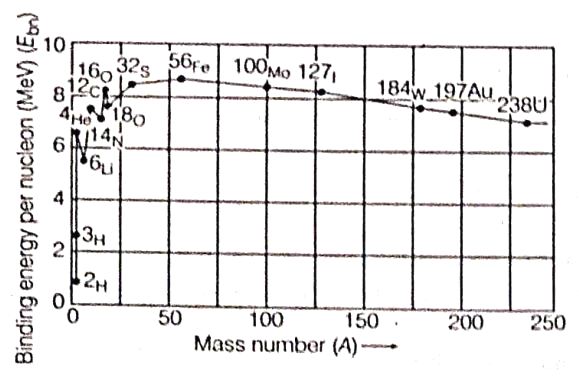
Also, when two light nuclei (A ≤ 10)join to form a heavier nucleus, Ebn of fused heavier nuclei is more than the Ebn of lighter nuclei. Energy would be released in this process, which is known as nuclear fusion.
19.
We never speak of quantization of orbits of planets around the Sun because the angular momentum associated with planetary motion is largely relative to the value of Planck’s constant (h). The angular momentum of the Earth in its orbit is of the order of 1070h. This leads to a very high value of quantum levels n of the order of 1070. For large values of n, successive energies and angular momenta are relatively very small. Hence, the quantum levels for planetary motion are considered continuous.
20.
Plot the graph between and potential energy of a pair of nucleons as a function of their separation
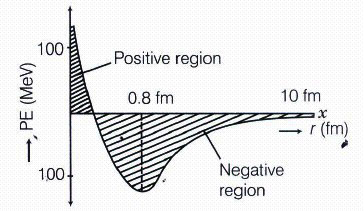
(i) For distance less than 0.8 fm, negative PE decreases to zero and then becomes positive
(ii) for distances larger than 0.8 fm, negative PE goes on decreasing.
21.
According to mass energy equivalence established by Einstein E = mc2. If B represents binding energy of hydrogen atom (= 13.6 eV), the equivalent mass of this energy \(=B / c^2\)
Hence, mass of a H-atom \(=m_p+m_e-B / c^2\)
It is less than sum of the masses of a proton and an electron.
22.
One electron volt is defined as the amount of energy acquired by an electron when it is accelerated under a potential difference of 1 volt.
23.
To produce three lines, the number of excited orbit can be obtained using this relation
\(
\frac{n(n-1)}{2} =3
\)
\(n^{2}-3 n =6
\)
\(n^{2}-3 n-6 =0
\)
\((n-3)(n+2) =0
\)
\(n =3 \text { or } n=-2
\)
\(\therefore \quad n =3 .
\)
Final energy of electron,
\(E_{n}=\frac{-13.6 \mathrm{eV}}{n^{2}}=\frac{-13.6 \mathrm{eV}}{(3)^{2}}=-1.5 \mathrm{eV}\)
24.
(i) We know that,
\(\rho=\frac{3 m}{4 \pi R_{0}^{3}}\)
\(\therefore \quad \rho=\frac{3 \times 1.6 \times 10^{-17} \mathrm{~kg}}{4 \times 3.14 \times\left(1.2 \times 10^{-15}\right)^{3}}\)
\(=2.3 \times 10^{17} \mathrm{~kg} / \mathrm{m}^{3}\)
(ii) Nuclear density (P) is independent on mass number, hence nuclear density of a-particle \(\left({ }_{2}^{4} \mathrm{He}\right)\) and thorium \(\left({ }_{90}^{228} \mathrm{Th}\right)\)is equal to each other.
(iii) For a-particle, also nuclear density is equal to 2.3 x 10¹⁷ kg/m 3, as explained earlier.
25.
(i) An electron undergoes transition from second excited state to the first excited state which corresponds to Balmer series and then to the ground state which corresponds to Lyman series.
(ii) The wavelength of the emitted radiations in the two cases.
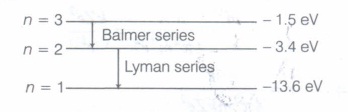
We know that,\(\lambda=\frac{h c}{\Delta E}\)
Frorn n3 \(\rightarrow\) n2,
\(\lambda_{1}=\frac{h c}{E_{3}-E_{2}}\)
\(=\frac{h c}{(-1.5)-(-3.4)}=\frac{h c}{1.9}\)
From n2 \(\rightarrow\) n1
\(\lambda_{2}=\frac{h c}{E_{2}-E_{1}}\)
\(=\frac{h c}{(-3.4)-(-13.6)}=\frac{h c}{10.20}\)
\(\therefore \quad \frac{\lambda_{1}}{\lambda_{2}}=\frac{10.20}{1.9}=5.3\)
26.
Let a sample of radioactive material have N0 nuclei, at t = 0
At time t, Number of nuclei = N
As per the decay law
\(-\frac{dN}{dt}=\lambda N\)
\(\Rightarrow \ \int _{ { N }_{ 0 } }^{ N }{ \frac { dN }{ N } } =\int _{ 0 }^{ t }{ -\lambda } dt\)
\(\Rightarrow \ { \left( \log _{ e }{ N } \right) }_{ { N }_{ 0 } }^{ N }=-\left( { t }_{ 0 } \right) { t }^{ 1/2 }\)
\(\frac{N}{N_0}=e^-\lambda^ t\)
\(\Rightarrow \ \ N={ N }_{ 0 }{ e }^{ -\lambda t }\)
After one half life, Number of nuclei becomes \(\frac{N_0}{2}\)
\(\Rightarrow \ \frac { N_{ 0 } }{ 2 } =N_{ 0 }e^{ - }\lambda ^{ T }1/2\)
\(\Rightarrow\) 2 = \(e^\lambda \)T1/2
\(\Rightarrow\) loge 2 = \({ \lambda T }_{ \frac { 1 }{ 2 } }\)
\(\Rightarrow\) \({ \lambda T }_{ \frac { 1 }{ 2 } }\) = 0.6931
\(\Rightarrow\) \({ T }_{ \frac { 1 }{ 2 } }\) = \(\frac{0.6931}{\lambda}\)
27.
(i) \(\alpha \) rays
(ii) \(\gamma \) rays
(iii) \(\beta \) rays
28.
In an ordinary atom, as a first approximation, we ignore the motion of the nucleus, being too heavy. In a positronium atom, a positron replaces proton of hydrogen atom. As electron and positron masses are equal, the motion of the positron cannot be ignored. We consider motion of electron and positron about their centre of mass. A detailed analysis (beyond the scope of this book) shows that formulae of Bohr model apply to positronium atom provided that we replace \({ m }_{ e }\) by what is known as reduced mass of the electron. For positronium, the reduced mass is \({ m }_{ e }/2.\) In the transition n = 2 to n = 1, the wavelength of radiation emitted is double than that of the corresponding radiation emitted for a similar transition in hydrogen atom, which has a wavelength of \(1217\mathring { A } \) ; and hence is equal to \(2\times 1217=2434\mathring { A } .\) This radiation lies in the ultra-violet part of the electromagnetic spectrum.
29.
The given nuclear reaction is:
\({ }_{1}^{1} H+{ }_{1}^{3} H \rightarrow_{1}^{2} H+{ }_{1}^{2} H\)
It is given that:
Atomic mass \(m\left({ }_{1}^{1} H\right)=1.007825 \mathrm{u}\)
Atomic mass \(m\left({ }_{1}^{3} H\right)=3.016049 \mathrm{u}\)
Atomic mass \(m\left({ }_{1}^{2} H\right)=2.014102 u\)
According to the question, the Q-value of the reaction can be written as:
\(Q=\left[m\left({ }_{1}^{1} H\right)+m\left({ }_{1}^{3} H\right)-2 m\left({ }_{1}^{2} H\right)\right] c^{2}\)
\(=[1.007825+3.016049-2 \times 2.014102] c^{2}\)
\(Q=-0.00433 \times 931.5=-4.0334 \mathrm{MeV}\)
The negativeQ-value of the reaction shows that the reaction is endothermic.
The given nuclear reaction is:
\(\text { (ii) }{ }_{6}^{12} \mathrm{C}+{ }_{6}^{12} \mathrm{C} \rightarrow{ }_{10}^{20} \mathrm{Ne}+{ }_{2}^{4} \mathrm{He}\)
t is given that:
Atomic mass of \(m\left({ }_{6}^{12} C\right)=12.0 u\)
Atomic mass of \(m\left(\begin{array}{l} 20 \\ 10 \end{array}\right)=19.992439\)
Atomic mass of \(m\left({ }_{2}^{4} \mathrm{He}\right)=4.002603 \mathrm{u}\)
The Q-value of this reaction is given as:
\(Q=\left[2 m\left({ }_{6}^{12} C\right)-m\left({ }_{10}^{20} N e\right)-m\left({ }_{2}^{4} H e\right)\right] c^{2}\)
\(=[2 \times 12.0-19.992439-4.002603] c^{2}\)
\(=\left(0.004958 c^{2}\right) u\)
\(=0.004958 \times 931.5=4.618377 \mathrm{MeV}\)
The positive Q-value of the reaction shows that the reaction is exothermic.
30.
Atomic mass of \(\begin{array}{l} 26 \\ 56 \end{array} \text { Fe }\),m1 = 55.934939 u
\(\begin{array}{l} 26 \\ 56 \end{array} \text { Fe }\) nucleus has 26 protons and (56 − 26) = 30 neutrons
Hence, the mass defect of the nucleus,Δm = 26 x mH + 30 x mn − m1
Where,
Mass of a proton, mH = 1.007825 u
Mass of a neutron, mn = 1.008665 u
∴Δm = 26 x 1.007825 + 30 x 1.008665 − 55.934939
= 26.20345 + 30.25995 − 55.934939
= 0.528461 u
But 1 u = 931.5 MeV/c2
∴Δm = 0.528461 x 931.5 MeV/c2
The binding energy of this nucleus is given as:
Eb1 = Δmc2
Where,
c = Speed of light
∴Eb1 = 0.528461 x 931.5 \(\left(\frac{M e V}{c^{2}}\right) \times c^{2}\)
= 492.26 MeV
Average binding energy per nucleon =\(\frac{492.26}{56}=8.79 \mathrm{MeV}\)
Atomic mass of \(\begin{array}{l} 209 \\ 83 \end{array} \text { Bi }\), m2 = 208.980388 u
\(\begin{array}{l} 209 \\ 83 \end{array} \text { Bi }\) nucleus has 83 protons and (209 − 83) 126 neutrons.
Hence, the mass defect of this nucleus is given as:
Δm' = 83 x mH + 126 x mn − m2
Where,
Mass of a proton, mH = 1.007825 u
Mass of a neutron, mn = 1.008665 u
∴Δm' = 83 x 1.007825 + 126 x 1.008665 − 208.980388
= 83.649475 + 127.091790 − 208.980388
= 1.760877 u
But 1 u = 931.5 MeV/c2
∴Δm' = 1.760877 x 931.5 MeV/c2
Hence, the binding energy of this nucleus is given as:
Eb2 = Δm'c2
= 1.760877 x 931.5 \(\left(\frac{M e V}{c^{2}}\right) \times c^{2}\)
= 1640.26 MeV
Average bindingenergy per nucleon \(=\frac{1640.26}{209}=7.848 \mathrm{MeV}\)
31.
Mass of proton, mp = 1.00783 u
Mass of neutron, mn = 1.00867 u
In \({ }_7^{14} \mathrm{~N} \text {, }\)there are 7 protons and 7 neutrons.
\(\therefore\) Mass defect, \(\Delta\)m = (7mp + 7mn) - mN
\(=7 \times 1.00783+7 \times 1.00867-14.00307\)
= 0.11243 u
Binding energy of nitrogen nucleus
= \(\Delta\)m \(\times\) 931 MeV
= 0.11243 \(\times\) 931MeV = 104.67 MeV
32.
The Rydberg formula is
\(h c / \lambda_{i f}=\frac{m e^{4}}{8 \varepsilon_{o}^{2} h^{2}}\left(\frac{1}{n_{f}^{2}}-\frac{1}{n_{i}^{2}}\right)\)
The wavelengths of the first four lines in the Lyman series correspond to transitions from ni = 2, 3, 4, 5 to nf = 1. We know that
\(\frac{m e^{4}}{8 \varepsilon_{b}^{7} h^{2}}\) = 13.6 eV = 21.76 × 10⁻¹⁹ J
Therefore,
\(\lambda _{i 1}=\frac{h c}{21.76 \times 10^{-19}\left(\frac{1}{1}-\frac{1}{n_{i}^{2}}\right)}^{m}\)
\(=\frac{6.625 \times 10^{-34} \times 3 \times 10^{8} \times n_{i}^{2}}{21.76 \times 10^{-19} \times\left(n_{i}^{2}-1\right)} \mathrm{m}=\frac{0.9134 \mathrm{n}_{i}^{2}}{\left(n_{\mathrm{L}}^{2}-1\right)} \times 10^{-7} \mathrm{~m}\)
\(=913.4 n_{i}^{2} /\left(n_{i}^{2}-1\right) \) \(\overset{\unicode{xb0} }{A}\)
Substituting ni = 2, 3, 4, 5, we get \(\lambda \)21 = 1218 Å, \(\lambda \)31 = 1028 Å, \(\lambda \)41 = 974.3 Å, and \(\lambda \)51 = 951.4 Å.
33.
(i) (c)
(ii) (d): \(\omega=\frac{v}{r} . \text { Further } v \propto \frac{1}{n} \text { and } r \propto n^{2},\)
\(\text { Hence } \omega \propto\left(1 / n^{3}\right)\)
(iii) (c)
(iv) (b): The energy of nth Bohr orbit in hydrogen atom is
\(E_{n}=-\frac{13.6}{n^{2}} \mathrm{eV}\)
For lowest orbit, n = 1
\(\therefore \quad E_{1}=-13.6 \mathrm{eV}\)
Thus, the lowest Bohr orbit in hydrogen atom has the least energy
(v) (b)
34.
35.
36.
37.
(a): Time taken for the light emission from an atom = 10-8 s.
Time taken for release of energy in fission = 10-6 s
\(\text { Required ratio }=\frac{10^{-8}}{10^{-6}}=\frac{1}{100}=1: 100\)
38.
(b): When we put R = 107 m-1and K = 3,4, 5 in the given formula, values of \(\lambda\) calculated lie between 4000 \(\dot A\) and 8000 \(\dot A\), which is the visible region. The reason is true, but does not explain the assertion properly.
39.
(a): Helium-neon laser uses a gaseous mixture of helium and neon. An electric discharge in the gas pumps the helium atoms to higher energy level, (which is meta stable energy level).
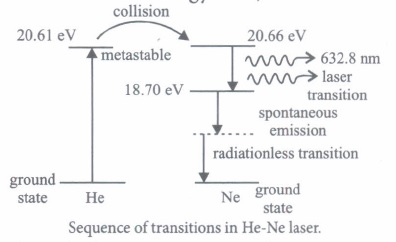
Then these helium atom excite the neon atoms to higher level by collision and produce an inverted population of neon atom which emit radiation when they are stimulated to fall to lower level.
40.
(d): The tube light is nothing but a gas discharge tube, which can emit light of different colours. This colour depends mainly upon the nature of the gas inside the tube and the nature of the glass. For neon gas the colour is bright red and for CO2 it is bluish. Again the fluorescent glow looks yellowish green for soda glass. So it is the nature of the glass and the gas inside the tube which determines the colour of the fluorescent glow. As argon is filled inside a tube light, the colour of the light is white.

12th Standard CBSE Syllabus & Materials
12th Standard CBSE
CBSE 12th Computer Science Python Revision Tour I - New Previous year Question Papers Study Material - QB365 Set A
NEW12th Standard CBSE
CBSE 12th Business Studies Planning Important Questions And Answers Study Material - QB365 Set A
NEW12th Standard CBSE
CBSE 12th Business Studies Business Environment Important Questions And Answers Study Material - QB365 Set A
NEW12th Standard CBSE
CBSE 12th Business Studies Principles of Management Important Questions And Answers Study Material - QB365 Set A



NCERT Books

Syllabus

Exam Pattern

Sample Question Papers

Previous year Question Papers

Important Notes

MCQ Practice test

NCERT Exemplers

Case study Questions

Image Based Questions

Passage based Questions

HOT Questions

Value Based Questions

Model Questions Papers
NCERT ( Book Back ) Questions

Assertion and Reason
Important Questions And Answers

CBSE 12th Standard CBSE Subjects
CBSE Standards