
 100% FREE ACCESS
12th Standard CBSE Syllabus & Materials
12th Standard CBSE
CBSE 12th Economics Government Budget and the Economy Previous year Question Papers Study Material - QB365 Set A
NEW12th Standard CBSE
CBSE 12th Computer Science Interface Python with MySQL - New Previous year Question Papers Study Material - QB365 Set A
NEW12th Standard CBSE
CBSE 12th Computer Science Database Concept - New Previous year Question Papers Study Material - QB365 Set A
NEW12th Standard CBSE
CBSE 12th Computer Science Data Communication - New Previous year Question Papers Study Material - QB365 Set A
NEW12th Standard CBSE
CBSE 12th Computer Science Data Structures - New Previous year Question Papers Study Material - QB365 Set A
NEW12th Standard CBSE
CBSE 12th Computer Science Functions - New Previous year Question Papers Study Material - QB365 Set A

Published on: 02/11/2025
Download CBSE Class 12th Standard CBSE Physics question papers, sample papers, important questions, and previous year solved papers in PDF format. Get free study materials, NCERT solutions, and exam preparation resources for Class 12th Standard CBSE Physics
Questions + Answers key
Take MCQ Physics Test
1.
The electron, in a hydrogen atom, is in its second excited state. Calculated the wavelength of the lines in the Lyman series, that can be emitted through the permissible transitions of this electron. (Given the value of Rydberg constant, R = 1.1 x 10⁷ m-1)
2.
Calculate the half-life period of a radioactive substances,if its activity drops to \(\frac { 1 }{ 16 } \) th of its initial value in 30 years
3.
Why do stable nuclei never have more protons than neutrons?
4.
Defina distance of closest approach and impact parameter.
5.
Obtain the relation N = N0e\(-\lambda t\) for a sample of radioactive material having decay constant \(\lambda\), where N is the number of nuclei present at instant t. Hence obtain the relation between decay constant \(\lambda\) and half life T1/2 of the sample.
6.
(i) State Bohr's quantisation condition for defining stationary orbits. How does de-Broglie's hypothesis explain the stationary orbits?
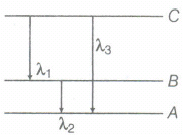
(ii) Find the relation between the three wavelengths \(\lambda\)1, \(\lambda\)2 and \(\lambda\)3 from the energy level diagram shown below.
7.
The half-life of a radioactive substance is the 20s. Calculate (i) the decay constant, and (ii) time taken by the sample to decay by of\(7/8th\) its initial value.
8.
Determine the radius of the first orbit of hydrogen atom.What would be the velocity and frequency of electron in this orbit? Given \(h=6.62\times { 10 }^{ -34 }J-s.\quad m=9.1\times { 10 }^{ -31 }kg;\quad e=1.6\times { 10 }^{ -19 }C,\quad k=9\times { 10 }^{ 9 }N{ m }^{ 2 }{ C }^{ -2 }\)
9.
The ground state energy of hydrogen atom is -13.6 eV.
(i) What are the potential energy and K.E of electron is 3rd excited state?
(ii) If the electron jumps to the frequency of photon emitted.
10.
(a) Using Bohr's postulates derive the expression for the total energy of the electron in the stationary states of the hydrogen atom.
(b) Using Ryberg formula, calculate the wavelengths of the spectral lines of the first member of the Lyman series and of the Balmer series.
11.
Calculate the binding energy per nucleon of the nucleus \(_{ 26 }{ { Fe }^{ 56 } }\). Given that mass of \(_{ 26 }{ { Fe }^{ 56 } }\) = 55.934939 u, the mass of proton = 1.007825 u and mass of neutron = 1.008665 u and 1u = 931 MeV.
1.
For second excited state, n = 3
Hence two possible transition of the Lyman series: 3→1 and 2→1
Wavelength for transition 3→1, nf = 1, ni = 3
\(\frac { 1 }{ \lambda } =R\left( \frac { 1 }{ { n }_{ f }^{ 2 } } -\frac { 1 }{ { n }_{ i }^{ 2 } } \right) \)
\(\frac { 1 }{ \lambda } =1.1\times { 10 }^{ 7 }\left( \frac { 1 }{ 1 } -\frac { 1 }{ 9 } \right) \)
\(=1.1\times { 10 }^{ 7 }\left( \frac { 8 }{ 9 } \right) \)
⇒ λ = \(\frac { 9 }{ 8\times 1.1\times { 10 }^{ -7 } } \)
= 1.023 x 10-7
= 102. 3nm
For transition 2→1, nf =1, ni=2
\(\frac { 1 }{ \lambda } =1.1\times { 10 }^{ 7 }\left( 1-\frac { 1 }{ 4 } \right) \)
⇒ λ = 212 nm
2.
\(N=\frac { { N }_{ 0 } }{ { 16 }^{ ' } } \)
Where 30 years
\(N={ N }_{ 0 }\left( \frac { 1 }{ 2 } \right) ^{ n }\)
\(\frac { N }{ { N }_{ 0 } } =\left( \frac { 1 }{ 2 } \right) ^{ 4 }\)
No.of half lives = 4
\(4=\frac { Time \ of \ disintegration }{ half \ life \ period } \)
\(\Rightarrow \frac { 30 \ years }{ 4 } =half \ life \ period\)
Half-life period = 7.5 years
3.
Because the protons are positively charged, so they repel each other. Since, this repulsion force is more, so that an excess of neutrons are required to reduce this repulsion.
4.
Distance of closest approach is the distance between the centre of nucleus and the point from which the alpha particle approaching directly to the nucleus returns.
Impact parameter is the perpendicular distance of the velocity vector of the alpha particle from the central line of the nucleus, when the particle is far away from the atom.
5.
Let a sample of radioactive material have N0 nuclei, at t = 0
At time t, Number of nuclei = N
As per the decay law
\(-\frac{dN}{dt}=\lambda N\)
\(\Rightarrow \ \int _{ { N }_{ 0 } }^{ N }{ \frac { dN }{ N } } =\int _{ 0 }^{ t }{ -\lambda } dt\)
\(\Rightarrow \ { \left( \log _{ e }{ N } \right) }_{ { N }_{ 0 } }^{ N }=-\left( { t }_{ 0 } \right) { t }^{ 1/2 }\)
\(\frac{N}{N_0}=e^-\lambda^ t\)
\(\Rightarrow \ \ N={ N }_{ 0 }{ e }^{ -\lambda t }\)
After one half life, Number of nuclei becomes \(\frac{N_0}{2}\)
\(\Rightarrow \ \frac { N_{ 0 } }{ 2 } =N_{ 0 }e^{ - }\lambda ^{ T }1/2\)
\(\Rightarrow\) 2 = \(e^\lambda \)T1/2
\(\Rightarrow\) loge 2 = \({ \lambda T }_{ \frac { 1 }{ 2 } }\)
\(\Rightarrow\) \({ \lambda T }_{ \frac { 1 }{ 2 } }\) = 0.6931
\(\Rightarrow\) \({ T }_{ \frac { 1 }{ 2 } }\) = \(\frac{0.6931}{\lambda}\)
6.
(i) According to Bohr's principle, electrons revolve in a stationary orbit of which energy and momentum are fixed. The momentum of electrons in the fixed orbit is given by \(\frac { nh }{ 2\pi } \) (where n = the number of orbits). According to de-Broglie's hypothesis, the electron is associated with wave character. Hence, a circular orbit can be taken to be a stationary energy state only. if it contains an integral number of de-Broglie wavelengths, i.e., 2\(\pi\)r = n\(\lambda\)
(ii) According to question,
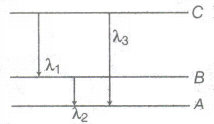
\({ E }_{ B }-{ E }_{ C }=\frac { hc }{ { \lambda }_{ 1 } } \quad \quad ...(i)\)
\({ E }_{ A }-{ E }_{ B }=\frac { hc }{ { \lambda }_{ 2 } } \quad \quad ...(ii)\)
\({ E }_{ C }-{ E }_{ A }=\frac { -hc }{ { \lambda }_{ 3 } } \quad ...(iii)\)
On adding Eqs. (i), (ii) and (iii), we get
EB - EC + EA - EB + EC - EA
\(=hc\left( \frac { 1 }{ { \lambda }_{ 1 } } +\frac { 1 }{ { \lambda }_{ 2 } } -\frac { 1 }{ { \lambda }_{ 3 } } \right) \)
\(\frac { 1 }{ { \lambda }_{ 3 } } =\frac { 1 }{ { \lambda }_{ 1 } } +\frac { 1 }{ { \lambda }_{ 2 } } \Rightarrow { \lambda }_{ 3 }=\frac { { { \lambda } }_{ 1 }{ \lambda }_{ 2 } }{ { \lambda }_{ 1 }+{ \lambda }_{ 2 } } \)
7.
\(Here,\ T=20s,\ \lambda =? \ t=?\frac { N }{ { N }_{ 0 } } =1-\frac { 7 }{ 8 } =\frac { 1 }{ 8 } \)
\(\lambda =\frac { 0.693 }{ T } =\frac { 0.693 }{ 20 } =0.0346{ s }^{ -1 }\)
\(As \ \frac { N }{ { N }_{ 0 } } ={ \left( \frac { 1 }{ 2 } \right) }^{ n }=\frac { 1 }{ 8 } \)
\(n=3, \ t=3 \ T=3\times 20s=60s\)
8.
\(0.53\mathring { A } ;2.19\times { 10 }^{ 6 }{ ms }^{ -1 };6.6\times { 10 }^{ 15 }Hz\)
9.
\((i) \ -1.7eV; \ 0.85 \ eV; \ (ii) \ 3\times { 10 }^{ 15 }Hz\)
Here, \({ E }_{ 1 }=-13.6\quad eV\)
For third excited state, n = 4
\(\therefore \ { E }_{ 4 }=\frac { -13.6 }{ { 4 }^{ 2 } } =-0.85 \ eV\)
\( \therefore K.E=-{ E }_{ 4 }=0.85eV\)
\( P.E=-2(K.E)=-2(0.85)eV=-1.70eV\)
Energy emitted, \(\Delta E={ E }_{ 4 }-{ E }_{ 1 }\)
\(hv=-0.85-(-13.6)eV=12.75 \ eV\)
\(v=\frac { 12.75\times 1.6\times { 10 }^{ -19 } }{ 6.6\times { 10 }^{ -34 } } =3\times { 10 }^{ 15 }Hz\)
10.
\(mvr = \frac {nh}{2\pi}\)
\(\frac { { mv }^{ 2 } }{ r } =\frac { 1 }{ 4\pi { \varepsilon }_{ 0 } } \frac { { e }^{ 2 } }{ { r }^{ 2 } } \)
\(r=\frac { { e }^{ 2 } }{ { 4\pi \varepsilon }_{ 0 }{ mv }^{ 2 } } \)
\(r=\frac { { Ze }^{ 2 } }{ { 4\pi \varepsilon }_{ 0 }m{ \left( \frac { nh }{ 2\pi mr } \right) }^{ 2 } } \)
\(\Rightarrow\) \(r=\frac { { \epsilon }_{ 0 }{ n }^{ 2 }{ h }^{ 2 } }{ { \pi me }^{ 2 } } \)
Potential energy U \(=-\frac { 1 }{ 4{ \pi \epsilon }_{ 0 } } .\frac { { e }^{ 2 } }{ { r } } \)
\(=\frac { { me }^{ 4 } }{ { 4\epsilon }_{ 0 }{ n }^{ 2 }{ h }^{ 2 } } \)
\(KE=\frac { 1 }{ 2 } { mv }^{ 2 }=\frac { 1 }{ 2 } m{ \left( \frac { nh }{ 2\pi mr } \right) }^{ 2 }\)
\(=\frac { { n }^{ 2 }{ h }^{ 2 }{ \pi }^{ 2 }{ m }^{ 2 }{ e }^{ 4 } }{ { 8\pi }^{ 2 }{ me }_{ 0 }^{ 2 }{ n }^{ 2 }{ h }^{ 2 } } \)
\(KE=\frac { { me }^{ 4 } }{ { 8\varepsilon }_{ 0 }^{ 2 }{ n }^{ 2 }{ h }^{ 2 } } \)
TE = KE + PE
\(=-\frac { { me }^{ 4 } }{ { 8\epsilon }_{ 0 }^{ 2 }{ n }^{ 2 }{ h }^{ 2 } } \)
(b)Rydberg formula: For first member of Lyman series
\(\frac { 1 }{ \lambda } =R\left( \frac { 1 }{ { 1 }^{ 2 } } -\frac { 1 }{ { 2 }^{ 2 } } \right) \)
\(=\frac { 4 }{ 3R } \)
For first member of Balmer Series
\(\frac { 1 }{ \lambda } =R\left( \frac { 1 }{ { 2 }^{ 2 } } -\frac { 1 }{ { 3 }^{ 2 } } \right) \)
\(\lambda =\frac { 36 }{ 5R } \)
11.
\(In \ _{ 26 }{ { Fe }^{ 56 } },\ no.of \ protons \ 26;\)
no. of neutrons = 56 - 26 = 30
\( \therefore \ Mass\ defect=26{ m }_{ p }+30{ m }_{ n }-{ M }_{ Fe }\)
\(=26\times 1.007825+30\times 1.008665-55.934939\)
\( =26.20345+30.25995-55.934939\)
\( =0.528461\ u\)
\( B.E/nucleon=\frac { 0.528461\times 931 }{ 56 } =8.79MeV/N\)

12th Standard CBSE Syllabus & Materials
12th Standard CBSE
CBSE 12th Computer Science Python Revision Tour I - New Previous year Question Papers Study Material - QB365 Set A
NEW12th Standard CBSE
CBSE 12th Business Studies Planning Important Questions And Answers Study Material - QB365 Set A
NEW12th Standard CBSE
CBSE 12th Business Studies Business Environment Important Questions And Answers Study Material - QB365 Set A
NEW12th Standard CBSE
CBSE 12th Business Studies Principles of Management Important Questions And Answers Study Material - QB365 Set A



NCERT Books

Syllabus

Exam Pattern

Sample Question Papers

Previous year Question Papers

Important Notes

MCQ Practice test

NCERT Exemplers

Case study Questions

Image Based Questions

Passage based Questions

HOT Questions

Value Based Questions

Model Questions Papers
NCERT ( Book Back ) Questions

Assertion and Reason
Important Questions And Answers

CBSE 12th Standard CBSE Subjects
CBSE Standards