
 100% FREE ACCESS
12th Standard CBSE Syllabus & Materials
12th Standard CBSE
CBSE 12th Economics Government Budget and the Economy Previous year Question Papers Study Material - QB365 Set A
NEW12th Standard CBSE
CBSE 12th Computer Science Interface Python with MySQL - New Previous year Question Papers Study Material - QB365 Set A
NEW12th Standard CBSE
CBSE 12th Computer Science Database Concept - New Previous year Question Papers Study Material - QB365 Set A
NEW12th Standard CBSE
CBSE 12th Computer Science Data Communication - New Previous year Question Papers Study Material - QB365 Set A
NEW12th Standard CBSE
CBSE 12th Computer Science Data Structures - New Previous year Question Papers Study Material - QB365 Set A
NEW12th Standard CBSE
CBSE 12th Computer Science Functions - New Previous year Question Papers Study Material - QB365 Set A

Published on: 02/11/2025
Download CBSE Class 12th Standard CBSE Physics question papers, sample papers, important questions, and previous year solved papers in PDF format. Get free study materials, NCERT solutions, and exam preparation resources for Class 12th Standard CBSE Physics
Questions + Answers key
Take MCQ Physics Test
1.
A capacitor of 200 pF is charged by a 300 V battery. The battery is then disconnected and the charge capacitor is connected to another uncharged capacitor of 100 pF. Calculate the difference between the final energy stored in the combined system and the initial energy stored in the single capacitor.
2.
How rubbing of the two bodies produces electricity?
3.
Give reason for the following:
(i) High reverse voltage do not appear across a LED.
(ii) Sunlight is not always required for the working of a solar cell.
(iii) The electric field, of the junction of a Zener diode, is very high even for a small reverse bias voltage of about 5 V.
4.
Draw a block diagram of a detector for AM signal and show, using necessary processes and the waveforms, how the original message signal is detected from the input AM wave
5.
An electron is revolving around the nucleus with a constant speed of 2.2 x 10⁸ m/s. Find the de Broglie' wavelength associated with it.
6.
Define an equipotential surface. Draw equipotential surfaces
(i) in case of a single point charge
(ii) in a constant electric field in Z-direction. Why the equipotential surfaces about a single charge are not equidistant?
(iii) Can electric field exist tangential to, an equipotential surface? Give reason.
7.
Using Gauss's theorem, deduce an expression for the electric field intensity at any point due to a thin, infinitely long wire of charge/length '\(\lambda\)' C\m
8.
Three charges (all q = 10 C) are placed at the edge of an equilateral triangle of side 2 m. Find the net potential energy of the system.
9.
The electric field by E = \({1000\over r}Vm^{-1}\), and is directed outwards. What is the sign of the charge on the wire? If two points A and B are situated such that \(r_A=0.2m\) and \(r_B=0.4m\), find the value of \((V_B-V_A)\).
10.
A transistor is connected in common emitter configuration. The collector supply is 8 V and the voltage drop across a resistor of \(800\Omega \) in the collector circuit is 0.5 V. If the current gain factor (\(a\)) is 0.96, find the base current.
11.
(i) If f = 0.5 m for a glass lens, what is the power of the lens?
(ii) The radii of curvature of the faces of a double convex lens are 10 cm and 15 cm. Its focal length is 12 cm. What is the refractive index of glass?
(iii) A convex lens has 20 cm focal length in air. What is focal length in water? (Refractive index of air-water = 1.33, refractive index for air-glass = 1.5.)
12.
(a) A point object is placed in front of a double convex lens (of refractive index n =n2/n1 with respect air) with its spherical faces of radii of curvature R1 and R2.. Show the path of rays due to surface to obtain the formation of the real image of the object.
Hence obtain the lens maker's formula for a thin lens.
(b) A double convex lens having both faces of the same radius of curvature has refractive index 1.55. Find out the radius of curvature of the lens required to get the focal length of 20 cm.
1.
\(3\times { 10 }^{ -6 }J\)
2.
When we rub two bodies, due to friction, some electrons are transferred from one body to another. The body which gains electrons becomes negatively charged and which loses electrons becomes positively charged by equal amount.
3.
(i) It is because reverse break down voltage of LED is very low i.e., nearly 5 V.
(ii) Because solar cell can work with any light whose photon energy is more than the band gap energy.
(ill) The heavy doping of p and n sides of p-n junction, makes the deplection region very thin, hence for a small reverse bias voltage, electric field is very high.
4.
s.png)
When a message is received, it gets attenuated through the channel. Therefore, the receiving antenna is to be followed by an amplifier and a detector. The carrier frequency is.usually changed to a lower frequency (IF) stage. The detected signal may not be strong enough to be use and hence, is required to be amplified. (1) In order to obtain the original message signal m(t) of angular frequency, a simple method is used which is shown below in the form of a block diagram:
s.png)
When the received modulated signal is passed through a rectifier, an envelope signal is produced. This envelope signal is the message signal. In order to retrieve the message, the signal is passed through an envelope detector
5.
v = 2.2 x 10⁸ ms-1
\(\lambda\) = ?
\(\lambda =\frac { h }{ mv } =\frac { 6.63\times { 10 }^{ -34 } }{ 9.1\times { 10 }^{ -31 }\times 22\times { 10 }^{ 8 } } \)
\(=0.331\times { 10 }^{ -11 }=3.3\times { 10 }^{ -12 }\)
6.
Any surface that has same electric potential at every point on it is called equipotential surface.
(i) Equipotential surface in case of single point charge
s.png)
(ii) Equipotential surfaces when the electric field is in Z-direction.
s.png)
The equipotential surfaces due to a single point charge is represented by concentric spherical shells of increasing radius, so they are not equidistant.
(iii) No, the electric field does not exist tangentially to an equipotential surface because no work done in moving a charge from one point to other on equipotential surface. This indicates that the component of electric field along the equipotential surface is zero. Hence, the equipotential surface is perpendicular to field line.
7.
Electric field intensity due to a long wire : A line charge is in the form of a thin charged rod with uniform linear charge density A (charge per unit length),
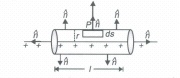
To determine the electric field intensity \(\overrightarrow{E}\) at any point P at a perpendicular distance r from the rod, let a right circular closed cylinder of radius r and length I with the infinitely long line of charge as its axis (as shown in figure). The magnitude of \(\overrightarrow{E}\) at every point on the curved surface of the cylinder is the same as all such points are at the same distance from the line charge. Also \(\overrightarrow{E}\) and unit vector \(\hat{n}\) it normal to curved surface are in the same direction so, \(\theta\)= 0°.
\(\therefore\) Contribution of curved surface of cylinder towards electric flux,
\(\oint_s \overrightarrow{E} \overrightarrow{ds} = \oint_s \overrightarrow{E} \hat{n}{ds}\)
= \(E \oint_s ds = E(2\pi r l)\)
where ( \(2\pi r l\) ) is area of the curved surface of the cylinder.
On the ends of cylinder, the angle between electric field \(\overrightarrow{E}\) and \(\hat{n}\) is 90°. So it will not contribute to electric flux on cylinder.
\(\Longrightarrow\) \(E \oint_s ds = E(2\pi r l)\)
Charge enclosed in the cylinder linear charge density length
q = \(\lambda \)I
According to Gauss's theorem \(\oint_s \overrightarrow{E} \overrightarrow{ds} = \frac{q}{\epsilon_0}\)
\(\Longrightarrow\) \((2\pi r l)\times E = \frac{\lambda l}{\epsilon_0}\)
\( E = \frac{\lambda l}{2\pi\epsilon_0rl}\)
\( E = \frac{l}{r}\)
(As \(\frac{\lambda}{2\pi\epsilon_0r} \) = constant)
8.
Given, charge, q = 10C (q1 = q2 = q)
Each side of equilateral triangle, r = 2 m
Potential energy (PE) = ?
Potential energy between two charges is given by
\(PE=\frac { k{ q }_{ 1 }{ q }_{ 2 } }{ r } \) [\(\because \) r = distance between q1 and q2]
\(\therefore \) PE of system will be three times the potential energy between the two charges as the equal charge is placed at the vertices of equilateral triangle.
So, PEnet = \(\frac { 3\times kqq }{ r } =\frac { 3{ kq }^{ 2 } }{ r } =\frac { 3\times 9\times { 10 }^{ 9 } \times 10\times 10 }{ 2 } \)
= 1.35 x 10¹² J
9.
As the field is directed outwards, charge on the wire must be positive.
\(V_B-V_A=-\int _{ A }^{ B }{ \overrightarrow { E } .\overrightarrow { dt } } =-\int _{ r=0.2m }^{ r=0.4m }{ \frac { 1000 }{ r } } dr\)
\(V_B-V_A=-1000[log_er]^{r=0.4m}_{r=0.2m}\)
= - 1000\([log_e0.4-log_e0.2]\)
= - 1000 loge2
\(V_B-V_A=-1000\times 0.6931\)
\(=-693.1 volt\)
10.
0.026 mA
\(I_{ c }=\frac { V_{ L } }{ R_{ L } } =\frac { 0.5 }{ 800 } =\frac { 5 }{ 8 } mA\)
\( I_{ b }=I_{ e }-I_{ c }=\frac { I_{ c } }{ \alpha } -I_{ c }=I_{ c }\left( \frac { 1 }{ \alpha } -1 \right) \)
\( =\frac { 5 }{ 8 } \left( \frac { 1 }{ 0.96 } -1 \right) =0.026mA\)
11.
(i) Power = +2 dioptre.
(ii) Here, we have f = +12 cm, R1 = +10 cm, R2 = -15 cm.
Refractive index of air is taken as unity.
We use the lens formula. The sign convention has to be applied for f, R1 and R2.
Substituting the values, we have
\(\frac { 1 }{ 12 } =(n-1)\left( \frac { 1 }{ 10 } -\frac { 1 }{ 15 } \right) \)
This gives n = 1.5.
(iii) For a glass lens in air, n2 = 1.5, n1 = 1, f = +20 cm. Hence, the lens formula gives
\(\frac { 1 }{ 20 } =0.5\left( \frac { 1 }{ { R }_{ 1 } } -\frac { 1 }{ { R }_{ 2 } } \right) \)
For the same glass lens in water, n2 = 1.5, n1 = 1.33. Therefore \(\frac { 1.33 }{ f } =(1.5-1.33)\left[ \frac { 1 }{ { R }_{ 1 } } -\frac { 1 }{ { R }_{ 2 } } \right] \)
Combining these two equations, we find f = + 78.2 cm.
12.
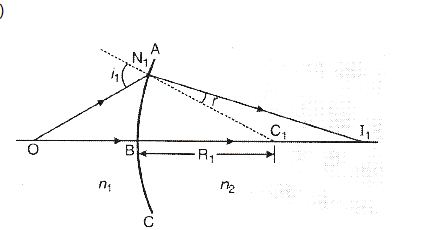
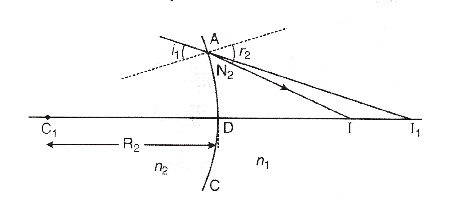
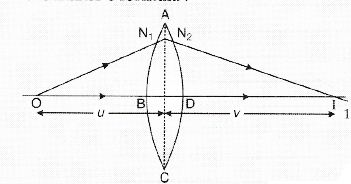
The first refracting ABC forms the image I1 of the object O. The image I1 acts as virtual object for the second refracting surface ADC, which forms the real image I as shown in the diagram
For refraction at ABC
\(\frac { { n }_{ 2 } }{ { v }_{ 1 } } -\frac { { n }_{ 1 } }{ u } =\frac { { n }_{ 2 }-{ n }_{ 1 } }{ { R }_{ 1 } } \)
For refraction at ADC
\(\frac { { n }_{ 1 } }{ v } -\frac { { n }_{ 2 } }{ { v }_{ 1 } } =\frac { { n }_{ 1 }-{ n }_{ 2 } }{ { R }_{ 2 } } \)
Adding equation (i) and equation (ii)
\(\frac { { n }_{ 1 } }{ v } -\frac { { n }_{ 2 } }{ u } =\left( { n }_{ 2 }-{ n }_{ 1 } \right) \left( \frac { 1 }{ { R }_{ 1 } } -\frac { 1 }{ { R }_{ 2 } } \right) \)
\(\frac { 1 }{ v } -\frac { 1 }{ u } =\left( \frac { { n }_{ 2 } }{ { n }_{ 1 } } -1 \right) \left( \frac { 1 }{ { R }_{ 1 } } -\frac { 1 }{ { R }_{ 2 } } \right) \)
We know, If \(u=\infty ,v=f\)
\(\frac { 1 }{ v } -\frac { 1 }{ u } =\frac { 1 }{ f } \)
\(\frac { 1 }{ f } =\left( \frac { { n }_{ 2 } }{ { n }_{ 1 } } -1 \right) \frac { 1 }{ { R }_{ 1 } } -\frac { 1 }{ { R }_{ 2 } } \)
\(\frac { 1 }{ f } =\left( { \mu }_{ 21 }-1 \right) \left( \frac { 1 }{ { R }_{ 1 } } -\frac { 1 }{ { R }_{ 2 } } \right) \)
\(\frac { 1 }{ f } =\left( { \mu }_{ 21 }-1 \right) \left( \frac { 1 }{ { R }_{ 1 } } -\frac { 1 }{ { R }_{ 2 } } \right) \)
\(\frac { 1 }{ f } =\left( 1.55-1 \right) \left( \frac { 1 }{ R } -\frac { 1 }{ -R } \right) \)
\(=0.55\times \frac { 2 }{ R } \)
\(R=0.55\times 2\times 20=22 \ cm\)

12th Standard CBSE Syllabus & Materials
12th Standard CBSE
CBSE 12th Computer Science Python Revision Tour I - New Previous year Question Papers Study Material - QB365 Set A
NEW12th Standard CBSE
CBSE 12th Business Studies Planning Important Questions And Answers Study Material - QB365 Set A
NEW12th Standard CBSE
CBSE 12th Business Studies Business Environment Important Questions And Answers Study Material - QB365 Set A
NEW12th Standard CBSE
CBSE 12th Business Studies Principles of Management Important Questions And Answers Study Material - QB365 Set A



NCERT Books

Syllabus

Exam Pattern

Sample Question Papers

Previous year Question Papers

Important Notes

MCQ Practice test

NCERT Exemplers

Case study Questions

Image Based Questions

Passage based Questions

HOT Questions

Value Based Questions

Model Questions Papers
NCERT ( Book Back ) Questions

Assertion and Reason
Important Questions And Answers

CBSE 12th Standard CBSE Subjects
CBSE Standards