
 100% FREE ACCESS
12th Standard CBSE Syllabus & Materials
12th Standard CBSE
CBSE 12th Economics Government Budget and the Economy Previous year Question Papers Study Material - QB365 Set A
NEW12th Standard CBSE
CBSE 12th Computer Science Interface Python with MySQL - New Previous year Question Papers Study Material - QB365 Set A
NEW12th Standard CBSE
CBSE 12th Computer Science Database Concept - New Previous year Question Papers Study Material - QB365 Set A
NEW12th Standard CBSE
CBSE 12th Computer Science Data Communication - New Previous year Question Papers Study Material - QB365 Set A
NEW12th Standard CBSE
CBSE 12th Computer Science Data Structures - New Previous year Question Papers Study Material - QB365 Set A
NEW12th Standard CBSE
CBSE 12th Computer Science Functions - New Previous year Question Papers Study Material - QB365 Set A

Published on: 02/11/2025
Download CBSE Class 12th Standard CBSE Physics question papers, sample papers, important questions, and previous year solved papers in PDF format. Get free study materials, NCERT solutions, and exam preparation resources for Class 12th Standard CBSE Physics
Questions + Answers key
Take MCQ Physics Test
1.
At what speed must an electron revolve around the nucleus of hydrogen atom so that it may not be pulled into the nucleus by electrostatic attraction? Given, mass of electron \(=9.1\times { 10 }^{ -31 }\), radius of orbit \(=0.5\times { 10 }^{ -10 }m\) and \(e=1.6\times { 10 }^{ -19 }C\).
2.
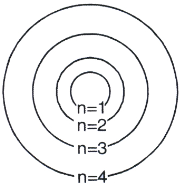
In the given figure for the stationary orbits of the hydrogen atom, mark the transition representing the Balmer and Lyman series
3.
'The half life \(_{ 6 }^{ 14 }{ C }\) is 5700 years.' What does it mean ?
Two radioactive nuclei X and Y initially contain an equal number of atoms. Their half life is 1 hour and 2 hours respectively. Calculate the ratio of their rates of disintegration after two hours.
4.
The Bohr model for the spectre of a H-atom
will not be applicable to hydrogen in the molecular form
will not be applicable as it is for a He-atom
is valid only at room temperature
predicts continuous as well as discrete spectral lines
5.
For the ground state, the electron in the H-atom has an angular momentum =h, according to the simple Bohr model. Angular momentum is a vector and hence there will be infinitely many orbits with the vector pointing in all possible directions. In actuality, this is not true,
because only one of these would have a minimum energy
because only one of these would have a minimum energy
angular momentum must be in the direction of spin of electron
because electrons go arround only in horizontal obits.
6.
Taking the Bohr radius as a0 = 53pm, the radius of Li++ ion its ground state, on the basis of Bohr's model, will be about
53pm
27pm
18pm
13pm
7.
If the both the numbers of protons and neutrons are conserved in a nuclear reaction like
\(_{ 6 }^{ 12 }{ C }+_{ 6 }^{ 12 }{ C\longrightarrow }_{ 10 }^{ 20 }{ Ne }+_{ 2 }^{ 4 }{ He }\)
In what way is the mass converted into energy? Explain.
8.
What is meant by critical mass in a nuclear chain reaction?
9.
The natural boron is found to be composed of two isotopes of \(_{ 5 }{ B^{ 10 } }\) and \(_{ 5 }{ B^{ 11 } }\) . The masses of these two isotopes are 10.003 u and 11.009 u respectively. The atomic mass of natural boron is 10.81 u. Determine the relative abundance of each isotope in the natural boron.
10.
A nucleus \(_{ n }{ { X }^{ m } }\) emits one \(\alpha \)- particle and one \(\beta \)-particle. What are the mass number and atomic number of the product nucleus?
11.
Select the pairs of isobars and isotones from the following nuclei: \(_{ 6 }{ C^{ 14 } },_{ 7 }{ N^{ 13 } },_{ 7 }{ N^{ 14 } },_{ 8 }{ O^{ 16 } }:\) :
12.
Define ionisation energy. How would the ionisation energy change when electron in hydrogen atom is replaced by a particle 200 times heavier than electron, but having the same charge?
13.
What is the impact parameter for scattering of \(\alpha \)- particle by \(180°\)?
14.
What are the values of first and second excitation potential of hydrogen atom?
15.
What is the value of Rydberg constant?
16.
(a) Using Bohr's postulates derive the expression for the total energy of the electron in the stationary states of the hydrogen atom.
(b) Using Ryberg formula, calculate the wavelengths of the spectral lines of the first member of the Lyman series and of the Balmer series.
17.
A nuclear reactor is a powerful device, wherein nuclear energy is utilised for peaceful purposes. It is based upon controlled nuclear chain reaction. The nuclear chain reaction is controlled by the use of control rods (of boron or cadmium) and moderators like heavy water, graphite, etc. The whole reactor is protected with concrete walls 2 to 2.5 metre thick, so that radiations emitted during nuclear reactions may not produce harmful effects.
Read the above passage and answer the following questions:
(i) Give any two merits of nuclear reactors.
(ii) What is radiactive waste?
(iii) Why do people often oppose the location site of a nuclear reactor? What do you suggest?
18.
The energy of an electron in a hydrogen atom is \({ E }_{ n }=\frac { -13.6 }{ { n }^{ 2 } } eV\), where n = 1, 2, 3,... Show that
(i) the electron in a hydrogen atom cannot have an energy of -6.8eV.
(ii) spacing between the lines within the given set of observed hydrogen spectrum decreases as n increases.
19.
Alpha ray _____________ led to the discovery of _____________.
1.
\(2.25\times { 10 }^{ 6 }m{ s }^{ -1 }\)
2.
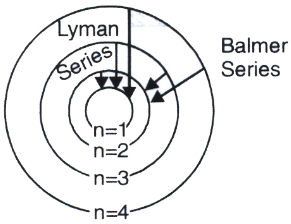
The transition representing the Balmer and Lyman series are shown in fig
3.
1 : 1
4.
(b)
will not be applicable as it is for a He-atom
5.
(a)
because only one of these would have a minimum energy
6.
(c)
18pm
7.
The sum of masses of nuclei of product element us less than the sum of masses of reactions and hence loss of mass take place during the reaction.This difference of mass of product element and reactant concerts into energy and liberated in the form of heat.
\(_{ 10 }^{ 20 }{ Ne }\)Here, sum of masses of and \(_{ 2 }^{ 4 }{ He }\) is less than the sum of two \(_{ 6 }^{ 12 }{ C }\) and conversion of this mass defect is used to produce energy.
8.
Critical mass in a nuclear chain reaction is the minimum mass of fissionable material that would sustain the nuclear chain reaction at a steady rate. The neutron reproduction factor K, in this case, becomes equal to one i.e. rate of production of neutrons is just equal to the rate of loss of neutrons.
9.
Let \(_{ 5 }{ B^{ 10 } }\) be x%. Therefore \(_{ 5 }{ B^{ 11 } }\) will be (100-x)%.
As average atomic mass = weighted average of the masses of isotopes
\(\therefore \ 10.81=\frac { 10.003x+11.009(100-x) }{ 100 } \)
Calculate x = 19.78%
\(\therefore \) (100-x)=100-19.78=80.22%
10.
With emission of an alpha particle \(\left({ }_2 H e^4\right)\) and a beta particle \(\left(-1 e^0\right)\) the product nucleus has mass number = (m-4) and charge number = (n-1).
11.
\(\text { Isobars }\left({ }_6 C^{14}{ }_7 N^{14}\right) \text {, Isotones }\left({ }_6 C^{14}{ }_8 O^{16}\right) \text {. }\)
12.
Ionisation energy is the minimum energy required to knock out an electron from an atom.Its value will be different for different atoms. Ionisation energy will also depend on the orbit from which electron is to be removed.
When an electron in hydrogen atom is replaced by a particle 200 times heavier than electron but having the same charge, ionisation energy will not change, as it depends only on charge and not on mass of particle.
13.
Zero. This follows from the relation \(b=\frac { Z{ e }^{ 2 }cot\quad { \theta }/{ 2 } }{ 4\pi { \epsilon }_{ 0 }\left( \frac { 1 }{ 2 } m{ v }^{ 2 } \right) } \)
14.
10.2 V; 12.09 V.
15.
\(R=1.097 \times 10^7 \mathrm{~m}^{-1}\)
16.
\(mvr = \frac {nh}{2\pi}\)
\(\frac { { mv }^{ 2 } }{ r } =\frac { 1 }{ 4\pi { \varepsilon }_{ 0 } } \frac { { e }^{ 2 } }{ { r }^{ 2 } } \)
\(r=\frac { { e }^{ 2 } }{ { 4\pi \varepsilon }_{ 0 }{ mv }^{ 2 } } \)
\(r=\frac { { Ze }^{ 2 } }{ { 4\pi \varepsilon }_{ 0 }m{ \left( \frac { nh }{ 2\pi mr } \right) }^{ 2 } } \)
\(\Rightarrow\) \(r=\frac { { \epsilon }_{ 0 }{ n }^{ 2 }{ h }^{ 2 } }{ { \pi me }^{ 2 } } \)
Potential energy U \(=-\frac { 1 }{ 4{ \pi \epsilon }_{ 0 } } .\frac { { e }^{ 2 } }{ { r } } \)
\(=\frac { { me }^{ 4 } }{ { 4\epsilon }_{ 0 }{ n }^{ 2 }{ h }^{ 2 } } \)
\(KE=\frac { 1 }{ 2 } { mv }^{ 2 }=\frac { 1 }{ 2 } m{ \left( \frac { nh }{ 2\pi mr } \right) }^{ 2 }\)
\(=\frac { { n }^{ 2 }{ h }^{ 2 }{ \pi }^{ 2 }{ m }^{ 2 }{ e }^{ 4 } }{ { 8\pi }^{ 2 }{ me }_{ 0 }^{ 2 }{ n }^{ 2 }{ h }^{ 2 } } \)
\(KE=\frac { { me }^{ 4 } }{ { 8\varepsilon }_{ 0 }^{ 2 }{ n }^{ 2 }{ h }^{ 2 } } \)
TE = KE + PE
\(=-\frac { { me }^{ 4 } }{ { 8\epsilon }_{ 0 }^{ 2 }{ n }^{ 2 }{ h }^{ 2 } } \)
(b)Rydberg formula: For first member of Lyman series
\(\frac { 1 }{ \lambda } =R\left( \frac { 1 }{ { 1 }^{ 2 } } -\frac { 1 }{ { 2 }^{ 2 } } \right) \)
\(=\frac { 4 }{ 3R } \)
For first member of Balmer Series
\(\frac { 1 }{ \lambda } =R\left( \frac { 1 }{ { 2 }^{ 2 } } -\frac { 1 }{ { 3 }^{ 2 } } \right) \)
\(\lambda =\frac { 36 }{ 5R } \)
17.
(i) Nuclear reactors are used in electric power generation. They are also used to produce radioactive isotopes which have applications in medicine, industry and agriculture.
(ii) Radioactive waste consists of fission products and transuranic elements such as plutonium and americium. This waste is extremely hazardous to all forms of life on earth.
(iii) People often oppose the location site of a nuclear reactor because any leakage of nuclear radiations can affect adversely miles of area surrounding it. Elaborate safety measures are needed not only for reactor operations, but also for handling and disposal of radioactive waste.
I would suggest that Government must take stringent safety measures and assure people of safeguards in the event of nuclear accidents. At the same time, people must also be educated accordingly.
18.
\(Here,\ { E }_{ n }=\frac { -13.6 }{ { n }^{ 2 } } eV\)
\( Putting\ n=1,2,3,......,\ we\ get\)
\( { E }_{ 1 }=\frac { -13.6 }{ { 1 }^{ 2 } } eV=-13.6eV\)
\({ E }_{ 2 }=\frac { -13.6 }{ { 2 }^{ 2 } } eV=-3.4eV\)
\( { E }_{ 3 }=\frac { -13.6 }{ { 3 }^{ 2 } } eV=-1.51eV\)
\( { E }_{ 4 }=\frac { -13.6 }{ { 4 }^{ 2 } } eV=-0.85eV;{ E }_{ \infty }=0\)
Clearly, an electron in a hydrogen atom cannot have the energy of -6.8 eV.
(ii) As the value of n increases, energy diff. between two consecutive energy levels decreases.
19.
()
scattering through large angles; atomic nucleus,

12th Standard CBSE Syllabus & Materials
12th Standard CBSE
CBSE 12th Computer Science Python Revision Tour I - New Previous year Question Papers Study Material - QB365 Set A
NEW12th Standard CBSE
CBSE 12th Business Studies Planning Important Questions And Answers Study Material - QB365 Set A
NEW12th Standard CBSE
CBSE 12th Business Studies Business Environment Important Questions And Answers Study Material - QB365 Set A
NEW12th Standard CBSE
CBSE 12th Business Studies Principles of Management Important Questions And Answers Study Material - QB365 Set A



NCERT Books

Syllabus

Exam Pattern

Sample Question Papers

Previous year Question Papers

Important Notes

MCQ Practice test

NCERT Exemplers

Case study Questions

Image Based Questions

Passage based Questions

HOT Questions

Value Based Questions

Model Questions Papers
NCERT ( Book Back ) Questions

Assertion and Reason
Important Questions And Answers

CBSE 12th Standard CBSE Subjects
CBSE Standards