
 100% FREE ACCESS
12th Standard CBSE Syllabus & Materials
12th Standard CBSE
CBSE 12th Economics Government Budget and the Economy Previous year Question Papers Study Material - QB365 Set A
NEW12th Standard CBSE
CBSE 12th Computer Science Interface Python with MySQL - New Previous year Question Papers Study Material - QB365 Set A
NEW12th Standard CBSE
CBSE 12th Computer Science Database Concept - New Previous year Question Papers Study Material - QB365 Set A
NEW12th Standard CBSE
CBSE 12th Computer Science Data Communication - New Previous year Question Papers Study Material - QB365 Set A
NEW12th Standard CBSE
CBSE 12th Computer Science Data Structures - New Previous year Question Papers Study Material - QB365 Set A
NEW12th Standard CBSE
CBSE 12th Computer Science Functions - New Previous year Question Papers Study Material - QB365 Set A

Published on: 07/03/2026
Download CBSE Class 12th Standard CBSE Physics question papers, sample papers, important questions, and previous year solved papers in PDF format. Get free study materials, NCERT solutions, and exam preparation resources for Class 12th Standard CBSE Physics
Questions + Answers key
Take MCQ Physics Test
1.
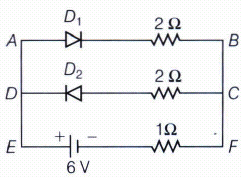
Assuming that the two diodes D1 and D2 used in the electric circuit as shown in the figure are ideal, find out the value of the current flowing through 1 \(\Omega \) resistor.
2.
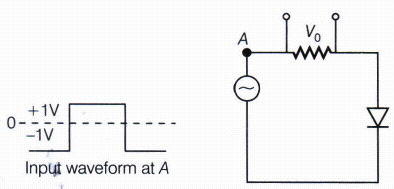
Draw the output waveform across the resistor in the given figure
3.
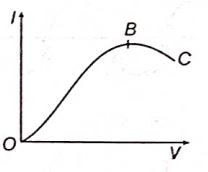
The graph shown in the figure represents a plot of current versus voltage for a given semiconductor. Identify the region, if any, over which the semiconductor has a negative resistance.
4.
Why do stable nuclei never have more protons than neutrons?
5.
Write symbolically the nuclear \({ \beta }^{ + }\) decay process of \(_{ 6 }{ { C }^{ 11 } }\) . Is the decayed product X an isotope or isobar of \(_{ 6 }{ { C }^{ 11 } }\)?
Given the mass values of \((_{ 6 }{ { C }^{ 11 } })\)
11.011434 u and m(X) = 11.009305 u. Estimate the Q value in the process.
6.
You are given two nuclei \(_{ 3 }{ { X }^{ 7 } }\) and \(_{ 3 }{ { Y }^{ 4 } }\) . Explain giving reasons, as to which one of the two nuclei is likely to be more stable?
7.
Out of alpha, beta and gamma radiations, which are affected by electric field and magnetic field?
8.
Why is nuclear density same for all nuclei?
9.
The formation of depletion region in a p-n junction diode is due to
movement of dopant atoms
diffusion of the electrons and holes
drift of electrons only
drift of holes only
10.
The ratio of the nuclear densities of two nuclei having mass numbers 64 and 125 is
\(\frac{64}{125}\)
\(\frac{4}{5}\)
\(\frac{5}{4}\)
1
11.
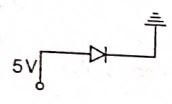
Which is reverse biased diode?
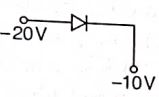
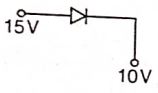
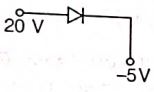
12.
A 220 V AC supply is connected between points A and B (figure). What will be the potential difference V across the capacitor?
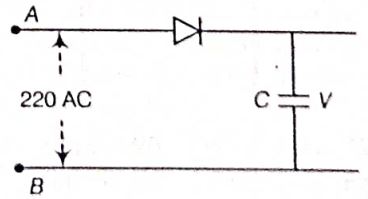
220 V
110 V
0 V
\(220 \sqrt{2} \mathrm{~V}\)
13.
In fusion reaction occurring in the sun,
hydrogen is converted into carbon
hydrogen and helium are converted into carbon and other heavier metals/elements
helium is converted into hydrogen
hydrogen is converted into helium
14.
In the nuclear decay given below
\(_{ Z }{ { X }^{ A } }\longrightarrow _{ Z+1 }{ { Y }^{ A } }\longrightarrow _{ Z-1 }{ { B* }^{ A-4 } }\longrightarrow _{ Z-1 }{ { B }^{ A-4 } }\)
The particles emitted in the sequence are :
\(\alpha ,\ \beta ,\ \gamma \)
\(\beta ,\ \alpha ,\ \gamma \)
\(\gamma ,\ \beta ,\ \alpha \)
\(\beta ,\ \gamma ,\ \alpha \)
15.
Hydrogen \(\left( _{ 1 }{ { H }^{ 1 } } \right) \), Deuterium \(\left( _{ 1 }{ { H }^{ 2 } } \right) \), singly ionized helium \({ \left( _{ 2 }{ { H }^{ 4 } } \right) }^{ + }\) and doubly ionized Lithium \({ \left( _{ 3 }{ { Li }^{ 7 } } \right) }^{ ++ }\) all have one electron around the nucleus. Consider an electron transition from n = 2 to n = 1. If wavelengths of emitted radiation are \({ \lambda }_{ 1 },{ \lambda }_{ 2 },{ \lambda }_{ 3 },{ \lambda }_{ 4 }\) respectively, then approximately which one of the following is correct?
\({ \lambda }_{ 1 }={ \lambda }_{ 2 }=4{ \lambda }_{ 3 }=9{ \lambda }_{ 4 }\)
\({ \lambda }_{ 1 }=2{ \lambda }_{ 2 }=3{ \lambda }_{ 3 }=4{ \lambda }_{ 4 }\)
\(4{ \lambda }_{ 1 }=2{ \lambda }_{ 2 }=2{ \lambda }_{ 3 }={ \lambda }_{ 4 }\)
\({ \lambda }_{ 1 }=2{ \lambda }_{ 2 }=2{ \lambda }_{ 3 }={ \lambda }_{ 4 }\)
16.
(a) A germanium crystal is doped with antimony. With the help of energy-band diagram, explain how the conductivity of the doped crystal is affected.
(b) Briefly explain the two processes involved in the formation of a p-n junction.
(c) What will the effect of (I) forward biasing, and (II) reverse biasing be on the width of depletion layer in a p-n junction diode?
17.
(a) Explain with the help of a diagram, how a depletion layer and barrier potential are formed in a junction diode
(b) Draw a circuit diagram of full wave rectifier. Explain its working and draw input and output waveforms full wave rectifier. Explain its working and draw input and output waveforms
18.
(i) Differentiate between nuclear fission and nuclear fusion.
(ii) Deuterium undergoes fusion as per the reaction
\({ }_1^2 \mathrm{H}+{ }_1^2 \mathrm{H} \longrightarrow{ }_2^3 \mathrm{He}+{ }_0^1 n+3.27 \mathrm{MeV}\)
Find the duration for which an electric bulb of 500 W can be kept glowing by the fusion of 100 g of deuterium.
19.
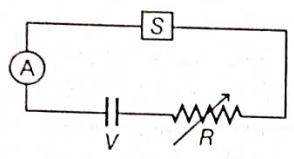
The figure shows a piece of pure semiconductor S in series with a variable resistor R and a Source of constant voltage V. Should the value of R be increased or decreased to keep the reading of the ammeter constant, when semiconductor S is heated? Justify your answer.
Or
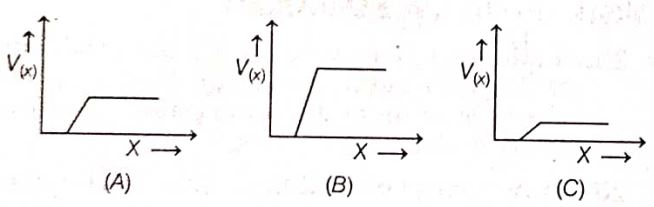
The graph of potential barrier versus width of depletion region for an unbiased diode is shown in graph A. In comparison to A, graphs B and C are obtained after biasing the díode in different ways. Identify the type of biasing in B and C and justify your answer.
20.
Briefly explain how a potential barrier is set up across a p-n junction as a result of diffusion and drift of the charge carriers.
21.
(i) Write the basic nuclear process involved in the emission of β+ in a symbolic form by a radioactive nucleus.
(ii) In the reactions given below:
\(\text { (a) }{ }_{6}^{11} \mathrm{C} \rightarrow{ }_{y}^{z} \mathrm{~B}+x+\mathrm{v}\)
\(\text { (b) }{ }_{6}^{12} \mathrm{C} \rightarrow{ }_{6}^{12} \mathrm{C}+{ }_{a}^{20} \mathrm{Ne}+{ }_{b}^{c} \mathrm{He}\)
Find the values of x, y and z and a, band c
22.
From the relation R = R0A1/3, where R0 is a constant and A is the mass number of a nucleus, show that the nuclear matter density is nearly constant (i.e. independent of A).
23.
(i) State Bohr's quantisation condition for defining stationary orbits. How does de-Broglie's hypothesis explain the stationary orbits?
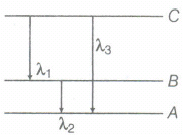
(ii) Find the relation between the three wavelengths \(\lambda\)1, \(\lambda\)2 and \(\lambda\)3 from the energy level diagram shown below.
24.
A heavy nucleus breaks into comparatively lighter nuclei which are more stable compared to the original heavy nucleus. When a heavy nucleus like uranium is bombarded by slow moving neutrons, it splits into two parts releasing large amount of energy. The typical fission reaction of \({ }_{92} \mathrm{U}^{235}\).
\({ }_{92} \mathrm{U}^{235}+{ }_{0} n^{1} \rightarrow{ }_{56} \mathrm{Ba}^{141}+{ }_{36} \mathrm{Kr}^{92}+3{ }_{0} n^{1}+200 \mathrm{MeV}\)
The fission of 92U235approximately released 200 MeV of energy.
(i) If 200 MeV energy is released in the fission of a single nucleus of \({ }_{92}^{235} \mathrm{U}\),the fissions which are required to produce a power of 1kW is
| (a) 3.125 x 10¹³ | (b) 1.52 x 10⁶ | (c) 3.125 x 10¹² | (d) 3.125 x 10¹⁴ |
(ii) The release in energy in nuclear fission is consistent with the fact that uranium has
| (a) more mass per nucleon than either ofthe two fragments |
| (b) more mass per nucleon as the two fragment |
| (c) exactly the same mass per nucleon as the two fragments |
| (d) less mass per nucleon than either of two fragments. |
(iii) When 92U235undergoes fission, about 0.1% of the original mass is converted into energy. The energy released when 1 kg of 92U235undergoes fission is
| (a) 9 x 10¹¹J | (b) 9 x 10¹³J | (c) 9 x 10¹⁵J | (d) 9 x 10¹⁸J |
(iv) A nuclear fission is said to be critical when multiplication factor or K
| (a) K= 1 | (b) K> 1 | (c) K< 1 | (d) K=0 |
(v) Einstein's mass-energy conversion relation E = mc2 is illustrated by
| (a) nuclear fission | (b) \(\beta\)-decay | (c) rocket propulsion | (d) steam engine |
1.
According to the question,
D2 is in reverse bias, so it acts as open circuit
\(\begin{aligned}
R_{\mathrm{eq}} & =2+1=3 \Omega
\end{aligned}\)
\(\begin{aligned}
I & =\frac{V}{R_{\mathrm{eq}}}=\frac{6}{3}=2 \mathrm{~A}
\end{aligned}\)
2.
As, we know that the diode only works in forward biased, so the output is obtained only when positive input is given, so the output waveform is

3.
Resistance of a material can be found out by the slope of the curve V versus I. Part BC of the curve shows the negative resistance as with the increase in current, there is a decrease in voltage
4.
Because the protons are positively charged, so they repel each other. Since, this repulsion force is more, so that an excess of neutrons are required to reduce this repulsion.
5.
\(_{ 6 }{ { C }^{ 11 } }\rightarrow _{ 5 }{ { X }^{ 11 } }+_{ 1 }{ { e }^{ 0 } }(i.e.,\quad { \beta }^{ + })+Q\)
Clearly, \(_{ 5 }{ { X }^{ 11 } }\) is an isobar of \(_{ 6 }{ { C }^{ 11 } }\).
Mass defect, \(\Delta m\) = 11.011434-(11.009305+0.000545)
= 0.001584 u
Q value of reaction \(=0.001584\times 931\ MeV\)
= 1.4747 MeV
6.
In case of \(_{ 3 }{ { X }^{ 7 } }\),
\(\frac { neutron\quad number }{ proton\quad number } =\frac { 7-3 }{ 3 } =1.33\)
In case of \(_{ 3 }{ { Y }^{ 4 } }\quad \)
\(\frac { neutron\quad number }{ proton\quad number } =\frac { 4-3 }{ 3 } =\frac { 1 }{ 3 } =0.33\)
For stability, this ratio has to be close to one.
Obviously, nucleus \(_{ 3 }{ { X }^{ 7 } }\) is more stable than the nucleus \(_{ 3 }{ { Y }^{ 4 } }\).
7.
Both, alpha and beta radiations are affected by both, electric field and magnetic field.
8.
This is because density \(=\frac{m a s s}{\text { volume }}\) and volume of nucleus varies directly as its mass number
9.
(b)
diffusion of the electrons and holes
10.
(d)
1
11.
(b)
12.
(d)
\(220 \sqrt{2} \mathrm{~V}\)
13.
(d)
hydrogen is converted into helium
14.
(b)
\(\beta ,\ \alpha ,\ \gamma \)
15.
(a)
\({ \lambda }_{ 1 }={ \lambda }_{ 2 }=4{ \lambda }_{ 3 }=9{ \lambda }_{ 4 }\)
16.
17.
.png)
(a) Due to the diffusion of electrons and the holes, from their majority zone to minority zone, a layer of positive and negative space charge region on either side on the junction is formed. This is called the depletion region.
The loss of electrons, from n-region and gain of electrons by the p-region, causes a difference of potential across the junction. This tends to prevent the movement of charge carriers across the junction and is, therefore, termed as barrier potential.
.png)
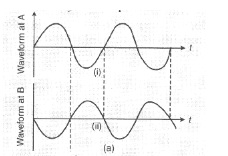
For positive half cycle of input ac, one of the two diodes gets forward biased and conducts and output current is obtained across the load RL, For negative half cycle of input ac, the other diode
gets forward biased and thus output current is obtained due to it. Therefore, output is obtained for both the cycles of input ac.
.png)
18.
(a) Fission is the process of separating two heavy, unstable atomic nuclei into two lighter nuclei, also releasing energy, but less than with fusion. Fusion is where two light atomic nuclei unite and release energy.
| Nuclear Fission | Nuclear Fusion |
| When the nucleus of an atom splits into lighter nuclei through a nuclear reaction the process is termed nuclear fission. | Nuclear fusion is a reaction through which two or more light nuclei collide with each other to form a heavier nucleus. |
| When each atom split, a tremendous amount of energy is released. | The energy released during nuclear fusion is several times greater than the energy released during nuclear fusion. |
| Fission reactions do not occur in nature naturally. | Fusion reactions occur in stars and the sun. |
| Little energy is needed to split an atom in a fission reaction. | High energy is needed to bring fuse two or more atoms together in a fusion reaction. |
| Atomic bomb works on the principle of nuclear fission. | Hydrogen bomb works on the principle of a nuclear fusion bomb. |
(b) Number of atoms in 100g deuterium, \(\frac{100}{2} \times 6.023 \times 10^{-23}\)
Energy Released- \(\frac{3.27}{2} \times 1.6 \times 10^{-13} \mathrm{~J}\)
Time required t = Total energy(E) / Power of lamp (P)
= 500 \(\times\) 60 \(\times\) 60 \(\times\) 24 \(\times\) 365
t = 1.5768 \(\times\) 1010 years.
19.
The value of resistance (R) should be increased to keep the reading of ammeter constant, as with the increase in the temperature of a semiconductor, its resistance decreases and current tends to increase.
Or
For graph B,
As the potential barrier in graph B is higher with respect to potential barrier in graph 4, i.e. potential barrier in graph B is increased. So, it is the case of reverse biased condition.
For graph C,
As the potential barrier in graph C is decreased with respect to potential barrier in graph A. So, the graph C is the case of forward biased condition.
20.
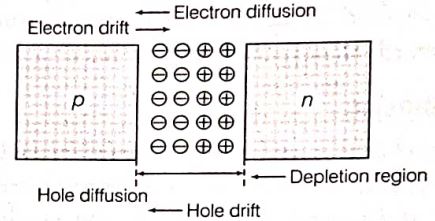
The accumulation of negative charges in the p-region and positive charges in the M-region set up a potential difference across the junction. This acts as a barrier and is called potential barrier.
21.
(i) The basic nuclear process involved in the emission of β+ during radioactivity is given by
\({ }_{Z}^{A} X \longrightarrow{ }_{Z-1}^{A} Y+\beta^{+}+v\)
(ii) (a) According to question
\({ }_{6}^{11} \mathrm{C} \longrightarrow{ }_{y}^{z} \mathrm{~B}+x+\mathrm{v}\)
For β+-decay,
\(z X^{A} \longrightarrow z_{-1} Y^{A}+\beta^{+}+v\)
On comparing Eqs. (i) and (ii), we get
\(y=5, z=11 \text { and } x=\beta^{+}\)
\(\text { (b) }{ }_{6}^{12} \mathrm{C}+{ }_{6}^{12} \mathrm{C} \longrightarrow{ }_{a}^{20} \mathrm{Ne}+{ }_{b}^{c} \mathrm{He}\)
Helium have 4 mass number and 2 charge number. So reaction will be
\({ }_{6}^{12} \mathrm{C}+{ }_{6}^{12} \mathrm{C} \longrightarrow{ }_{10}^{20} \mathrm{Ne}+{ }_{2}^{4} \mathrm{He}\)
On comparing Eqs. (i) and (ii), we get
a = 10, b = 2 and c = 4
22.
We have the expression for nuclear radius as:
R = R0A1/3
Where,
R0 = Constant.
A = Mass number of the nucleus
Nuclear matter density, \(\rho \ =\frac{Mass\ of\ the\ nucles}{Volume\ of\ the\ nucles}\)
Let m be the average mass of the nucleus.
Hence, mass of the nucleus = mA
\(\therefore \rho=m \frac{A}{\frac{4}{3} \pi R^{3}}=\frac{3 \mathrm{~mA}}{4 \pi\left(R_{0} A^{\frac{1}{3}}\right)^{3}}=\frac{3 m A}{4 \pi R_{0}^{3} A}=\frac{3 \mathrm{~m}}{4 \pi R_{0}^{3}}\)
Hence, the nuclear matter density is independent of A. It is nearly constant.
23.
(i) According to Bohr's principle, electrons revolve in a stationary orbit of which energy and momentum are fixed. The momentum of electrons in the fixed orbit is given by \(\frac { nh }{ 2\pi } \) (where n = the number of orbits). According to de-Broglie's hypothesis, the electron is associated with wave character. Hence, a circular orbit can be taken to be a stationary energy state only. if it contains an integral number of de-Broglie wavelengths, i.e., 2\(\pi\)r = n\(\lambda\)
(ii) According to question,
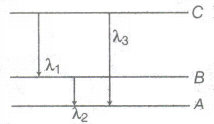
\({ E }_{ B }-{ E }_{ C }=\frac { hc }{ { \lambda }_{ 1 } } \quad \quad ...(i)\)
\({ E }_{ A }-{ E }_{ B }=\frac { hc }{ { \lambda }_{ 2 } } \quad \quad ...(ii)\)
\({ E }_{ C }-{ E }_{ A }=\frac { -hc }{ { \lambda }_{ 3 } } \quad ...(iii)\)
On adding Eqs. (i), (ii) and (iii), we get
EB - EC + EA - EB + EC - EA
\(=hc\left( \frac { 1 }{ { \lambda }_{ 1 } } +\frac { 1 }{ { \lambda }_{ 2 } } -\frac { 1 }{ { \lambda }_{ 3 } } \right) \)
\(\frac { 1 }{ { \lambda }_{ 3 } } =\frac { 1 }{ { \lambda }_{ 1 } } +\frac { 1 }{ { \lambda }_{ 2 } } \Rightarrow { \lambda }_{ 3 }=\frac { { { \lambda } }_{ 1 }{ \lambda }_{ 2 } }{ { \lambda }_{ 1 }+{ \lambda }_{ 2 } } \)
24.
(i) (a) : Let the number of fissions per second be n. Energy released per second
\(=n \times 200 \mathrm{MeV}=n \times 200 \times 1.6 \times 10^{-13} \mathrm{~J}\)
Energy required per second = power x time
\(=1 \mathrm{~kW} \times 1 \mathrm{~s}=1000 \mathrm{~J}\)
\(\therefore \quad n \times 200 \times 1.6 \times 10^{-13}=1000\)
\(\text { or } \quad n=\frac{1000}{3.2 \times 10^{-11}}=\frac{10}{3.2} \times 10^{13}=3.125 \times 10^{13}\)
(ii) (a)
(iii) (b): As only 0.1% of the original mass is converted into energy, hence out of 1 kg mass 1 g is converted into energy.
\(\therefore\) Energy released during fission, \(E=\Delta m c^{2}\)
\(=1 \mathrm{~g} \times\left(3 \times 10^{8} \mathrm{~m} \mathrm{~s}^{-1}\right)^{2}=10^{-3} \times 9 \times 10^{16} \mathrm{~J}=9 \times 10^{13} \mathrm{~J}\)
(iv) (a)
(v) (a)

12th Standard CBSE Syllabus & Materials
12th Standard CBSE
CBSE 12th Computer Science Python Revision Tour I - New Previous year Question Papers Study Material - QB365 Set A
NEW12th Standard CBSE
CBSE 12th Business Studies Planning Important Questions And Answers Study Material - QB365 Set A
NEW12th Standard CBSE
CBSE 12th Business Studies Business Environment Important Questions And Answers Study Material - QB365 Set A
NEW12th Standard CBSE
CBSE 12th Business Studies Principles of Management Important Questions And Answers Study Material - QB365 Set A



NCERT Books

Syllabus

Exam Pattern

Sample Question Papers

Previous year Question Papers

Important Notes

MCQ Practice test

NCERT Exemplers

Case study Questions

Image Based Questions

Passage based Questions

HOT Questions

Value Based Questions

Model Questions Papers
NCERT ( Book Back ) Questions

Assertion and Reason
Important Questions And Answers

CBSE 12th Standard CBSE Subjects
CBSE Standards