 100% FREE ACCESS
12th Standard CBSE Syllabus & Materials
12th Standard CBSE
CBSE 12th Economics Government Budget and the Economy Previous year Question Papers Study Material - QB365 Set A
NEW12th Standard CBSE
CBSE 12th Computer Science Interface Python with MySQL - New Previous year Question Papers Study Material - QB365 Set A
NEW12th Standard CBSE
CBSE 12th Computer Science Database Concept - New Previous year Question Papers Study Material - QB365 Set A
NEW12th Standard CBSE
CBSE 12th Computer Science Data Communication - New Previous year Question Papers Study Material - QB365 Set A
NEW12th Standard CBSE
CBSE 12th Computer Science Data Structures - New Previous year Question Papers Study Material - QB365 Set A
NEW12th Standard CBSE
CBSE 12th Computer Science Functions - New Previous year Question Papers Study Material - QB365 Set A

Published on: 07/03/2026
Download CBSE Class 12th Standard CBSE Physics question papers, sample papers, important questions, and previous year solved papers in PDF format. Get free study materials, NCERT solutions, and exam preparation resources for Class 12th Standard CBSE Physics
Questions + Answers key
Take MCQ Physics Test
1.
In Bohr's model of H-atom, the radius of the first electron orbit is 0.53 A. What will be the radius of the third orbit and the first orbit of singly ionised helium atom?
2.
Two nuclei have mass numbers in the ratio 1:8.What is the ratio of their nuclear radii?
3.
What characteristic property of nuclear force explain the constancy of binding energy per nucleon (BE/A) in the range of mass number 'A' lying 30
4.
What is doping?
5.
Suppose a pure Si crystal has \(5\times 10^{ 28 }\) atmos \(m^{ -3 }\). It is doped by ppm concentration of pentavalent As. Calculate the number of electrons and holes. Given that \({ n }_{ i }=1.5\times { 10 }^{ 16 }m^{ 3 }\)
6.
Draw the energy band diagrams of
(i) n-type and
(ii) p-type semiconductor at temperature, T> OK.
In the case n-type Si semiconductor, the donor energy level is slightly below the bottom of conduction band whereas in p-type semiconductor, the acceptor energy level is slightly above the top of the valence band. Explain, what role do these energy levels play in conduction and valence bands.
7.
Explain giving necessary reactions, how energy is released during
(i) fission
(ii) fusion
8.
The binding energies of deuteron \(\left( _{ 1 }{ { H }^{ 2 } } \right) \) and alpha particle \(\left( _{ 2 }{ { He }^{ 4 } } \right) \) are 1.25 and 7.2 MeV/nucleon respectively. Which nucleus is more stable? Calculate binding energy per nucleon of \(_{ \ 26 }{ { Fe }^{ 56 } }.m\left( _{ \ 26 }{ { Fe }^{ 56 } } \right) =55.934939\) amu, m (proton) = 1.007825 amu, m (neutron) = 1.008665 a.m.u
9.
Calculate shortest wavelength of Balmer series. Given \(R=1.097\times { 10 }^{ 7 }{ m }^{ -1 }\).
10.
An alpha particle is scattered through an angle of \(10°\) on passing through a thin foil of copper (Z = 29). If energy of the particle is 5MeV, what is the impact parameter?
11.
A 2V battery is connected across the points A and B as shown in the figure. Assuming that the resistance of each diode is zero in forward bias and infinity in reverse bias, the current supplied by the battery when its positive terminal is connected to A is
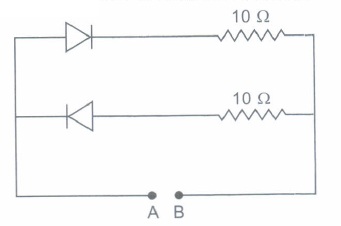
0.2 A
0.4 A
Zero
0.1 A
12.
The forbidden energy band gap in conductors, semiconductors and insulators are EG1, EG2 and EG3 respectively. The relation among them is
EG1 = EG2 = EG3
EG1 < EG2 < EG3
EG1 > EG2 > EG3
EG1 < EG2 > EG3
13.
The quantity which is not conserved in a nuclear reaction is
momentum.
charge.
mass.
none of these
14.
The hydrogen atom can give spectral lines in the Lyman, Balmer and Paschen series. Which of the following statement is correct?
Lyman series is in the infrared region.
Balmer series is in the visible region.
Paschen series is in the visible region.
Balmer series is in the ultraviolet region
15.
If 13.6 eV energy is required to ionise the hydrogen atom, then energy required to remove an electron from n = 2 is
10.2 eV
0 eV
3.4 eV
6.8 eV
16.
The substance which is doped in an intrinsic semiconductor to make p-type semiconductor is
phosphorus
antimony
aluminium
arsenic
17.
Binding energy of hydrogen nucleus is
- 13.6 eV
0
13.6 eV
6.8 eV
18.
If the orbital radius of the electron in a hydrogen atom is 4.7 x 10⁻¹¹ m. Compute the kinetic energy of the electron in hydrogen atom.
15.3eV
- 15.3eV
13.6 eV
-13.6 eV
19.
Mobilities of electrons and holes in a sample of intrinsic germanium at room temperature are \(0.36{ m }^{ 2 }{ v }^{ -1 }s^{ -1 } \ and \ 0.17 \ { m }^{ 2 }{ v }^{ -1 }s^{ -1 }\)The electron and hole densities are each equal to \(2.5 \times 10^{ 19 }m^{ -3 }\) .The electrical conductivity of germanium is
0.47 \(Sm^{ -1 }\)
1.09 \(Sm^{ -1 }\)
2.12 \(Sm^{ -1 }\)
4.24 \(Sm^{ -1 }\)
20.
1 curie = k disintegrations/sec, where kis
\(3.7\times { 10 }^{ 10 }\)
\(3.7\times { 10 }^{ -10 }\)
\(7.3\times { 10 }^{ -10 }\)
\(7.3\times { 10 }^{ 10 }\)
21.
In intrinsic semiconductor at room temperature, the number of electrons and holes are
equal
zero
unequal
infinite
22.
The ground state energy of electron in case of \(_{ 3 }{ { Li }^{ 7 } }\)is
13.6 eV
-13.6 eV
30.4 eV
-30.4 eV
23.
The number of silicon atoms per m3 is 5 x 1028. This is doped simultaneously with 5 x 10²² atoms per m3 of Arsenic and 5 x 10²⁰ atoms per m3 of Indium. Calculate the number of electrons and holes. Given that ni = 1.5 x 10¹⁶ m–3. Is the material n-type or p-type?
24.
If 200 MeV energy is released in the fission of a single nucleus of \(_{ 92 }{ { U }^{ 235 } }\) , how many fissions must occur per second to produce a power of 1kW?
25.
Find the energy equivalent of one atomic mass unit, first in joule and then in MeV. Using this, express the mass defect of \(_{ 8 }{ { O }^{ 16 } }\) in \(MeV/{ c }^{ 2 }\)
Given \({ m }_{ p }=1.00727 \ amu, \ { m }_{ n }=1.00866 \ amu,\)
\({ m }_{ oxy }=15.99053 \ amu\)
\(Take \ 1amu=933.75 \ MeV/{ c }^{ 2 }\)
1.
Radius of the nth Bohr orbit \(r=\frac{n^{2} h^{2} \varepsilon_{0}}{\pi m Z e^{2}}\)
Again, \(r \propto \frac{1}{Z}\)
\(\therefore\) \(\frac{r_{\mathrm{He}^{+}}}{r_{\mathrm{H}}}=\frac{Z_{\mathrm{H}}}{Z_{\mathrm{He}^{+}}}\)
For hydrogen, Z = 1 and for helium, Z = 2
\(\therefore\) \(\frac{r_{\mathrm{He}^{+}}}{r_{\mathrm{H}}}=\frac{1}{2}\)
\(\Rightarrow \quad r_{\mathrm{He}^{+}}=\frac{1}{2} r_{\mathrm{H}}=\frac{0.53}{2}=0.265 \) \(\overset{o}{A}\)
For radius of third orbit, i.e. for n = 3
r3 = (3)2 x 0.265 \(\overset{o}{A}\)
= 9 x 0.265\(\overset{o}{A}\)
= 2.38\(\overset{o}{A}\)
2.
\(R=R_0 A^{1 / 3}, R_1 / R_2=A_1^{1 / 3} / A_2^{1 / 3}=1,{ }^{1 / 3} / 27_{1 / 3}=1 / 3\)
3.
Saturation/Short nature of nuclear force
4.
Doping is a process of deliberate addition of a desirable impurity in a pure semiconductor to modify its properties in a controlled manner.
5.
Note that thermally generated electrons (ni ~1016m–3) are negligibly small as compared to those produced by doping.
Therefore, ne \(\approx\) ND
Since ne nh = \(n_{i}^{2}\) , The number of holes
nh = (2.25 x 1032 ) / (5 x10²²)
= ~ 4.5 x 10⁹ m–3
6.
The donor energy level ED is just below the bottom of the conduction band. At room temperature this small energy gap is easily converted by the thermally excited electrons. The conduction band has more electrons as they have been contributed both by thermal excitation and donor impurities. Whereas the acceptor energy level EA lies slightly above the top of the valence band. At room temperature, many electrons of the valence band get excited to these acceptor energy levels, leaving behind equal number of holes in the valence band. These holes can conduct current. Thus, the valence band has more holes than the electrons in the conduction band.
7.
Nuclear Fission The phenomenon of splitting of heavy nuclei (mass number> 120) into smaller nuclei of nearly equal masses is known as nuclear fission.
In nuclear fission, the sum of the masses Y of the product is less than the sum of masses of the reactants. This difference of mass gets converted into energy E = me! and hence sample amount of energy is released in a nuclear fission.
e.g. \(_{ 235 }^{ 92 }{ U }+_{ 0 }^{ 1 }{ n }\rightarrow _{ 56 }^{ 141 }{ Ba }+_{ 36 }^{ 92 }{ Kr }+6_{ 0 }^{1 }{ n }+Q\)
Masses of reactant
= 235.0439 amu + 1.0087 amu
= 236.0526 amu
Masses of product
= 140.9139 + 91.8973 + 3.0261
= 235.8373 amu
Mass defect = 236.0526 - 235.8373
= 0.2153 amu
\(\because\) 1amu \(\equiv\) 931 MeV
\(\Rightarrow\) Energy released = 0.2153 x 931 = 200 MeV nearly
Thus, energy is liberated in nuclear fission \(_{92}^{235}{U}.\)
8.
Helium : 8.79 MeV / nucleon.
9.
\(3646.8\mathring { A } \)
\(Take \ { n }_{ 1 }=2 \ and \ { n }_{ 2 }=\infty \)
10.
\(0.95\times { 10 }^{ -13 }m\)
11.
(a)
0.2 A
12.
(b)
EG1 < EG2 < EG3
13.
(c)
mass.
14.
(b)
Balmer series is in the visible region.
15.
(c)
3.4 eV
16.
(c)
aluminium
17.
(c)
13.6 eV
18.
(a)
15.3eV
19.
(c)
2.12 \(Sm^{ -1 }\)
20.
(a)
\(3.7\times { 10 }^{ 10 }\)
21.
equal
22.
(d)
-30.4 eV
23.
For each atom doped with arsenic, one free electron is received. Similarly, for each atom doped of indium, a vacancy is created. So, number of free electrons introduced by pentavalent impurity is
\(N_{\mathrm{As}}=5 \times 10^{22} \mathrm{~m}^{-3}\)
The number of holes introduced by trivalent impurity added is
\(N_{\mathrm{I}}=5 \times 10^{20} \mathrm{~m}^{-3}\)
So, net number of electrons added is
ne = NAs - N1
\(\begin{aligned}
=5 \times 10^{22}-5 \times 10^{20}
\end{aligned}\)
\(\begin{aligned}
=4.95 \times 10^{22} \mathrm{~m}^{-3}
\end{aligned}\)
We know that, \(n_e n_h=n_i^2\)
So, \(n_h=\frac{n_i^2}{n_e}=\frac{\left(1.5 \times 10^{16}\right)^2}{4.95 \times 10^{22}}\)
\(=4.54 \times 10^9 \mathrm{~m}^{-3}\)
As, ne > nh (number of holes). So, the material is n-type semiconductor.
24.
Here, energy released/fission
= 200MeV
\(=200\times 1.6\times { 10 }^{ -13 }J=3.2\times { 10 }^{ -11 }J\)
\( Total \ energy \ required/sec=1 \ kW=1000w\)
\( =1000J/s.\)
\( Number\ of \ fissions/sec\)
\( =\frac { Energy \ reqd.\ per \ sec. }{ energy \ released/fission }\)
\(=\frac { 1000 }{ 3.2\times { 10 }^{ -11 } } =3.125\times { 10 }^{ 13 }s\)
25.
\(we \ know, \ 1 \ amu=1.66\times { 10 }^{ -27 }kg\)
\(From \ E={ mc }^{ 2 }=(1.66\times { 10 }^{ -27 }){ \left( 3\times { 10 }^{ 8 } \right) }^{ 2 }\)
\( =1.494\times { 10 }^{ -10 }J\)
\(E=\frac { 1.494\times { 10 }^{ -10 } }{ 1.6\times { 10 }^{ -13 } } MeV=933.75MeV\)
\(For \ oxygen_{ 8 }{ { O }^{ 16 } }, \ mass \ defect\)
\(=8{ m }_{ p }+8{ m }_{ n }-{ M }_{ oxy }\)
\(=8\times 1.00727+8\times 1.00866-15.99053\)
\( =0.13691 \ amu\)
\(=0.13691\times 933.75MeV/{ c }^{ 2 }\)
\( =127.8MeV/{ c }^{ 2 }\)

12th Standard CBSE Syllabus & Materials
12th Standard CBSE
CBSE 12th Computer Science Python Revision Tour I - New Previous year Question Papers Study Material - QB365 Set A
NEW12th Standard CBSE
CBSE 12th Business Studies Planning Important Questions And Answers Study Material - QB365 Set A
NEW12th Standard CBSE
CBSE 12th Business Studies Business Environment Important Questions And Answers Study Material - QB365 Set A
NEW12th Standard CBSE
CBSE 12th Business Studies Principles of Management Important Questions And Answers Study Material - QB365 Set A



NCERT Books

Syllabus

Exam Pattern

Sample Question Papers

Previous year Question Papers

Important Notes

MCQ Practice test

NCERT Exemplers

Case study Questions

Image Based Questions

Passage based Questions

HOT Questions

Value Based Questions

Model Questions Papers
NCERT ( Book Back ) Questions

Assertion and Reason
Important Questions And Answers

CBSE 12th Standard CBSE Subjects
CBSE Standards