
 100% FREE ACCESS
12th Standard CBSE Syllabus & Materials
12th Standard CBSE
CBSE 12th Economics Government Budget and the Economy Previous year Question Papers Study Material - QB365 Set A
NEW12th Standard CBSE
CBSE 12th Computer Science Interface Python with MySQL - New Previous year Question Papers Study Material - QB365 Set A
NEW12th Standard CBSE
CBSE 12th Computer Science Database Concept - New Previous year Question Papers Study Material - QB365 Set A
NEW12th Standard CBSE
CBSE 12th Computer Science Data Communication - New Previous year Question Papers Study Material - QB365 Set A
NEW12th Standard CBSE
CBSE 12th Computer Science Data Structures - New Previous year Question Papers Study Material - QB365 Set A
NEW12th Standard CBSE
CBSE 12th Computer Science Functions - New Previous year Question Papers Study Material - QB365 Set A

Published on: 07/03/2026
Download CBSE Class 12th Standard CBSE Physics question papers, sample papers, important questions, and previous year solved papers in PDF format. Get free study materials, NCERT solutions, and exam preparation resources for Class 12th Standard CBSE Physics
Questions + Answers key
Take MCQ Physics Test
1.
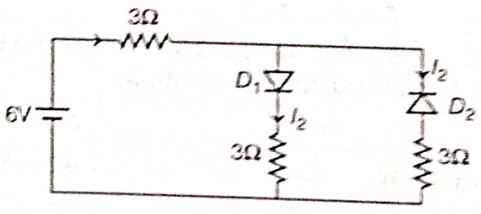
Find the current I1, and I2, shown below if diodes D1, and D2, are ideal.
2.
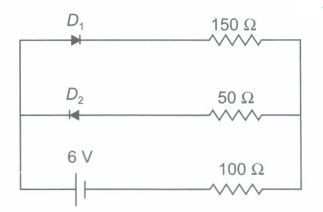
The circuit shown in the figure contains two diodes each with a forward resistance of 50 \(\Omega\) and infinite backward resistance. Find the current through the 100 \(\Omega\) resistance.
3.
(i) Write the basic nuclear process involved in the emission of β+ in a symbolic form by a radioactive nucleus.
(ii) In the reactions given below:
\(\text { (a) }{ }_{6}^{11} \mathrm{C} \rightarrow{ }_{y}^{z} \mathrm{~B}+x+\mathrm{v}\)
\(\text { (b) }{ }_{6}^{12} \mathrm{C} \rightarrow{ }_{6}^{12} \mathrm{C}+{ }_{a}^{20} \mathrm{Ne}+{ }_{b}^{c} \mathrm{He}\)
Find the values of x, y and z and a, band c
4.
In half wave rectification , what is the output frequency if the input frequency is 50 Hz. What is the output frequency of a full wave rectification for the same input frequency.
5.
Three photo diodes D1 , D2 and D3 are made of semiconductor having band gaps of 2.5 eV, 2eV and 3 eV respectively. Which one will be able to detect light of wavelength 600 \(\overset{o}{A}\)?
6.
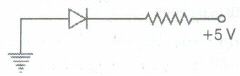
(i) In the following diagram, is the junction diode forward biased or reverse biased?
(ii) Draw the circuit diagram of a full wave rectifier and state how it works?
7.
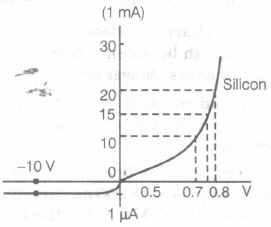
The V-I characteristic of a silicon diode is as shown in the figure. Calculate the resistance of the diode at
(i) I = 15 mA and
(ii) V = -10 V
8.
Identify the nature of the 'radioactive radiations', emitted in each step
of the 'decay chain' given below:
\(_{ Z }^{ A }{ X\rightarrow _{ Z-2 }^{ A-4 }{ Y } }\rightarrow _{ Z-2 }^{ A-4 }{ Y }\rightarrow _{ Z-1 }^{ A-4 }W\)
9.
(a) Deduce the expression ,N = \({ N }_{ 0 }{ e }^{ -\lambda t }\), for the law of radioactive decay
(b) (i) Write symbolically the process expressing the \({ \beta }^{ + }\) decay of \(_{ 11 }^{ 22 }{ Na }\) . Also write the basic nuclear process underlying this decay.
(ii) Is the nucleus formed in the decay of the nucleus \(_{ 11 }^{ 22 }{ Na }\), an isotope or an isobar?
10.
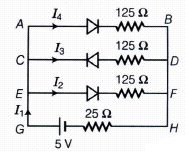
If each diode in figure has a forward bias resistance of \(25\Omega \) and infinite resistance in reverse bias, what will be the values of the currents \(I_{ 1 },I_{ 2 },I_{ 3 } \ and \ I_{ 4 }\) ?
11.
A half wave rectifier is used to supply 50 V d.c. to a resistance load of \(800\Omega \) . Diode has a resistance of \(200\Omega \) . Calculate maximum a.c. voltage required.
12.
An a.c. supply of 230 V is applied to a half wave rectifier circuit through a transformer of turn ratio 10 : 1. Find the output d,c. voltage. Assume the diode to be ideal.
13.
Calculate the binding energy per nucleon in the nuclei of \(_{ 15 }{ { P }^{ 31 } }\) Given \(m(_{ 15 }{ { P }^{ 31 }) }\)= 30.97376 u \(m(_{ 0 }{ { n }^{ 1 }) }=1.00865\ u;\) \(m(_{ 1 }{ { H }^{ 1 }) }=1.00782u\)
14.
The binding energy per nucleon for \(_{ 6 }{ { C }^{ 12 } }\) is 7.68 MeV/N and that for \(_{ 6 }{ { C }^{ 13 } }\) is 7.47 MeV/N. Calculate the energy required to remove a neutron \(_{ 6 }{ { C }^{ 13 } }\).
15.
A semiconductor has equal electron and hole concentration of \(6\times 10^{ 8 }/m^{ 3 }\) . On doping with certain impurity, electron concentration increases to \(9\times 10^{ 12 }/m^{ 3 }\) .
(i) Identify the new semiconductor obtained after doping.
(ii) Calculate the new hole concentration.
(iii) How does the energy gap vary with doping?
16.
Calculate the impact parameter of a 5 MeV particle scattered by \(90°\), when it approaches a gold nucleus (Z = 79).
17.
A heavy nucleus P of mass number 240 and binding energy 7.6 MeV per nucleon splits in to two nuclei Q and R of mass numbers 110, 130 and binding energy per nucleon 8.5 MeV and 8.4 MeV, respectively. Calculate the energy released in the fission.
18.
The Q value of a nuclear reaction \(A+b \rightarrow C+d\) is defined by \(Q=\left[m_{A}+m_{b}-m_{C}-m_{d}\right] c^{2}\) where the masses refer to the respective nuclei. Determine from the given data the Q-value of the following reactions and state whether the reactions are exothermic or endothermic.
\(\text { (i) }{ }_{1}^{1} \mathrm{H}+{ }_{1}^{3} \mathrm{H} \rightarrow{ }_{1}^{2} \mathrm{H}+{ }_{1}^{2} \mathrm{H}\)
\(\text { (ii) }{ }_{6}^{12} \mathrm{C}+{ }_{6}^{12} \mathrm{C} \rightarrow{ }_{10}^{20} \mathrm{Ne}+{ }_{2}^{4} \mathrm{He}\)
Atomic masses are given to be
\(m\left({ }_{1}^{2} \mathrm{H}\right)=2.014102 \mathrm{u}\)
\(m\left({ }_{1}^{3} \mathrm{H}\right)=3.016049 \mathrm{u}\)
\(m\left(\begin{array}{c} 12 \\ 6 \end{array} \mathrm{C}\right)=12.000000 \mathrm{u}\)
\(m\left(\begin{array}{l} 20 \\ 10 \end{array} \mathrm{Ne}\right)=19.992439 \mathrm{u}\)
1.
From the given circuit diagram, diode D1, is in forward bias whereas diode D2 is in reverse bias.
Hence, no current will flow through diode D2.
\(\therefore\) I2 = 0
Now, circuit diagram is reduced as
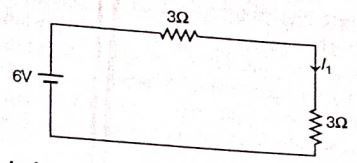
\(\therefore\) Equivalent resistance, R = 3 + 3 = 6\(\Omega\)
Now, Current \(I_1=\frac{V}{R}=\frac{6}{6}=1 \mathrm{~A}\)
2.
In the given circuit, diode D1 is forward biased with forward resistance of 50\(\Omega\) and D2 is reversed biased, which offers infinite backward resistance.
\(\therefore \ I=\frac{\text { Applied voltage }}{\text { Total resistance }}\)
\(I=\frac{6}{50+150+100}\)
\(I=\frac{6}{300}=0.02 \mathrm{~A}\)
Therefore, current through 100 \(\Omega\) resistance = 0.02 A
3.
(i) The basic nuclear process involved in the emission of β+ during radioactivity is given by
\({ }_{Z}^{A} X \longrightarrow{ }_{Z-1}^{A} Y+\beta^{+}+v\)
(ii) (a) According to question
\({ }_{6}^{11} \mathrm{C} \longrightarrow{ }_{y}^{z} \mathrm{~B}+x+\mathrm{v}\)
For β+-decay,
\(z X^{A} \longrightarrow z_{-1} Y^{A}+\beta^{+}+v\)
On comparing Eqs. (i) and (ii), we get
\(y=5, z=11 \text { and } x=\beta^{+}\)
\(\text { (b) }{ }_{6}^{12} \mathrm{C}+{ }_{6}^{12} \mathrm{C} \longrightarrow{ }_{a}^{20} \mathrm{Ne}+{ }_{b}^{c} \mathrm{He}\)
Helium have 4 mass number and 2 charge number. So reaction will be
\({ }_{6}^{12} \mathrm{C}+{ }_{6}^{12} \mathrm{C} \longrightarrow{ }_{10}^{20} \mathrm{Ne}+{ }_{2}^{4} \mathrm{He}\)
On comparing Eqs. (i) and (ii), we get
a = 10, b = 2 and c = 4
4.
Given, input frequency = 50 Hz
For a half-wave rectifier, the output frequency is equal to the input frequency.
\(\therefore\) Output frequency = 50 Hz
For a full-wave rectifier, the output frequency is twice the input frequency.
\(\therefore\) Output frequency = 2 x 50 = 100 Hz.
5.
Given, wavelength of light,
A = 6000\(\overset{o}{A}\) = 6000 x 10-10 m
\(\therefore\) Energy of the light photon,
\(E=\frac{h c}{\lambda}=\frac{6.6 \times 10^{-34} \times 3 \times 10^{8}}{6000 \times 10^{-10} \times 1.6 \times 10^{-19}} \mathrm{eV}=2.06 \mathrm{eV}\)
The incident radiation which is detected by the photodiode having energy should be greater than the band gap. So, it is only valid for diode D2 . Then, diode D2 will detect this radiation.
6.
The given diagram shown below
.png)
The circuit above can be redrawn as follows
.png)
As the p-section is connected to negative terminal of the battery, the diode shown is reverse biased.
(ii) During the first half of input cycle, the upper end of the coil is at positive potential and lower end at negative potential. The function diode DI is forward biased and D2 in reverse biased. Current flows in output load in the
direction shown in figure. During the second half of input cycle, D2 is forward biased. In this way, current flows in the load in the single direction as shown in figure.
.png)
7.
Considering the diode characteristics as a straight line between I = 10 mA to I = 20 mA passing through the origin, we can calculate the resistance using Ohm’s law.
(a) From the curve, at I = 20 mA, V = 0.8 V, I = 10 mA, V = 0.7 V
\(r_{f b}=\Delta V / \Delta I=0.1 \mathrm{~V} / 10 \mathrm{~mA}=10 \ \Omega\)
(b) From the curve at V = –10 V, I = –1 \(\mu\) A,
Therefore,
\(r_{r b}=10 \mathrm{~V} / 1 \mu \mathrm{A}=1.0 \times 10^{7} \ \Omega\)
8.
(i) \(\alpha \) rays
(ii) \(\gamma \) rays
(iii) \(\beta \) rays
9.
(a) \(\frac { dN }{ dt } =-\lambda N\)
\(\int _{ { N }_{ 0 } }^{ N }{ \frac { dN }{ N } =\int _{ 0 }^{ t }{ -\lambda dt } } \)
\(\left[ { log }_{ e }^{ N } \right] _{ { N }_{ 0 } }^{ N }=-\lambda \left[ t \right] _{ 0 }^{ t }\)
\(loge\frac { N }{ { N }_{ 0 } } =-\lambda t\)
\(N={ N }_{ 0 }{ e }^{ -\lambda t }\)
(b) (i) \(_{ 11 }^{ 22 }{ Na }\rightarrow _{ 10 }^{ 22 }Ne+{ e }^{ x }+\upsilon \)
Also accept,if a student does not identify the product nucleus and writes as
\(_{ 11 }^{ 22 }{ Na }\rightarrow _{ 10 }^{ 22 }Xe+{ e }^{ x }+\upsilon \)
Basic process
\(p\rightarrow n+{ e }^{ + }+\upsilon \)
(ii) Isobar
10.
Given, forward biased resistance = \(25\Omega \)
Reverse biased resistance = \(\infty \)
As the diode in branch CD is in reverse biased which having resistance infinite.
so \(I_{ 3 }\)= 0
Resistance in branch AB = 25 + 125 = 150\(\Omega \)(say R1)
Resistance in branch EF = 25 + 125 = 150\(\Omega \)(say R2)
AB is parallel to EF.
so, resultant resistance, \(\frac { 1 }{ { R }^{ \prime } } =\frac { 1 }{ { R }_{ 1 } } +\frac { 1 }{ { R }_{ 2 } } =\frac { 1 }{ 150 } +\frac { 1 }{ 150 } =\frac { 2 }{ 150 } \)
\(\Rightarrow { R }^{ \prime }=75\Omega \)
Total resistance, \(R={ R }^{ \prime }+25=75+25=100\Omega \)
Current, \({ I }_{ 1 }=\frac { V }{ R } =\frac { 5 }{ 100 } =0.05A\)
\({ I }_{ 1 }={ I }_{ 4 }+{ I }_{ 2 }+{ I }_{ 3 }\quad [Here,\quad { I }_{ 3 }=0]\)
\(\\ { I }_{ 1 }={ I }_{ 4 }+{ I }_{ 2 }\)
Here, the resistances R1 and R2 are same
\({ I }_{ 4 }={ I }_{ 2 }\)
\(\\ { I }_{ 1 }=2{ I }_{ 2 }\)
\(\\ \Rightarrow { I }_{ 2 }=\frac { { I }_{ 1 } }{ 2 } =\frac { 0.05 }{ 2 } =0.025A\)
\(\\ { I }_{ 4 }=0.025A\)
\(\\ { I }_{ 1 }=0.05A\)
\(\\ { I }_{ 2 }=0.025A\)
\(\\ { I }_{ 3 }=0\)
\(\\ { I }_{ 4 }=0.025A\)
11.
196.43 V
12.
10.36V
13.
\(In \ _{ 15 }{ { P }^{ 31 }, }number \ of \ protons=15\)
number of neutrons = 31−15 = 16
Mass defect,
\( \Delta m=15\times 1.00782+16\times 1.00865-30.97376\)
\(=0.28194amu\)
\(B.E./nucleon=\frac { 0.28194\times 931 }{ 31 } =8.47MeV/N\)
14.
Total B.E of \(_{ 6 }{ { C }^{ 12 } }\)\(=12\times 7.68=92.16\quad MeV\)
Total B.E of \(_{ 6 }{ { C }^{ 13 } }\) \(=13\times 7.47=97.11\quad MeV\)
As \(_{ 6 }{ { C }^{ 13 } }\) has one excess neutron than \(_{ 6 }{ { C }^{ 12 } }\),
\(\therefore \) Energy required to remove a neutron
= 97.11-92.16 = 4.95 MeV
15.
(i) n-type
(ii) \(4\times 10^{ 4 }/m^{ 3 }\)
(iii) Energy gap decreases with doping
Here,
\({ n }_{ i }=6\times 10^{ 8 }m^{ -3 };{ n }_{ e }=9\times 10^{ 12 }m^{ -3 }\)
\( { n }_{ h }=\frac { { n }_{ i }^{ 2 } }{ { n }_{ e } } =\frac { \left( 6\times 10^{ 8 } \right) ^{ 2 } }{ 9\times 10^{ 12 } } =4\times 10^{ 4 }m^{ -3 }\)
As, after doping, \({ n }_{ e }>{ n }_{ h }\) so the new semiconductors is n-type. Energy gap decreases with doping.
16.
\(2.27\times { 10 }^{ -14 }m\)
Here, \(b=?\ KE=5MeV=5\times 1.6\times { 10 }^{ -13 }J\)
\(\theta =90°,\ \quad Z=79\)
\( b=\frac { Z{ e }^{ 2 }cot{ \theta }/{ 2 } }{ 4\pi { \epsilon }_{ 0 }(KE) } \)
\( =\frac { 9\times { 10 }^{ 9 }\times 79{ \left( 1.6\times { 10 }^{ -19 } \right) }^{ 2 }cot45° }{ 5\times 1.6\times { 10 }^{ -13 } }\)
\( b=2.27\times { 10 }^{ -14 }m\)
17.
From the given situation, nuclear reaction is given as
\(P^{240} \longrightarrow Q^{10}+R^{130}+\Delta E\)
Energy released in the fission
\(\Delta E=110 \times 8.4+130 \times 8.5-240 \times 7.6\)
= 924 + 1105 - 1824
= 205 MeV
18.
The given nuclear reaction is:
\({ }_{1}^{1} H+{ }_{1}^{3} H \rightarrow_{1}^{2} H+{ }_{1}^{2} H\)
It is given that:
Atomic mass \(m\left({ }_{1}^{1} H\right)=1.007825 \mathrm{u}\)
Atomic mass \(m\left({ }_{1}^{3} H\right)=3.016049 \mathrm{u}\)
Atomic mass \(m\left({ }_{1}^{2} H\right)=2.014102 u\)
According to the question, the Q-value of the reaction can be written as:
\(Q=\left[m\left({ }_{1}^{1} H\right)+m\left({ }_{1}^{3} H\right)-2 m\left({ }_{1}^{2} H\right)\right] c^{2}\)
\(=[1.007825+3.016049-2 \times 2.014102] c^{2}\)
\(Q=-0.00433 \times 931.5=-4.0334 \mathrm{MeV}\)
The negativeQ-value of the reaction shows that the reaction is endothermic.
The given nuclear reaction is:
\(\text { (ii) }{ }_{6}^{12} \mathrm{C}+{ }_{6}^{12} \mathrm{C} \rightarrow{ }_{10}^{20} \mathrm{Ne}+{ }_{2}^{4} \mathrm{He}\)
t is given that:
Atomic mass of \(m\left({ }_{6}^{12} C\right)=12.0 u\)
Atomic mass of \(m\left(\begin{array}{l} 20 \\ 10 \end{array}\right)=19.992439\)
Atomic mass of \(m\left({ }_{2}^{4} \mathrm{He}\right)=4.002603 \mathrm{u}\)
The Q-value of this reaction is given as:
\(Q=\left[2 m\left({ }_{6}^{12} C\right)-m\left({ }_{10}^{20} N e\right)-m\left({ }_{2}^{4} H e\right)\right] c^{2}\)
\(=[2 \times 12.0-19.992439-4.002603] c^{2}\)
\(=\left(0.004958 c^{2}\right) u\)
\(=0.004958 \times 931.5=4.618377 \mathrm{MeV}\)
The positive Q-value of the reaction shows that the reaction is exothermic.

12th Standard CBSE Syllabus & Materials
12th Standard CBSE
CBSE 12th Computer Science Python Revision Tour I - New Previous year Question Papers Study Material - QB365 Set A
NEW12th Standard CBSE
CBSE 12th Business Studies Planning Important Questions And Answers Study Material - QB365 Set A
NEW12th Standard CBSE
CBSE 12th Business Studies Business Environment Important Questions And Answers Study Material - QB365 Set A
NEW12th Standard CBSE
CBSE 12th Business Studies Principles of Management Important Questions And Answers Study Material - QB365 Set A



NCERT Books

Syllabus

Exam Pattern

Sample Question Papers

Previous year Question Papers

Important Notes

MCQ Practice test

NCERT Exemplers

Case study Questions

Image Based Questions

Passage based Questions

HOT Questions

Value Based Questions

Model Questions Papers
NCERT ( Book Back ) Questions

Assertion and Reason
Important Questions And Answers

CBSE 12th Standard CBSE Subjects
CBSE Standards