
 100% FREE ACCESS
12th Standard CBSE Syllabus & Materials
12th Standard CBSE
CBSE 12th Economics Government Budget and the Economy Previous year Question Papers Study Material - QB365 Set A
NEW12th Standard CBSE
CBSE 12th Computer Science Interface Python with MySQL - New Previous year Question Papers Study Material - QB365 Set A
NEW12th Standard CBSE
CBSE 12th Computer Science Database Concept - New Previous year Question Papers Study Material - QB365 Set A
NEW12th Standard CBSE
CBSE 12th Computer Science Data Communication - New Previous year Question Papers Study Material - QB365 Set A
NEW12th Standard CBSE
CBSE 12th Computer Science Data Structures - New Previous year Question Papers Study Material - QB365 Set A
NEW12th Standard CBSE
CBSE 12th Computer Science Functions - New Previous year Question Papers Study Material - QB365 Set A

Published on: 20/08/2026
Download CBSE Class 12th Standard CBSE Physics question papers, sample papers, important questions, and previous year solved papers in PDF format. Get free study materials, NCERT solutions, and exam preparation resources for Class 12th Standard CBSE Physics
Questions + Answers key
Take MCQ Physics Test
1.
Aradioactive isotope has a half-life of 10 yr. How long will it take for the activity to reduce to 3.125%?
2.
Obtain approximately the ratio of the nuclear radii of the gold isotope \({ }_{79}^{197} \mathrm{Au}\) and the silver isotope \({ }_{47}^{107} \mathrm{Ag}\).
3.
Calculate the energy equivalent of 1 g of substance.
4.
Given the mass of iron nucleus as 55.85u and A = 56, find the nuclear density?
5.
Show that the density of nucleus over a wide range of nuclei is constant independent of mass number.
6.
Draw a plot of potential energy between a pair of nucleons as a function of their separation. Mark the regions where potential energy is (i) positive and (ii) negative.
7.
Write symbolically the nuclear \({ \beta }^{ + }\) decay process of \(_{ 6 }{ { C }^{ 11 } }\) . Is the decayed product X an isotope or isobar of \(_{ 6 }{ { C }^{ 11 } }\)?
Given the mass values of \((_{ 6 }{ { C }^{ 11 } })\)
11.011434 u and m(X) = 11.009305 u. Estimate the Q value in the process.
8.
Show that the decay rate R of a sample of radionuclide is related to the number of radioactive nuclei N at the same instant by the expression \(R=\lambda N\).
9.
You are given two nuclei \(_{ 3 }{ { X }^{ 7 } }\) and \(_{ 3 }{ { Y }^{ 4 } }\) . Explain giving reasons, as to which one of the two nuclei is likely to be more stable?
10.
Assuming the nuclei to be spherical in shape, how does the surface area of a nucleus of mass number \({ A }_{ 1 }\) compare with that of a nucleus of mass number \({ A }_{ 2 }\)?
11.
Name the process responsible for energy production in the sun.
12.
A nucleus \(_{ 92 }{ { U }^{ 235 } }\) undergoes alpha decay and transforms into thorium. What is mass number and charge number of nucleus produced?
13.
The mean life of a radioactive sample is \({ T }_{ m }\). What is the time in which 50% of the sample would get decayed?
14.
Out of alpha, beta and gamma radiations, which are affected by electric field and magnetic field?
15.
The binding energies of deutron \((_{ 1 }{ H^{ 2 } })\) and \(\alpha \)- particle \((_{ 2 }{ He^{ 4 } })\) are 1.25 and 7.2 MeV/nucleon respectively. Which nucleus is more stable?
16.
A nucleus pf mass number A has mass defect \(\left( \Delta m \right) \). What is BE per nucleon of this nucleus?
17.
Why is nuclear density same for all nuclei?
18.
Calculate the height of the potential barrier for a head on collision of two deuterons. (Hint: The height of the potential barrier is given by the Coulomb repulsion between the two deuterons when they just touch each other. Assume that they can be taken as hard spheres of radius 2.0 fm.)
19.
How long can an electric lamp of 100W be kept glowing by fusion of 2.0 kg of deuterium? Take the fusion reaction as
\({ }_{1}^{2} \mathrm{H}+{ }_{1}^{2} \mathrm{H} \rightarrow{ }_{2}^{3} \mathrm{He}+\mathrm{n}+3.27 \mathrm{MeV}\)
20.
The Q value of a nuclear reaction \(A+b \rightarrow C+d\) is defined by \(Q=\left[m_{A}+m_{b}-m_{C}-m_{d}\right] c^{2}\) where the masses refer to the respective nuclei. Determine from the given data the Q-value of the following reactions and state whether the reactions are exothermic or endothermic.
\(\text { (i) }{ }_{1}^{1} \mathrm{H}+{ }_{1}^{3} \mathrm{H} \rightarrow{ }_{1}^{2} \mathrm{H}+{ }_{1}^{2} \mathrm{H}\)
\(\text { (ii) }{ }_{6}^{12} \mathrm{C}+{ }_{6}^{12} \mathrm{C} \rightarrow{ }_{10}^{20} \mathrm{Ne}+{ }_{2}^{4} \mathrm{He}\)
Atomic masses are given to be
\(m\left({ }_{1}^{2} \mathrm{H}\right)=2.014102 \mathrm{u}\)
\(m\left({ }_{1}^{3} \mathrm{H}\right)=3.016049 \mathrm{u}\)
\(m\left(\begin{array}{c} 12 \\ 6 \end{array} \mathrm{C}\right)=12.000000 \mathrm{u}\)
\(m\left(\begin{array}{l} 20 \\ 10 \end{array} \mathrm{Ne}\right)=19.992439 \mathrm{u}\)
21.
A given coin has a mass of 3.0 g. Calculate the nuclear energy that would be required to separate all the neutrons and protons from each other. For simplicity assume that the coin is entirely made of \({ }_{29}^{63} \mathrm{Cu}\) atoms (of mass 62.92960 u).
22.
Obtain the binding energy of the nuclei \(\begin{array}{l} 26 \\ 56 \end{array} \text { Fe }\) and \(\begin{array}{l} 209 \\ 83 \end{array} \text { Bi }\)in units of MeV from the following data:
m (\(\begin{array}{l} 26 \\ 56 \end{array} \text { Fe }\) ) = 55.934939 u
m (\(\begin{array}{l} 209 \\ 83 \end{array} \text { Bi }\) ) = 208.980388 u
23.
Obtain the binding energy (in MeV) of a nitrogen nucleus \(\left(\begin{array}{c} 14 \\ 7 \end{array} \mathrm{~N}\right)\) given m \(\left(\begin{array}{c} 14 \\ 7 \end{array} \mathrm{~N}\right)\)=14.00307 u
24.
Answer the following questions:
(a) Are the equations of nuclear reactions (such as those given in Section 13.7) ‘balanced’ in the sense a chemical equation (e.g.,\(2 \mathrm{H}_{2}+\mathrm{O}_{2} \rightarrow 2 \mathrm{H}_{2} \mathrm{O}\)) is? If not, in what sense are they balanced on both sides?
(b) If both the number of protons and the number of neutrons are conserved in each nuclear reaction, in what way is mass converted into energy (or vice-versa) in a nuclear reaction?
(c) A general impression exists that mass-energy interconversion takes place only in nuclear reaction and never in chemical reaction. This is strictly speaking, incorrect. Explain
25.
Calculate binding energy per nucleon of \(_{ 83 }{ { Bi }^{ 209 } }\)Given that
\({ m }_{ p }=1.00727\ amu,\ { m }_{ n }=1.00866\ amu,\)
\( m(_{ 83 }{ { Bi }^{ 209 } })=208.980388\ amu\)
\( m(neutron)=1.008665 \ amu\)
\(m(proton)=1.007825 \ amu\)
26.
Calculate the binding energy per nucleon of \(_{ 20 }{ Ca^{ 40 } }\) the nucleus. Given \(m(_{ 20 }{ Ca^{ 40 } })=39.962589 \ u;{ m }_{ n }=1.008665u;\)
\( { m }_{ p }=1.007825\ u\)
\( Take\ 1a.m.u.=931\ MeV\)
27.
Calculate the B.E/nucleon of \(_{ 17 }{ { Cl }^{ 35 } }\) the nucleus. Given that mass of proton = 1.007825 u, mass of neutron = 1.008665 u, mass of \(_{ 17 }{ { Cl }^{ 35 } }\) = 34.980000 u; 1 u = 931 MeV.
28.
Calculate the binding energy per nucleon of the nucleus \(_{ 26 }{ { Fe }^{ 56 } }\). Given that mass of \(_{ 26 }{ { Fe }^{ 56 } }\) = 55.934939 u, the mass of proton = 1.007825 u and mass of neutron = 1.008665 u and 1u = 931 MeV.
29.
From the relation R = R0A1/3, where R0 is a constant and A is the mass number of a nucleus, show that the nuclear matter density is nearly constant (i.e. independent of A).
30.
Find the energy equivalent of one atomic mass unit, first in Joules and then in MeV. Using this, express the mass defect of \({ }_{8}^{16} \mathrm{O} \text { in } \mathrm{MeV} / \mathrm{c}^{2}\)
1.
After n half lives, activity of sample is
\(R=R_{0}\left(\frac{1}{2}\right)^{n}\)
where, R0 = initial activity.
Given, \(T=10 \mathrm{yr}, R=3.125 \% R_{0}, n=\frac{t}{T}\)
where t = instantaneous time
We have, \(\frac{R}{R_{0}}=\left(\frac{1}{2}\right)^{t / T}\)
\(\therefore \quad \frac{3.125}{100} \frac{R_{0}}{R_{0}}=\left(\frac{1}{2}\right)^{t / 10}\)
\(\Rightarrow \quad \frac{1}{32}=\left(\frac{1}{2}\right)^{5}=\left(\frac{1}{2}\right)^{t / 10} \Rightarrow 5=\frac{t}{10}\)
\(\therefore \quad t=50 \mathrm{yr}\)
2.
Radius of nuclei, R = R0 A1/3
where, A is the mass number of nucleus and R0 is an empirical constant.
\(\therefore\) \(R \propto A^{1 / 3}\)
\(\Rightarrow \quad \frac{R_{\text {gold }}}{R_{\text {silver }}}=\left(\frac{A_{\text {gold }}}{A_{\text {silver }}}\right)^{1 / 3}=\left(\frac{197}{107}\right)^{1 / 3}=1.225=1.23\)
3.
Energy, \(E=10^{-3} \times\left(3 \times 10^{8}\right)^{2} \mathrm{~J}\)
\(E=10^{-3} \times 9 \times 10^{16}=9 \times 10^{13} \mathrm{~J}\)
Thus, if one gram of matter is converted to energy, there is a release of enormous amount of energy.
4.
mFe = 55.85
u = 9.27 × 10⁻²⁶ kg
Nuclear density = \(\frac{\text { mass }}{\text { volume }}=\frac{9.27 \times 10^{-26}}{(4 \pi / 3)\left(1.2 \times 10^{-15}\right)^{3}} \times \frac{1}{56}\)
= 2.29 × 10¹⁷ kg m–3
The density of matter in neutron stars (an astrophysical object) is comparable to this density. This shows that matter in these objects has been compressed to such an extent that they resemble a big nucleus.
5.
We have
\(R={ R }_{ 0 }{ A }^{ \frac { 1 }{ 3 } }\)
\(\therefore \) Density \(\rho \) = \(\frac { mA }{ \frac { 4 }{ 3 } \pi \left( { R }_{ 0 }{ A }^{ \frac { 1 }{ 3 } } \right) ^{ 3 } } \)
=\(\frac { m }{ \frac { 4 }{ 3 } \pi { R }_{ 0 }^{ 3 } } \)
Hence is independent of A. (Here m is the mass of the nucleus).
6.
Plot the graph between and potential energy of a pair of nucleons as a function of their separation
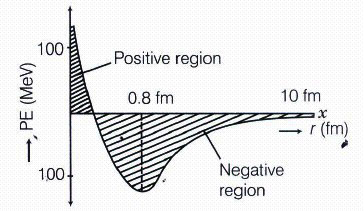
(i) For distance less than 0.8 fm, negative PE decreases to zero and then becomes positive
(ii) for distances larger than 0.8 fm, negative PE goes on decreasing.
7.
\(_{ 6 }{ { C }^{ 11 } }\rightarrow _{ 5 }{ { X }^{ 11 } }+_{ 1 }{ { e }^{ 0 } }(i.e.,\quad { \beta }^{ + })+Q\)
Clearly, \(_{ 5 }{ { X }^{ 11 } }\) is an isobar of \(_{ 6 }{ { C }^{ 11 } }\).
Mass defect, \(\Delta m\) = 11.011434-(11.009305+0.000545)
= 0.001584 u
Q value of reaction \(=0.001584\times 931\ MeV\)
= 1.4747 MeV
8.
According to radioactive decay law.
\(R=-\frac { dN }{ dt } =\frac { -d }{ dt } ({ N }_{ 0 }{ e }^{ -\lambda t })=\lambda { N }_{ 0 }{ e }^{ -\lambda t }\ =\lambda N\).
Rate of decay,
\(R=-\frac { dN }{ dt } =\frac { -d }{ dt } ({ N }_{ 0 }{ e }^{ -\lambda t })=\lambda { N }_{ 0 }{ e }^{ -\lambda t }\ =\lambda N\)
9.
In case of \(_{ 3 }{ { X }^{ 7 } }\),
\(\frac { neutron\quad number }{ proton\quad number } =\frac { 7-3 }{ 3 } =1.33\)
In case of \(_{ 3 }{ { Y }^{ 4 } }\quad \)
\(\frac { neutron\quad number }{ proton\quad number } =\frac { 4-3 }{ 3 } =\frac { 1 }{ 3 } =0.33\)
For stability, this ratio has to be close to one.
Obviously, nucleus \(_{ 3 }{ { X }^{ 7 } }\) is more stable than the nucleus \(_{ 3 }{ { Y }^{ 4 } }\).
10.
\(\frac { { A }_{ 1 } }{ { A }_{ 2 } } ={ \left( \frac { { R }_{ 1 } }{ { R }_{ 2 } } \right) }^{ 2 }={ \left[ { \left( \frac { { A }_{ 1 } }{ { A }_{ 2 } } \right) }^{ { 1 }/{ 3 } } \right] }^{ 2 }={ \left( \frac { { A }_{ 1 } }{ { A }_{ 2 } } \right) }^{ 2/{ 3 } }\)
11.
Fusion of four hydrogen nuclei into helium nucleus.
12.
\({ }_{92} U^{235} \rightarrow_2 H e^4+{ }_{92-2} T h^{235-4}\)
Mass number of Thorium = 235-4 = 231
Charge number of Thorium = 92-2 = 90
13.
Time in which 50% of the sample will get decayed is half life
\(T=\frac{0.693}{\lambda}=0.693 \tau=0.693 T_m\)
14.
Both, alpha and beta radiations are affected by both, electric field and magnetic field.
15.
\(\alpha \text {-particle }\left({ }_2 H e^4\right)\) is more stable, because a nucleus is more stable when value of binding energy per nucleon is larger.
16.
\(B E / \text { nucleon }=\frac{(\Delta m) c^2}{A}\)
17.
This is because density \(=\frac{m a s s}{\text { volume }}\) and volume of nucleus varies directly as its mass number
18.
When two deuterons collide head-on, the distance between their centres, d is given as:
Radius of 1st deuteron + Radius of 2nd deuteron
Radius of a deuteron nucleus = 2 fm = 2 x 10⁻¹⁵ m
∴ d = 2 x 10⁻¹⁵ + 2 x 10−15 = 4 x 10⁻¹⁵ m
Charge on a deuteron nucleus = Charge on an electron = e = 1.6 x 10⁻¹⁹ C
Potential energy of the two-deuteron system:
\(V=\frac{e^{2}}{4 \pi \in_{0} d}\)
Where,
∈0 = Permittivity of free space
\(\frac{1}{4 \pi \in_{0}}=9 \times 10^{9} \mathrm{Nm}^{2} \mathrm{C}^{-2}\)
\(\therefore V=\frac{9 \times 10^{9} \times\left(1.6 \times 10^{-19}\right)^{2}}{4 \times 10^{-15}} J\)
\(=\frac{9 \times 10^{9} \times\left(1.6 \times 10^{-19}\right)^{2}}{4 \times 10^{-15} \times\left(1.6 \times 10^{-19}\right) e V}\)
= 360 keV
Hence, the height of the potential barrier of the two-deuteron system is 360 keV
19.
The given fusion reaction is:
\({ }_{1}^{2} \mathrm{H}+{ }_{1}^{2} \mathrm{H} \rightarrow{ }_{2}^{3} \mathrm{He}+\mathrm{n}+3.27 \mathrm{MeV}\)
Amount of deuterium, m = 2 kg
1 mole, i.e., 2 g of deuterium contains 6.023 x 10²³ atoms.
∴ 2.0 kg of deuterium contains \(=\frac{6.023 \times 10^{23}}{2} \times 2000=6.023 \times 10^{26} \text { atoms }\)
It can be inferred from the given reaction that when two atoms of deuterium fuse, 3.27 MeV energy is released.
∴Total energy per nucleus released in the fusion reaction:
\(E=\frac{3.27}{2} \times 6.023 \times 10^{26} \mathrm{MeV}\)
\(=\frac{3.27}{2} \times 6.023 \times 10^{26} \times 1.6 \times 10^{-19} \times 10^{6}\)
\(=1.576 \times 10^{14} J\)
Power of the electric lamp, P = 100 W = 100 J/s
Hence, the energy consumed by the lamp per second = 100 J
The total time for which the electric lamp will glow is calculated as:
\(\frac{1.576 \times 10^{14}}{100} s\)
\(\frac{1.576 \times 10^{14}}{100 \times 60 \times 60 \times 24 \times 365} \approx 4.9 \times 10^{4} \text { year }\)
20.
The given nuclear reaction is:
\({ }_{1}^{1} H+{ }_{1}^{3} H \rightarrow_{1}^{2} H+{ }_{1}^{2} H\)
It is given that:
Atomic mass \(m\left({ }_{1}^{1} H\right)=1.007825 \mathrm{u}\)
Atomic mass \(m\left({ }_{1}^{3} H\right)=3.016049 \mathrm{u}\)
Atomic mass \(m\left({ }_{1}^{2} H\right)=2.014102 u\)
According to the question, the Q-value of the reaction can be written as:
\(Q=\left[m\left({ }_{1}^{1} H\right)+m\left({ }_{1}^{3} H\right)-2 m\left({ }_{1}^{2} H\right)\right] c^{2}\)
\(=[1.007825+3.016049-2 \times 2.014102] c^{2}\)
\(Q=-0.00433 \times 931.5=-4.0334 \mathrm{MeV}\)
The negativeQ-value of the reaction shows that the reaction is endothermic.
The given nuclear reaction is:
\(\text { (ii) }{ }_{6}^{12} \mathrm{C}+{ }_{6}^{12} \mathrm{C} \rightarrow{ }_{10}^{20} \mathrm{Ne}+{ }_{2}^{4} \mathrm{He}\)
t is given that:
Atomic mass of \(m\left({ }_{6}^{12} C\right)=12.0 u\)
Atomic mass of \(m\left(\begin{array}{l} 20 \\ 10 \end{array}\right)=19.992439\)
Atomic mass of \(m\left({ }_{2}^{4} \mathrm{He}\right)=4.002603 \mathrm{u}\)
The Q-value of this reaction is given as:
\(Q=\left[2 m\left({ }_{6}^{12} C\right)-m\left({ }_{10}^{20} N e\right)-m\left({ }_{2}^{4} H e\right)\right] c^{2}\)
\(=[2 \times 12.0-19.992439-4.002603] c^{2}\)
\(=\left(0.004958 c^{2}\right) u\)
\(=0.004958 \times 931.5=4.618377 \mathrm{MeV}\)
The positive Q-value of the reaction shows that the reaction is exothermic.
21.
Mass of a copper coin, m’ = 3 g
Atomic mass of \({ }_{29} C u^{63}\) atom, m = 62.92960 u
The total number \({ }_{29} C u^{63}\) of atoms in the coin, \(N=\frac{N_{A} \times m \prime}{\text { Mass number }}\)
Where,
NA = Avogadro’s number = 6.023 x 10²³ atoms /g
Mass number = 63 g
\(\therefore N=\frac{6.023 \times 10^{23} \times 3}{63}=2.868 \times 10^{22} \text { atoms } / \mathrm{g}\)
\({ }_{29} C u^{63}\) nucleus has 29 protons and (63 − 29) 34 neutrons
∴Mass defect of this nucleus, Δm' = 29 x mH + 34 x mn − m
Where,
Mass of a proton, mH = 1.007825 u
Mass of a neutron, mn = 1.008665 u
∴Δm' = 29 x 1.007825 + 34 x 1.008665 − 62.9296
= 0.591935 u
Mass defect of all the atoms present in the coin, Δm = 0.591935 x 2.868 x 1022
= 1.69766958 x 10²² u
But 1 u = 931.5 MeV/c2
∴Δm = 1.69766958 x 1022 x 931.5 MeV/c2
Hence, the binding energy of the nuclei of the coin is given as:
Eb= Δmc2
= 1.69766958 x 1022 x 931.5 \(\left(\frac{\mathrm{MeV}}{c^{3}}\right) \times c^{3}\)
= 1.581 x 1025 MeV
But 1 MeV = 1.6 x 10⁻¹³ J
Eb = 1.581 x 1025 x 1.6 x 10−13
= 2.5296 x 10¹² J
This much energy is required to separate all the neutrons and protons from the given coin.
22.
Atomic mass of \(\begin{array}{l} 26 \\ 56 \end{array} \text { Fe }\),m1 = 55.934939 u
\(\begin{array}{l} 26 \\ 56 \end{array} \text { Fe }\) nucleus has 26 protons and (56 − 26) = 30 neutrons
Hence, the mass defect of the nucleus,Δm = 26 x mH + 30 x mn − m1
Where,
Mass of a proton, mH = 1.007825 u
Mass of a neutron, mn = 1.008665 u
∴Δm = 26 x 1.007825 + 30 x 1.008665 − 55.934939
= 26.20345 + 30.25995 − 55.934939
= 0.528461 u
But 1 u = 931.5 MeV/c2
∴Δm = 0.528461 x 931.5 MeV/c2
The binding energy of this nucleus is given as:
Eb1 = Δmc2
Where,
c = Speed of light
∴Eb1 = 0.528461 x 931.5 \(\left(\frac{M e V}{c^{2}}\right) \times c^{2}\)
= 492.26 MeV
Average binding energy per nucleon =\(\frac{492.26}{56}=8.79 \mathrm{MeV}\)
Atomic mass of \(\begin{array}{l} 209 \\ 83 \end{array} \text { Bi }\), m2 = 208.980388 u
\(\begin{array}{l} 209 \\ 83 \end{array} \text { Bi }\) nucleus has 83 protons and (209 − 83) 126 neutrons.
Hence, the mass defect of this nucleus is given as:
Δm' = 83 x mH + 126 x mn − m2
Where,
Mass of a proton, mH = 1.007825 u
Mass of a neutron, mn = 1.008665 u
∴Δm' = 83 x 1.007825 + 126 x 1.008665 − 208.980388
= 83.649475 + 127.091790 − 208.980388
= 1.760877 u
But 1 u = 931.5 MeV/c2
∴Δm' = 1.760877 x 931.5 MeV/c2
Hence, the binding energy of this nucleus is given as:
Eb2 = Δm'c2
= 1.760877 x 931.5 \(\left(\frac{M e V}{c^{2}}\right) \times c^{2}\)
= 1640.26 MeV
Average bindingenergy per nucleon \(=\frac{1640.26}{209}=7.848 \mathrm{MeV}\)
23.
Mass of proton, mp = 1.00783 u
Mass of neutron, mn = 1.00867 u
In \({ }_7^{14} \mathrm{~N} \text {, }\)there are 7 protons and 7 neutrons.
\(\therefore\) Mass defect, \(\Delta\)m = (7mp + 7mn) - mN
\(=7 \times 1.00783+7 \times 1.00867-14.00307\)
= 0.11243 u
Binding energy of nitrogen nucleus
= \(\Delta\)m \(\times\) 931 MeV
= 0.11243 \(\times\) 931MeV = 104.67 MeV
24.
(a) A chemical equation is balanced in the sense that the number of atoms of each element is the same on both sides of the equation. A chemical reaction merely alters the original combinations of atoms. In a nuclear reaction, elements may be transmuted. Thus, the number of atoms of each element is not necessarily conserved in a nuclear reaction. However, the number of protons and the number of neutrons are both separately conserved in a nuclear reaction. [Actually, even this is not strictly true in the realm of very high energies – what is strictly conserved is the total charge and total ‘baryon number’. We need not pursue this matter here.] In nuclear reactions, the number of protons and the number of neutrons are the same on the two sides of the equation.
(b) We know that the binding energy of a nucleus gives a negative contribution to the mass of the nucleus (mass defect). Now, since proton number and neutron number are conserved in a nuclear reaction, the total rest mass of neutrons and protons is the same on either side of a reaction. But the total binding energy of nuclei on the left side need not be the same as that on the right hand side. The difference in these binding energies appears as energy released or absorbed in a nuclear reaction. Since binding energy contributes to mass, we say that the difference in the total mass of nuclei on the two sides get converted into energy or vice-versa. It is in these sense that a nuclear reaction is an example of massenergy interconversion.
(c) From the point of view of mass-energy interconversion, a chemical reaction is similar to a nuclear reaction in principle. The energy released or absorbed in a chemical reaction can be traced to the difference in chemical (not nuclear) binding energies of atoms and molecules on the two sides of a reaction. Since, strictly speaking, chemical binding energy also gives a negative contribution (mass defect) to the total mass of an atom or molecule, we can equally well say that the difference in the total mass of atoms or molecules, on the two sides of the chemical reaction gets converted into energy or vice-versa. However, the mass defects involved in a chemical reaction are almost a million times smaller than those in a nuclear reaction.This is the reason for the general impression, (which is incorrect ) that mass-energy interconversion does not take place in a chemical reaction.
25.
\(In\ _{ 83 }{ { Bi }^{ 209 } }, \) number of protons = 83
number of neutrons = 209 - 83 = 126
Mass defect,
\(\Delta m=83\times { m }_{ p }+126\times { m }_{ n }-M(Bi)\)
\(=83\times 1.007825+126\times 1.008665-208.980388\)
\(=83.649475\times 127.091790-208.980388\)
\(=1.760877\ amu\)
\( B.E/nucleon=\frac { 1.760877\times 931 }{ 209 }\)
\( =7.85\ MeV/N\)
26.
\(In\ a\ nucleus\ _{ 20 }{ Ca^{ 40 } },\) number of protons = 20, number of neutrons = 40 - 20 = 20
Total mass of 20 protons and 20 neutrons \(=20{ m }_{ p }+20{ m }_{ n }=({ m }_{ p }+{ m }_{ n })\)
\( =20(1.007825+1.008665)=40.3298\ u\)
Mass defect, \( \Delta m=40.3298-39.962589\)
\( =0.367211 \ u\)
\(Total \ B.E.=0.367211\times 931\ MeV\)
\(=341.873441\ MeV\)
\( B.E./nucleon=\frac { 341.873441 }{ 40 } =8.547MeV/N\)
27.
\(In \ _{ 17 }{ { Cl }^{ 35 } }, \ no.of \ protons=17;\)
no. of neutrons = 35 - 17 = 18
\( \therefore \ Mass\ defect=17{ m }_{ p }+18{ m }_{ n }-{ M }_{ Cl }\)
\( =17\times 1.007825+18\times 1.008665-34.980000\)
\( =17.133025+18.155970-34.980000\)
\(=0.308995\ u\)
\( B.E/nucleon=\frac { 0.308995\times 931 }{ 35 } =8.22MeV/N\)
28.
\(In \ _{ 26 }{ { Fe }^{ 56 } },\ no.of \ protons \ 26;\)
no. of neutrons = 56 - 26 = 30
\( \therefore \ Mass\ defect=26{ m }_{ p }+30{ m }_{ n }-{ M }_{ Fe }\)
\(=26\times 1.007825+30\times 1.008665-55.934939\)
\( =26.20345+30.25995-55.934939\)
\( =0.528461\ u\)
\( B.E/nucleon=\frac { 0.528461\times 931 }{ 56 } =8.79MeV/N\)
29.
We have the expression for nuclear radius as:
R = R0A1/3
Where,
R0 = Constant.
A = Mass number of the nucleus
Nuclear matter density, \(\rho \ =\frac{Mass\ of\ the\ nucles}{Volume\ of\ the\ nucles}\)
Let m be the average mass of the nucleus.
Hence, mass of the nucleus = mA
\(\therefore \rho=m \frac{A}{\frac{4}{3} \pi R^{3}}=\frac{3 \mathrm{~mA}}{4 \pi\left(R_{0} A^{\frac{1}{3}}\right)^{3}}=\frac{3 m A}{4 \pi R_{0}^{3} A}=\frac{3 \mathrm{~m}}{4 \pi R_{0}^{3}}\)
Hence, the nuclear matter density is independent of A. It is nearly constant.
30.
1u = 1.6605 x 10⁻²⁷ kg
To convert it into energy units, we multiply it by c2 and find that energy equivalent = \(1.6605 \times 10^{-27} \times\left(2.9979 \times 10^{8}\right)^{2} \mathrm{~kg} \mathrm{~m}^{2} / \mathrm{s}^{2}\)
\(=1.4924 \times 10^{-10} \mathrm{~J}\)
\(=\frac{1.4924 \times 10^{-10}}{1.602 \times 10^{-19}} \mathrm{eV}\)
\(=0.9315 \times 10^{9} \mathrm{eV}\)
\(=931.5 \mathrm{MeV}\)
or, \(1 \mathrm{u}=931.5 \mathrm{MeV} / \mathrm{c}^{2}\)
For, \({ }_{8}^{16} \mathrm{O}, \quad \Delta M=0.13691 \mathrm{u}=0.13691 \times 931.5 \mathrm{MeV} / \mathrm{c}^{2}\)
\(=127.5 \mathrm{MeV} / \mathrm{c}^{2}\)
The energy needed to separate \({ }_{8}^{16} \mathrm{O}\) into its constituents is thus 127.5 MeV/c2.

12th Standard CBSE Syllabus & Materials
12th Standard CBSE
CBSE 12th Computer Science Python Revision Tour I - New Previous year Question Papers Study Material - QB365 Set A
NEW12th Standard CBSE
CBSE 12th Business Studies Planning Important Questions And Answers Study Material - QB365 Set A
NEW12th Standard CBSE
CBSE 12th Business Studies Business Environment Important Questions And Answers Study Material - QB365 Set A
NEW12th Standard CBSE
CBSE 12th Business Studies Principles of Management Important Questions And Answers Study Material - QB365 Set A



NCERT Books

Syllabus

Exam Pattern

Sample Question Papers

Previous year Question Papers

Important Notes

MCQ Practice test

NCERT Exemplers

Case study Questions

Image Based Questions

Passage based Questions

HOT Questions

Value Based Questions

Model Questions Papers
NCERT ( Book Back ) Questions

Assertion and Reason
Important Questions And Answers

CBSE 12th Standard CBSE Subjects
CBSE Standards