 100% FREE ACCESS
12th Standard CBSE Syllabus & Materials
12th Standard CBSE
CBSE 12th Economics Government Budget and the Economy Previous year Question Papers Study Material - QB365 Set A
NEW12th Standard CBSE
CBSE 12th Computer Science Interface Python with MySQL - New Previous year Question Papers Study Material - QB365 Set A
NEW12th Standard CBSE
CBSE 12th Computer Science Database Concept - New Previous year Question Papers Study Material - QB365 Set A
NEW12th Standard CBSE
CBSE 12th Computer Science Data Communication - New Previous year Question Papers Study Material - QB365 Set A
NEW12th Standard CBSE
CBSE 12th Computer Science Data Structures - New Previous year Question Papers Study Material - QB365 Set A
NEW12th Standard CBSE
CBSE 12th Computer Science Functions - New Previous year Question Papers Study Material - QB365 Set A

Published on: 24/05/2021
QB365 Provides the updated NCERT Examplar Questions for Class 12 Maths, and also provide the detail solution for each and every ncert examplar questions , QB365 will give all kind of study materials will help to get more marks
Download CBSE Class 12th Standard CBSE Maths question papers, sample papers, important questions, and previous year solved papers in PDF format. Get free study materials, NCERT solutions, and exam preparation resources for Class 12th Standard CBSE Maths
Questions + Answers key
Take MCQ Maths Test1.
Show that the lines \(\frac { x-1 }{ 2 } =\frac { y-2 }{ 3 } =\frac { z-3 }{ 4 } \) and \(\frac { x-4 }{ 5 } =\frac { y-1 }{ 2 } =z\) intersect Also, find the point of intersection.
2.
(a) Find the image of the point (1,6,3) in the line \(\frac { x }{ 1 } =\frac { y-1 }{ 2 } =\frac { z-2 }{ 3 } .\)
(b) Also write the equation of the line joining the: given point and its image and find the length of the: segment joining the given point and its image
3.
If a variable line in two adjacent positions has direction cosines l,m,n,\(l+\delta l,m+\delta m,n+\delta n\) and show that the small angle \(\delta \theta \) between two positions is given by \({ (\delta \theta ) }^{ 2 }={ (\delta l) }^{ 2 }+(\delta m)^{ 2 }+{ (\delta n) }^{ 2 }\).
4.
Show that the equation of a plane which meets the axes in A,B and C and the given centroid of triangle ABC is the point \((\alpha ,\beta ,\gamma )\) is \(\frac { x }{ \alpha } +\frac { y }{ \beta } +\frac { z }{ \gamma } =3\)
1.
If lines intersect then \(\left(\vec{a}_{2}-\overrightarrow{a_{1}}\right) \cdot\left(\vec{b}_{1} \times \overrightarrow{b_{2}}\right)=0\)
\(\text { i.e. }\left|\begin{array}{ccc} 4-1 & 1-2 & 0-3 \\ 2 & 3 & 4 \\ 5 & 2 & 1 \end{array}\right|=0 \)
\(\Rightarrow 3(3-8)+1(2-20)-3(4-15)=0 \)
\(\Rightarrow-15-18+33=0, \text { true }\)
Hence, the lines intersect
For point of intersection, take general points on the two
\(\text {lines as }(2 \lambda+1,3 \lambda+2,4 \lambda+3)\text { and }(5 \mu+4,2 \mu+1, \mu)\)
If lines intersect then for same values \(\lambda \text { and } \mu \text {. }\)
\(2 \lambda+1=5 \mu+4 \Rightarrow 2 \lambda-5 \mu=3 \)
\(3 \lambda+2=2 \mu+1 \Rightarrow 3 \lambda-2 \mu=-1 \)
\(4 \lambda+3=\mu \Rightarrow 4 \lambda-\mu=-3\)
Solving \((i i) \text { and (iii) for } \lambda, \mu \text {, we get }\)
\(\lambda=-1, \mu=-1\)
Substituting in (iv), we get -4+1 = -3 true
Hence, for \(\lambda=-1, \mu=-1 \) the lines intersect.
Substituting in \( (i) \text {, for } \lambda=-1 \text {, }\)
Point of intersection is \( (-2+1,-3+2,-4+3) \text {, i.e }(-1,-1,-1) \)
2.
(a) Let P be the given point (1, 6, 3) and M, the foot of perpendicular from P on the given line AB
\(i.e.\quad \frac { x }{ 1 } =\frac { y-1 }{ 2 } =\frac { z-2 }{ 3 } (=k(say))\)
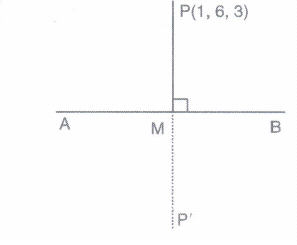
Any point on the given line is:
(k , 1+ 2k , 2 + 3k).
For some value of k, let the point be M.
:. Direction-ratios of PM are:
< k - 1 , 1 + 2k - 6, 2 + 3k - 3 >
i.e. < k - 1, 2k - 5, 3k - 1 > .
Since \(PM\bot AB\) ,
:. (1) (k-l) + (2) (2k- 5) + (3) (3k-l) = 0
\(\Rightarrow\)k - 1 + 4k - 10 + 9k - 3 = 0
\(\Rightarrow\) 14k = 14 \(\Rightarrow\) k = 1.
:. Foot of perpendicular Mis (1,1+2,2+3) i.e. (1,3,5).
Let \(P'(\alpha ,\beta ,\gamma )\) be the image of P in the given line.
Then M is the mid-point of [PP']
\(\frac { \alpha +1 }{ 2 } =1\frac { \beta +6 }{ 2 } =3,\frac { \gamma +3 }{ 2 } =5\)
\(\alpha +1=2,\beta +6=6,\gamma +3=10\)
\(\Rightarrow \alpha =1,\beta =0,\gamma =7\)
Hence the reqd image is(1,0,7).
(b) (i) The equations of PP' are:
\(\frac { x-1 }{ 1-1 } =\frac { y-6 }{ 0-6 } =\frac { z-3 }{ 7-3 } \)
\(i.e.\quad \frac { x-1 }{ 0 } =\frac { y-6 }{ -6 } =\frac { z-3 }{ 4 } \)
\(\Rightarrow \frac { x-1 }{ 1-1 } =\frac { y-6 }{ -3 } =\frac { z-3 }{ 2 } \)
(ii) Length od segment [PP']
\(\sqrt { { \left( 1-1 \right) }^{ 2 }+{ \left( 0-6 \right) }^{ 2 }+{ \left( 7-3 \right) }^{ 2 } } \)
\(=\sqrt { 0+36+16 } =\sqrt { 52 } =2\sqrt { 13 } units.\)
3.
Since \(l, m, n \text { and } l+\delta l, m+\delta m, n+\delta n\) are direction cosines of a variable line in two different positions,therefore,
\(l^{2}+m^{2}+n^{2}=1\)
\(\text { and }(l+\delta l)^{2}+(m+\delta m)^{2}+(n+\delta n)^{2}=1\)
\(\text { Now, }(l+\delta l)^{2}+(m+\delta m)^{2}+(n+\delta n)^{2}=1\)
\(\Rightarrow\left(l^{2}+m^{2}+n^{2}\right)+2(l \cdot \delta l+m \cdot \delta m+n \cdot \delta n) \)
\(+(\delta l)^{2}+(\delta m)^{2}+(\delta n)^{2}=1[\text { from }(i i)] \)
\(\Rightarrow 1+2(l \delta l+m \delta m+n \delta n)+(\delta l)^{2} \)
\(+(\delta m)^{2}+(\delta n)^{2}=1[\text { using }(i)] \)
\(\Rightarrow 2(l \delta l+m \delta m+n \delta n)=-\left[(\delta l)^{2}+(\delta m)^{2}+(\delta n)^{2}\right] \)
\(\Rightarrow(l \delta l+m \delta m+n \delta n)=-\frac{1}{2}\left[(\delta l)^{2}+(\delta m)^{2}+(\delta n)^{2}\right]
\)
\(\text { Also } \cos (\delta \theta)=l(l+\delta l)+m(m+\delta m)+n(n+\delta) \)
\(=\left(l^{2}+m^{2}+n^{2}\right)+(l \delta l+m \delta m+n \delta n)
\)
\(=1-\frac{1}{2}\left[(\delta l)^{2}+(\delta m)^{2}+(\delta n)^{2}\right] \quad[\text { using }(i) \text { and (iii)] }\)
\(\Rightarrow 2(1-\cos \delta \theta)=(\delta I)^{2}+(\delta m)^{2}+(\delta n)^{2}\)
\(\Rightarrow 2 \times 2 \sin ^{2} \frac{\delta \theta}{2}=(\delta l)^{2}+(\delta m)^{2}+(\delta n)^{2}\)
\(\left[\because 1-\cos 2 \theta=2 \sin ^{2} \theta\right]\)
\(\Rightarrow 4\left[\frac{\delta \theta}{2}\right]^{2}=(\delta l)^{2}+(\delta m)^{2}+(\delta n)^{2}\)
\(\text { [if } \theta \text { is small, then } \sin \theta \rightarrow \theta]\)
\(\Rightarrow(\delta \theta)^{2}=(\delta l)^{2}+(\delta m)^{2}+(\delta n)^{2}
\)
which is true.
4.
Substitute in (i) we get \(\frac { x }{ 3\alpha } +\frac { y }{ 3\beta } +\frac { z }{ 3\gamma } =1\Rightarrow \frac { x }{ \alpha } +\frac { y }{ \beta } +\frac { z }{ \gamma } =3\)

12th Standard CBSE Syllabus & Materials
12th Standard CBSE
CBSE 12th Computer Science Python Revision Tour I - New Previous year Question Papers Study Material - QB365 Set A
NEW12th Standard CBSE
CBSE 12th Business Studies Planning Important Questions And Answers Study Material - QB365 Set A
NEW12th Standard CBSE
CBSE 12th Business Studies Business Environment Important Questions And Answers Study Material - QB365 Set A
NEW12th Standard CBSE
CBSE 12th Business Studies Principles of Management Important Questions And Answers Study Material - QB365 Set A



NCERT Books

Syllabus

Exam Pattern

Sample Question Papers

Previous year Question Papers

Important Notes

MCQ Practice test

NCERT Exemplers

Case study Questions

Image Based Questions

Passage based Questions

HOT Questions

Value Based Questions

Model Questions Papers
NCERT ( Book Back ) Questions

Assertion and Reason
Important Questions And Answers

CBSE 12th Standard CBSE Subjects
CBSE Standards