
 100% FREE ACCESS
12th Standard CBSE Syllabus & Materials
12th Standard CBSE
CBSE 12th Economics Government Budget and the Economy Previous year Question Papers Study Material - QB365 Set A
NEW12th Standard CBSE
CBSE 12th Computer Science Interface Python with MySQL - New Previous year Question Papers Study Material - QB365 Set A
NEW12th Standard CBSE
CBSE 12th Computer Science Database Concept - New Previous year Question Papers Study Material - QB365 Set A
NEW12th Standard CBSE
CBSE 12th Computer Science Data Communication - New Previous year Question Papers Study Material - QB365 Set A
NEW12th Standard CBSE
CBSE 12th Computer Science Data Structures - New Previous year Question Papers Study Material - QB365 Set A
NEW12th Standard CBSE
CBSE 12th Computer Science Functions - New Previous year Question Papers Study Material - QB365 Set A

Published on: 24/05/2021
QB365 Provides the updated NCERT Exemplar Questions for Class 12, and also provide the detail solution for each and every case study questions. NCERT Exemplar questions are latest updated question pattern from NCERT, QB365 will helps to get more marks in Exams
Download CBSE Class 12th Standard CBSE Physics question papers, sample papers, important questions, and previous year solved papers in PDF format. Get free study materials, NCERT solutions, and exam preparation resources for Class 12th Standard CBSE Physics
Questions + Answers key
Take MCQ Physics Test1.
The deuteron id bound by nuclear forces just as H-atom is made up of p and e bound by electrostatic forces. If we consider the force between neutron and proton in deuteron as given in the form a coulomb potential but with an effective charge' F=\(\frac { 1 }{ { 4\pi \varepsilon }_{ 0 } } .\frac { { e }^{ '2 } }{ r } .\) Estimate the value of (e' /e) given that the binding energy of a deuteron is 2.2MeV.
2.
Consider a radioactive nucleus A which decays to a stable nucleus C through the following sequence:
A \(\longrightarrow \) B \(\longrightarrow \) C
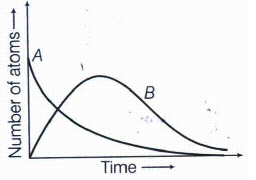
where, B is an intermediate nuclei, which is also radioactive. Considering that there are N0 atoms of A initially, plot the graph showing the variation of number of atoms of A and B versus time.
3.
(i) The radius of the innermost electron orbit of a hydrogen atom is \({ r }_{ 1 }=5.3\times 10^{ -11 }\) Calculate its radius in n=2 orbit.
(ii) The total energy of an electron in the second excited state of the hydrogen atom is -1.51eV. Find out its
(a) kinetic energy and
(b) potential energy in this state
1.
The binding energy is H-atom,
\(E=\frac { { me }^{ 4 } }{ { \pi \varepsilon }_{ 0 }^{ 2 }{ h }^{ 2 } } =13.6 \ eV\quad ........(i)\)
If proton and neutron had charge e' each and were governed by the same electrostatic force, then in the above equation we would need to replace electronic mass m by the reduced mass m' of proton-neutron and the electronic charge e by e' .
\({ m }^{ ' }=\frac { M\times N }{ M+N } =\frac { M }{ 2 } \)
\( =\frac { 1836 \ m }{ 2 } =918 \ m\)
Here, M represents mass of a neutron/proton.
\(\therefore\) Binding energy \(=\frac { 918m{ \left( { e }^{ ' } \right) }^{ 4 } }{ { 8\varepsilon }_{ 0 }^{ 2 }{ h }^{ 2 } } =2.2\) MeV
Dividing Eqs. (ii) and (i), we get
\(918{ \left( \frac { { e }^{ ' } }{ e } \right) }^{ 4 }=\frac { 2.2 \ MeV }{ 13.6 \ eV }\)
\(=\frac { 2.2\times { 10 }^{ 6 } }{ 13.6 } \)
\( { \left( \frac { { e }^{ ' } }{ e } \right) }^{ 4 }=\frac { 2.2\times { 10 }^{ 6 } }{ 13.6\times 918 } =176.21\)
\( \left( \frac { { e }^{ ' } }{ e } \right) ={ \left( 176.21 \right) }^{ 1/4 }\)
\( =3.64\)
2.
By considering the situation given in the question,
At t = 0, NA = N0 (maximum), while NB = 0. As time increases, NA decreases exponentially and the number of atoms of B increases. They become (NB) maximum and finally drop to zero exponentially by radioactive decay law. So, graph showing the variation of number of atoms of A and B will be shown as below:
3.
Given, Bohr's radius, \({ r }_{ 1 }=5.3\times 10^{ -11 }\)
We know that, \({ r }_{ n }=n^{ 2 }{ r }_{ 1 }\)
Let be radius of the orbit for n = 2
Therefore, \(r_{ 2 }=(2)^{ 2 }\times 5.3\times 10^{ -11 }\quad =2.12\times 10^{ -10 }m\)
(ii) Given, total energy of an electron in second excited state,
E = 1.51 eV
(a) Kinetic energy of electron is equal to negative of the total energy
\(\Rightarrow \) K = -E = -(-1.51) = 1.51 eV
(b) Potential energy of electron is equal to negative of twice of its kinetic energy
\(\Rightarrow \) U = -2K = -2 x 1.51 = -3.02 eV

12th Standard CBSE Syllabus & Materials
12th Standard CBSE
CBSE 12th Computer Science Python Revision Tour I - New Previous year Question Papers Study Material - QB365 Set A
NEW12th Standard CBSE
CBSE 12th Business Studies Planning Important Questions And Answers Study Material - QB365 Set A
NEW12th Standard CBSE
CBSE 12th Business Studies Business Environment Important Questions And Answers Study Material - QB365 Set A
NEW12th Standard CBSE
CBSE 12th Business Studies Principles of Management Important Questions And Answers Study Material - QB365 Set A



NCERT Books

Syllabus

Exam Pattern

Sample Question Papers

Previous year Question Papers

Important Notes

MCQ Practice test

NCERT Exemplers

Case study Questions

Image Based Questions

Passage based Questions

HOT Questions

Value Based Questions

Model Questions Papers
NCERT ( Book Back ) Questions

Assertion and Reason
Important Questions And Answers

CBSE 12th Standard CBSE Subjects
CBSE Standards