
 100% FREE ACCESS
12th Standard CBSE Syllabus & Materials
12th Standard CBSE
CBSE 12th Economics Government Budget and the Economy Previous year Question Papers Study Material - QB365 Set A
NEW12th Standard CBSE
CBSE 12th Computer Science Interface Python with MySQL - New Previous year Question Papers Study Material - QB365 Set A
NEW12th Standard CBSE
CBSE 12th Computer Science Database Concept - New Previous year Question Papers Study Material - QB365 Set A
NEW12th Standard CBSE
CBSE 12th Computer Science Data Communication - New Previous year Question Papers Study Material - QB365 Set A
NEW12th Standard CBSE
CBSE 12th Computer Science Data Structures - New Previous year Question Papers Study Material - QB365 Set A
NEW12th Standard CBSE
CBSE 12th Computer Science Functions - New Previous year Question Papers Study Material - QB365 Set A

Published on: 24/05/2021
QB365 Provides the updated NCERT Exemplar Questions for Class 12, and also provide the detail solution for each and every case study questions. NCERT Exemplar questions are latest updated question pattern from NCERT, QB365 will helps to get more marks in Exams
Download CBSE Class 12th Standard CBSE Physics question papers, sample papers, important questions, and previous year solved papers in PDF format. Get free study materials, NCERT solutions, and exam preparation resources for Class 12th Standard CBSE Physics
Questions + Answers key
Take MCQ Physics Test1.
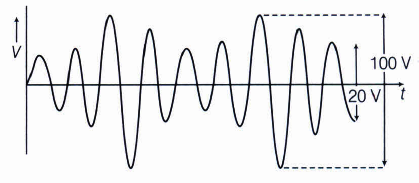
An amplitude modulated wave is as shown in the figure.Calculate
(i) the percentage modulation
(ii) peak carrier voltage and
(iii) peak value of information voltage.
2.
(i) Draw the plot of amplitude versus for an amplitude modulated wave whose carrier wave(\({ \omega }_{ c }\) ) is carrying two modulating signals, \({ \omega }_{ 1 }\) and\({ \omega }_{ 2 }\)
(ii) Is the plot symmetrical about \({ \omega }_{ c }\)?Comment especially about plot in region \(\omega <\omega _{ c }\)
(iii) Extrapolate and predict the problems, one can expect if more waves are to be modulated
(iv) Suggest solution to the above problem. In the process can one understand another advantage of modulation in terms of bandwidth?
3.
An audio signal is modulated by a carrier wave of 20 MHz such that the bandwidth required for modulation is 3kHz.Could this wave be demodulated by a diode detector which has the values of R and C as
(i) R=\(1k\Omega ,C=0.01\mu F\)
(ii) R=\(10k\Omega ,C=0.01\mu F\)
(iii) R=\(10k\Omega ,C=1\mu F\)
4.
Consider an optical communication system operating at = 800nm. Suppose only 1% of optical source frequency is the available channel bandwidth for optical communication. How many channels can be accommodated for transmitting
(i) audio signals requiring a bandwidth of 8kHz?
(ii) video TV signals requiring an approximate bandwidth of 4.5MHz? Support your answer with suitable calculations.
5.
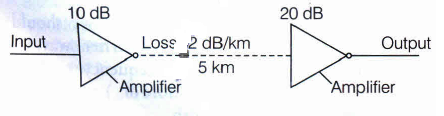
Figure shows a communication system. Which is the output power when input signal is 1.01 mW? (Gain in dB=\(10\log { _{ 10 }\frac { { P }_{ 0 } }{ { P }_{ 1 } } } \))
1.
Maximum voltage, Vmax = \(\frac { 100 }{ 2 } \)= 50 V
Minimum voltage, Vmin = \(\frac { 20 }{ 2 } \)= 10 V
(i) Percentage modulation,
\(\mu =\frac { { V }_{ max }-{ V }_{ min } }{ { V }_{ max }{ +V }_{ min } }\times100\)
\(=\frac { 50-10 }{ 50+10 } \times100=\frac { 40 }{ 60 } \times100=66.67%\)
(ii) Peak carrier voltage,
\({ V }_{ c }=\frac { { V }_{ max }+{ V }_{ min } }{ 2 } =\frac { 50+10 }{ 2 } =30\ V\)
(iii) Peak value of information voltage,
\({ V }_{ m }=\mu { V }_{ c }=\frac { 66.67 }{ 100 } \times 30=20 \ V\)
2.
(i) The plot of amplitude versus can be shown in the figure below.
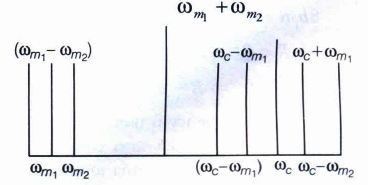
(ii) From figure, we note that frequency spectrum is not symmetric about \({ \omega }_{ c }\) .Crowding of spectrum is present for \(\omega <\omega _{ c }\)
(iii) If more waves are to be modulated, then there will be more crowding in the modulating signal in the region.\(\omega <\omega _{ c }\)That will result more chances of mixing of signals
(iv) To accommodate more signals, we should increase bandwidth and frequency carries waves \({ \omega }_{ c }\). This shows that large carrier frequency enables to carry more information(i.e.more \(\omega _{ m }\))and the same will in turn increase bandwidth.
3.
Give ,carrier wave frequency
\({ f }_{ c }=20MHz=20\times { 10 }^{ 6 }Hz\)
Bandwidth required for modulation is
\({ 2f }_{ m }=3kHz=3\times { 10 }^{ 3 }Hz\)
\(\Rightarrow \ \ { f }_{ m }=\frac { 3\times { 10 }^{ 3 } }{ 2 } =1.5\times { 10 }^{ 3 }Hz\) s
Demodulation by a diode is possible,if the condition
Thus,\(\frac { 1 }{ { f }_{ c } } =\frac { 1 }{ 20\times { 10 }^{ 6 }Hz } =0.5\times { 10 }^{ -7 }s\) .....(i)
and \(\frac { 1 }{ { f }_{ m } } =\frac { 1 }{ 1.5\times { 10 }^{ 3 }Hz } =0.7\times { 10 }^{ -3 }s\) ......(ii)
Now,gain through all the option of R and C one by one,we get
(i) \(RC=1k\Omega \times 0.01\mu F\)
\(\\ ={ 10 }^{ 3 }\Omega \times ({ 0.01 }\times { 10 }^{ -6 }F)={ 10 }^{ -5 }s\)
Here, condition \(\frac { 1 }{ { f }_{ c } } <\) is satisfied
Hence, it can be demodulated.
(ii) \((RC=1k\Omega \times 0.01\mu F={ 10 }^{ 4 }\Omega \times { 10 }^{ -8 }F={ 10 }^{ -4 }s)\)
Here, condition\(\frac { 1 }{ { f }_{ c } }\) <
Hence, it can be demodulated
(iii) \(RC=10k\Omega \times 1\mu F={ 10 }^{ 4 }\Omega \times { 10 }^{ -6 }F={ 10 }^{ -2 }s\)
Here, condition\(\frac { 1 }{ { f }_{ c } } >RC,\) so this cannot be demodulated.
4.
Given \(\lambda =800nm,c=3\times { 10 }^{ 8 }\quad m/s\)
Source frequency, \(v=\frac { c }{ \lambda } =\frac { 3\times { 10 }^{ 8 } }{ 8\times { 10 }^{ -7 } } =3.75\times { 10 }^{ 14\quad }Hz\)
Now, total bandwidth of a channel
=1% of optical source frequency
=\(\frac { 1 }{ 100 } \times 3.75\times { 10 }^{ 14 }=3.75\times { 10 }^{ 12 }Hz\)
Number of channels
=\(\frac { Total \ bandwidth \ of \ channel }{ Bandwidth \ needed \ per \ channel }\)
(i) Number of channels for bandwidth of 8kHz
\(=\frac { 3.75\times { 10 }^{ 12 } }{ 8\times { 10 }^{ 3 } } =4.7\times { 10 }^{ 8 }\)
(ii) Number of channels for video bandwidth of 4.5 MHz
\(=\frac { 3.75\times { 10 }^{ 12 } }{ 4.5\times { 10 }^{ 6 } } =8.3\times { 10 }^{ 5 }\)
5.
The distance travelled by the signal is 5km. Loss suffered in path of transmission = 2dB/km
So, total loss suffered in 5 km = \(-2\times 5=-10dB\)
Total amplifier gain = 10dB + 20dB = 30dB
Overall gain in signal = 30 - 10 = 30dB
According to the question, gain in dB = \(10{ log }_{ 10 }\frac { { P }_{ 0 } }{ { P }_{ 1 } } \)
\(\because \ 20=10{ log }_{ 10 }\frac { { P }_{ 0 } }{ P_{ i } } or\quad { log }_{ 10 }\frac { { P }_{ 0 } }{ P_{ i } } =2\)
Where\({ P }_{ i }=1.01mW\ and\ { P }_{ 0 }\) is the output power.
\(\because \ \frac { { P }_{ 0 } }{ { P }_{ i } } ={ 10 }^{ 2 }=100\)
\(\\ \Rightarrow { P }_{ 0 }={ p }_{ i }\times 100=1.01\times 100\ or\ { p }_{ 0 }=101mW\)
Thus the output is 101 mW.

12th Standard CBSE Syllabus & Materials
12th Standard CBSE
CBSE 12th Computer Science Python Revision Tour I - New Previous year Question Papers Study Material - QB365 Set A
NEW12th Standard CBSE
CBSE 12th Business Studies Planning Important Questions And Answers Study Material - QB365 Set A
NEW12th Standard CBSE
CBSE 12th Business Studies Business Environment Important Questions And Answers Study Material - QB365 Set A
NEW12th Standard CBSE
CBSE 12th Business Studies Principles of Management Important Questions And Answers Study Material - QB365 Set A



NCERT Books

Syllabus

Exam Pattern

Sample Question Papers

Previous year Question Papers

Important Notes

MCQ Practice test

NCERT Exemplers

Case study Questions

Image Based Questions

Passage based Questions

HOT Questions

Value Based Questions

Model Questions Papers
NCERT ( Book Back ) Questions

Assertion and Reason
Important Questions And Answers

CBSE 12th Standard CBSE Subjects
CBSE Standards