 100% FREE ACCESS
12th Standard CBSE Syllabus & Materials
12th Standard CBSE
CBSE 12th Economics Government Budget and the Economy Previous year Question Papers Study Material - QB365 Set A
NEW12th Standard CBSE
CBSE 12th Computer Science Interface Python with MySQL - New Previous year Question Papers Study Material - QB365 Set A
NEW12th Standard CBSE
CBSE 12th Computer Science Database Concept - New Previous year Question Papers Study Material - QB365 Set A
NEW12th Standard CBSE
CBSE 12th Computer Science Data Communication - New Previous year Question Papers Study Material - QB365 Set A
NEW12th Standard CBSE
CBSE 12th Computer Science Data Structures - New Previous year Question Papers Study Material - QB365 Set A
NEW12th Standard CBSE
CBSE 12th Computer Science Functions - New Previous year Question Papers Study Material - QB365 Set A

Published on: 24/05/2021
QB365 Provides the updated NCERT Exemplar Questions for Class 12, and also provide the detail solution for each and every case study questions. NCERT Exemplar questions are latest updated question pattern from NCERT, QB365 will helps to get more marks in Exams
Download CBSE Class 12th Standard CBSE Physics question papers, sample papers, important questions, and previous year solved papers in PDF format. Get free study materials, NCERT solutions, and exam preparation resources for Class 12th Standard CBSE Physics
Questions + Answers key
Take MCQ Physics Test1.
In an experiment with two coherent sources, the amplitude of the intensity variation is found to be 5% of the average intensity. What will be the relative intensities of the light waves of interfering source.
2.
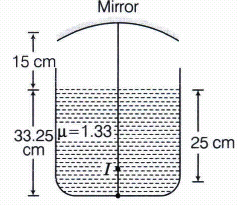
A container is filled with water (\(\mu \) = 1.33) upto a height of 33.25 cm. A concave mirror is placed 15 cm above the water level and the image of an object placed at the bottom is formed 25 cm below the water level. What will be the focal length?
3.
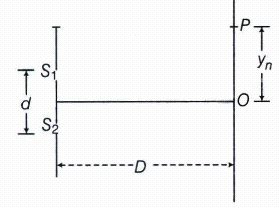
The intensity at the central maxima (O) in a Young's double experiment is \(I^o\). If the distance OP equals one-third of fringe width of the pattern, show that the intensity at point P would be I0 / 4
4.
A person with a normal near point (25 cm) using a compound microscope with objective of focal length 8.0 mm and an eyepiece of focal length 2.5 cm can bring an object placed at 9.0 mm from the objective in sharp focus.What is the separation between the two lenses?Calculate the magnifying power of the microscope.
1.
As we know that, \(I={ I }_{ av }\pm 0.05{ I }_{ av }\)
\(\Rightarrow \) \({ I }_{ max }={ I }_{ av }\left( 1+0.05 \right) =1.05{ I }_{ av }\)
\({ I }_{ min }={ I }_{ av }\left( 1-0.05 \right) =0.95{ I }_{ av }\)
Dividing Eqs. (i) and (ii), we get
\(\Rightarrow \) \(\frac { { I }_{ max } }{ { I }_{ min } } =\frac { 1.05 }{ 0.95 } \)
\(\Rightarrow \) \(\left( \frac { r+1 }{ r-1 } \right) ^{ 2 }=\frac { 105 }{ 95 } \)
\(\Rightarrow \) \({ r }^{ 2 }+1+2r)95=105({ r }^{ 2 }+1-2r)\)
\(\Rightarrow \) \({ 10r }^{ 2 }-400r+10=0\Rightarrow r=40\)
\(\frac { { I }_{ 1 } }{ { I }_{ 2 } } ={ r }^{ 2 }=({ 40) }^{ 2 }=1600:1\)
2.
-18.3 cm
3.
Intensity can be found out, if we know the phase difference. Phase difference can be calculated with the help of path difference. So first of all, path difference will be calculated.
Given, \(OP={ y }_{ n }\)
The distance OP equals one-third of frings width of the pattern.
i.e \({ y }_{ n }=\frac { \beta }{ 3 } =\frac { 1 }{ 3 } \left( \frac { D\lambda }{ d } \right) =\frac { D\lambda }{ 3d } \)
\(\Rightarrow \ \frac { { dy }_{ n } }{ D } =\frac { \lambda }{ 3 } \)
Path difference=\({ S }_{ 2 }P-{ S }_{ 1 }P=\frac { { dy }_{ n } }{ D } =\frac { \lambda }{ 3 } \)
\(\therefore \) Phase difference, \(\phi =\frac { 2\pi }{ \lambda } \times \)path difference
\(\frac { 2\pi }{ \lambda } \times \frac { \lambda }{ 3 } =\frac { 2\pi }{ 3 } \)
If intensuty at central frings is \(I^o\), then intensity at a point P, where phase difference \(\phi \) is given by
\(I=I^o\)\({ cos }^{ 2 }\phi \)
\(I=I^o\)\({ \left( cos\frac { 2\pi }{ 3 } \right) }^{ 2 }\)
= \(I^o\)\({ \left( -cos\frac { \pi }{ 3 } \right) }^{ 2 }\)=\(I^o\)\({ \left( -\frac { 1 }{ 2 } \right) }^{ 2 }\)=\(\quad \frac { { I }_{ \circ } }{ 4 } \)
Hence, the intensity at point p would be \( \frac { { I }_{ \circ } }{ 4 } \).
4.
Given, focal length of objective, f0 = 8mm = 0.8 cm
Focal length of eyepiece, fe = 2.5 cm
Distance of object from objective, u0 = - 9 mm = - 0.9 cm
Distance of image from eyepiece, ve = - D = - 25 cm
Using lens formula for eyepiece, \(\frac { 1 }{ { v }_{ e } } -\frac { 1 }{ { u }_{ e } } =\frac { 1 }{ { f }_{ e } } \\ \)
or \(\frac { 1 }{ { u }_{ e } } =\frac { 1 }{ { v }_{ e } } -\frac { 1 }{ { f }_{ e } } =-\frac { 1 }{ 25 } -\frac { 1 }{ 2.5 } =\frac { -1-10 }{ 25 } =-\frac { 11 }{ 25 } \\ \)
ue = - 2.27 cm
Using lens formula for objective, \(\frac { 1 }{ { v }_{ e } } -\frac { 1 }{ { u }_{ 0 } } =\frac { 1 }{ { f }_{ 0 } } \)
or \(\frac { 1 }{ { v }_{ 0 } } =\frac { 1 }{ { f }_{ 0 } } +\frac { 1 }{ { u }_{ 0 } } =-\frac { 1 }{ 0.8 } -\frac { 1 }{ 0.9 } =-\frac { 0.9-0.8 }{ 0.72 } =\frac { 0.1 }{ 0.72 } \\ \)
Distance of image for objective lens, v0 = 7.2 cm
Separation between two lenses,
\(L=|{ u }_{ e }|+|{ v }_{ 0 }|=2.27+7.2=9.47 \ cm\)
Magnifying power of co,pound microscope,
\(m=\frac { { v }_{ o } }{ { u }_{ 0 } } (1+\frac { D }{ { f }_{ e } } )=\frac { 7.2 }{ 0.9 } (1+\frac { 25 }{ 2.5 } )=88\)

12th Standard CBSE Syllabus & Materials
12th Standard CBSE
CBSE 12th Computer Science Python Revision Tour I - New Previous year Question Papers Study Material - QB365 Set A
NEW12th Standard CBSE
CBSE 12th Business Studies Planning Important Questions And Answers Study Material - QB365 Set A
NEW12th Standard CBSE
CBSE 12th Business Studies Business Environment Important Questions And Answers Study Material - QB365 Set A
NEW12th Standard CBSE
CBSE 12th Business Studies Principles of Management Important Questions And Answers Study Material - QB365 Set A



NCERT Books

Syllabus

Exam Pattern

Sample Question Papers

Previous year Question Papers

Important Notes

MCQ Practice test

NCERT Exemplers

Case study Questions

Image Based Questions

Passage based Questions

HOT Questions

Value Based Questions

Model Questions Papers
NCERT ( Book Back ) Questions

Assertion and Reason
Important Questions And Answers

CBSE 12th Standard CBSE Subjects
CBSE Standards