
 100% FREE ACCESS
7th Standard CBSE Syllabus & Materials
7th Standard CBSE
CBSE 7th Social Science Theme E - Understanding Market - New Sample Question Papers Study Material - QB365 Set A
NEW7th Standard CBSE
CBSE 7th Social Science Theme E - From Barter to Money - New Sample Question Papers Study Material - QB365 Set A
NEW7th Standard CBSE
CBSE 7th Social Science Theme D - The Constitution of India- An Introduction - New Sample Question Papers Study Material - QB365 Set A
NEW7th Standard CBSE
CBSE 7th Social Science Theme D - From the Rulers to the Ruled : Types of Governments - New Sample Question Papers Study Material - QB365 Set A
NEW7th Standard CBSE
CBSE 7th Social Science Theme B - The Age of Reorganisation - New Sample Question Papers Study Material - QB365 Set A
NEW7th Standard CBSE
CBSE 7th Social Science Theme B - The Rise of Empires - New Sample Question Papers Study Material - QB365 Set A
Published on: 31/10/2025
Download CBSE Class 7th Standard CBSE Mathematics question papers, sample papers, important questions, and previous year solved papers in PDF format. Get free study materials, NCERT solutions, and exam preparation resources for Class 7th Standard CBSE Mathematics
Questions + Answers key
Take MCQ Mathematics Test
1.
If the sum of two consecutive whole numbers is 53. Find the smaller number.
2.
Evaluate each of the following: (-49) \(\div\) (49)
3.
Arrange 7, - 5, 4, 0 and - 4 in ascending order and then mark them on a number line to check your answer.
4.
For a polyhedron, if 'F' stands for number of faces, V stands for number of vertices and E stands for number of edges, then which of the following relationships is named as Euler's formula?
F + V = E + 2
F + E = V + 2
V + E = F + 2
F + V = E - 2
5.
[(- 10) x (+ 9)] + (- 10) is equal to :
100
-100
80
-80
6.
Which of the following is the simplest form of [(- 5) + (- 7)]/[(- 2) + (- 1)]?
-12
12
4
-4
7.
Khilona earned scores of 97,73 and 88, respectively in her first three examinations. If she scored 80 in the fourth examination, then her average score will be
increased by 1
increased by 1.5
decreased by 1
decreased by 1.5
8.
If the sum of two integers a and b is zero, then
a=0, b=0
a = -b
Both (a) and (b) are not zero
None of these
9.
Why is the top view of the glass a pair of concentric cricles? Will the side view appear different if taken from some other direction?
10.
A circular disc of radius 14 em is divided into two equal parts. What is the perimeter of each semicircular shape disc?\(\left[ \pi =\frac { 22 }{ 7 } \right] \)
11.
Solve: 5x +\(\frac{1}{3}\)=2-3x
12.
In a class test containing 10 questions, 5 marks are awarded for every correct answer and (-2) marks are awarded for every incorrect answer and 0 for each question not attempted.
(a) Mohan gets 6 correct and 4 incorrect answers, what is his score?
(b) Rekha gets 5 correct and 3 incorrect answers and 2 questions she did not attempt. What is her score?
(c) Mayank gets 5 correct and 5 incorrect answers. What is his score?
(d) Jeetu gets 3 correct and 5 incorrect answers. What is his score?
13.
To make idlis, Reena's mother said you must take 2 parts rice and 1 part urad dal. Could you say what, percent of such a mixture would be rice or what percent of it would be urad dal?
14.
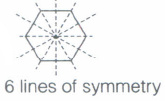
Draw all the symmetry lines for the following figures.

15.
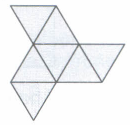
State the order of rotation and angle of rotation of the following figure.
16.
What is the quotient, when an integer is divided by 1?
17.
The mean marks (out of 100) of a group of students is 60. If their marks are 85, 62, 36, 48, 72, x, 75 and 39, then find the value of x.
18.
Find x, such that \(\left(1\over5\right)^5\times\left(1\over 5\right)^{19}=\left(1\over 5\right)^{8x}\)
19.
Find:
(a) 9% of Rs.700
(b) 6\(\frac { 2 }{ 3 } \)% of 75 m
(c) 7'5% of 80 kg
(d) 8% of 5 litres
1.
Let consecutive numbers be x and x + 1.
Hence, according to question,
x + x + 1 = 53
\(\Rightarrow\) 2x + 1 = 53
\(\Rightarrow\) 2x = 53-1
[On transposing 1 to RHS]
\(\Rightarrow\) 2x = 52
\(\Rightarrow \quad \frac { 2x }{ 2 } =\frac { 52 }{ 2 } \)
\(\Rightarrow\) x = 26
\(\therefore\) Smaller number is 26
2.
We have, (-49) \(\div\) (49) = - (49 \(\div\) 49) = - (49/49) = -1
3.
We have, 7, - 5, 4, 0 and - 4
Since every positive integer is greater than 0 and every negative integer is less than O. So, rearrange the given numbers in ascending order i.e. -5, - 4, 0, 4, 7.
In order to represent the given integers on the number line, we draw a line and mark a point on it almost in the middle (say0) of the line.
Now, starting from 0 and count 4 units on the right of the middle point, we get 4 and further count 3 units from 4 to the right, we obtain 7.
Again, starting from 0 and count 4 units to the left of it, we obtain - 4 and further count 1 unit from its left, we get -5.

4.
(a)
F + V = E + 2
5.
(b)
-100
6.
(c)
4
7.
(d)
decreased by 1.5
8.
(b)
a = -b
9.
The top view of the glass is a pair of concentric circles because its top is a circle as well as its base is a concentric circle of smaller radius.
Due to symmetry, the side view will not appear different if taken from some other direction.
10.
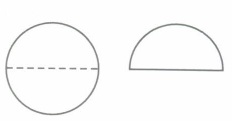
Here, radius (r) = 14 cm
\(\because\)Circumference of circle =2\(\pi\)r
\(\therefore\) Circumference of the semi-circular disc =\(\frac{1}{2}\)(2\(\pi\)r)=\(\pi\)r
=\(\frac{22}{7}\)\(\times\)14== 44 cm
Since, diameter = 2 x r
= 2 x 14 em = 28 em
\(\therefore\)Perimeter of the semi-circular disc = 44 cm + 28 cm = 72 cm
11.
We have: 5x +\(\frac{1}{3}\)=2-3x
\(\Rightarrow \) 5x+3x=2-\(\frac{1}{3}\)
[Transposing (-3x) to L.H.S. and 1. to R.H.S.]
\(\Rightarrow \) 8x=\(\frac{6-1}{3}=\frac{5}{3}\)
\(\Rightarrow \) x=\(\frac{5}{3}\times \frac{1}{8}=\frac{5}{24}\)
Thus, x=\(\frac{5}{24}\)
is the required solution of the given equation.
12.
(a) Score of Mohan= 6 \(\times\) (5) + 4 \(\times\) (- 2)
= 30 + (-8)
=30 - 8 = 22
(b) Rekha's score = 5 \(\times\) (5) + 3 \(\times\) (-2) + 2 \(\times\) 0
= 25 + (-6) + 0
= 25 - 6 = 19
(c) Mayank's score = 5 \(\times\) (5) + 5 \(\times\) (- 2)
= 25 + (-10) = 25 -10 = 15
(d) Jeet's score = 3 \(\times\) (5) + 5 \(\times\) (- 2)
= 15 + (-10) = 15-10 = 5
13.
In ratio, we would write this as
Rice : Urad dal = 2 : 1
= 2 + 1 = 3 total parts
Now, thi s means \(\frac { 2 }{ 3 } \)X100%
=\(\frac { 200 }{ 3 } =66\frac { 2 }{ 3 } \)%
and, urad dal in % =\(\frac { 1 }{ 3 } \times 100\)% = 33 \(\frac { 1 }{ 3 } \)%
14.
15.
The given figure have order of rotation is 3 and angIe of rotation will be \(\frac { 360° }{ 3 } =120°\)
16.
()
The integer itself.
17.
Total number of students = 8
Sum of the marks obtained =85 + 62 + 36 + 48 + x + 75 + 39 + 72=417+x
\(\therefore \)Mean marks =\(\frac { (417\quad +x) }{ 8 } \)
\(\Rightarrow \)\(\frac { (417\quad +x) }{ 8 } \)=60
\(\Rightarrow \)417 + x = 60 x 8 = 480
\(\Rightarrow \)x = 480 - 417 = 63
Thus, the required value of x = 63
18.
\(⇒\ \left(1\over 5\right)^{5+19}=\left(1\over 5\right)^{8x}\)
[∵ am x an = am+n]
\(⇒\ \left(1\over 5\right)^{24}=\left(1\over 5\right)^{8x}\)
When bases are equal, then by equating their exponents, we get
8x = 24
\(∴\ x={24\over 8}=3\)
19.
(a) 9% of Rs.700= \(\frac { 9 }{ 100 } \times \)700
= 9 X 7
= Rs.63
(b) 6 \(\frac { 2 }{ 3 } \)% of 75m =\(\frac { 20 }{ 3 } \)% of 75 m
=\(\frac { 20 }{ 300 } \times \)75 m
=\(\frac { 1 }{ 15 } \times \)75 m
=5 m
(c) 7.5 % of 80 kg =\(\frac { 7.5 }{ 100 } \times \)80 kg
=\(\frac { 3 }{ 40 } \times \)80 = 6 kg
(d) 8% of 5 liters =\(\frac { 8 }{ 100 } \times \)5 litres
=\(\frac { 40 }{ 100 } \times \)0.4 litre.

7th Standard CBSE Syllabus & Materials
7th Standard CBSE
CBSE 7th Social Science Theme B - New Beginnings : Cities and States - New Sample Question Papers Study Material - QB365 Set A
NEW7th Standard CBSE
CBSE 7th Social Science Theme A - Climates of India - New Sample Question Papers Study Material - QB365 Set A
NEW7th Standard CBSE
CBSE 7th Social Science Theme A - Geographical Diversity of India - New Sample Question Papers Study Material - QB365 Set A
NEW7th Standard CBSE
CBSE 7th Science Earth, Moon and the Sun - New Sample Question Papers Study Material - QB365 Set A


NCERT Books

Syllabus

Exam Pattern

Sample Question Papers

Previous year Question Papers

Important Notes

MCQ Practice test

NCERT Exemplers

Case study Questions

Image Based Questions

Passage based Questions

HOT Questions

Value Based Questions

Model Questions Papers
NCERT ( Book Back ) Questions

Assertion and Reason
Important Questions And Answers

CBSE 7th Standard CBSE Subjects
CBSE Standards