100% FREE ACCESS
7th Standard CBSE Syllabus & Materials
7th Standard CBSE
CBSE 7th Social Science Theme E - Understanding Market - New Sample Question Papers Study Material - QB365 Set A
NEW7th Standard CBSE
CBSE 7th Social Science Theme E - From Barter to Money - New Sample Question Papers Study Material - QB365 Set A
NEW7th Standard CBSE
CBSE 7th Social Science Theme D - The Constitution of India- An Introduction - New Sample Question Papers Study Material - QB365 Set A
NEW7th Standard CBSE
CBSE 7th Social Science Theme D - From the Rulers to the Ruled : Types of Governments - New Sample Question Papers Study Material - QB365 Set A
NEW7th Standard CBSE
CBSE 7th Social Science Theme B - The Age of Reorganisation - New Sample Question Papers Study Material - QB365 Set A
NEW7th Standard CBSE
CBSE 7th Social Science Theme B - The Rise of Empires - New Sample Question Papers Study Material - QB365 Set A

Published on: 31/10/2025
Download CBSE Class 7th Standard CBSE Mathematics question papers, sample papers, important questions, and previous year solved papers in PDF format. Get free study materials, NCERT solutions, and exam preparation resources for Class 7th Standard CBSE Mathematics
Questions + Answers key
Take MCQ Mathematics Test
1.
Find the order of the rotational symmetry of a square.
2.
Illustrate the rotation of an equilateral triangle and find its order of rotational order.
3.
After rotating by 60°about a centre, a figure looks exactly the same as its original position. At what other angles will this happen for the figure?
4.
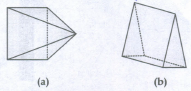
Identify the following figures:
5.
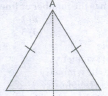
Does an isosceles triangle has a line of symmetry.If any, show it.
6.
State about the rotational symmetry of a square.
7.
What other names can be given to the line of symmetry of:
(a) An isosceles triangle?
(b) A circle?
8.
If a figure has two or more lines of symmetry, should it have rotational symmetry?
9.
How many lines of symmetry are there in a regular pentagon?
10.
After rotating by 60° about a centre, a figure looks exactly the same as its original position. At what other angles will this happen for the figure?
11.
Name the quadrilateral which have both line and rotational symmetry of order more than 1.
12.
Name any two figures that have both line symmetry and rotational symmetry.
13.
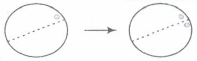
Given the line(s) of symmetry, find the other hole(s).

14.
Copy the figure with punched holes and find the axes of symmetry for the following:

15.
Copy the figure with punched holes and find the axes of symmetry for the following:

1.
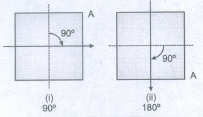
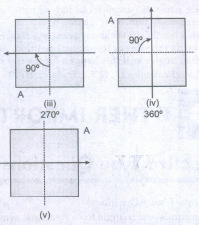
Let us consider a square ABCD.
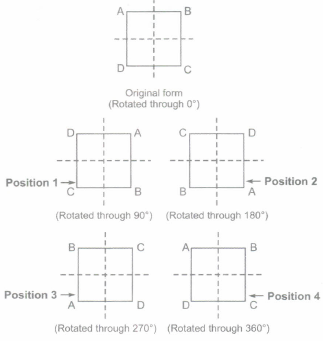
Obviously, each of the above four times, the figure fits on-to-it self.
∴ It has a rotational symmetry of order 4.
2.
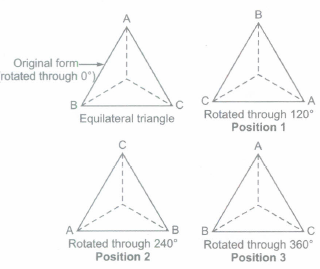
Since, each of the above three positions fits into the original.
∴ It has a rotational symmetry of order 3.
3.
After rotating by 60° about a centre, a figure looks exactly the same as its original position. This will also happen for the figure at angles 120°,180°,240°, 300°,360°respectively
4.
(a) Rectangular Pyramid
(b) Triangular Prism
5.
Isosceles triangle has only one line of symmetry
6.
A square has a rotational symmetry of order 4 about its centre, In this case:
(a) The centre of rotation is the centre of the square.
(b) The angle of rotation is 90°.
(c) The direction of rotation is clock wise.
(d) The order is 4.
7.
(a) Median of an isosceles triangle.
(b) Diameter of a circle
8.
When a figure has two or more lines of symmetry, then the figure should have a rotational symmetry of order more than 1 e.g., square.
9.
5
10.
After rotating by 60° about a centre, a figure looks exactly the same as its original position. This will also happen for the figure at angles 120°, 180°,240°,300° and 360°, respectively.
11.
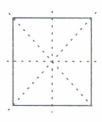
The name of quadrilateral having both line of symmetry and rotational symmetry of order more than 1 is square.
It has 4 lines of symmetry and rotational symmetry of order 4.
12.
Two figures that have both line symmetry and rotational symmetry are an equilateral triangle and a circle.
13.
With respect to the given line(s) of symmetry, the other hole(s) are marked in the figures given below:
14.
On copying the figure with punched holes, the axis of symmetry corresponding to the punched holes are shown by dotted lines in the figures given below

15.
On copying the figure with punched holes, the axis of symmetry corresponding to the punched holes are shown by dotted lines in the figures given below


7th Standard CBSE Syllabus & Materials
7th Standard CBSE
CBSE 7th Social Science Theme B - New Beginnings : Cities and States - New Sample Question Papers Study Material - QB365 Set A
NEW7th Standard CBSE
CBSE 7th Social Science Theme A - Climates of India - New Sample Question Papers Study Material - QB365 Set A
NEW7th Standard CBSE
CBSE 7th Social Science Theme A - Geographical Diversity of India - New Sample Question Papers Study Material - QB365 Set A
NEW7th Standard CBSE
CBSE 7th Science Earth, Moon and the Sun - New Sample Question Papers Study Material - QB365 Set A



NCERT Books

Syllabus

Exam Pattern

Sample Question Papers

Previous year Question Papers

Important Notes

MCQ Practice test

NCERT Exemplers

Case study Questions

Image Based Questions

Passage based Questions

HOT Questions

Value Based Questions

Model Questions Papers
NCERT ( Book Back ) Questions

Assertion and Reason
Important Questions And Answers

CBSE 7th Standard CBSE Subjects
CBSE Standards