
 100% FREE ACCESS
7th Standard CBSE Syllabus & Materials
7th Standard CBSE
CBSE 7th Social Science Theme E - Understanding Market - New Sample Question Papers Study Material - QB365 Set A
NEW7th Standard CBSE
CBSE 7th Social Science Theme E - From Barter to Money - New Sample Question Papers Study Material - QB365 Set A
NEW7th Standard CBSE
CBSE 7th Social Science Theme D - The Constitution of India- An Introduction - New Sample Question Papers Study Material - QB365 Set A
NEW7th Standard CBSE
CBSE 7th Social Science Theme D - From the Rulers to the Ruled : Types of Governments - New Sample Question Papers Study Material - QB365 Set A
NEW7th Standard CBSE
CBSE 7th Social Science Theme B - The Age of Reorganisation - New Sample Question Papers Study Material - QB365 Set A
NEW7th Standard CBSE
CBSE 7th Social Science Theme B - The Rise of Empires - New Sample Question Papers Study Material - QB365 Set A

Published on: 31/10/2025
Download CBSE Class 7th Standard CBSE Science question papers, sample papers, important questions, and previous year solved papers in PDF format. Get free study materials, NCERT solutions, and exam preparation resources for Class 7th Standard CBSE Science
Questions + Answers key
Take MCQ Science Test
1.
"Forests are our lifeline." Write five sentences on this tropic.
2.
List any five points that would make your visit more fruitful.
3.
State four reasons, why we must preserve forest.
4.
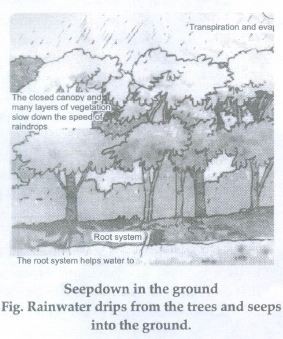
Explain how the forest act a natural absorber of rain water.
5.
A snake charmer came to the society and smelled the presence of a cobra near the guardroom. The head of the society agreed to allow the man to search, catch and take away the snake with him. Little Krishi who was seeing all this disagreed. He explained the people that it might disturb the food chain in the environment. Now, answer the following questions
(a) Describe food chain.
(b) Construct a food chain involving snake at one of its level.
(c) What are the values shown by Krishi?
6.
Sachin lives in a village, this village is surrounded by a forest. One day he noticed that in nearby pond sedimentation is increased so much that water has become muddy, streams are drying up. There is scarcity of fuel wood. He soon realised that he has to raise the issue of forest protection from cutting down trees, etc. Soon he involved the nearby village people and made an organisation to take an initiative.
Now, answer the following questions
(a) What changes might have Sachin noticed in his area?
(b) Give the porbable reason for such changes mentioned above.
(c) What are the values shown by Sachin?
7.
Figure shows a part of a forest.
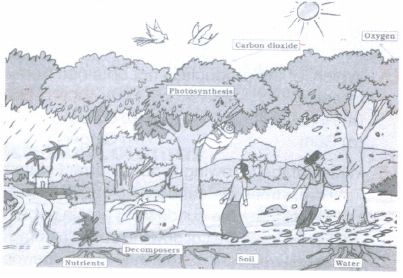
Write any three activities going on in the forest on the basis of this figure
8.
Write the major steps by which we can conserve the forest.
9.
"Forest is a dynamic entity, full of life and vitality". Explain briefly.
10.
People say that nothing goes waste in a forest. Can you explain how?
1.
(i) Forests give oxygen to keep us alive.
(ii) Forests absorb carbon dioxide, a gas which in excess in atmosphere contribute to climatic changes.
(iii) Forests provide us wood, gum, medicinal plants and many more things.
(iv) Forests save the soil from erosion.
(v) Forests help in maintaining the ground water level.
2.
(i) Make sure that you have permission to go into the forest.
(ii) To make sure that you can find your way around. Get a map and go along with someone who is familiar with the area.
(iii) Keep a record of the things you see and do.
(iv) Record bird calls and other animal calls.
(v) Learn to recognise animal droppings and never disturb any animal.
3.
We must protect our forest because:
(i) Forests provide us with oxygen.
(ii) They protect soil and provide habitat to a large number of animals.
(iii) Forest help in bringing good rainfall in neighbouring areas.
(iv) They are sources of medicines, timber and many other useful products.
4.
The forest acts as a natural absorber of rain water and allows it to seep. It helps to maintain the water table throughout the year. Forests not only helps in controlling floods but also help to maintain the flow of water in the streams so that we get a steady supply of water. On the other hand, if trees are not present rain hits the ground directly and may flood the area around it. Heavy rain may also damage the soil. Roots of trees normally bind the soil together, but in their absence the soil is washed away or eroded.
5.
(a) The sequence of living organisms in which one organism eats another is called a food chain.
(b) \(\underset { (Procedur) }{ Grass } \longrightarrow \underset { (Herbivore) }{ Insect } \longrightarrow \underset { (Carnivore) }{ Frog } \longrightarrow \underset { (Large\quad carnivore) }{ Snake } \longrightarrow \underset { (Top\quad carnivore) }{ Eagle } \)
(c)Scientific attitude, Obligation to maintain the ecosystem of nature.
6.
(a) Sachin noticed the disturbance in the water cycle in his area like stream drying up. Pond water getting muddy, less availability of fuel wood, etc.
(b) Deforestation.
(c) Love for nature and environmental consciousness.
7.
The three activities going on in the forest on the basis of the given figure are
(i) Oxygen is given out by plant leaves.
(ii) Carbon dioxide is consumed by the plants to prepare their food by the process of photosynthesis.
(iii) Nutrients are being added to the soil by the action of decomposers.
8.
Forests maintain balance in nature. There conservation is the need of the hour. We should take the following steps to conserve the forests.
(i) Planned harvesting An efficient way to get wood from forests for our requirements is to cut only some of the trees in an area. The uncut trees prevent erosion. Fruits of these trees produce seeds so that new trees can grow. This way the forest cover is maintained.
(ii) Afforestation This is the practice of renewing a forest by planting seedlings or small trees. These days, in our country, planned afforestation is being done not only by the government but also by private organisations for commercial purposes. Selective cutting of trees in these plantations provides wood for construction and also keeps the forest cover intact.
(iii)Protection from fire Huge forest areas are destroyed by fire every year. Fire may occur due to the carelessness of people or due to lightning during a storm or by friction between dry stems and dry branches of trees.Forest fires are controlled by spraying fire extinguishing solutions from aircrafts or by changing the direction of wind by using strong blowers.
9.
Forests harbour great variety of plants and animals. Plants provide food to herbivores. Larger number of herbivores means increased availability of food for a variety of carnivores. Wide variety of animals helps forest to regenerate.
10.
Nothing goes waste in a forest because of the following reasons
(i) Dry leaves and remains of dead animals are converted to a dark coloured substance called humus. This provides nutrients to the plants.
(ii) Dead animals become food for vultures, crows, jackals and insects.
(iii) Broken branches of trees are used as fuel by the people living in the vicinity of the forest.

7th Standard CBSE Syllabus & Materials
7th Standard CBSE
CBSE 7th Social Science Theme B - New Beginnings : Cities and States - New Sample Question Papers Study Material - QB365 Set A
NEW7th Standard CBSE
CBSE 7th Social Science Theme A - Climates of India - New Sample Question Papers Study Material - QB365 Set A
NEW7th Standard CBSE
CBSE 7th Social Science Theme A - Geographical Diversity of India - New Sample Question Papers Study Material - QB365 Set A
NEW7th Standard CBSE
CBSE 7th Science Earth, Moon and the Sun - New Sample Question Papers Study Material - QB365 Set A



NCERT Books

Syllabus

Exam Pattern

Sample Question Papers

Previous year Question Papers

Important Notes

MCQ Practice test

NCERT Exemplers

Case study Questions

Image Based Questions

Passage based Questions

HOT Questions

Value Based Questions

Model Questions Papers
NCERT ( Book Back ) Questions

Assertion and Reason
Important Questions And Answers

CBSE 7th Standard CBSE Subjects
CBSE Standards