
 100% FREE ACCESS
7th Standard CBSE Syllabus & Materials
7th Standard CBSE
CBSE 7th Social Science Theme E - Understanding Market - New Sample Question Papers Study Material - QB365 Set A
NEW7th Standard CBSE
CBSE 7th Social Science Theme E - From Barter to Money - New Sample Question Papers Study Material - QB365 Set A
NEW7th Standard CBSE
CBSE 7th Social Science Theme D - The Constitution of India- An Introduction - New Sample Question Papers Study Material - QB365 Set A
NEW7th Standard CBSE
CBSE 7th Social Science Theme D - From the Rulers to the Ruled : Types of Governments - New Sample Question Papers Study Material - QB365 Set A
NEW7th Standard CBSE
CBSE 7th Social Science Theme B - The Age of Reorganisation - New Sample Question Papers Study Material - QB365 Set A
NEW7th Standard CBSE
CBSE 7th Social Science Theme B - The Rise of Empires - New Sample Question Papers Study Material - QB365 Set A

Published on: 31/10/2025
Download CBSE Class 7th Standard CBSE Science question papers, sample papers, important questions, and previous year solved papers in PDF format. Get free study materials, NCERT solutions, and exam preparation resources for Class 7th Standard CBSE Science
Questions + Answers key
Take MCQ Science Test
1.
Explain why there is a need of variety of animals and plants in a forests
2.
Why should we worry about the conditions and issues related to forest far from us?
3.
List five products we get from forests.
4.
Explain why there is no waste in a forest.
5.
Explain the role of forests in maintaining the balance between oxygen and carbon dioxide in the atmosphere.
6.
What are decomposers? Name any two of them. What do they do in the forest?
7.
Which of the following is not a forest product?
Gum
Plywood
Sealing wax
Kerosene
8.
Microorganisms act upon the dead plants to produce
sand
mushroom
humus
wood
9.
Flow of energy in nature takes the following path
carnivores ⟶ herbivores ⟶ green plants
green plants ⟶ herbivores ⟶ carnivores
sun ⟶ green plants ⟶ herbivores ⟶ carnivores
sun ⟶ carnivores ⟶ herbivores ⟶ green plants
10.
Plants do not depend on animals for
pollination
food
seed dispersal
nutrients
11.
Which of the following statements is incorrect?
Forests protect the soil from erosion
Plants and animals in a forest are not dependent on one another
Forests influence the climate and water cycle
Soil helps forest to grow and regenerate
12.
State the consequence when one food chain is disturbed in an ecosystem.
13.
Are there similar kind of trees in every forests?
14.
Paheli wrote a food chain in the following way: Frog ⟶ Eagle ⟶ Insects ⟶ Grass ⟶ Snake. The chain is not in the correct order. Help her to write the food chain correctly.
15.
Give the reason behind variations found in the forests of different regions.
16.
Paheli while moving in a forest observed that there was no noise pollution, though lots of heavy vehicles were passing from the nearby highway. Explain why.
17.
List some animals which live in deeper areas of the forest.
18.
A snake charmer came to the society and smelled the presence of a cobra near the guardroom. The head of the society agreed to allow the man to search, catch and take away the snake with him. Little Krishi who was seeing all this disagreed. He explained the people that it might disturb the food chain in the environment. Now, answer the following questions
(a) Describe food chain.
(b) Construct a food chain involving snake at one of its level.
(c) What are the values shown by Krishi?
19.
Sachin lives in a village, this village is surrounded by a forest. One day he noticed that in nearby pond sedimentation is increased so much that water has become muddy, streams are drying up. There is scarcity of fuel wood. He soon realised that he has to raise the issue of forest protection from cutting down trees, etc. Soon he involved the nearby village people and made an organisation to take an initiative.
Now, answer the following questions
(a) What changes might have Sachin noticed in his area?
(b) Give the porbable reason for such changes mentioned above.
(c) What are the values shown by Sachin?
20.
Cycling of papers help in the conservation of the forests. Justify.
1.
A greater variety of plants and animals in the forests help it to regenerate and grow. Greater variety of plants means more food and habitat for the herbivores. An increase in herbivores means more food for carnivores.
2.
There are various reasons for which we should be vigilant about matters related to forests:
(i) A decrease in forest area would lead to an increase in carbon dioxide in air. This will lead to an increase of earth's temperature.
(ii) Soil erosion would occur if there are no forests.
(iii) Floods would occur if there are no forests
(iv) Forests provide shelter and food to the living organisms.
3.
(i) Fruits
(ii) Vegetables
(iii) Medicines
(iv) Oxygen
(v) Cereals
4.
There is no waste in a forest because microorganisms act on the wastes and convert them into humus. The humus ensures that the nutrients are returned back to the soil.
5.
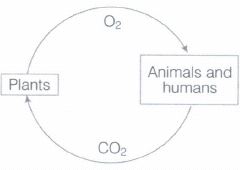
Forests are called the green lungs. This is because plants in forests release oxygen through the process of photosynthesis and help in providing oxygen to animals for respiration. They consume carbon dioxide released by the animals. In this way, plants help in maintaining a balance of oxygen and carbon dioxide in atmosphere.
6.
Decomposers are the microorganisms that convert the dead plants and animals into humus. Bacteria and mushroom are the two types of decomposers.
They help in the process of recycling of nutrients by decomposing various dead organisms such as plants and animals to form humus. Therefore, decomposers are helpful for the environment.
7.
(d)
Kerosene
8.
(c)
humus
9.
(c)
sun ⟶ green plants ⟶ herbivores ⟶ carnivores
10.
(b)
food
11.
(b)
Plants and animals in a forest are not dependent on one another
12.
Since, all food chains are interlinked disturbance in one food chain will affect the other food chain in a forest.
13.
No, due to different climatic conditions, there are variations in the types of trees and other plants. From forest to forest.
14.
Grass ⟶ Insects ⟶ Frog ⟶ Eagle
15.
The variation in the type of plants and animals is found in different forests because of the climatic conditions of that particular area.
16.
Paheli observed that there is no noise pollution in a forest even though there are lots of heavy vehicles passing from the nearby highway. It is because trees present in the forest absorb the noise.
17.
Boars, bisons, jackals, porcupines, elephants, etc., live in the deeper areas of the forest.
18.
(a) The sequence of living organisms in which one organism eats another is called a food chain.
(b) \(\underset { (Procedur) }{ Grass } \longrightarrow \underset { (Herbivore) }{ Insect } \longrightarrow \underset { (Carnivore) }{ Frog } \longrightarrow \underset { (Large\quad carnivore) }{ Snake } \longrightarrow \underset { (Top\quad carnivore) }{ Eagle } \)
(c)Scientific attitude, Obligation to maintain the ecosystem of nature.
19.
(a) Sachin noticed the disturbance in the water cycle in his area like stream drying up. Pond water getting muddy, less availability of fuel wood, etc.
(b) Deforestation.
(c) Love for nature and environmental consciousness.
20.
The papers are made from wood pulp. We derive wood by cutting down trees. If we recycling existing quantity of paper in the market and will not let it decompose, we can stop cutting of forest trees for new raw materials required for paper making.It takes years to grow a tree and cutting a tree takes only few minutes. So, we should give a serious thought before cutting a single tree even and should encourage recycling of papers every where In our country and in the world.

7th Standard CBSE Syllabus & Materials
7th Standard CBSE
CBSE 7th Social Science Theme B - New Beginnings : Cities and States - New Sample Question Papers Study Material - QB365 Set A
NEW7th Standard CBSE
CBSE 7th Social Science Theme A - Climates of India - New Sample Question Papers Study Material - QB365 Set A
NEW7th Standard CBSE
CBSE 7th Social Science Theme A - Geographical Diversity of India - New Sample Question Papers Study Material - QB365 Set A
NEW7th Standard CBSE
CBSE 7th Science Earth, Moon and the Sun - New Sample Question Papers Study Material - QB365 Set A



NCERT Books

Syllabus

Exam Pattern

Sample Question Papers

Previous year Question Papers

Important Notes

MCQ Practice test

NCERT Exemplers

Case study Questions

Image Based Questions

Passage based Questions

HOT Questions

Value Based Questions

Model Questions Papers
NCERT ( Book Back ) Questions

Assertion and Reason
Important Questions And Answers

CBSE 7th Standard CBSE Subjects
CBSE Standards