 100% FREE ACCESS
7th Standard CBSE Syllabus & Materials
7th Standard CBSE
CBSE 7th Social Science Theme E - Understanding Market - New Sample Question Papers Study Material - QB365 Set A
NEW7th Standard CBSE
CBSE 7th Social Science Theme E - From Barter to Money - New Sample Question Papers Study Material - QB365 Set A
NEW7th Standard CBSE
CBSE 7th Social Science Theme D - The Constitution of India- An Introduction - New Sample Question Papers Study Material - QB365 Set A
NEW7th Standard CBSE
CBSE 7th Social Science Theme D - From the Rulers to the Ruled : Types of Governments - New Sample Question Papers Study Material - QB365 Set A
NEW7th Standard CBSE
CBSE 7th Social Science Theme B - The Age of Reorganisation - New Sample Question Papers Study Material - QB365 Set A
NEW7th Standard CBSE
CBSE 7th Social Science Theme B - The Rise of Empires - New Sample Question Papers Study Material - QB365 Set A

Published on: 31/10/2025
Download CBSE Class 7th Standard CBSE Science question papers, sample papers, important questions, and previous year solved papers in PDF format. Get free study materials, NCERT solutions, and exam preparation resources for Class 7th Standard CBSE Science
Questions + Answers key
Take MCQ Science Test
1.
"Forest is a dynamic living entity". justify this statement.
2.
Reena is a student of class X of a Govt. School. She is a member of "Eco club" of her school. What suggestions would you like to give Reena to improve the environment in her school?
3.
How do forests help in controlling floods and maintain steady supply of water?
4.
Write the importance of forest.
5.
In which way forests are helpful in controlling flood and soil erosion?
6.
Explain the term autotroph, heterotroph and saprotroph.
7.
Sketch a diagram to show how plants maintain the balance between carbon dioxide and oxygen in the atmosphere?
8.
Explain how root system of plants help in the prevention of flood?
9.
Deforestation can increase the earth's temperature. Is it true? Give reason.
10.
Crown is different from canopy.Explain how.
11.
State the role of scavengers in cleaning of our environment.
12.
Is it possible to construct a food chain without a producer? State the reason to support your answer.
13.
Give any four factors which are responsible for the destruction of forests.
14.
Plants help in maintaining O2-CO2 cycle. Explain it in the light of photosynthesis and respiration.
15.
Forests are valuable resources. Explain.
1.
The wide varieties of animals both herbivores and carnivores help the forest to regenerate and grow. The decomposers help in maintaining the supply of nutrients to the wide variety of growing plants in the forest which provide greater opportunities for food and habitat of herbivores which ensure food for carnivores. Therefore, the forest is a dynamic living entity full of life and vitality.
2.
(i) Growing plants and trees in the open area in the school.
(ii) Arrangement for water harvesting.
(iii) Reporting any kind of water leakage in the school.
3.
The uppermost layer of the forest canopy intercepts the flow of rain drops and most of the water comes down through the branches and stems of the trees. From leaves it drips slowly over branches of the shrubs and herbs. All this slows down the speed of raindrops and also slows down the speed of running water.
Thus, forests act as a natural absorber of rainwater and allows it to seep. It helps to maintain the water table throughout the year. In this way, forests help in controlling floods and maintain steady supply of water.
4.
Importance of forests:
(i) Forests provide us with oxygen.
(ii) They maintain the balance of carbon dioxide and oxygen in atmosphere.
(iii)They protect the soil.
(iv) They help in bringing good rainfall in the neighbouring areas.
(v) They are the source of medicines, timber and other useful products and also provide wood.
5.
Due to spoilage of forest trees, the rainwater drops fall slowly on the ground. The forest also slows down the speed of rainwater and allowed it to seep. In absence of tress the rainwater hits the ground directly and may flood the area around it. Roots of forest trees bind the soil together and thus prevents soil erosion also.
6.
Autotrophs: Such living organisms which are capable of manufacturing their own food by the process of photosynthesis by using CO2 water and light. e.g., green plants.
Heterotrophs: Such organisms which are not capable of manufacturing their own food and depend for their food on other organisms are known as heterotrophs.
Saprotrophs: Such heterotrophs which obtain their nutrition from dead decaying organic material are called saprotrophs.
7.
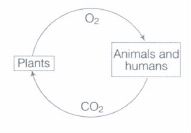
Decomposers and scavengers are cleaning agents. So, every entity in the forest plays a key and vital role making it a dynamic living entity, full of life and vitality.
8.
The root system helps water to seep down in the ground. It helps to maintain the water table throughout the year. Roots of trees normally bind the soil together and stop the erosion of soil.
9.
Yes, if there are no tress and plants, there will be no photosynthesis. So, no CO2 of the atmosphere will be used. This will increase the level of CO2, resulting in the increase of earth's temperature.
10.
The part of the tree with branches is known as the crown. When the crown of tall trees in the forests forms a roof-like covering over the others plants, it is known as a canopy.
11.
Scavengers eat the dead animals and act as the cleaning agents of our environment. Some of these animals (scavengers) are vultures, crows, jackals, hyena, some insects, etc.
12.
No, in any food chain, producers are always at the beginning. It is the producer which provides food to all living organisms. In a food chain, if producer is absent, then there will be no flow of energy. So, we can say that it is not possible to construct a food chain without a producer.
13.
The four factors which are responsible for the destruction of forests are
(i) Construction of roads.
(ii) Construction of buildings.
(iii) Industrial development.
(iv) Increasing demand of wood.
14.
Photosynthesis is the process during which CO2 is used by the plants and O2 is released as a products. This O2 is used by the animals for their respiration and CO2 is released during it which is again used for photosynthesis by plants. In this way, O2 - CO2 cycle is balanced by plants.
15.
Forest products play vital role in socio-economic development. We get food (cereals, pulses, fruits), fire wood, fibre, construction material, industrial products (tannins, lubricants, dyes, resins, perfumes) and products of medicinal importance. It is also the home of diverse wildlife which maintains the ecosystem. Thus, forests are valuable resources.

7th Standard CBSE Syllabus & Materials
7th Standard CBSE
CBSE 7th Social Science Theme B - New Beginnings : Cities and States - New Sample Question Papers Study Material - QB365 Set A
NEW7th Standard CBSE
CBSE 7th Social Science Theme A - Climates of India - New Sample Question Papers Study Material - QB365 Set A
NEW7th Standard CBSE
CBSE 7th Social Science Theme A - Geographical Diversity of India - New Sample Question Papers Study Material - QB365 Set A
NEW7th Standard CBSE
CBSE 7th Science Earth, Moon and the Sun - New Sample Question Papers Study Material - QB365 Set A



NCERT Books

Syllabus

Exam Pattern

Sample Question Papers

Previous year Question Papers

Important Notes

MCQ Practice test

NCERT Exemplers

Case study Questions

Image Based Questions

Passage based Questions

HOT Questions

Value Based Questions

Model Questions Papers
NCERT ( Book Back ) Questions

Assertion and Reason
Important Questions And Answers

CBSE 7th Standard CBSE Subjects
CBSE Standards