
 100% FREE ACCESS
7th Standard CBSE Syllabus & Materials
7th Standard CBSE
CBSE 7th Social Science Theme E - Understanding Market - New Sample Question Papers Study Material - QB365 Set A
NEW7th Standard CBSE
CBSE 7th Social Science Theme E - From Barter to Money - New Sample Question Papers Study Material - QB365 Set A
NEW7th Standard CBSE
CBSE 7th Social Science Theme D - The Constitution of India- An Introduction - New Sample Question Papers Study Material - QB365 Set A
NEW7th Standard CBSE
CBSE 7th Social Science Theme D - From the Rulers to the Ruled : Types of Governments - New Sample Question Papers Study Material - QB365 Set A
NEW7th Standard CBSE
CBSE 7th Social Science Theme B - The Age of Reorganisation - New Sample Question Papers Study Material - QB365 Set A
NEW7th Standard CBSE
CBSE 7th Social Science Theme B - The Rise of Empires - New Sample Question Papers Study Material - QB365 Set A

Published on: 31/10/2025
Download CBSE Class 7th Standard CBSE Science question papers, sample papers, important questions, and previous year solved papers in PDF format. Get free study materials, NCERT solutions, and exam preparation resources for Class 7th Standard CBSE Science
Questions + Answers key
Take MCQ Science Test
1.
Choose the correct order of terms that describes the process of nutrition in ruminants.
swallowing \(\rightarrow \) partial digestion \(\rightarrow \) chewing of cud \(\rightarrow \) complete digestion
chewing of cud \(\rightarrow\) swallowing \(\rightarrow\) partial digestion \(\rightarrow\) complete digestion
chewing of cud \(\rightarrow\) swallowing \(\rightarrow\) mixing with digestive juices \(\rightarrow\) digestion
swallowing \(\rightarrow\) chewing and mixing \(\rightarrow\) partial digestion \(\rightarrow\) complete digestion
2.
Animals are not:
Autotrophs
Parasites
Saprotrophs
Holozoic
3.
Cellulose rich food substances are good sources of roughage in human beings because
human beings do not have cellulose: digesting enzymes
cellulose gets absorbed in the human blood and converts into fibres
the cellulose digesting bacteria convert cellulose into fibres
cellulose breaks down into smaller components which are egested as roughage
4.
The finger-like outgrowths of Amoeba helps to ingest food. However, the finger-like outgrowths of human intestine helps to
digest the fatty food substances
make the food soluble
absorb the digested food
absorb the undigested food
5.
Water from the undigested food is absorbed mainly in the
stomach
foodpipe
small intestine
large intestine
6.
What happens when we do not clean our teeth after eating food.
7.
Write three functions of tongue
8.
Choose the odd one out from each group and give reasons.
(a) liver, salivary gland, starch, gall bladder
(b) stomach, liver, pancreas, salivary gland
(c) tongue, absorption, taste, swallow
(d) oesophagus, small intestine, large intestine, rectum.
9.
'A' got her gall bladder removed surgically as she was diagnosed with stones in her gall bladder. After the surgery, she faced problems in digestion of certain food items when consumed in bulk. Can you tell which kind of food items would they be and why?
10.
Name the type of carbohydrate that can be digested by ruminants but not by humans. Give the reason also.
11.
Stomach
12.
Why does a doctor put a glucose drip to a patient who has just been operated?
13.
Explain the digestion of cellulose in the animals.
14.
What do you understand by animal nutrition?
15.
Record your observations
16.
Name the parts of the alimentary canal where
(a) water gets absorbed from undigested food
(b) digested food gets absorbed
(c) taste of the food is perceived
(d) bile juice is produced
17.
How do ruminants digest the cellulose?
18.
Explain the human digestive system with the help of labelled diagram.
19.
Open your mouth, look into a mirror and try to count the different types of teeth of teeth in your mouth. Record your observations in the table below:
| Type of teeth | Number of teeth | |
| In my mouth | In the figure | |
| Incisors | ||
| Canines | ||
| Premolars | ||
| Molars |
(a) Did you observe any difference in the number of teeth? If yes, could you identify which type of teeth showed the difference?
(b) Compare the number and type of teeth in an adult (say your parents or cousins who have reached the age of 25-30 or more). Note your observation.
20.
Little Rishi (student of class VI) was watching his favourite cartoon serial on television. Suddenly he got hiccups. His elder brother Shubham who was sitting near by him gave him a glass of water and suggested not to eat too fast in a hurry. Little Rishi got confused as he had heard that 'hicki' comes when someone remembers. He asked his father. His father smiled and explained him that it is only a myth. He also explained him the proper scientific reason behind it.
(a) What is hiccup?
(b) Why do we get hiccup?
(c) What are the values shown by Rishi?
21.
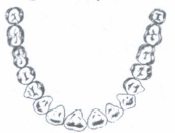
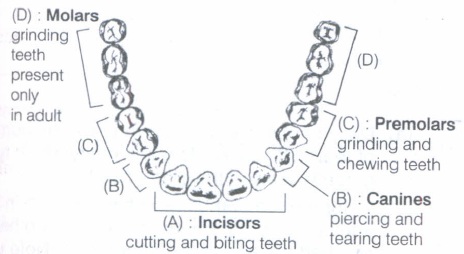
Label the given figure as directed below in A to D and give the name of each type of teeth.
(a) The cutting and biting teeth as A
(b) The piercing and tearing teeth as B
(c) The grinding and chewing teeth as C
(d) The grinding teeth present only in adult as D.
22.
..................... is the largest gland in the human body.
23.
Four kinds of teeth present in human are ______, ______, _______ and ______.
24.
Name the juice secreted by salivary gland?
25.
Which teeth do you use for biting and cutting?
1.
(a)
swallowing \(\rightarrow \) partial digestion \(\rightarrow \) chewing of cud \(\rightarrow \) complete digestion
2.
(a)
Autotrophs
3.
(a)
human beings do not have cellulose: digesting enzymes
4.
(c)
absorb the digested food
5.
Large intestine absorbs the water from undigested food.
6.
If we do not clean our teeth and mouth after eating, many harmful bacteria start to live in it. These bacteria breakdown the sugars present from the leftover food and release acids. The acids gradually damage the teeth. This is called tooth decay. It causes tooth loss in many cases.
7.
(i) It helps in talking.
(ii) It helps to mix saliva with the food.
(iii)It also helps in swallowing food.
8.
(a) Starch, because rest all are glands and starch is a type of carbohydrate.
(b) Stomach, because rest all are digestive glands and stomach is a digestive organ.
(c) Tongue, because rest all are digestive processes and tongue is a part of digestive system.
(d) Small intestine, because it carriers the process of digestion and rest are not involved in digestion.
9.
After surgical removal of gall bladder, A' would face problems in digestion of fat and fatty substances when consumed in bulk. This is because the bile juice stored in the gall bladder helps in digestion of fats.
10.
Cellulose is the carbohydrate that can be digested by ruminants but not by humans because ruminants have a large sac-like structure called rumen which is located between the small intestine and large intestine. Certain bacteria are present in rumen which helps in digesting cellulose.
11.
()
Acid release
12.
This is because the patient cannot digest the food and glucose needs no digestion.
13.
Many animals including humans cannot digest cellulose. But ruminants can digest it. They have a large sac like structure called caecum between the small intestine and large intestine. The cellulose of the food is digested in this part by the action of certain bacteria which are not present in the humans.
14.
Animal nutrition includes nutrients, mode of intake of food and its utilisation in the body.
15.
| Type of Teeth | Number of teeth | Total | |
| Lower Jaw | Upper Jaw | ||
|
Cutting and Biting teeth |
2 |
2 |
4 |
| Piercing and tearing teeth | 4 | 4 | 8 |
| Chewing and grinding teeth | 10 | 10 | 20 |
16.
(a) large intestine
(b) small intestine
(c) tongue
(d) liver
17.
The food of ruminants like grass is rich in cellulose (a type of carbohydrate). Ruminants have a large sac-like structure between the small intestine and large intestine. The cellulose of the food is digested here by the action of certain bacteria which are not present in humans. In this way ruminants can digest the cellulose but many animals including human can not digest cellulose.
18.
When the ingest food in our mouth, salivary glands of the mouth secrete saliva which moistens the food. It also converts the starch into sugar. The tongue helps in chewing by moving the food in various directions. Saliva contains enzyme called salivary amylase which converts starch into sugar.
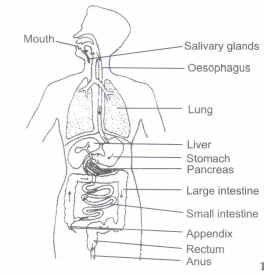
From mouth, food goes into food pipe called oesophagus. As food enters into the food pipe, muscles of its wall starts contraction and relaxation movement. This movement is called peristaltic movement that pushes the food into the stomach. The peristaltic movement occurs throughout the alimentary canal. The oesophagus leads the food to a saclike structure called stomach. The food is churned and partly digested in the stomach. The semi-solid food passes from the stomach to much coiled tube-like structure called the small intestine. The small intestine serves two purposes-digestion and absorption of the digested food. It is about 20 feet long. The inner surface of the small intestine has a large number of finger-like projections called villi. The villi increase the surface area for the absorption of digested food. The absorbed food enters into the blood stream and carried away to various parts of the body for assimilation. The undigested food moves from the small intestine to the large intestine where mainly absorption of water from the undigestion takes place. From the large intestine, the undigested food passes to the rectum which pushes it out of the body through the opening called the anus as faeces.
19.
| Type of teeth | Number of teeth | |
| In my mouth | In the figure | |
| Incisors | 4 | 4 |
| Canines | 8 | 8 |
| Premolars | 8 | 8 |
| Molars | 8 | 12 |
(a) Yes, the difference has been observed in the number of molars.
(b) The number and type of teeth varries in an adult as compared to the child. Children have 28 teeth in their mouth.There are only four molars in each jaw.
While, adults have 32 teeth in their mouth which means six molars in each jaw.
20.
(a) Hiccup is a choking sensation that produces a characteristic gulping sound repeatedly. It is called 'hicki' in our local language.
(b) Sometimes, when we eat too fast in a hurry or talk too much or laugh while eating, then a little of windpipe remains open due to which food particles may enter the windpipe. It may result in a choking sensation called hiccups.
(c) He is sincere and curious to know about the things at an early age.
21.
22.
()
liver
23.
()
incisor, cannines, premolar, molar
24.
()
Saliva.
25.
()
The incisors

7th Standard CBSE Syllabus & Materials
7th Standard CBSE
CBSE 7th Social Science Theme B - New Beginnings : Cities and States - New Sample Question Papers Study Material - QB365 Set A
NEW7th Standard CBSE
CBSE 7th Social Science Theme A - Climates of India - New Sample Question Papers Study Material - QB365 Set A
NEW7th Standard CBSE
CBSE 7th Social Science Theme A - Geographical Diversity of India - New Sample Question Papers Study Material - QB365 Set A
NEW7th Standard CBSE
CBSE 7th Science Earth, Moon and the Sun - New Sample Question Papers Study Material - QB365 Set A



NCERT Books

Syllabus

Exam Pattern

Sample Question Papers

Previous year Question Papers

Important Notes

MCQ Practice test

NCERT Exemplers

Case study Questions

Image Based Questions

Passage based Questions

HOT Questions

Value Based Questions

Model Questions Papers
NCERT ( Book Back ) Questions

Assertion and Reason
Important Questions And Answers

CBSE 7th Standard CBSE Subjects
CBSE Standards