
 100% FREE ACCESS
7th Standard CBSE Syllabus & Materials
7th Standard CBSE
CBSE 7th Social Science Theme E - Understanding Market - New Sample Question Papers Study Material - QB365 Set A
NEW7th Standard CBSE
CBSE 7th Social Science Theme E - From Barter to Money - New Sample Question Papers Study Material - QB365 Set A
NEW7th Standard CBSE
CBSE 7th Social Science Theme D - The Constitution of India- An Introduction - New Sample Question Papers Study Material - QB365 Set A
NEW7th Standard CBSE
CBSE 7th Social Science Theme D - From the Rulers to the Ruled : Types of Governments - New Sample Question Papers Study Material - QB365 Set A
NEW7th Standard CBSE
CBSE 7th Social Science Theme B - The Age of Reorganisation - New Sample Question Papers Study Material - QB365 Set A
NEW7th Standard CBSE
CBSE 7th Social Science Theme B - The Rise of Empires - New Sample Question Papers Study Material - QB365 Set A

Published on: 31/10/2025
Download CBSE Class 7th Standard CBSE Science question papers, sample papers, important questions, and previous year solved papers in PDF format. Get free study materials, NCERT solutions, and exam preparation resources for Class 7th Standard CBSE Science
Questions + Answers key
Take MCQ Science Test
1.
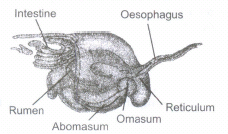
Which one of the following is not secreted by the walls of stomach?
hydrochloric acid
Mucous
Digestive juice
Bile juice
2.
Saliva converts starch into:
Fats
Sugar
proteins
Minerals
3.
Hydrochloric acid is secreted by
linings of small intestine
inner lining of stomach
pancreas
lining of liver
4.
Water from the undigested food is absorbed mainly in the
stomach
foodpipe
small intestine
large intestine
5.
Fat is completely digested in the
stomach
mouth
small intestine
large intestine
6.
Write various components of food.
7.
Where is the bile produced? Which component of the food does it help to digest?
8.
What are villi? What is their location and function?
9.
The breakdown of complex components of food into simpler substances is called ..............
10.
Glucose is the simplest form of ...........
11.
_____ is the simplest form of carbohydrate.
12.
_____ is the process of taking food inside the body.
13.
Amoeba digests its food in the ______
14.
House fly
15.
Animals
16.
Rectum
17.
Liver
18.
Stomach
19.
What do you understand by rumen?
20.
What is large intestine? Write its function.
21.
We should not eat hurriedly. Give reason.
22.
You were blindfolded and asked to identify the drinks provided in two different glasses. You could identify drink A as lime juice and B as bitter gourd juice. How could you do it inspite of being blindfolded?
23.
Identify the location of salivary gland.
24.
How do ruminants digest the cellulose?
25.
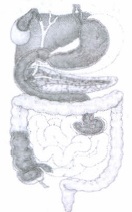
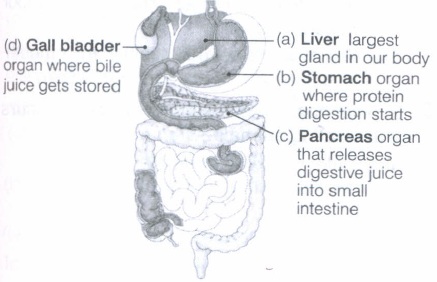
Label the following parts of above figure and name them.
(a) The largest gland in our body.
(b) The organ where protein digestion starts.
(c) The organ that releases digestive juice into the small intestine.
(d) The organ where bile juice gets stored.
26.
All heterotrophs have a similar basic process of nutrition.
27.
Mucus protects the stomach lining from damage.
28.
The large intestine is longer and wider than the small intestine of the human alimentary canal.
29.
Ruminant can digest cellulose (carbohydrate).
30.
Simplest form of fat is sugars and glucose.
31.
What is Bile?
32.
Name the two parts of digestive system.
33.
Name the two components of food.
34.
Which one for chewing and grinding?
35.
Which ones for piercing and tearing?
1.
(b)
Mucous
2.
(b)
Sugar
3.
(b)
inner lining of stomach
4.
Large intestine absorbs the water from undigested food.
5.
Small intestine is the site for complete digestion of fats by the action of bile juice
6.
The various components of food are as following:
(i) Carbohydrates
(ii) Fats
(iii) Proteins
(iv) Vitamins
(v)Minerals
(vi) Water and Roughage
7.
Bile juice is produced by the liver and stored in gall bladder. It helps in digestion of fats present in food.
8.
Villi are the finger-like projections in the inner walls of the small intestine.
Function Villi increases the surface area for absorption of digested food.
9.
()
digestion
10.
carbohydrates
11.
()
Glucose
12.
()
Ingestion
13.
()
food vacuole
14.
()
Sponging
15.
()
Heterotrophs
16.
()
Release of faeces
17.
()
Bile juice secretion
18.
()
Acid release
19.
The grass eating animals quickly swallow the grass and store it in a separate part of the stomach. This part is called rumen.
20.
Large intestine is the part of a alimentary canal which is wider and shorter than small intestine. Its main function is to absorb water and some salts from the undigested food. It also helps in the egestion of undigested food.
21.
We should not eat hurriedly because if we ingest food in hurry or we talk or laugh while eating we experience hiccups, coughing or choking sensation.
22.
Inspite of being blindfolded, one could identify two different drinks with the help of taste buds present in the tongue.
23.
Salivary gland is present in the buccal cavity and it secretes saliva.
24.
The food of ruminants like grass is rich in cellulose (a type of carbohydrate). Ruminants have a large sac-like structure between the small intestine and large intestine. The cellulose of the food is digested here by the action of certain bacteria which are not present in humans. In this way ruminants can digest the cellulose but many animals including human can not digest cellulose.
25.
26.
(a)
27.
(a)
28.
(b)
29.
(a)
30.
(b)
31.
()
Bileis a secretion secreted by liver.
32.
()
Digestive track and associated glands.
33.
()
Carbohydrates and fat.
34.
()
Premolars and molars
35.
()
Canine
7th Standard CBSE Syllabus & Materials
7th Standard CBSE
CBSE 7th Social Science Theme B - New Beginnings : Cities and States - New Sample Question Papers Study Material - QB365 Set A
NEW7th Standard CBSE
CBSE 7th Social Science Theme A - Climates of India - New Sample Question Papers Study Material - QB365 Set A
NEW7th Standard CBSE
CBSE 7th Social Science Theme A - Geographical Diversity of India - New Sample Question Papers Study Material - QB365 Set A
NEW7th Standard CBSE
CBSE 7th Science Earth, Moon and the Sun - New Sample Question Papers Study Material - QB365 Set A

NCERT Books

Syllabus

Exam Pattern

Sample Question Papers

Previous year Question Papers

Important Notes

MCQ Practice test

NCERT Exemplers

Case study Questions

Image Based Questions

Passage based Questions

HOT Questions

Value Based Questions

Model Questions Papers
NCERT ( Book Back ) Questions

Assertion and Reason
Important Questions And Answers

CBSE 7th Standard CBSE Subjects
CBSE Standards