
 100% FREE ACCESS
7th Standard CBSE Syllabus & Materials
7th Standard CBSE
CBSE 7th Social Science Theme E - Understanding Market - New Sample Question Papers Study Material - QB365 Set A
NEW7th Standard CBSE
CBSE 7th Social Science Theme E - From Barter to Money - New Sample Question Papers Study Material - QB365 Set A
NEW7th Standard CBSE
CBSE 7th Social Science Theme D - The Constitution of India- An Introduction - New Sample Question Papers Study Material - QB365 Set A
NEW7th Standard CBSE
CBSE 7th Social Science Theme D - From the Rulers to the Ruled : Types of Governments - New Sample Question Papers Study Material - QB365 Set A
NEW7th Standard CBSE
CBSE 7th Social Science Theme B - The Age of Reorganisation - New Sample Question Papers Study Material - QB365 Set A
NEW7th Standard CBSE
CBSE 7th Social Science Theme B - The Rise of Empires - New Sample Question Papers Study Material - QB365 Set A

Published on: 31/10/2025
Download CBSE Class 7th Standard CBSE Science question papers, sample papers, important questions, and previous year solved papers in PDF format. Get free study materials, NCERT solutions, and exam preparation resources for Class 7th Standard CBSE Science
Questions + Answers key
Take MCQ Science Test
1.
2. (a) Draw a diagram of a pitcher plant to show the following parts:
(i) Pitcher
(ii) Lid
(b) What is the mode of nutrition of this plant?
(c) Is it an autotroph or partial heterotroph?
2.
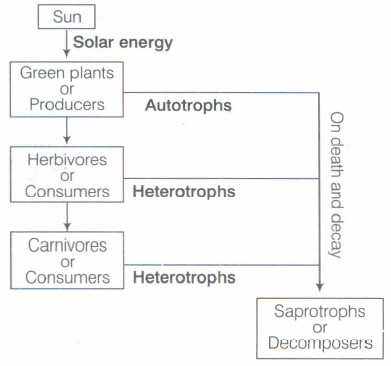
Show with the help of a sketch that the plants are the ultimate source of food.
3.
Give a brief description of the process of synthesis of food in green plants.
4.
The term that is used for the mode of nutrition in yeast, mushroom and bread-mould is :
autotrophic
insectivorous
saprophytic
parasitic
5.
In the absence of which of the following will photosynthesis not occur in leaves?
Guard cells
Chlorophyll
Vacuole
Spacebetween cells
6.
Which part of the plant takes in carbon dioxide from the air for photosynthesis?
Root hair
Stomata
Leaf veins
Sepals
7.
The plant which traps and feeds on insects is
Cuscuta
China rose
pitcher plant
rose
8.
Amarbel is an example of
autotroph
parasite
saprotroph
host
9.
Bacteria Rhizobium
10.
Saprotroph
11.
Animals
12.
Amarbel
13.
Nitrogen
14.
Why is it true to say that insectivorous plants are partial heterotrophs? Explain
15.
How to Rhizobium bacteria take nitrogen from atmosphere?
16.
Why do some plants feed on insects?
17.
A carbohydrate is produced by plants as food source. It is constituted from which molecules?
18.
Asha went to visit her grandfather in his village. He was having a serious discussion with his fellow members regarding the productivity level of crops for present year. They all were worried about how to increase the productivity of crop Asha listened to this and then suggested to the group that the reason may be decreased level of minerals in soil.
She told her grandfather to plant crops like pulses, gram, beans, etc., for a year then follow with regular crops. This will increase the crop productivity?
(a) What will you name the process suggested by Asha? Why is there decrease in crop productivity?
(b) What are noted benefits of this process? Will the results be as what Asha expressed?
(c) What values are shown by Asha?
19.
Chlorophyll which captures ............ from sunlight.
20.
Leaves have a green pigment called ..............
21.
The plants that provide nutrition to the parasitic plant are called _____________
22.
Cuscuta is a ___________ plant.
23.
All green plants possess ______________ in their leaves.
24.
Rhizobium can fix atmospheric nitrogen into nitrogen compound.
25.
Lichen is a saprophytic plant.
26.
Pitcher plant eats insects.
27.
Fungi are green plants that can synthesise their own food.
28.
Chlorophyll is present in an animal cell.
29.
All green plants are called ...............
30.
............ is produced and ..............is utilised during photosynthesis.
31.
Plants like cuscuta takes food from .............. plant.
1.
(a)
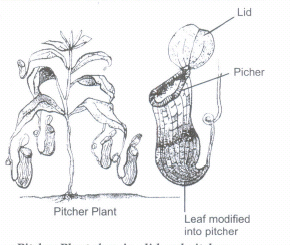
Fig. : Pitcher Plant showing lid and pitcher
(b) Autotrophic and Heterotrophic both.
(c) Partial heterotroph.
2.
The following sketch shows that the plants are the ultimate source of food.
3.
Plants prepare their own food by the process of photosynthesis. Leaves of the plants have green pigment called chlorophyll, which helps them to capture the energy of the sunlight. The plants synthesise their food from carbon dioxide and water in the presence of sunlight. This process is called photosynthesis. The reaction for the process of photosynthesis can be shown as follows:

During photosynthesis, food is synthesised and oxygen is released in the process.
4.
(c)
saprophytic
5.
(b)
Chlorophyll
6.
(b)
Stomata
7.
(c)
pitcher plant
8.
(b)
parasite
9.
()
N2-fixing
10.
()
Fungi
11.
()
Heterotrophs
12.
()
Parasite
13.
()
Bacteria
14.
Insectivorous plants are green and can do photosynthesis so they are called autotrophs. But they also can trap insects and digest them. Due to this, they are called partial heterotrophs.
15.
Rhizobium bacteria can take nitrogen from atmosphere and convert it into a soluble form which is used by that plant in which bacteria live.
16.
Insectivorous plants grow in soil which lack nitrogen, therefore they eat insects to fulfil their need of nitrogen.
17.
Carbohydrates are composed of carbon, hydrogen and oxygen.
18.
(a) This process is known as crop rotation. All the plants/crops grown in soil use the minerals present in soil for their own use. This continuous usage depletes the concentration of mineral in soil.
(b) After growing leguminous plants, the mineral content of soil is restored and enriched to new level. Yes, the benefit of leguminous plant is the re-enrichment of soil minerals.
(c) Asha is observant, sincere and interested in applying her knowledge to situations.
19.
()
Energy
20.
()
chlorophyll
21.
()
host
22.
()
parasitic
23.
()
chlorophyll
24.
(a)
25.
(b)
26.
(a)
27.
(b)
28.
(b)
29.
()
Autotrophs
30.
()
Oxygen, carbon dioxide
31.
()
Host

7th Standard CBSE Syllabus & Materials
7th Standard CBSE
CBSE 7th Social Science Theme B - New Beginnings : Cities and States - New Sample Question Papers Study Material - QB365 Set A
NEW7th Standard CBSE
CBSE 7th Social Science Theme A - Climates of India - New Sample Question Papers Study Material - QB365 Set A
NEW7th Standard CBSE
CBSE 7th Social Science Theme A - Geographical Diversity of India - New Sample Question Papers Study Material - QB365 Set A
NEW7th Standard CBSE
CBSE 7th Science Earth, Moon and the Sun - New Sample Question Papers Study Material - QB365 Set A



NCERT Books

Syllabus

Exam Pattern

Sample Question Papers

Previous year Question Papers

Important Notes

MCQ Practice test

NCERT Exemplers

Case study Questions

Image Based Questions

Passage based Questions

HOT Questions

Value Based Questions

Model Questions Papers
NCERT ( Book Back ) Questions

Assertion and Reason
Important Questions And Answers

CBSE 7th Standard CBSE Subjects
CBSE Standards