100% FREE ACCESS
7th Standard CBSE Syllabus & Materials
7th Standard CBSE
CBSE 7th Social Science Theme E - Understanding Market - New Sample Question Papers Study Material - QB365 Set A
NEW7th Standard CBSE
CBSE 7th Social Science Theme E - From Barter to Money - New Sample Question Papers Study Material - QB365 Set A
NEW7th Standard CBSE
CBSE 7th Social Science Theme D - The Constitution of India- An Introduction - New Sample Question Papers Study Material - QB365 Set A
NEW7th Standard CBSE
CBSE 7th Social Science Theme D - From the Rulers to the Ruled : Types of Governments - New Sample Question Papers Study Material - QB365 Set A
NEW7th Standard CBSE
CBSE 7th Social Science Theme B - The Age of Reorganisation - New Sample Question Papers Study Material - QB365 Set A
NEW7th Standard CBSE
CBSE 7th Social Science Theme B - The Rise of Empires - New Sample Question Papers Study Material - QB365 Set A

Published on: 31/10/2025
Download CBSE Class 7th Standard CBSE Science question papers, sample papers, important questions, and previous year solved papers in PDF format. Get free study materials, NCERT solutions, and exam preparation resources for Class 7th Standard CBSE Science
Questions + Answers key
Take MCQ Science Test
1.
Cud is the name given to the food of ruminants which is
swallowed and undigested
swallowed and partially digested
properly chewed and partially digested
properly chewed and completely digested
2.
If iodine is dropped on the boiled leaf it gives blue-black colour due to the presence of
starch
protein
fat
vitamin
3.
The arboreal animal among the following is
elephant
lion
butterfly
lion-tailed macaque
4.
Products of a neutralisation reaction are always
an acid and a base
an acid and a salt
a salt and water
a salt and a base
5.
Amarbel is an example of
autotroph
parasite
saprotroph
host
6.
What is the importance of breathing.
7.
Why do we cover plug pin holes which are within the reach of children with cellotape or plastic cover when not in use?
8.
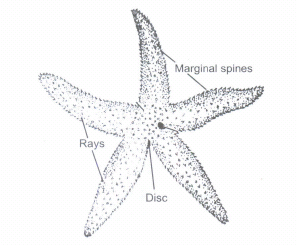
Explain the mode of feeding of starfish.
9.
What type of substance is formed when a metal oxide is dissolved in water ? What are these generally called?
10.
Unscramble the following terms related to modes of nutrition:
(i) RASPAEIT,(ii) ROPEHYSTAp, (iii) TOROPHAUT, (iv) SIBIOMSIS.
11.
Mention the period proclaimed as the International Decade for action on Water for Life.
12.
Name any four useful products other than wood, which we get from forests.
13.
What are chemical fertilizers? Write their harmful effects
14.
How will you prove that light travels in straight line?
15.
Vivek went to visit his grandfather in village where he saw that his grandfather's field of wheat is infected with fungus but no one is aware of this. Vivek told him that he should use an antifungal agent in his fields to stop this infection?
(a) What is fungus?
(b) Can fungus only cause disease or can it be helpful also?
(c) What values are shown by Vivek?
16.
Complete the table given below of the contaminant survey.
| Types of sewage | Point of origin | Substances which contaminate | Any other remark |
|---|---|---|---|
| Sullage water | Kitchen | ||
| Foul waste | Toilets | ||
| Trade waste | Industrial and commercial organisations |
17.
The terms sewage, sewers and sewerage are interlinked with each other. Can you explain, how?
18.
Write differences between decomposers and scavengers.
19.
Can you say why your parents insist that you should eat regularly?
20.
Why is difficult of force the paper ball into the bottle?
21.
Does sweat serve any other function?
22.
Are the days shorter in winter than in summer?
23.
The bacteria Rhizobium lives in the roots of ...........
24.
Complete the paragraph related to the history of silk moth by filling in the blanks.
The_______(a)________silk moth lays_______(b)__________, from which hatch _______(c)_______called_______(d)_________or________(e)_______.They grow in size and when caterpillar is ready to enter the next stage of its life history called ________(f)_______, it first weaves a covering to hold itself, which is known as________(g)_________..
1.
(b)
swallowed and partially digested
2.
(a)
starch
3.
(d)
lion-tailed macaque
4.
(c)
a salt and water
5.
(b)
parasite
6.
All the organisms need energy for their various functions. Energy is released from the breakdown of food (glucose) with the help of oxygen. The breathing ensures the continuous supply of oxygen to different body cells.
7.
The child may put his/her fingers into the socket and he/she may get an electric shock which could be fatal.
8.
Starfish feeds on aquatic animals which are covered by hard shells of calcium carbonate. After opening the shells, the starfish pops out its stomach through its mouth to eat the soft animals inside the shell. After eating the animal, the stomach goes back into the body and the food is slowly digested.
9.
When a metal oxide is dissolved in water, a base is formed e.g., sodium oxide (Na2O) in water gives sodium hydroxide. These are called alkalies.
10.
(i) PARASITE, (ii) SAPROPHYTE, (iii) AUTOTROPH, (iv) SYMBIOSYS
11.
2005 -2015 is the period proclaimed as the International Decade for action on Water for Life.
12.
Four useful products other than wood which we get from forests are gum, spices, fodder for animals and medicinal plants.
13.
The chemical substances which are rich in nutrients and used to maintain fertility are called fertilizers. They also produce harmful effects. They ramain in soil and spoil the porous structure of the soil which is essential for plant growth. They also kill the soil organisms like earthworms. Earthworms burrows and loosens the soil and makes it porous.
14.
Take three cardboards of similar size and make a hole in the centre of each. Make sure that the size and position of the hole is the same in each cardboard.
Now put the three cardboards in vertical position with the help of bricks in such a way that the holes in the three cardboards are in a straight line. Place a lighted candle in front of the cardboard no. 1 as shown in Fig. Look through the hole of the last cardboard no. 3.
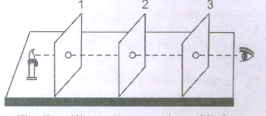
The flame can be seen clearly through the holes. When one of the cardboards is slightly raised, no flame can be seen. This shows that light travels in a straight line. No flame can be seen when the holes of the three cardboards are not in a straight line because light can not bend.
15.
(a) Fungus are non-green plants that grow on dead and decaying matter for their food.
(b) Fungus are also useful as it can cure different type of infections.
(c) Vivek is sincere, curious and knowledge with a keen sense of applying it where necessary.
16.
Given below is the table of contaminant survey explaining types of sewage with their point of origin and contaminate in them.
| Types of sewage | Point of origin | Substances which contaminate | Any other remark |
|---|---|---|---|
| Sullage water | Kitchen | Cooking oils, fats, etc. | May choke drains |
| Foul waste | Toilets | Faeces and urine | Cause diseases like dysentery, cholera, etc |
| Trade waste | Industrial and commercial organisations | Chemicals like paints, solvents, motor oil, etc | Causes water and soil pollution |
17.
The terms like sewage, sewers and sewerage are interlinked with each other because sewage is a mixture of wastewater coming out of homes and other places. Sewers are pipes which carry sewage and sewerage is a network of sewage carrying pipes.
18.
Difference between decomposers and scavengers is
| Decomposer | Scavenger |
| These are the microbes which break dead organic matter into simple molecules to be used by plants again. |
These animals eat the body of dead animals and are called cleaning agent of forests, e.g. jackal, fox, vultures, etc. |
19.
()
Food gives us energy and builds our body. If we do not eat regularly, we will suffer bodily.
20.
()
When air is blow in the pressure inside the bottle rises up. Then it is hard to force the ball in.
21.
()
Sweating keeps us cool can sustains body temperature.
22.
()
Yes, the days are shorter in winter than in summer.
23.
()
Legumes (pulses)
24.
(a) female
(b) eggs
(c)larvae
(d) caterpillars
(e) silkworms
(f) pupa
(g) cocoon

7th Standard CBSE Syllabus & Materials
7th Standard CBSE
CBSE 7th Social Science Theme B - New Beginnings : Cities and States - New Sample Question Papers Study Material - QB365 Set A
NEW7th Standard CBSE
CBSE 7th Social Science Theme A - Climates of India - New Sample Question Papers Study Material - QB365 Set A
NEW7th Standard CBSE
CBSE 7th Social Science Theme A - Geographical Diversity of India - New Sample Question Papers Study Material - QB365 Set A
NEW7th Standard CBSE
CBSE 7th Science Earth, Moon and the Sun - New Sample Question Papers Study Material - QB365 Set A



NCERT Books

Syllabus

Exam Pattern

Sample Question Papers

Previous year Question Papers

Important Notes

MCQ Practice test

NCERT Exemplers

Case study Questions

Image Based Questions

Passage based Questions

HOT Questions

Value Based Questions

Model Questions Papers
NCERT ( Book Back ) Questions

Assertion and Reason
Important Questions And Answers

CBSE 7th Standard CBSE Subjects
CBSE Standards