 100% FREE ACCESS
7th Standard CBSE Syllabus & Materials
7th Standard CBSE
CBSE 7th Social Science Theme E - Understanding Market - New Sample Question Papers Study Material - QB365 Set A
NEW7th Standard CBSE
CBSE 7th Social Science Theme E - From Barter to Money - New Sample Question Papers Study Material - QB365 Set A
NEW7th Standard CBSE
CBSE 7th Social Science Theme D - The Constitution of India- An Introduction - New Sample Question Papers Study Material - QB365 Set A
NEW7th Standard CBSE
CBSE 7th Social Science Theme D - From the Rulers to the Ruled : Types of Governments - New Sample Question Papers Study Material - QB365 Set A
NEW7th Standard CBSE
CBSE 7th Social Science Theme B - The Age of Reorganisation - New Sample Question Papers Study Material - QB365 Set A
NEW7th Standard CBSE
CBSE 7th Social Science Theme B - The Rise of Empires - New Sample Question Papers Study Material - QB365 Set A

Published on: 31/10/2025
Download CBSE Class 7th Standard CBSE Science question papers, sample papers, important questions, and previous year solved papers in PDF format. Get free study materials, NCERT solutions, and exam preparation resources for Class 7th Standard CBSE Science
Questions + Answers key
Take MCQ Science Test
1.
What are the different types of inorganic and organic impurities generally present in sewage?
2.
A mixture (x) in water contains suspended solids, organic impurities, inorganic impurities (a) nutrients. (b) disease causing bacteria and other microbes. Give names for (x), (a) and (b) ?
3.
What are the various alternative arrangements for sewage disposal other than WWTP?
4.
How a vermi-composting toilet works?
5.
List the various sources of water pollutions.
6.
What is potable water? Write its characteristics
7.
What do you mean by water cleaning?
8.
How can we control water pollution?
9.
Outline your role as an active citizen in relation to sanitation.
10.
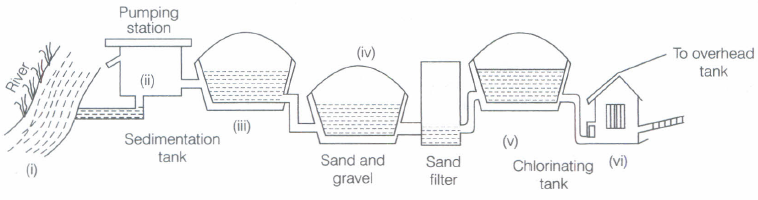
Observe the given figure and answer the following: What does this figure show?
11.
With reference to the treatment of polluted water at home by aeration, filtration, chlorination processes answer the following questions.
Do chlorine have an odour?
12.
Three statements are provided here which define the terms, i.e. sludge, sewage and wastewater.
Pick out the correct definition for each of these terms.
(a) The settled solids that are removed in wastewater treatment with a scraper.
(b) Water from kitchen used for washing dishes.
(c) Wastewater released from homes, industries, hospitals and other public buildings.
13.
Can we contribute in sanitation at public places? Explain.
14.
Describe onsite disposal systems.
15.
The terms sewage, sewers and sewerage are interlinked with each other. Can you explain, how?
1.
(i) Inorganic impurities - nitrates, phosphates and metals.
(ii) Organic impurities - fruit and vegetable wastes, oil, urea, human faeces, animal waste, pesticides and herbicides
2.
(x) sewage
(a) nitrates, phosphates and metal
(b) phosphorus and nitrogen
3.
Various alternative arrangements for sewage disposal other than WWTP are septic tanks, chemical toilets and composting pits. Septic tanks are suitable for places where there is no sewage system, such as hospitals, isolated buildings or cluster of 4-5 houses. In other methods, the excreta flow through covered drains into a biogas plant. The biogas thus produced is used as a source of energy.
4.
It is a design of a toilet in which humans excreta is treated by earthworms. It is a novel, low wateruse toilet for safe processing of human waste. The operation of the toilet is very simple and hygienic. In this toilet excreta is completely converted to vermi cakes-a resource much needed for soil.
5.
(i) Domestic wastes
(ii) Agricultural wastes
(iii) Fertilizers
(iv) Insecticides and pesticides
(v)Industrial wastes
(vi) Discharge of sewage
6.
The water which is fit for drinking by human beings is called potable water.
Characteristics:
(i)It is transparent.
(ii)It is odourless and colourless.
(ill) It is harmless or free from disease causing bacteria.
7.
Cleaning of water is a process of removing pollutants from water before it enters a water body or is reused. This process of waste water treatment is commonly known as sewage treatment. It takes place in several stages.
8.
We can control pollution by following measures:
(i)By avoiding disposal of industrial and household wastes into river water.
(ii)By avoiding washing of clothes, cleaning utensils and bathing with soap near the source of water.
(iii) By covering the mouth of well so that dust, leaves etc., may not fall into it.
9.
We all have a part to play in keeping our environment clean and healthy. We must shoulder our responsibility in maintaining the water sources in a healthy state. Adopting good sanitation practices should be our way of life. As an agent of change, our individual initiative will make much difference. We can set an example to others with our energy, ideas and optimism. Much can be done if people work together. There is great power in collective action.
10.
This figure shows the supply of drinking water, its processing and its source as well. Functions of each part of the figure.
11.
Yes, chlorine have a peculiar odour which is not worse than wastewater.
12.
(a) The settled solids that are removed in wastewater treatment with a scraper is sludge.
(b) Water from kitchen which is used for washing dishes is wastewater.
(c) Wastewater released from homes, industries, hospitals and other public buildings is sewage.
13.
Yes, we all have a, role to play in keeping our environment clean and healthy. All of us can contribute in maintaining sanitation at public places. We should not scatter litter anywhere. If there is no dustbin in sight, we should carry the litter home and throw it in the dustbin .
14.
Some organizations offer hygienic onsite human waste disposal technology. These toilets do not require scavenging. Excreta from the toilet seats flow through covered drains into a biogas plant. The biogas produced is used as a source of energy.
15.
The terms like sewage, sewers and sewerage are interlinked with each other because sewage is a mixture of wastewater coming out of homes and other places. Sewers are pipes which carry sewage and sewerage is a network of sewage carrying pipes.

7th Standard CBSE Syllabus & Materials
7th Standard CBSE
CBSE 7th Social Science Theme B - New Beginnings : Cities and States - New Sample Question Papers Study Material - QB365 Set A
NEW7th Standard CBSE
CBSE 7th Social Science Theme A - Climates of India - New Sample Question Papers Study Material - QB365 Set A
NEW7th Standard CBSE
CBSE 7th Social Science Theme A - Geographical Diversity of India - New Sample Question Papers Study Material - QB365 Set A
NEW7th Standard CBSE
CBSE 7th Science Earth, Moon and the Sun - New Sample Question Papers Study Material - QB365 Set A



NCERT Books

Syllabus

Exam Pattern

Sample Question Papers

Previous year Question Papers

Important Notes

MCQ Practice test

NCERT Exemplers

Case study Questions

Image Based Questions

Passage based Questions

HOT Questions

Value Based Questions

Model Questions Papers
NCERT ( Book Back ) Questions

Assertion and Reason
Important Questions And Answers

CBSE 7th Standard CBSE Subjects
CBSE Standards