
 100% FREE ACCESS
7th Standard CBSE Syllabus & Materials
7th Standard CBSE
CBSE 7th Social Science Theme E - Understanding Market - New Sample Question Papers Study Material - QB365 Set A
NEW7th Standard CBSE
CBSE 7th Social Science Theme E - From Barter to Money - New Sample Question Papers Study Material - QB365 Set A
NEW7th Standard CBSE
CBSE 7th Social Science Theme D - The Constitution of India- An Introduction - New Sample Question Papers Study Material - QB365 Set A
NEW7th Standard CBSE
CBSE 7th Social Science Theme D - From the Rulers to the Ruled : Types of Governments - New Sample Question Papers Study Material - QB365 Set A
NEW7th Standard CBSE
CBSE 7th Social Science Theme B - The Age of Reorganisation - New Sample Question Papers Study Material - QB365 Set A
NEW7th Standard CBSE
CBSE 7th Social Science Theme B - The Rise of Empires - New Sample Question Papers Study Material - QB365 Set A

Published on: 31/10/2025
Download CBSE Class 7th Standard CBSE Science question papers, sample papers, important questions, and previous year solved papers in PDF format. Get free study materials, NCERT solutions, and exam preparation resources for Class 7th Standard CBSE Science
Questions + Answers key
Take MCQ Science Test
1.
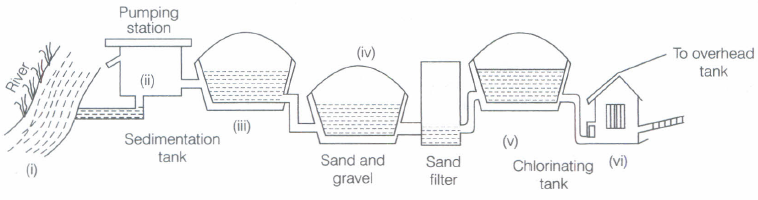
Observe the given figure and answer the following: State the functions of each part of the figure?
2.
With reference to the treatment of polluted water at home by aeration, filtration, chlorination processes answer the following questions.
Do chlorine have an odour?
3.
With reference to the treatment of polluted water at home by aeration, filtration, chlorination processes answer the following questions.
What is removed by the sand filter?
4.
A man travelling in a train threw an empty packet of food on the platform. Do you think this is a proper waste disposal method? Elaborate.
5.
Untreated human excreta is a health hazard. Explain.
6.
In the chemical process of water treatment water is treated with some chemicals. Describe chlorination in light of it.
7.
Protozoa is causative organism of which waterborne disease?
8.
Give some examples of onsite sewage disposal systems.
9.
Mention the use of dried sludge.
10.
The Eucalyptus trees are planted along sewage ponds. Give reason.
11.
Think and suggest some ways to minimise waste and pollutants at their source, taking your home as an example.
12.
There are many alternative sewage disposal systems which have been developed as per needs of the community, persons, occasions, etc. Few situations/specifications of the sewage need are given below. Write the name of sewage which can be used in the following conditions.
(a) A toilet which can provide high quality manure.
(b) The toilet which is used in aeroplane during flight.
(c) A toilet which can be used in some out door gathering.
(d) A toilet used in limited water supply.
(e) A toilet which contaminates water of hand pump installed nearby.
13.
Which one of the following is a quality of wastewater?
Fowl smell
Bad taste
Dirty look
All of these
14.
One of the following type of trees are said to help in purifying wastewater quite rapidly when planted all along the sewage ponds. These are
Eucalyptus trees
Ficus trees
neem trees
peepal trees
15.
The system of a network of pipes used for taking away wastewater from homes or public buildings to the treatment plant is known as
sewers
sewerage
transport system
treatment plant
16.
Which of the following is/are products of wastewater treatment?
Biogas
Sludge
Both biogas and sludge
Aerator
17.
Sewage is mainly a
liquid waste
solid waste
gaseous waste
mixture of solid and gas
18.
Bacteria play important _______________ in sewage treatment.
19.
The full form of WWTP is _______________
20.
All portable toilets are ________________ toilets.
21.
Stagnant water blocked in drains is good breeding place for _______________
22.
Wastewater is treated in ______________ treatment plant.
23.
Urea is an inorganic impurity present in sewage.
24.
Aerobic bacteria produces biogas sludge in the digester tank.
25.
Tuberculosis is a water-borne disease.
26.
Wastewater is transparent, colourless, odourless.
27.
Poor sanitation and contaminated drinking water is the cause of a large number of diseases.
1.
(i) River It is the source of water.
(ii) Pumping station Pump the water to collect it in reservoir.
(iii) Sedimentation tank Impurities are settle in the bottom of tank.
(iv) Sand and gravel and sand filter Remove the dirt from the water.
(v) Chlorinating tank Chlorine is mixed in water to disinfect the water and to kill the germs.
(vi) To overhead tank Purified water is stored in this tank for supply to the households for drinking.
2.
Yes, chlorine have a peculiar odour which is not worse than wastewater.
3.
Sand filter removes tiny suspended impurities.
4.
No, one must always put the waste in a nearby dustbin or carry it home and dispose it in dustbins there.
Waste, not properly disposed may enter into the drains and choke them. It also makes public places dirty and unhygienic.
5.
Human excreta may cause water pollution and soil pollution which can lead to a lot of health related problems. Water polluted with it contains disease causing bacteria which can spread epidemics and becomes the most common route for water-borne diseases like cholera, dysentery, typhoid, etc.
6.
Chlorination is the process of adding chlorine (chemical) in water to make it safe for drinking.
7.
Dysentry.
8.
Chemical toilets, septic tanks, composting pits, etc.
9.
It is used as manure, thus returning organic matter and nutrients to the soil.
10.
The Eucalyptus trees are planted along sewage ponds because these trees absorb all surplus wastewater rapidly and release pure water vapour into the atmosphere.
11.
We can minimise waste and pollutants entering the water and create less wastewater by taking following few steps at home:
(i) By not throwing used tea leaves, solid food remains, etc., in the drain. We should throw it in the dustbin.
(ii) By not throwing chemicals like medicines, paints, insecticides, etc., in the drain as they increase the pollution load of the sewage
12.
(a) Vermi-composting toilets
(b) Vacuum toilets
(c) Chemical toilets
(d) Composting toilets
(e) Septic tank toilets
13.
(d)
All of these
14.
(a)
Eucalyptus trees
15.
(b)
sewerage
16.
(c)
Both biogas and sludge
17.
(a)
liquid waste
18.
()
role
19.
()
wastewater treatment plant
20.
()
chemical
21.
()
insect vectors
22.
()
waste
23.
(b)
24.
(b)
25.
(b)
26.
(b)
27.
(a)

7th Standard CBSE Syllabus & Materials
7th Standard CBSE
CBSE 7th Social Science Theme B - New Beginnings : Cities and States - New Sample Question Papers Study Material - QB365 Set A
NEW7th Standard CBSE
CBSE 7th Social Science Theme A - Climates of India - New Sample Question Papers Study Material - QB365 Set A
NEW7th Standard CBSE
CBSE 7th Social Science Theme A - Geographical Diversity of India - New Sample Question Papers Study Material - QB365 Set A
NEW7th Standard CBSE
CBSE 7th Science Earth, Moon and the Sun - New Sample Question Papers Study Material - QB365 Set A



NCERT Books

Syllabus

Exam Pattern

Sample Question Papers

Previous year Question Papers

Important Notes

MCQ Practice test

NCERT Exemplers

Case study Questions

Image Based Questions

Passage based Questions

HOT Questions

Value Based Questions

Model Questions Papers
NCERT ( Book Back ) Questions

Assertion and Reason
Important Questions And Answers

CBSE 7th Standard CBSE Subjects
CBSE Standards