 100% FREE ACCESS
8th Standard CBSE Syllabus & Materials
8th Standard CBSE
CBSE 8th Social Science Theme D - Factors of Production - New Model Questions Papers Study Material - QB365 Set A
NEW8th Standard CBSE
CBSE 8th Social Science Theme C - Universal Franchise and India's Electoral System - New Model Questions Papers Study Material - QB365 Set A
NEW8th Standard CBSE
CBSE 8th Social Science Theme B - The Rise of the Marathas - New Model Questions Papers Study Material - QB365 Set A
NEW8th Standard CBSE
CBSE 8th Social Science Theme B - Reshaping India's Political Map - New Model Questions Papers Study Material - QB365 Set A
NEW8th Standard CBSE
CBSE 8th Social Science Theme A - Natural Resources and Their Use - New Model Questions Papers Study Material - QB365 Set A
NEW8th Standard CBSE
CBSE 8th Science Keeping Time with Skies - New Model Questions Papers Study Material - QB365 Set A

Published on: 29/10/2025
Download CBSE Class 8th Standard CBSE Science question papers, sample papers, important questions, and previous year solved papers in PDF format. Get free study materials, NCERT solutions, and exam preparation resources for Class 8th Standard CBSE Science
Questions + Answers key
Take MCQ Science Test
1.
How can you take care of the eyes?
2.
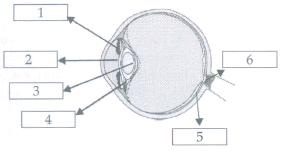
Write down the names of parts of the eye in the blank spaces shown in fig. below.
3.
Describe the construction of a kaleidoscope.
4.
Describe an activity to show that the incident ray, the reflected ray and the normal at the point of incidence, all lie in the same plane.
5.
Explain the reason for the following statement. We usually take some time to see the objects in a dim light room, when we enter into the room from bright sunlight outside.
6.
Aditya visited a lake on two days. On the first day, the reflection of the surrounding mountains could be seen clearly in water of the lake. On the second day, he was not able to see the reflection of the mountains clearly. Give one possible reason for this phenomenon and explain your answer clearly.
7.
How is the phenomenon of reflection used in making a kaleidoscope? What are the applications of a kaleidoscope?
8.
A man stands 10m in front of a large plane mirror. So, how far must he walk before he is 5 m away from his image?
9.
Explain the process which enables us to perceive motion in a cartoon film.
10.
Boojho planned an activity to observe an object A through pipes as shown in figure so that he could see objects which he could not directly see.
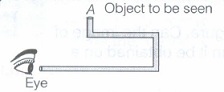
(a) Mention how many mirrors should he use to see the objects.
(b) Indicate the positions of the mirrors in the figure.
(c) State what must be the angle w.r.t. the incident light at which he should place the mirrors.
(d) Indicate the direction of rays in the figure.
(e) If any of the mirrors is removed, will he be able to see the objects?
1.
Care of the eyes: It is necessary to take proper care of eyes. Few suggestions are as follows:
(i) If advised, use suitable spectacles.
(ii) Too little or too much light is bad for eyes. Insufficient light causes eye strain and headaches.
(iii) Do not look at the sun or a powerful light directly.
(iv) Never rub your eyes. If particles of dust go into your eyeswash your eyeswith cleanwater.
(v) Always read at the normal distance for vision. Do not read by bringing the book too close to your eyes or keeping it too far.
2.
(1) Cornea
(2) Iris
(3) Eye lens
(4) Ciliary muscles
(5) Sclera
(6) Blind Spot.
3.
The construction of a kaleidoscope :
(i) Get three rectangular mirror strips each about 15 em long and 4 cm wide.
(ii) Join them together to form prism.
(iii) Fix them in a circular cardboard tube or a tube of thick chart paper.
(iv) Make sure that the tube is slightly longer than the mirror strips.
(v) Close one end of the tube by a cardboard dice having a hole in the centre through which we can see.
(vi) To increase durability paste a piece of transparent plastic sheet under the cardboard disc.
(vii) At the other end touching mirror fix a circular plane glass plate.
(viii) Place several small pieces of coloured glass bangles this glass plate.
(ix) Close this end of the tube by a ground glass plate. Keep enough space between the pieces to move around.
4.
An activity to show that the incident ray, the reflected ray and the normal at the point of incidence, all lie in the same plane is as follows:
(i) Fix a white sheet of paper on a drawing board or a table.
(ii) Take a comb and drain all its openings except one in the middle using a slack paper.
(iii) Hold the comb perpendicular to the sheet of paper.
(iv) Throw light from a torch through the opening of the comb from one side.
(v) With the adjustment of the torch and comb, we see a ray of light along the paper strike the mirror.
(vi) After striking the mirror the ray of light is reflected in another direction. The ray that strikes any surface is called the incident ray.
(vii) The ray that comes back from the surface after reflection is called the reflected ray.
Theoretically, we can describe the above activity as follows:
(1) Draw a straight horizontal line with small slanted line on it showing the painted side of the mirror as shown in the figure below.
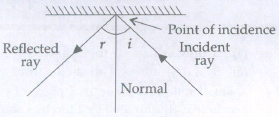
(2) Draw the incident ray, reflected ray and normal as shown such that the angle of incidence is equal to the angle of reflection and all the three rays lie in the same plane.
5.
Since, when we are in the bright sunlight at that moment iris causes the pupil to become smaller so that a little amount of light can enter the eye. Morever, the rods of retina are also made to get adjusted in the same manner.
And when a person enters into dim light room, then iris take some time to increase the pupil diameter, due to which large amount of light enters the eye, so that's why when we enter into the room from bright sunlight outside, then we usually take some time to see the objects in a dim room.
6.
The unclear image of the mountains on the second day is probably due to wind blowing across the lake causing it to lose its calmness. When the lake is calm, the surface of the lake is smooth and regular reflection occurs, allowing a clear image of the mountains to be formed. When the wind blows across the lake, the surface of the lake becomes rough and uneven causing a diffused reflection. Hence, the image formed of the mountains will be unclear and blurred.
7.
Kaleidoscope is a cylinder with mirrors containing loose, coloured objects such as beads or pebbles and bits of glass. As the viewer looks into one end, light entering the other creates a colourful pattern due to reflection. Its applications are given below:
(i) It works on the principle of multiple reflections, where several mirrors are placed at an angle (usually 60°) to one another. Typically, these are three rectangular mirrors set at 60° to each other so that they form an equilateral triangle.
(ii) The 60° angle creates seven duplicate images of the objects, 5 at 60° and 2 at 90°. As the tube is rotated, the tumbling of the coloured objects presents varying colours and patterns.
(iii) It is used in decoration purposes, toys, etc.
8.
As per the given information point 'O' initial position of the man and I initial position of the image of the man can be show with the help of a figure.
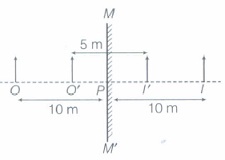
Point O' final position of the man and I' final position of the image of the man. From the figure,
O'P + PI' = 5m [O'P = PI']
\(\Rightarrow\) O'P+ O'P = 5m
\(\Rightarrow\) O'P = 2.5m
Distance walked by the man = OP - O'P
= 10 - 2.5
= 7.5m.
9.
In a cartoon film, the movement of cartoons is completely perceived by brain after getting signals from optic nerve. Since persistence of vision is completely brain centred.
The image is formed on retina which changes continuously and through optic nerve, signals reach to the brain and brain orders eyes to watchit in continuous motion.
10.
(a) Number of mirrors = 3
(b) Positions of the mirrors are as shown in figure.
(c) Mirrors should be placed at 45° w.r.t. the incident light. So, that ray can move forward.
(d) Direction of rays is shown in figure.
(e) He will not be able to see the objects if any of the mirrors is removed since he will not get the rays after that removed mirror.

8th Standard CBSE Syllabus & Materials
8th Standard CBSE
CBSE 8th Science Particulate Nature of Matter - New Model Questions Papers Study Material - QB365 Set A
NEW8th Standard CBSE
CBSE 8th Science Pressure, Winds, Stroms and Cyclones - New Model Questions Papers Study Material - QB365 Set A
NEW8th Standard CBSE
CBSE 8th Mathematics Quadrilaterals - New Model Questions Papers Study Material - QB365 Set A
NEW8th Standard CBSE
CBSE 8th Mathematics A story of Numbers - New Model Questions Papers Study Material - QB365 Set A



NCERT Books

Syllabus

Exam Pattern

Sample Question Papers

Previous year Question Papers

Important Notes

MCQ Practice test

NCERT Exemplers

Case study Questions

Image Based Questions

Passage based Questions

HOT Questions

Value Based Questions

Model Questions Papers
NCERT ( Book Back ) Questions

Assertion and Reason
Important Questions And Answers

CBSE 8th Standard CBSE Subjects
CBSE Standards