
 100% FREE ACCESS
8th Standard CBSE Syllabus & Materials
8th Standard CBSE
CBSE 8th Social Science Theme D - Factors of Production - New Model Questions Papers Study Material - QB365 Set A
NEW8th Standard CBSE
CBSE 8th Social Science Theme C - Universal Franchise and India's Electoral System - New Model Questions Papers Study Material - QB365 Set A
NEW8th Standard CBSE
CBSE 8th Social Science Theme B - The Rise of the Marathas - New Model Questions Papers Study Material - QB365 Set A
NEW8th Standard CBSE
CBSE 8th Social Science Theme B - Reshaping India's Political Map - New Model Questions Papers Study Material - QB365 Set A
NEW8th Standard CBSE
CBSE 8th Social Science Theme A - Natural Resources and Their Use - New Model Questions Papers Study Material - QB365 Set A
NEW8th Standard CBSE
CBSE 8th Science Keeping Time with Skies - New Model Questions Papers Study Material - QB365 Set A

Published on: 29/10/2025
Download CBSE Class 8th Standard CBSE Science question papers, sample papers, important questions, and previous year solved papers in PDF format. Get free study materials, NCERT solutions, and exam preparation resources for Class 8th Standard CBSE Science
Questions + Answers key
Take MCQ Science Test
1.
Water is one of our most precious commodities and no life can survive without it. It has been predicted that water scarcity will become the subjects of 'Wars' in the near future. Write any two ways in which water is getting polluted. Write any two measures to stop water pollution at your level.
2.
My sister is in the habit of keeping the tap open while brushing her teeth. She loves to bath under shower. My neighbour uses hosepipe attached to drinking water supply pipe for washing his scooter and car.According to me their way of handling the most precious source water is absolutely wrong. Do you agree with me or not? What changes in the above situation can be done to conserve water?
3.
How does air get polluted? Explain.
4.
Why is it advised that industries should switch over to cleaner fuels such as CNG and LPG in the TajMahal Zone in Agra ?
5.
Complete the crossword puzzle with the help of clues given below
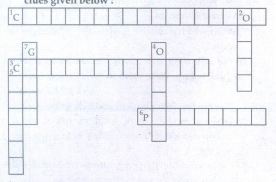
Across:
(i) Pollutant which is used in refrigerators and air conditioners. (18)
(iii) Produced on incomplete combustion of fuels. (14) 6. This chemical protects our crops and is washed into water bodies from the field. (9) Down:
(ii) This layer protects us from harmful ultraviolet rays. (5)
(iv) It is essential for combustion. (6)
(v) Disease which is caused by drinking contaminated water. (7)
(iv) River which is famous in India and sustains most of the northern, central and eastern Indian population. (5)
6.
An Indian holy river is among the ten most endangered rivers list of WWF. Which is it? How is the water of this river polluted?
7.
Read the paragraph and answer the questions following it.
Water is essential for life. Without water there would be no life. We usually take water as granted for its purity, but we must ensure the quality-of water. Pollution of water originates from human activities. Through different paths, pollution reaches to groundwater. Easily identified source or place of pollution is called as point source, e.g. municipal and industrial discharge pipes, where pollutants enter the water source. Non-point sources of pollution are those where a source of pollution cannot be easily identified, e.g. agricultural run-off, acid rain, etc.
(a) How do you classify the various sources of water pollution?
(b) What are the point sources of water pollution?
(c) Name any two non-point sources of water pollution?
8.
We should plant trees and nurture the ones already present in the neighbourhood. Why?
9.
Arjun while travelling with his father saw the same message displayed at every traffic signal. The message was 'stop the vehicle engine at the red lights to save the fuel'. He noticed his father turning the engine off at each signal. He was confused to see this and asked his father
(a) It is recommended to stop the vehicle engine at the red light signals. Give reason.
(b) Suggest the process associated when vehicle engine is ON.
(c) What values are government trying to inculcate in people with the message?
(d) Will you support the message? Why?
(e) Mention the values shown by Arjun.
10.
What do CFCs stand for? Name some devices where CFCs are used. Why CFCs are considered as pollutants?
1.
Water is an important and precious resource. Nowadays it is polluted with many harmful substances such as sewage, toxic chemicals, silt etc. which get mixed with water. Many industries discharge harmful chemicals into rivers and streams. To avoid these situations many compulsory rules must be obeyed as various physical and chemical processes in the sewage treatment plants must be done before discharging sewage into the water bodies. At our individual level we should consciously save water and do not waste it. Reuse and Recycle should be our Mantra.
2.
If my sister and neighbour are wasting the precious water, I agree with you because we have very less amount of potable water on the earth. As population increases there will be scarcity of this. To control this situation we must talk with them regarding importance of water and tell them alternative methods for their tasks, such as using bucket to take bath and clean their vehicles
3.
Air gets polluted by many reasons. Few of them are as follow:
(i) Vehicles produce high level of pollutants like carbon monoxide, carbon dioxide, nitrogen oxide, smoke etc. These are very poisonous gases. Burning of fuel from vehicles also produces pollution.
(ii) Many industries are also responsible for causing air pollution. Petroleum refineries release polluted gases such as sulphur dioxide, nitrogen dioxide etc. They cause respiratory problems, including lung damage.
(iii)Other kinds of pollutants are CFCs which are largely used in refrigerators, air conditioners and aerosol sprays. Those protect us from ultraviolet rays of the Sun.
(iv) Some human activities like forest fire, burning of fire wood, cow dung cakes, burning of chaff etc. cause air pollution.
(v) Some natural phenomenon like fast dust storms, volcanic eruption produce smoke and dust particles
4.
Pollutants in air are discolouring white marble of Taj Mahal. The Mathura Oil Refinery near Agra as well as various industries in and around Agra are emitting gaseous pollutants such as sulphur dioxide and nitrogen dioxide into the air which cause acid rain. Acid rain corrodes the marble (CaCOJ of the monuments Suspended particulate matter such as the soot particles emitted by Mathura Oil refinery has contributed towards the yellowing of the Marble. The Supreme Court of India ordered all the industries in Agra area to switch over to cleaner fuels like CNG and LPG to reduce air pollution.
5.
Across:
(i) Chlorofluorocarbons
(iii) Carbon monoxide
(iv) Pesticide
Down:
(ii) Ozone
(iv) Oxygen
(v) Cholera
(vii) Ganga
6.
The Ganga is the Indian holy river that is amongst the ten most endangered rivers list of WWF. The water has been highly polluted because the towns and cities through which the river flows, throw huge quantities of garbage, untreated sewage, dead bodies and many other harmful things, directly into the river. In fact, the river is dead at many places where the pollution levels are extremely high.
7.
(a) Various sources of water pollution are classified as point sources and non-point sources.
(b) The sources or places of pollution which are easily identifiable are point sources of water pollution.e.g. factories, power plants, etc.
(c) Agricultural run-off and acid rain are non-point sources of water pollution.
8.
We should plant trees and nurture the ones already present in the neighbourhood. This is to
(i) Reduce air pollution Plants clean the air. They also reduce dust particles in the air. This will lower down the pollution level
(ii) Minimise global warming The greenhouse gas CO2 is responsible for global warming. Plants utilise CO2 for making food and give out O2, Therefore, planting more trees will reduce the CO2 in atmosphere and thus global warming will be in control.
9.
(a) It is recommended to stop the vehicle engine at the red light signals to minimise the emissions of poisonous gases like CO, NO, etc from the automobile exhaust.
(b) With the vehicle engine ON, the incomplete combustion of fuel will take place with release of gases like CO.
(c) The government is trying to make people understand the need for reducing environment pollution and the small steps that they can take for environmental protection.
(d) Yes, I will support the message. It is for the common good.
(e) Arjun is keen learner, strong observer and responsible.
10.
CFCs stand for chlorofluorocarbons.
CFCs are used in refrigerators, air conditioners and aerosol sprays.
CFCs are considered as pollutants because these are depleting the useful ozone layer of the upper atmosphere.
CFCs released into the air, go up and ultimately reach high into the atmosphere where the protective ozone layer exists. The chlorofluorocarbons react with ozone gas of ozone layer and destroy it gradually. This allows the harmful ultraviolet rays of the sun to reach the earth and cause damage.

8th Standard CBSE Syllabus & Materials
8th Standard CBSE
CBSE 8th Science Particulate Nature of Matter - New Model Questions Papers Study Material - QB365 Set A
NEW8th Standard CBSE
CBSE 8th Science Pressure, Winds, Stroms and Cyclones - New Model Questions Papers Study Material - QB365 Set A
NEW8th Standard CBSE
CBSE 8th Mathematics Quadrilaterals - New Model Questions Papers Study Material - QB365 Set A
NEW8th Standard CBSE
CBSE 8th Mathematics A story of Numbers - New Model Questions Papers Study Material - QB365 Set A



NCERT Books

Syllabus

Exam Pattern

Sample Question Papers

Previous year Question Papers

Important Notes

MCQ Practice test

NCERT Exemplers

Case study Questions

Image Based Questions

Passage based Questions

HOT Questions

Value Based Questions

Model Questions Papers
NCERT ( Book Back ) Questions

Assertion and Reason
Important Questions And Answers

CBSE 8th Standard CBSE Subjects
CBSE Standards