 100% FREE ACCESS
8th Standard CBSE Syllabus & Materials
8th Standard CBSE
CBSE 8th Social Science Theme D - Factors of Production - New Model Questions Papers Study Material - QB365 Set A
NEW8th Standard CBSE
CBSE 8th Social Science Theme C - Universal Franchise and India's Electoral System - New Model Questions Papers Study Material - QB365 Set A
NEW8th Standard CBSE
CBSE 8th Social Science Theme B - The Rise of the Marathas - New Model Questions Papers Study Material - QB365 Set A
NEW8th Standard CBSE
CBSE 8th Social Science Theme B - Reshaping India's Political Map - New Model Questions Papers Study Material - QB365 Set A
NEW8th Standard CBSE
CBSE 8th Social Science Theme A - Natural Resources and Their Use - New Model Questions Papers Study Material - QB365 Set A
NEW8th Standard CBSE
CBSE 8th Science Keeping Time with Skies - New Model Questions Papers Study Material - QB365 Set A

Published on: 29/10/2025
Download CBSE Class 8th Standard CBSE Science question papers, sample papers, important questions, and previous year solved papers in PDF format. Get free study materials, NCERT solutions, and exam preparation resources for Class 8th Standard CBSE Science
Questions + Answers key
Take MCQ Science Test
1.
When the meteors enter the atmosphere of Earth, then what does exactly happen?
2.
Write a short note on (i) Comets (ii) Meteors and (iii) Meteorites
3.
What is waxing and vanning of moon?
4.
Explain how the Earth rotates on a tilted axis.
5.
Write in brief about any two constellations.
6.
How are phases of moon formed?
7.
Can you distinguish between planets and stars?
8.
Why do stars appear to move from East to West?
9.
Boojho's quiz: If I am 13 years old, how many times have I gone round the sun?
10.
Paheli: The Earth revolves around the Sun. Does it make Earth a satellite of the Sun?
11.
Explain the difference between a star and a shooting star in a tabular form.
12.
Explain the reason of changing of shape of moon everyday.
13.
The moment, the meteors enter the atmosphere of Earth, then what exactly happens? Explain in brief.
14.
The stars appear to move from east to west,explain why with the help of a reason.
15.
Explain the reason in brief for not existence of life on the mercury planet.
1.
The moment the meteors enter the Earth's atmosphere, then due to the friction of air, they get heated up and become visible. Then, they are seen as a bright streak of light flashing for a moment across the sky, so they usually get burnt out completely before reaching the surface of the Earth.
2.
(i) Comets : Comets are also members of our solar system. Comets are celestial bodies that revolve around the sun in highly elliptical orbits. However, their period of revolution round the sun is usually very large. A comet appears generally as bright head with a long tail. The length of the tail of the comet grows in size as it approaches the sun. The tail of a comet is always directed away from the sun.
(ii) Meteors : At night, when the sky is clear and the moon is not there, you may sometimes see bright streaks of light in the sky. These are commonly known as shooting stars, although they are not stars. They are called meteors. A meteor is usually a small heavenly object moving around the sun. Occasionally, a meteor enters the earth's atmosphere. At that time it has a very high speed. The friction due to atmosphere heats up meteor. It glows and evaporates in a very short time. That is why the bright streak appears for a very short time.
(iii) Meteorites: Some meteors are so large that a part of them reaches the surface of earth before they evaporate completely. These are called meteorites. Meteorites help scientists in investigating the nature of the material from which solar system was formed.
3.
Different phases of moon are visible from the Earth. This change in shapes occurs due to variation in sunlight reflected by moon from its surface. At certain times, it appears to be bright whereas at others it appears to be dark. When brightness of moon is increasing, it is called waxing, when brightness of moon is decreasing, it is called vanning.
4.
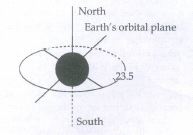
The plane of the equator is called the equatorial plane. The plane in which the Earth revolves round the sun is called the orbital plane of the Earth. These two planes are inclined to each other at an angle of 23.5°. This means that the axis of the Earth is inclined to its orbital plane at an angle of 66.5°.
5.
Ursa Major: We can see it during summer time in the early part of the night. It is also known as Big Dipper, the Great Bear or the Saptarishi. There are seven prominent stars in this. It appears like a big dipper or a question mark. Three stars are in the handle of the ladle and four in its bowl.
Orion: It is seen during winters in late evening. It has seven or eight bright stars. It is also called hunter. Three middle stars represent the belt of the hunter. The four bright stars appear to be arranged in the form of a quadrilateral
6.
The day on which the whole disc of the moon is visible is known as full moon day. Thereafter, every night the size of the bright part of the moon becomes thinner and thinner. On the fifteenth day the moon is not visible, which is known as new moon day. The next day, only a small portion of the moon appears in the sky, known as crescent and then again the moon grows larger every day. On 15th day again we get full view of the moon. These various shapes are called phases. We see different phases of moon as a result of difference in sunlight reflected by moon. Difference in sunlight incident on moon's surface arises due to revolution of moon around the earth.
7.
Yes, stars twinkle whereas planets do not. Also the planets keep changing their position with respect to the stars.
8.
As the earth rotates from West to East direction, so the stars appear to move from East to West direction as seen from the earth.
9.
As earth completes one revolution around the sun in one year, so boojho has gone 13 times round the sun.
10.
Generally, we use the term satellite for the bodies revolving around a planet. Moon is a natural satellite of the earth. So, Earth can be said to be a satellite of Sun.
11.
Difference between a star and a shooting star are
| Star | Shooting star |
| Due to air friction, a star does not get destroyed | After entering the atmosphere of the Earth, a shooting star burns due to heat and friction. |
| A star is very big in size | A shooting star is very very small. |
| A star is made up of hot gases like hydrogen. | A shooting star is made up of rock and metal. |
| A star is luminous. | A shooting star has no light of its own |
12.
Moon reflects the light of the Sun falling on it, thus that part of moon only appears bright which is towards us. The moon along with the Earth revolving around the Sun. As a result, the relative position of the moon continuously changing everyday.
13.
The moment, the meteors enter the Earth's atmosphere, then due to the friction of air, they get heated up and become visible. Then, they seen as a bright streak of light flashing for a moment across the sky, so they usually burnt out completely before reaching the surface of the Earth.
14.
As we know that the Earth rotates from west to east direction due to which the stars appear to move from east to west direction as seen from the Earth.
15.
As we know that the only planet which is nearest to the Sun is Mercury, due to which temperature on it is very high. So, the existence of life on it is impossible. Besides this, this planet has no sign of water on its surface and the gases like carbon dioxide, hydrogen, oxygen and nitrogen do not exist in its atmosphere.

8th Standard CBSE Syllabus & Materials
8th Standard CBSE
CBSE 8th Science Particulate Nature of Matter - New Model Questions Papers Study Material - QB365 Set A
NEW8th Standard CBSE
CBSE 8th Science Pressure, Winds, Stroms and Cyclones - New Model Questions Papers Study Material - QB365 Set A
NEW8th Standard CBSE
CBSE 8th Mathematics Quadrilaterals - New Model Questions Papers Study Material - QB365 Set A
NEW8th Standard CBSE
CBSE 8th Mathematics A story of Numbers - New Model Questions Papers Study Material - QB365 Set A



NCERT Books

Syllabus

Exam Pattern

Sample Question Papers

Previous year Question Papers

Important Notes

MCQ Practice test

NCERT Exemplers

Case study Questions

Image Based Questions

Passage based Questions

HOT Questions

Value Based Questions

Model Questions Papers
NCERT ( Book Back ) Questions

Assertion and Reason
Important Questions And Answers

CBSE 8th Standard CBSE Subjects
CBSE Standards