 100% FREE ACCESS
9th Standard CBSE Syllabus & Materials
9th Standard CBSE
CBSE 9th Science Is matter around us pure? - New Model Questions Papers Study Material - QB365 Set A
NEW9th Standard CBSE
CBSE 9th Science Matter in our surroundings - New Model Questions Papers Study Material - QB365 Set A
NEW9th Standard CBSE
CBSE 9th Mathematics Heron's Formula Sample Question Papers Study Material - QB365 Set A
NEW9th Standard CBSE
CBSE 9th Mathematics Circles Sample Question Papers Study Material - QB365 Set A
NEW9th Standard CBSE
CBSE 9th Mathematics Quadrilaterals Sample Question Papers Study Material - QB365 Set A
NEW9th Standard CBSE
CBSE 9th Mathematics Triangles Sample Question Papers Study Material - QB365 Set A

Published on: 14/08/2026
Download CBSE Class 9th Standard CBSE Mathematics question papers, sample papers, important questions, and previous year solved papers in PDF format. Get free study materials, NCERT solutions, and exam preparation resources for Class 9th Standard CBSE Mathematics
Questions + Answers key
Take MCQ Mathematics Test
1.
If a +b+ c=5 and ab+ bc + ca= 10, find the value of a2+b²+c2.
2.
Factor: 27b3 \(-\left(\frac{1}{64 b^3}\right)\)
3.
Factor completely: 2x2+x-6.
4.
Factor x2 - 5x +6.
5.
Factor x2+ 7x + 12.
6.
A square room has side (2x + 3) metres. Write an expression for its area in expanded form.
7.
Using (a – b)2 = a2- 2ab + b2, find(395)2.
8.
Expand \(\left(4 q+\frac{2}{s}\right)^2\)
9.
Expand using (a + b)²: (1.4w+2)2.
10.
Compute 1192 using (a + b+ c)2
11.
Simplify: 25z2 - 4y2:
(5z + 2y)(5z + 2y)
(5z - 2y)(5z + 2y)
(5z- 2y)(5z- 2y)
(5z- 4y)(5z + 4y)
12.
Which of the following is INCORRECT?
a3- b³ = (a + b)(a² + ab + b2)
a3+b3 = (a + b)(a² - ab + b2)
(a + b)³ = a3 + b3 +3ab(a + b)
(a- b)³= a3 - b³- 3ab(a - b)
13.
The factors of a3 - b3 are:
(a- b)(a² + ab + b2)
(a -b)(a²- ab + b2)
(a + b)(a2 + ab + b2)
(a+ b)(a2 - ab + b2)
14.
The value of 993 using (a - b3) with a= 100, b= 1 is:
970299
970300
970199
970399
15.
The table shows products p + q and pq. For which row do (x + p)(x +q ) factor the quadratic expression x2 + 7x - 18?
Row | (p +q, pq) |
|---|---|
P | (7,-18) |
Q | (-7, 18) |
R | (9, -2) |
S | (2, -9) |
P
Q
R
S
16.
Match the quadratic expressions with their factors.
Quadratic | Factors |
|---|---|
(P) x2+ 8x + 15 | (i) (x+ 2)(x+ 5) |
(Q) x2+ 7x + 10 | (ii) (x+ 3)(x + 5) |
(R)x2-9x + 18 | (iii) (x- 3)(x- 6) |
(S) x2-9x + 20 | (iv) (x- 4)(x- 5) |
(P)-(ii), (Q)-(i), (R)-(iii), (S)-(iv)
(P)-(i), (Q)-(ii), (R)-(iii), (S)-(iv)
(P)-(ii), (Q)-(i), (R)-(iv), (S)-(iii)
(P)-(iii), (Q)-(i), (R)-(ii), (S)-(iv)
17.
In the tile-picture below, a rectangle is formed using 2x2-tiles, 7x-tiles, and 3 unit tiles. Its dimensions are:
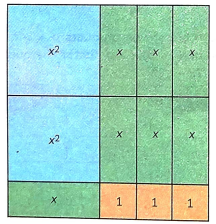
(2x + 3)(x + 1)
(2x + 1)(x + 3)
(x + 2)(2x + 3)
(2x + 2)(x + 3)
18.
A student arranges one x-tile, five x2-tiles and six unit tiles into a rectangle. The sides of the rectangle are:
(x+ 2)(x + 3)
(x+ 1)(x+ 6)
(x+3)(x + 4)
(x+ 2)(x + 4)
19.
For all real numbers a and b, (a + b)²> a2 + b2 holds whenever:
a and b have the same sign (both positive or both negative).
a and b have opposite signs
at least one of a, b is zero.
a= b
20.
A cricket ground is being designed as a square plot. Its side will be (30 + x) m. The expression for its area (in m²) is:
900+x2
900 + 30x + x2
900 + 60x + x2
900- 60x + x2
21.
Match the expressions in Column I with their expanded forms in Column II.
Column-l | Column-lI |
(P) (x + 5)(x- 5) | (i) x2+8x + 16 |
(Q) (x+ 4)2 | (ii)x2- 25 |
(R) (2x – 1)(2x + 1) | (iii) 4x2-1 |
(P)-(ii), (Q)-(i), (R)-(iii)
(P)-(i), (Q)-(ii), (R)-(iii)
(P)-(ii), (Q)-(iii), (R)-(i)
(P)-(iii), (Q)-(i), (R)-(ii)
22.
The table shows values of a and b. For which row is (a + b)² > a2+b2?
Row | (a, b) |
|---|---|
P | (3, -4) |
Q | (-2, -5) |
R | (6, 0) |
S | (1, -1) |
P
Q
R
S
23.
In the figure, a square of side (a + b) is partitioned into four pieces. The pieces represent the identity:
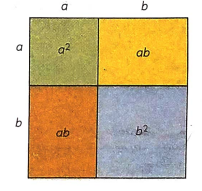
(a + b)² = a2 +2ab + b2
(a+ b)2 = a2-2ab + b2
a2- b2 = (a + b)(a - b)
(a- b)2 = a2+ 2ab - b2
24.
A school's square notice-board has a side of 99 cm. Its area using the identity (a - b)2 is:
9801 cm2
9810 cm2
9901 cm2
9800 cm2
25.
Which of the following is an algebraic identity?
x²+3= 12
(x+ 1)² =x2+2x+1
x+ 5 =9
2x-7=0
26.
Assertion (A): To simplify a rational expression, we must factor the numerator and the denominator first.
Reason (R): Only common terms of the numerator and denominator can be cancelled, not common factors.
Codes:
(a) Both assertion (A) and reason (R) are true and reason (R) the correct explanation of assertion (A).
(b) Both assertion (A) and reason (R) are true and reason (R) is not the correct explanation of assertion (A).
(c) Assertion (A) is true but reason (R) is false.
(d) Assertion (A) is false but reason (R) is true.
27.
Assertion (A): x2+8x + 16 is a perfect square.
Reason (R): A trinomial ax2+ bx + c is a perfect square when b2= 4ac.
Codes:
(a) Both assertion (A) and reason (R) are true and reason (R) is the correct explanation of assertion (A).
(b) Both assertion (A) and reason (R) are true and reason (R) is not the correct explanation of assertion (A).
(c) Assertion (A) is true but reason (R) is false.
(d) Assertion (A) is false but reason (R) is true.
28.
If a number plus its reciprocal equals \(\frac{10}{3},\)find the number.
29.
Factor completely 25a2- 10\(+\frac{1}{a^2} .\)
30.
Factor completely \(9 x^2+6+\frac{1}{x^2}\)
31.
Find the value of (135)2 using (a + b)(a – b) + b2 with a suitable choice of a and b.
32.
A kitchen floor is a square of side (x + 7) m. A smaller square tiled area of side (x + 3) m is set aside in the middle. Find the area of the un-tiled border strip in terms of x, and compute it for x=5.
33.
By factoring the expression, check that n3-n is always divisible by 6 for every natural number n. Give reasons.
34.
If a +b+ c= 4 and ab + bc + ca =7, find the value of a3+b3+c3-3abc.
35.
Factor completely using the splitting-the-middle term method, showing all steps: 6x2+ 17x+ 12. Draw an algebra-tile diagram to confirm the factorisation.
36.
Design a real-if word problem whose solution requires the identity (a + b)² = a2+ 2ab + b2. Solve your own problem, showing all steps.
37.
Factor completely and state the identity(s) used:
\(\frac{m^2}{9}+\frac{m k}{3}+\frac{k^2}{4}+3 n k+2 m n+9 n^2\)
1.
We have to find the value of a2+ b2 + c2, given that a+ b+ c=5 and ab + bc + ca 10,
Using the identity (a + b+ c)2
= a2+b2 + c2+ 2(ab + bc + ca)
Substituting the given values:
(5)2 = a2 + b2 + c2+2(10)
25 = a2 + b2 + c2+ 20
a2+b2 + c2= 25- 20
a2 + b²+ c2=5
∴ a2+b2 +c2=5
2.
\(27 b^3-\left(\frac{1}{64 b^3}\right)=(3 b)^3-\left(\frac{1}{(4 b)}\right)^3\)
\(=\left(\frac{3 b-1}{(4 b)}\right)\left[(3 b)^2+3 b\left(\frac{1}{(4 b)}\right)+\left(\frac{1}{(4 b)}\right)^2\right]\)
\(=\left(\frac{3 b-1}{(4 b)}\right)\left(9 b^2+\frac{3}{4}+\frac{1}{\left(16 b^2\right)}\right)\)
3.
Factorise: 2x2 +x-6
a x c=2 x (-6) =-12
Numbers: 4 and-3
2x2 +x-6 = 2x2+ 4x- 3x-6
= 2x(x + 2) - 3(x+ 2)
= (2x-3)(x + 2)
4.
Need p + q = -5, pq = +6.
Both p, g must be negative.
Negative factor-pairs of 6: (-1, -6), (-2, -3).
Only (-2, -3) sums to -5.
So,x2- 5x + 6 = (x- 2)(x - 3).
5.
Need p + q=7, pq= 12.
Positive factor-pairs of 12: (1, 12), (2, 6), (3. 4).
Only (3, 4) sums to 7.
So, x2 +7x+ 12 = (x+3)(x + 4).
6.
Area of a square= (side)2
Given side: (2x + 3) m
So, Area = (2x + 3)2
Using the identity:
(a+ b)² = a2+ 2ab +b2
(2x + 3)² = (2x)2+2(2x)(3) + 32
= 4x2 + 12x +9
7.
Use the identity (a - b)2 = a2-2ab+ b2
So, 395 =400-5.
Then,
3952 = (400 - 5)2
= 4002 - 2(400)(5) + 52
=160000 – 4000 + 25 = 156025
Hence, 3952 = 156025.
8.
Use the identity (a + b)² = a2+ 2ab + b2.
Here, a = 4q and b=\(\frac{2}{s} .\)
\(\left(4 q+\frac{2}{s}\right)^2=(4 q)^2+2(4 q)\left(\frac{2}{s}\right)+\left(\frac{2}{s}\right)^2\)
\(=16 q^2+\frac{16 q}{s}+\frac{4}{s^2}\)
Hence, the expanded form is \(16 q^2+\frac{16 q}{s}+\frac{4}{s^2}\)
9.
Use the identity (a + b)2= a2+ 2ab + b2
Here, a=1.4w and b =2
(1.4w + 2)2 = (1.4w)2 + 2(1.4w)(2) + (2)2
= 1.96w2+ 5.6w + 4
Hence, the expanded form is 1.96w2 + 5.6w + 4.
10.
119 = 100 + 10 +9.
Set a = 100, b = 10, c = 9:
1192 = 1002 + 102 + 92 + 2(100)(10) + 2(10)(9)+2(100)(9)
= 10000 + 100 + 81 + 2000 + 180+ 1800
= 14 161.
11.
25z2 - 4y2 = (5z)2 -(2y)2
Using the identity a2- b2= (a - b)(a + b), with a = 5z and b = 2y:
= (5z- 2y)(5z + 2y)
∴ The correct option is (b) (5z - 2y)(5z + 2y).
12.
The standard identity for the difference of two cubes is:
a3- b3 = (a- b)(a² + ab + b2)
But option (a) gives a3-b³ = (a + b)(a² + ab + b3), where the first factor (a + b) is wrong; it should be (a - b). The other three options match the correct standard identities:
(b) a3+b3= (a + b)(a2 - ab + b2 )
(c) (a+ b)3 = a3+b3+ 3ab(a + b)
(d) (a- b)3 = a3-b3- 3ab(a -b)
⇒ The correct option is (a) a3-b3=(a + b)(a² + ab + b2), which is the incorrect identity.
13.
Standard identity:
a3- b3 = (a - b) (a² + ab + b2).
14.
993 = (100– 1)3
Using identity:
(a- b)³ = a3 -3a2b+ 3ab2 - b3
= 1000000-3 x 10000 x 1+ 3 x 100 x 1 -1
= 1000000 - 30000 + 300 -1
=970299
15.
To factorise the quadratic expression x2+ 7x- 18, we compare it with the identity:
(x+ p)(x +q )-x2+ (p + q)x + pq
Thus, we require:
p+ q= 7 and pq= 18
Now, checking the given rows:
Row P: (7, -18) satisfies both conditions.
Row Q: (-7, 18) does not satisfy the required values.
Row R: (9, -2) does not satisfy the required values.
Row S: (2, -9) does not satisfy the required values.
Hence, the correct row is P.
16.
To match each quadratic expression with its correct factors, we factorise each expression:
(P) x2+ 8x + 15
Two numbers whose sum is 8 and product is 15 are 3 and 5.
= (x+3)(x+ 5) →(ii)
(Q) x2+ 7x+ 10
Two numbers whose sum is 7 and product is 10 are 2 and 5.
= (x+ 2)(x+ 5)→(i)
(R) x²-9x + 18
Two numbers whose sum is -9and product is 18 are -3 and -6.
= (x-3)(x-6) →(iii)
(S) x2-9x + 20
Two numbers whose sum is -9 and product is 20 are -4 and -5.
= (x- 4)(x-5)→(iv)
Hence, the correct matching is:
P → (ii), Q→(i),R→(iii),S→(iv)
17.
To determine the dimensions of the rectangle formed by the given tiles, we first express the total area as an algebraic expression.
The tiles consist of:
2 tiles of x2 ⇒total area = 2x2
7 tiles of x ⇒ total area =7x
3 unit tiles ⇒ total area =3
Thus, the total area of the rectangle is:
2x² + 7x+3
To find the dimensions, we factorise this expression. We look for two numbers whose product is 2 x 3 = 6 and whose sum is 7. These numbers are 6 and 1.
Splitting the middle term:
2x2+ 7x+3= 2x2 + 6x +x+3
= 2x (x + 3) + 1 (x+ 3)
= (2x + 1) (x+3)
Hence, the dimensions of the rectangle are (2x + 1) and (x+ 3).
18.
A student arranges one x2-tile, five x-tiles and six-unit tiles to form a rectangle.
Total area of the rectangle:
x²+ 5x + 6
To find the sides of the rectangle, we factorise the quadratic expression.
We need two numbers whose product is 6 and sum is 5.
These numbers are 2 and 3.
Thus,
x2+ 5x +6 = x2+2x+3x+6
= x(x + 2) + 3(x + 2)
= (x+ 2) (x+ 3)
Hence, the sides of the rectangle are:
(x+ 2) and (x + 3)
19.
We begin with the given inequality:
(a+ b)² > a2+b2
Expanding the left-hand side
(a+ b)2 =a2+ 2ab + b2
Substituting this in the inequality.
a2+ 2ab +b² >a2 + b2
Cancelling a2 and b2 from both sides, we get
2ab > 0
Dividing both sides by 2,
ab > 0
This happens when a and b have the same sign (both positive or both negative).
So, the correct answer is (a).
20.
Given, side length of squared cricket ground = (30 + x)m
Area of square ground
= (30 + x)2
=302 + 2(30)(x) + x²
= (900 + 60x + x2) m2
Hence, required expression is (c) 900 + 60x + x²
21.
Let us check all options one-by-one:
(P) (x + 5)(x- 5)
Applying the identity (a + b)(a - b) = a2- b2, we obtain:
(x+ 5)(x - 5) = x²-25
This corresponds to (ii) in Column Il.
(Q) (x+ 4)2
Employing the identity (a + b)2 = a2 + 2ab + b2 ,we get:
(x+ 4)2 = x2+2(x)(4) + 42
=x2 +8x + 16
This corresponds to (i) in Column Il.
(R) (2x- 1)(2x + 1)
Again applying (a - b)(a + b) = a2 - b2, we obtain:
(2x- 1)(2x + 1) = 4x2-1
This corresponds to (iii) in Column II
So, the correct answer is (P)-(ii). (Q)-(i). (R)-(iii).
22.
(a + b)2> a2 + b2
⇒ 2ab > 0
⇒ a and b have the same sign.
Let us check all options one-by-one:
Row Q gives (-2, -5), both negative, so 2ab = 20 > 0.
Row P: 2ab = -24;
Row R: 2ab = 0
Row S: 2ab = -2
Hence, option (b) gives correct answer.
23.
The four pieces, a2 + ab + ab + b2
= a2 + 2ab + b2
= (a + b)2, this matches option (a).
24.
Using the identity (a - b)² = a2- 2ab + b2
992 = (100 – 1)2
= 10000 - 200 + 1
= 9801 cm2
25.
Only (x + 1)2 =x2+ 2x+ 1 is true for every x.
The other three are equations that hold for specific values of x only.
26.
(c) Assertion (A) is true but reason (R) is false.
Explanation:
The Assertion states that to simplify a rational expression, we must first factorise both the numerator and the denominator. This is true, since cancellation is possible only after expressing the numerator and denominator as products of factors. The Reason states that only common terms can be cancelled, which is wrong; only common factors can be cancelled.
Hence, Assertion is true but Reason is false.
27.
(a) Both assertion A) and reason (R) are true and reason (R) is the correct explanation of assertion (A).
Explanation:
We are given:
x2 + 8x + 16
Using the identity:
(a + b)2 = a² +b2+ 2ab
Thus,
x2+ 8x + 16 = (x + 4)2
Hence, it is a perfect square.
Now,
The reason states:
A trinomial ax2 + bx + c is a perfect square when b2 = 4ac.
For the given expression:
⇒ a =1,b=8, c=16
Check:
b² =82= 64. 4ac = 4 x 1 x 16= 64
Since b2 = 4ac, the condition is satisfied.
28.
Let the required number be x.
According to the given condition:
\(x+\frac{1}{x}=\frac{10}{3}\)
Multiplying both sides by x:
\(x^2+1=\left(\frac{10}{3}\right) x\)
Rewriting the equation:
\(x^2-\left(\frac{10}{3}\right) x+1=0\)
Multiplying throughout by 3 to remove the fraction:
3x2-10x+3=0
Now, factorising:
3x2-10x+3 = 0
=3x2-9x - x+3=0
=3x(x -3)- 1(x-3) = 0
= (3x - 1)(x – 3) = 0
Therefore,
3x-1 =0 or x-3=0
So,
\(x=\frac{1}{3} \text { or } x=3\)
Hence, the required numbers are:
\(3 \text { and } \frac{1}{3}\)
29.
Expressing the first and third terms as perfect squares:
\(25 a^2=(5 a)^2 \text { and } \frac{1}{a^2}=\left(\frac{1}{a}\right)^2\)
The middle term can be written as:
\(-2(5 a) \frac{1}{a}=-2 \times 5=-10\)
Using the identity a2- 2ab + b2 = (a- b)2:
\(25 a^2-10+\frac{1}{a^2}=(5 a)^2-2(5 a)\left(\frac{1}{a}\right)+\left(\frac{1}{a}\right)^2\)
\(=\left(5 a-\frac{1}{a}\right)^2\)
\(\therefore 25 a^2-10+\frac{1}{a^2}=\left(5 a-\frac{1}{a}\right)^2\)
30.
Expressing the first and third terms as perfect squares:
\(9 x^2=(3 x)^2 \text { and } \frac{1}{x^2}=\left(\frac{1}{x}\right)^2\)
The middle term can be written as:
\(2(3 x)\left(\frac{1}{x}\right)=2 \times 3=6\)
∴ Using the identity a2 + 2ab + b2= (a + b)²:
\(9 x^2+6+\frac{1}{x^2}=(3 x)^2+2(3 x)\left(\frac{1}{x}\right)+\left(\frac{1}{x}\right)^2\)
\(=\left(3 x+\frac{1}{x}\right)^2\)
∴ \(9 x^2+6+\frac{1}{x^2}=\left(3 x+\frac{1}{x}\right)^2\)
31.
We have to find the value of(135)2 using the identity:
(a+ b)(a - b) + b² = a2 -b2 + b = a2
For a suitable choice, let us take a = 135 and b = 5, so that (a - b) and (a + b) become easy round numbers.
Then: a-b= 135 - 5=130
a+ b= 135 + 5 = 140
Now, applying the identity:
(135)2 = (a+ b)(a – b) + b2
= (140)(130) + (5)2
= 18200 + 25 = 18225
⇒ (135)2 = 18225
32.
Outer square area = (x + 7)2
Inner tiled square area = (x+ 3)2
Area of the un-tiled border strip:
(x+ 7)2- (x+ 3)2
Using expansion,
(x + 7)2 =x2 + 14x+ 49
(x+ 3)2 =x2+6x+9
So, (x2 + 14x + 49) - (x2+ 6x + 9)
= 8x + 40
Therefore, area of the untiled border strip is 8x + 40 m2.
For x = 5:
Area = 8(5) + 40
= 40 + 40
= 80 m².
33.
Factorising:
n3-n=n(n2 - 1)
= n(n- 1) (n + 1)
Thus, n3 -n= n(n - 1)(n + 1), which is the product of three consecutive natural numbers.
Among any three consecutive natural numbers:
One number is divisible by 2 (since every second number is even).
One number is divisible by 3 (since every third number is a multiple of 3).
Therefore, the product n(n - 1)(n + 1) is divisible by 2 x 3 =6.
Hence, n3 -n is always divisible by 6 for every natural number n.
34.
Using the identity:
a3+b3 +c3 -3abc= (a + b +c )(a² + b2 + c2- ab - bc - ca)
First, find a2 + b2 +c 2:
a2+b2 +c2=(a+ b+ c)2 -2(ab + bc + ca)
= 42 - 2(7)
= 16- 14
=2
Now,
a3+b3+c3-3abc=4(2-7)
= 4(-5)
=-20
Hence, the required value is -20.
35.
The given expression is 6x2+ 17x + 12.
To factorise a quadratic of the form ax2 + bx + c by splitting the middle term, we need to find two numbers whose:
Sum = b = 17 (the coefficient of x)
Product = a x c=6 x 12 =72
Let us list the factor pairs of 72 to find a suitable pair:
1x 72, 2 x 36,3 x 24, 4 x 18,6 x 12, 8 x 9
Among these, the pair (8,9) satisfies our condition, since:
8+9 =17
8 x 9 =72
Now,
6x2 + 17x + 12 = 6x2+8x+9x + 12
= 2x(3x + 4) + 3(3x + 4)
= (3x + 4)(2x + 3)
The arrangement is shown below:
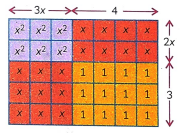
Algebra-Tile Diagram (Confirmation):
Algebra tiles provide a visual proof of the factorisation.
The given expression requires three types of tiles:
(i) Large square tiles, each of area x2 ____ total 6 tiles representing 6x2
(ii) Rectangular tiles, each of area x ___ total 17 tiles representing 17x
(iii) Unit square tiles, each of area 1___total 12 tiles representing 12
These tiles are arranged into a single large rectangle whose dimensions correspond to the two factors:
Length of the rectangle = (3x + 4) units
Breadth of the rectangle = (2x + 3) units
36.
Sample problem (student may create different ones): "A square pizza is cut into one big square slice of side 6 in, one small square slice of side 2 in, and two rectangular slices of sides 6 in x 2 in. What is the total area of the pizza, and is it itself a square? If so, what is its side?"
Total =62+ 22 + 2(6 x 2)
=36+ 4 + 24
= 64 sq. in.
Since, \(\sqrt{64}=8 ;\)
The pizza is indeed an 8-inch square, confirming (6 + 2)2= 62 + 2(6)(2) + 22.
This is the identity (a + b)2= a2 + 2ab + b2
with a = 6, b = 2.
37.
Given expression:
\(\frac{m^2}{9}+\frac{m k}{3}+\frac{k^2}{4}+3 n k+2 m n+9 n^2\)
We use the identity:
(a+ b+ c)² = a2 + b²+ c2+ 2ab + 2bc + 2ca
Rewriting the given expression, we observe that:
\(\frac{m^2}{9}=\left(\frac{m}{3}\right)^2, \frac{k^2}{4}=\left(\frac{k}{2}\right)^2, 9 n^2=(3 n)^2\)
Also,
\(\frac{m k}{3}=2\left(\frac{m k}{3}\right)\left(\frac{k}{2}\right)\)
\(3 n k=2\left(\frac{k}{2}\right)(3 n)\)
\(2 m n=2\left(\frac{m}{3}\right)(3 n)\)
Thus, the given expression is of the form (a + b+ c )2
where:
\(a=\frac{m}{3}, b=\frac{k}{2}, c=3 n\)
\(\left(\frac{m}{3}+\frac{k}{2}+3 n\right)^2\)
Hence, the factorised form of the given expression is:
\(\left(\frac{m}{3}+\frac{k}{2}+3 n\right)^2 .\)

9th Standard CBSE Syllabus & Materials
9th Standard CBSE
CBSE 9th Mathematics Lines and Angles Sample Question Papers Study Material - QB365 Set A
NEW9th Standard CBSE
CBSE 9th Mathematics Introduction to Euclid's Geometry Sample Question Papers Study Material - QB365 Set A
NEW9th Standard CBSE
CBSE 9th Mathematics Linear Equations in Two Variables Sample Question Papers Study Material - QB365 Set A
NEW9th Standard CBSE
CBSE 9th Mathematics Coordinate Geometry Sample Question Papers Study Material - QB365 Set A



NCERT Books

Syllabus

Exam Pattern

Sample Question Papers

Previous year Question Papers

Important Notes

MCQ Practice test

NCERT Exemplers

Case study Questions

Image Based Questions

Passage based Questions

HOT Questions

Value Based Questions

Model Questions Papers
NCERT ( Book Back ) Questions

Assertion and Reason
Important Questions And Answers

CBSE 9th Standard CBSE Subjects
CBSE Standards