 100% FREE ACCESS
9th Standard CBSE Syllabus & Materials
9th Standard CBSE
CBSE 9th Science Is matter around us pure? - New Model Questions Papers Study Material - QB365 Set A
NEW9th Standard CBSE
CBSE 9th Science Matter in our surroundings - New Model Questions Papers Study Material - QB365 Set A
NEW9th Standard CBSE
CBSE 9th Mathematics Heron's Formula Sample Question Papers Study Material - QB365 Set A
NEW9th Standard CBSE
CBSE 9th Mathematics Circles Sample Question Papers Study Material - QB365 Set A
NEW9th Standard CBSE
CBSE 9th Mathematics Quadrilaterals Sample Question Papers Study Material - QB365 Set A
NEW9th Standard CBSE
CBSE 9th Mathematics Triangles Sample Question Papers Study Material - QB365 Set A
Published on: 29/10/2025
Download CBSE Class 9th Standard CBSE Mathematics question papers, sample papers, important questions, and previous year solved papers in PDF format. Get free study materials, NCERT solutions, and exam preparation resources for Class 9th Standard CBSE Mathematics
Questions + Answers key
Take MCQ Mathematics Test
1.
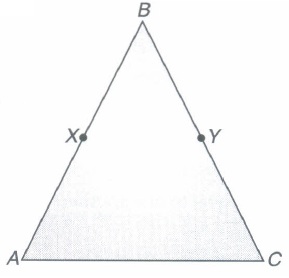
In the given figure, we have AB = BC, BX = BY. Show that AX = CY. State the axiom used.
2.
Find the mode of the following data:
| 1 | 3 | 5 | 7 | 3 |
| 5 | 4 | 7 | 2 | 6 |
| 7 | 12 | 10 | 11 | 3 |
| 7 | 8 | 6 | 7 | 7 |
| 4 | 2 | 11 | 7 | 15 |
3.
Write the coefficient of x3 of the following polynomials:
\({ 2x }^{ 3 }-7x+{ x }^{ 2 }+{ 3x }^{ 4 }\)
4.
Are the following statements true or false? Give reasons for your answers.
(i) Every whole number is a natural number.
(ii) Every integer is a rational number.
(iii) Every rational number is an integer.
5.
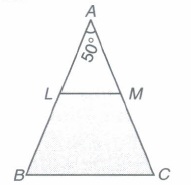
In the figure, ABC is an isosceles triangle in which AB = AC and LM is parallel 10 BC If LA = 50°, find \(\angle\)LMC.
6.
ABCD is a square. Co-ordinates of A and C are (-1,-1) and (1,1) respectively. Write the coordinates of B and D. Also write the equations of all the sides of square.
7.
In a survey of 200 men, it was found that 65 men take only coffee, 35 take only tea, 25 do not take either and the rest take both coffee and tea. Find the probability that a man selected at random:
(a) takes coffee
(b) takes only tea
8.
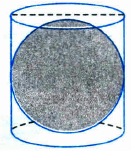
A right circular cylinder just encloses a sphere of radius r. Find
(i) surface area of the sphere,
(ii) curved surface area of the cylinder,
(iii) ratio of the areas obtained in (i) and (ii).
9.
A small indoor greenhouse (her-barium) is made entirely of glass panes (including base) held together with tape. It is 30 cm long, 25 cm wide and 25 cm high.
(i) What is the area of the glass?
(ii) How much of tape is needed for all the 12 edges?
10.
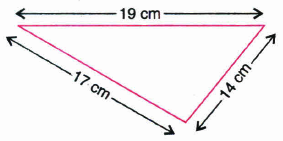
(a) Find the area of the triangle.
(b) Find the area of a triangle whose sides are 16 cm, 14 cm, nd 10 cm.
(c) The sides of a triangle are 7 cm, 12 cm, and 13 cm. Find its area.
d) Find the area of a triangle whose sides are 11 m, 60 m and 61 m.
11.
A villager Itwaari has a plot of land of the shape of a quadrilateral. The Gram Panchayat of the village decided to take over some portion of his plotfrom one of the corners to construct a Health Centre. Itwaari agrees to the above proposal with the condition that he should be given equal amount of land in lieu of his land adjoining his plot so as to form a triangular plot. Explain how this proposal will be implemented.
12.
In which quadrant do the given points lie?(9,6)
13.
Find the value of k, if x-1 is a factor of p(x) in each of the following cases: \(p(x)=2{ x }^{ 2 }+kx+\sqrt { 2 } \)
14.
Classify the following numbers as rational or irrational: \(\frac { 1 }{ \sqrt { 2 } } \)
15.
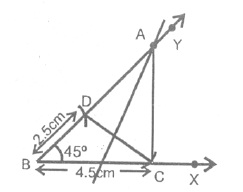
Construct a ΔABC in which BC = 4.7 cm,ㄥB = 45o and AB - AC = 2cm
16.
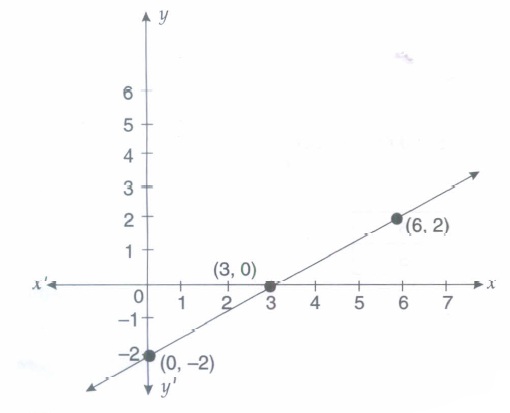
Draw the graph of \({2\over3}x-y=2\) and find the points where it cuts the co-ordinate axes.
17.
Find the sum of the following distribution:
| Variable (x) | Frequency (f) |
|---|---|
| 5 | 6 |
| 15 | 4 |
| 25 | 9 |
| 35 | 6 |
| 45 | 5 |
18.
The unequal side of an isosceles \(\Delta \) is 6 cm and its perimeter is 24 cm.Find its area.
19.
ABCD is a cyclic trapezium with AD || BC. If \(\angle B\) = 70°, determine other three angles of the trapezium.
20.
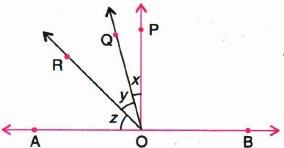
In the given figure PO \(\bot \) AB If x:y:z=1:3:5 then find the degree measure of x,y and z
21.
How many terms are there in the following polynomials?
x4 - 3x2 + 2
22.
In fourth quadrant, x is
+ve
-ve
0
None of these
23.
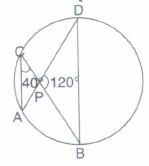
In the figure, ㄥACP=40 and ㄥBPD=120, then ㄥCBD=____________
24.
When a coin tossed, the probability of getting a head is?
25.
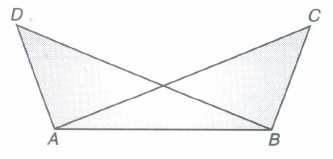
In given fig., AD = BC and \(\angle\)BAD =\(\angle\)ABC, then prove that \(\angle\)ACB = \(\angle\)BDA.
26.
Express in variables the things which are double of the same thing.
27.
Express the rational number \(0.\bar{9}\) in the form \(\frac{p}{q}\), where p and q are integers and q≠0.
28.
If -4 is a zero of the polynomial p(x) = x2 + 11x + k, then calculate the value of k.
1.
Since, AB = BC
AX + BX = BY + CY
Since, BX = BY
AX + BX - BX = BY + CY - BY
AX = CY
Axiom : If equals are subtracted from the equals, the remainders are equal.
2.
7
3.
2
4.
(i) False, because zero is a whole number but not a natural number.
(ii) True, because every integer m can be expressed in the form m/1, and so it is a rational number.
(iii) False because 3/5 is a rational number but not an integer.
5.
In \(\triangle\)ABC
AB = BC
\(\angle\)ABC = \(\angle\)ACB = 8
\(\angle\)B = \(\angle\)C = 8
\(\angle\)A + \(\angle\)B + \(\angle\)C = 1800
50° + 8 + 8 = 1800
28 = 180° - 50°
= 130°
8 = 65°
\(\angle\)B = \(\angle\)C = 65°
\(\therefore\) LMII BC 1
\(\therefore\) \(\angle\)LMC + \(\angle\)BCM = 180°
[\(\therefore\) \(\angle\)LMC and \(\angle\)BCM]
\(\angle\)LMC + 65° = 180°
\(\angle\)LMC = 180° - 65°
\(\angle\)LMC = 115°
6.
Given, A(-1,-1) and C(1,1)
Then, B(1,-1) and D(-1,1)
Also, equations of sides of square are,
AB: Y=-1
BC: X=1
CD: Y=1
DA: X=-1
7.
\((a)\frac { 7 }{ 10 }\)
\((b)\frac { 7 }{ 40 } \)
8.
(i) Surface area of the sphere = \(4\pi { r }^{ 2 }\)
(ii) For cylinder
Radius of the base = r
Height = 2r
\(\therefore\) Curved surface area of the cylinder
\(=2\pi \left( r \right) \left( 2r \right) =4\pi { r }^{ 2 }\)
(iii) Ratio of the areas obtained in (i) and (ii)
\(=\frac { Surface\ area\ of\ the\ sphere }{ Curved\ surface\ area\ of\ the\ cylinder } \)
\(\\ =\frac { 4\pi { r }^{ 2 } }{ 4\pi { r }^{ 2 } } =\frac { 1 }{ 1 } =1:1.\)
9.
(i) For herbarium
l = 30 cm, b = 25 cm,
h = 25 cm
\(\therefore \) Area of the glass = 2 (lb + bh + hl)
= 2[(30)(25) + (25)(25) + (25)(30)]
= 2[750 + 625 + 750] = 4250 cm2.
(ii) The tape needed for all the 12 edges
= 4 (l + b + h)
= 4(30 + 25 + 25) = 320 cm.
10.
(a) 114.89 cm2
(b) \(40\sqrt { 3 } \)cm2
(c) \(24\sqrt { 3 } \)cm2
(d) 330 m2
11.
Let ABCD be the plot of land of the shape of a quadrilateral. Let the portion ADE be taken over by the Gram Panchayat of the village from one corner D to construct a Health Centre. Join AC. Draw a line through D parallel to AC to meet BC produced in P. Join EP. Then Itwaari must be given the land ECP adjoining his plot so as to form a triangular plot ABP as then
\(ar(\Delta ADE)=ar(\Delta PEC)\)
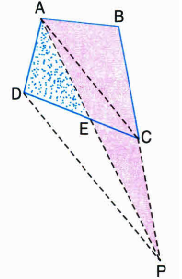
Proof: \(\Delta \)DAP and \(\Delta \)DCP are on the same base DP and between the same parallels DP and AC.
ar(\(\Delta \)DAP) = ar(\(\Delta \)DCP)
| Two triangles on the same base (or equal bases) and between the same parallels are equal in area
ar(\(\Delta \)DAP) - ar(\(\Delta \)DEP)
= ar(\(\Delta \)DCP) - ar(\(\Delta \)DEP)
I Subtracting ar(\(\Delta \) DEP) from both sides
ar(\(\Delta \) ADE) = ar(\(\Delta \) PCE)
ar(\(\Delta \)DAE) + ar(\(\Box \) ABCE)
= ar(\(\Delta \)PCE) + ar(\(\Box \) ABCE)
I Adding are \(\Box \) ABCE) to both sides
ar(\(\Box \) ABCD) = ar(\(\Delta \) ABP).
12.
I
13.
\(p(x)=2{ x }^{ 2 }+kx+\sqrt { 2 } \)
If x-1 is a factor of p(x), then p(1)=0 | By factor Theorem
\(\Rightarrow \ 2{ (1) }^{ 2 }+k(1)+\sqrt { 2 } =0\)
\(\Rightarrow \ 2+k+\sqrt { 2 } =0\)
\(\Rightarrow \ k=-(2+\sqrt { 2 } ).\)
14.
1(\(\neq 0\)) is a rational number and \(\sqrt { 2 } \)(\(\neq 0\)) is an irrational number.
\(\frac { 1 }{ \sqrt { 2 } } \) is an irrational number.
The quotient of a non-zero rational number with an irrational number is irrational.
15.
Steps of construction:
i) Draw a line segment BC = 4.7 cm. and at point B construct an angle of 45o i.e ㄥXBC=45o
ii) Cut the line segment BD = 2 cm (equal to AB-AC)on ray BX
iii) Join DC and draw the perpendicular bisector PQ of DC
iv) The perpendicular bisector intersects BXat point A. Jon AC ΔABC is the required triangle.
16.
\({2\over3}x-y=2\)
\(\Rightarrow 2x-3y=6\)
\(\Rightarrow 2x=3y+6\)
\(\Rightarrow x=\frac{3y+6}{2}\)
(i) When the line cuts x-axis then put y=0
i.e., 2x=6
x=3
Hence point is (3,0)
(ii) When the line cuts y-axis then put x=0
i.e., 3y+6=0
y=-2
Hence point is (0,-2)
| x | 0 | 3 | 6 |
| y | -2 | 0 | 2 |
17.
| Variable (x) | Frequency (f) | fx |
|---|---|---|
| 5 | 6 | 30 |
| 15 | 4 | 60 |
| 25 | 9 | 225 |
| 35 | 6 | 210 |
| 45 | 5 | 225 |
| Total | 30 | 750 |
\(\therefore\) Mean \(=\frac {{\sum fx}}{\sum f}= \frac {750}{30}=25\)
18.
b + b + 6 = 24
\(\Rightarrow \) b = 9 cm
\(\therefore \) Area \(=\frac { 9 }{ 4 } \sqrt { 4{ b }^{ 2 }-{ a }^{ 2 } } =\frac { 6 }{ 4 } \sqrt { 4{ (9) }^{ 2 }-{ (6) }^{ 2 } } \)
\(=\frac { 3 }{ 2 } \sqrt { 288 } =\frac { 3 }{ 2 } .12\sqrt { 2 } \)
\( 18\sqrt { 2 } \) cm2
19.
Given: ABCD is a cyclic trapezium with
AD || BC. \(\angle B\) = 70°.
To determine: Other three angles of the trapezium.
Determination:
\(\angle B+\angle D=180°\) | ∵ Opposite angles of a cyclic quadrilateral are supplementary
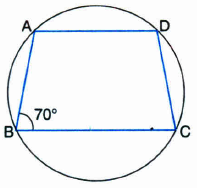
⇒ \(70°\angle D=180°\)
⇒ \(\angle D=180°-70°\)
⇒ \(\angle D=110°\)
Again, ∵ AD || BC and transversal AB intersects them
∴ \(\angle A+\angle B=180°\) | ∵ The sum of the consecutive interior angles on the same side of a transversal is 180°
⇒ \(\angle A+70°=180°\)
⇒ \(\angle A=180°-70°\)
⇒ \(\angle A=110°\)
Also, \(\angle A+\angle C=180°\)| ∵ Opposite angles of a cyclic quadrilateral are supplementary
⇒ \(110°+\angle C=180°\)
⇒ \(\angle C=180°-110°\)
⇒ \(\angle C=70°\).
20.
\(\therefore \) PO \(\bot \) AB
\(\therefore \angle AOP=90^{ 0 }\)
x:y:z=1:3:5=9
\(\therefore \angle x=\frac { 1 }{ 9 } x90^{ 0 }=10^{ 0 }\)
\(y=\frac { 3 }{ 9 } x90^{ 0 }=30^{ 0 }\)
\(y=\frac { 5 }{ 9 } x90^{ 0 }=50^{ 0 }\)
21.
Number of terms = 3
Terms: x4, -3x2, 2
22.
(a)
+ve
23.
()
[∵ Angles in the same segment are equal]
Now in ΔDPB
ㄥDPB+ㄥDBP+ㄥPDB=180°
⇒ 120°+ㄥDBP+40°=180°
ㄥDBP=180-(120°+40°)
ㄥDBP=20°
ㄥCBD=ㄥPBD=20°
24.
()
When a coin is tossed, total number of outcomes = 2(Head or Tail)
P(getting a head) = \(\frac{1}{2}\)
25.
()
AD = BC (Given)
\(\angle\)BAD =\(\angle\)ABC (Given)
AB = AB (Common)
\(\triangle DAB\cong \triangle CBA\) (By SAS)
\(\angle\)BDA =\(\angle\)ACB (By c.p.ct)
26.
()
Let, First thing = x
Second thing = y
then, x = 2y
27.
()
Let, x = 0.999...
⇒ 10x = 9.999...
⇒ 10x - x = (9.999...)-(0.999...)
⇒ 9x = 9
⇒ x = 1
28.
()
Given, p(x) = x2 + 11x + k
Since -4 is a zero of polynomial
p(-4) = 0
\(\Rightarrow\) (-4)2 + 11 \(\times\) (-4) + k = 0
\(\Rightarrow\) 16 - 44 + k = 0
\(\therefore\) k = 28

9th Standard CBSE Syllabus & Materials
9th Standard CBSE
CBSE 9th Mathematics Lines and Angles Sample Question Papers Study Material - QB365 Set A
NEW9th Standard CBSE
CBSE 9th Mathematics Introduction to Euclid's Geometry Sample Question Papers Study Material - QB365 Set A
NEW9th Standard CBSE
CBSE 9th Mathematics Linear Equations in Two Variables Sample Question Papers Study Material - QB365 Set A
NEW9th Standard CBSE
CBSE 9th Mathematics Coordinate Geometry Sample Question Papers Study Material - QB365 Set A



NCERT Books

Syllabus

Exam Pattern

Sample Question Papers

Previous year Question Papers

Important Notes

MCQ Practice test

NCERT Exemplers

Case study Questions

Image Based Questions

Passage based Questions

HOT Questions

Value Based Questions

Model Questions Papers
NCERT ( Book Back ) Questions

Assertion and Reason
Important Questions And Answers

CBSE 9th Standard CBSE Subjects
CBSE Standards