 100% FREE ACCESS
9th Standard CBSE Syllabus & Materials
9th Standard CBSE
CBSE 9th Science Is matter around us pure? - New Model Questions Papers Study Material - QB365 Set A
NEW9th Standard CBSE
CBSE 9th Science Matter in our surroundings - New Model Questions Papers Study Material - QB365 Set A
NEW9th Standard CBSE
CBSE 9th Mathematics Heron's Formula Sample Question Papers Study Material - QB365 Set A
NEW9th Standard CBSE
CBSE 9th Mathematics Circles Sample Question Papers Study Material - QB365 Set A
NEW9th Standard CBSE
CBSE 9th Mathematics Quadrilaterals Sample Question Papers Study Material - QB365 Set A
NEW9th Standard CBSE
CBSE 9th Mathematics Triangles Sample Question Papers Study Material - QB365 Set A
Published on: 29/10/2025
Download CBSE Class 9th Standard CBSE Mathematics question papers, sample papers, important questions, and previous year solved papers in PDF format. Get free study materials, NCERT solutions, and exam preparation resources for Class 9th Standard CBSE Mathematics
Questions + Answers key
Take MCQ Mathematics Test
1.
Ram and Ravi have the same weight. If they each gain weight by 2kg, how will their new weights be compared?
2.
Find the value of k (k≠0), if (x-3) is a factor of \(k^2x^2-kx^2+3kx-k.\)
3.
Simplify \(\sqrt { 2 } (\sqrt { 6 } -\sqrt { 8 } )+\sqrt { 3 } (\sqrt { 27 } -\sqrt { 6 } )\)
4.
Simplify: 172.17-5
5.
A shot-put is a metallic sphere of radius 3.5 cm. If the density of the metal is 7.8 g per cm3, find the mass of the shot-put.(Take \(\pi\) =22/7)
6.
In a mathematics test, 90 students obtained (out of 100)the marks given in the following table:
| Marks | No.of students |
| 1-20 | 8 |
| 21-40 | 12 |
| 41-50 | 15 |
| 51-60 | 20 |
| 61-70 | 13 |
| 71-80 | 17 |
| 81-90 | 05 |
Find the probability: Answers
(i) a student obtained less than 41,
(ii) a student obtained more than 50,
(iii) a student obtained between 41 and 80
7.
Find the total surface area of a cone, if its slant height is 21 m and diameter of its base is 24 m.
8.
Sides of a triangle in the ratio 5:12:13 and its perimeter is 120 cm. Find its area.
9.
Write \(\sqrt{7}y=2x\)as a linear equation of the form ax+by+c=0.Also write the values corresponding to a, b, c.Does the graph of this linear equation pass through origin?Give your answer in yes or no.
10.
Plot the points P(-1,-1), Q(2,3) and R(8,11).Show that they are collinear.
11.
Find p(0), p(1) and p(2) for each of the following polynomials:
p(x) = (x - 1) (x + 1)
12.
Look at several examples of rational numbers in the form p/q(\(q\neq 0\)), where p and q are integers with no common factors other than 1 and having terminating decimal representations. Can you guess what property q must satisfy?
13.
Where do the I and III quadrants meet?
in x - axis
in y - axis
at O
do not intersect
14.
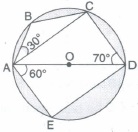
Find the angles ABC, ADE, BCD in the adjacent figure, where 'O' is the centre of the circle.
15.
Prove that the opposite angles of an isosceles trapezium are supplementary.
16.
Divide polynomial p(x) = x4 - 4x3+4x2-3x+4 by q(x)=x-1 and find what should be added in p(x), So that it is divisible by q(x).
17.
Find the mean of the following marks of 20 students on a screening test. (out of 100) 76,44,45,87,71,72,82,83,41,32,75,32,46,78,17,70,84,12,77,74
18.
Construct an equilateral triangle LMN, one of whose sides is 5 cm. Bisect \(\angle M\) of the triangle.
19.
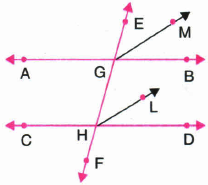
In figure EF is a transversal to two parallel lines AB and CD ,GM and HL are the bisectors of the corresponding angles EGB and EHD prove that GM || HL. First prove that \(\angle EGM=\angle GHL\)
20.
Draw the graph of linear equation 2x + y = 8 on Cartesian plane.Write the coordinates of the points where this line intersects x-axis and y-axis.
21.
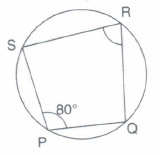
In the figure, quadrilateral PQRS is cyclic. If ㄥP=80°, then R is equal to __________
22.
If the probability of an event is represented by p, then \(0\le p\le1\) is True/False?
23.
What do we call a triangle if the angles are in the ratio 5 : 3 : 7?
24.
Give any one example of a geometrical line from your surroundings.
25.
Express the rational number \(0.\bar{9}\) in the form \(\frac{p}{q}\), where p and q are integers and q≠0.
26.
What is x+\(\frac { 1 }{ x } \)?
1.
Let x be the weight of Ram and Ravi each. On gaining 2 kg, weight of Ram and Ravi will be (x+2) kg each. According to Euclid's second axiom, when equals are added to equals, the wholes are equal. So, weights of Ram and Ravi are again equal.
2.
0, \(\frac{1}{27}\)
3.
\(5+2\sqrt { 3 } -3\sqrt { 2 } \)
4.
\(\frac { 1 }{ { 17 }^{ 3 } } \)
5.
Volume of the shot-put=\(=\frac { 4 }{ 3 } \times \frac { 22 }{ 7 } \times \frac { 35 }{ 10 } \times \frac { 35 }{ 10 } \times \frac { 35 }{ 10 } \)
\(=\frac { 11\times 49 }{ 3 } { cm }^{ 3 }\)
Mass of the shot-put\(=\frac { 11 }{ 3 } \times 49\times \frac { 78 }{ 10 } \)
= 1401.10 gm.
6.
(i) Pob. of less than 41
\(=\frac{8+12}{90}=\frac{20}{90}=\frac{2}{9}\)
(ii) Prob.of more than 50 \(=\frac{20+13+17+5}{90}=\frac{55}{90}=\frac{11}{18}\)
(iii)Prob. of marks between 41 and 80
\(=\frac{15+20+13+17}{90}=\frac{65}{90}=\frac{13}{18}\)
7.
Slant height (l) = 21 m
Diameter of base = 24 m
\(\therefore \) Radius of base (r) = \(\frac { 24 }{ 2 } m=12m\)
\(\therefore \) Total curved surface area of the cone
\(=\pi r\left( l+r \right) \)
\(\\ =\frac { 22 }{ 7 } \times 12\times \left( 21+12 \right) \)
\(\\ =\frac { 22 }{ 7 } \times 12\times 33=\frac { 8712 }{ 7 } =1244.57{ m }^{ 2 }.\)
8.
480 cm2
9.
\(2x-\sqrt{7}+0=0;\ a=2,\ b=-\sqrt{7}.,\ c=0\) Yes.
10.
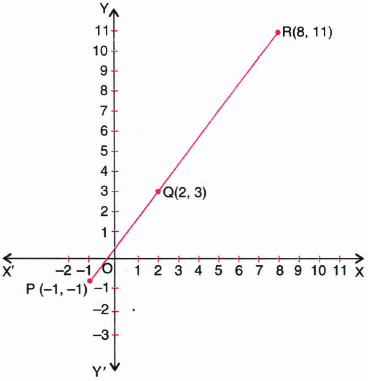
11.
\(\therefore \ p(0)=(0-1)(0+1)=(-1)(1)=-1\)
\(\\ p(1)=(1-1)(1+1)=(0)(2)=0\)
and \(p(2)=(2-1)(2+1)=(1)(3)=3\)
12.
\((i)\frac { 1 }{ 2 } =\frac { 1\times 5 }{ 2\times 5 } =\frac { 5 }{ 10 } =0.5\ |q=2\)
\(\\ (ii)\frac { 1 }{ 4 } =\frac { 1\times 25 }{ 4\times 25 } =\frac { 25 }{ 100 } =0.25\ |q={ 2 }^{ 2 }\)
\(\\ (iii)\frac { 3 }{ 8 } =\frac { 3\times 125 }{ 8\times 125 } =\frac { 375 }{ 1000 } =0.375\ |q={ 2 }^{ 3 }\)
\(\\ (iv)\frac { 31 }{ 25 } =\frac { 31\times 4 }{ 25\times 4 } =\frac { 124 }{ 100 } =1.24\ |q={ 5 }^{ 2 }\)
\(\\ (v)\frac { 7 }{ 125 } =\frac { 7\times 8 }{ 125\times 8 } =\frac { 56 }{ 1000 } =0.056\ |q=5^{ 3 }\)
\(\\ (vi)\frac { 13 }{ 20 } =\frac { 13\times 5 }{ 20\times 5 } =\frac { 65 }{ 100 } =0.65\ |q={ 2 }^{ 2 }\times 5\)
\(\\ (vii)\frac { 29 }{ 16 } =\frac { 29\times 625 }{ 16\times 625 } =\frac { 18125 }{ 10000 } =1.8125 |q={ 2 }^{ 4 }\)
The property that q must satisfy is that the prime factorization of q must have only powers of 2 or powers of 5 or both.
13.
(c)
at O
14.
\(\angle\)ACD = 90°, \(\angle\)AED = 90° (angle in semi-circle)
\(\angle\)ADE = 180° - (60° + 90°)
= 30° (angle sum property)
\(\angle\)ABC = 180° - \(\angle\)CDA
= 180°- 70° = 110° (ADCB is a cyclic quadrilateral)
\(\angle\)BCA = 180 - (110° + 30°) = 40° (Angle sum property)
\(\angle\)BCD = \(\angle\)BCA + \(\angle\)ACD
Therefore
\(\angle\)BCD = 40° + 90° = 130°.
15.
In trapezium ABCD,
AB II DC and AD = BC
Through C, draw
CE II DA.
DC II AE and CE is transversal.
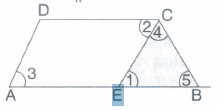
∠1=∠2
∠3=∠1
∠2=∠3=∠1
∠2+∠3=2∠1
∠A+∠C=∠3+∠2+∠4
=2∠1+∠4
Also ∠1=∠5
∠A+∠C=∠1+∠4+∠5=180°
Similarly, we can show that ㄥB+ㄥD=180°
Hence, the opposite angles of an isosceles trapezium are supplementary.
16.
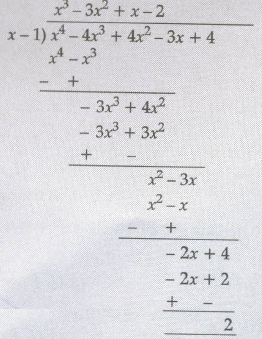
Quotient = x3-3x2 + x-2
Remainder = 2
So, -2 should be added in p(x).
So that it is completely divisible by q(x)
17.
Mean
\(=\frac {76+44+45+87+71+72+82+83+41+32+75+32+46+78+17+70+84+12+77+74} {20}\)
\(=\frac {1198}{20}=59.9\)
18.
Steps of Construction
1. Draw a line segment MN = 5 cm.
2. With M as centre and 5 cm as radius, draw an arc on one side of MN.
3. With N as centre and 5 cm as radius, draw another arc on the same side of MN to intersect the former arc at L.
4. Join LM and LN. Then, \(\Delta \) LMN is the required equilateral triangle.
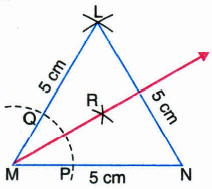
5. Taking M as centre and any radius, draw an arc to intersect the line segments MN and ML at P and Q respectively.
6. Next, taking P and Q as centres and with 1 the radius more than \(\frac { 1 }{ 2 } \) PQ, draw arcs to intersect each other, say at R.
7. Draw the ray MR. This ray MR is the required bisector of the \(\angle M\).
19.
AB || CD
and a transversal EF intersects them
\(\therefore \)\(\angle EGB=\angle GHD\)
| corresponding Angles
\(\Rightarrow 2\angle EGM=2\angle GHL\)
GM and HL are the bisectors of \(\Rightarrow \angle EGM=\angle GHL\) respectively
\(\Rightarrow \angle EGM=\angle GHL\)
But these angles form a pair of equal corresponding angles for lines GM and HL and transversal EF.
\(\therefore \) GM || HL.
20.
2.x + y = 8
⇒ y=8-2x
Table of solution
| x | 4 | 0 |
|---|---|---|
| y | 0 | 8 |
We plot the points (4, 0) and (0, 8) on a graph paper and join the same by a ruler to get the line which is the graph of the equation 2.x + y = 8.
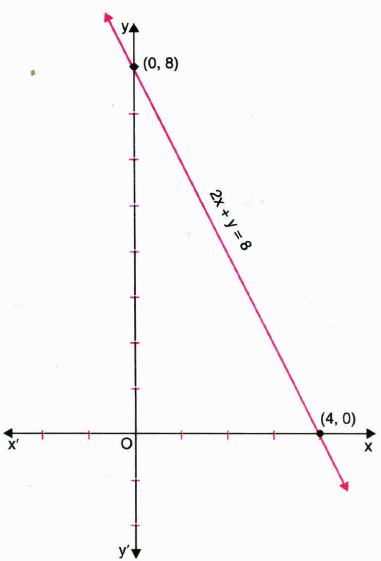
From graph, we see that this line intersects the x-axis at the point (4, 0) and the y-axis at the point (0,8).
21.
()
Since, quadrilateral PQRS is cyclic
ஃ ㄥP+ㄥR=180°
⇒ 80°+ㄥR=180°
⇒ ㄥR=100°
22.
()
Probability of an event associated with a random experiment lies between 0 and 1 (both included). So given statement is true.
23.
()
Let the angles of triangle are 5x, 3x and 7x, then
5x + 3x + 7x = 180°
\(\Rightarrow\) 15x = 180°
Thus, x = 12°
\(\therefore\) Angles are 60°, 36°, 84°
\(\therefore\) Each angle is less than 90°
\(\therefore\) The triangle is an acute-angled triangle.
24.
()
Meeting place of two walls.
25.
()
Let, x = 0.999...
⇒ 10x = 9.999...
⇒ 10x - x = (9.999...)-(0.999...)
⇒ 9x = 9
⇒ x = 1
26.
()
Not a polynomial.

9th Standard CBSE Syllabus & Materials
9th Standard CBSE
CBSE 9th Mathematics Lines and Angles Sample Question Papers Study Material - QB365 Set A
NEW9th Standard CBSE
CBSE 9th Mathematics Introduction to Euclid's Geometry Sample Question Papers Study Material - QB365 Set A
NEW9th Standard CBSE
CBSE 9th Mathematics Linear Equations in Two Variables Sample Question Papers Study Material - QB365 Set A
NEW9th Standard CBSE
CBSE 9th Mathematics Coordinate Geometry Sample Question Papers Study Material - QB365 Set A



NCERT Books

Syllabus

Exam Pattern

Sample Question Papers

Previous year Question Papers

Important Notes

MCQ Practice test

NCERT Exemplers

Case study Questions

Image Based Questions

Passage based Questions

HOT Questions

Value Based Questions

Model Questions Papers
NCERT ( Book Back ) Questions

Assertion and Reason
Important Questions And Answers

CBSE 9th Standard CBSE Subjects
CBSE Standards