
 100% FREE ACCESS
9th Standard CBSE Syllabus & Materials
9th Standard CBSE
CBSE 9th Science Is matter around us pure? - New Model Questions Papers Study Material - QB365 Set A
NEW9th Standard CBSE
CBSE 9th Science Matter in our surroundings - New Model Questions Papers Study Material - QB365 Set A
NEW9th Standard CBSE
CBSE 9th Mathematics Heron's Formula Sample Question Papers Study Material - QB365 Set A
NEW9th Standard CBSE
CBSE 9th Mathematics Circles Sample Question Papers Study Material - QB365 Set A
NEW9th Standard CBSE
CBSE 9th Mathematics Quadrilaterals Sample Question Papers Study Material - QB365 Set A
NEW9th Standard CBSE
CBSE 9th Mathematics Triangles Sample Question Papers Study Material - QB365 Set A

Published on: 29/10/2025
Download CBSE Class 9th Standard CBSE Mathematics question papers, sample papers, important questions, and previous year solved papers in PDF format. Get free study materials, NCERT solutions, and exam preparation resources for Class 9th Standard CBSE Mathematics
Questions + Answers key
Take MCQ Mathematics Test
1.
In a one-day cricket Match, Sachin palyed 40 balls and hit 12 sixes and Saurav played 30 balls and hit 9 fours. Find the probability that Sachin will hit a six in the next ball and also find the probability that Saurav will not hit a four in the next ball.
2.
A solid piece of metal, cuboidal in shape, with dimensions 24 cm, 18 cm and 14 cm is recast into a cube. calculate the lateral surface area of the cube.
3.
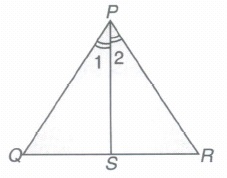
In the given figure, PR > PQ and PS bisect \(\angle\)QRP. Prove that \(\angle\)PSR>\(\angle\)PSQ
4.
Find the value of a for which (x-a) is a factor of the polynomial x6-ax5+x4-ax3+3x-a+2.
5.
Find the surface area of a sphere of diameter:
(i) 14 cm
(ii) 21 cm
(iii) 3.5 m.
6.
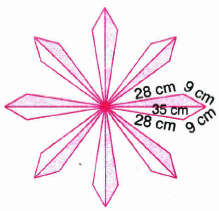
A floral design on a floor is made up of 16 tiles which are triangular, the sides of the triangle being 9 cm, 28 cm, and 35 cm. Find the cost of polishing the tiles at the rate of 50 p per cm2 .
7.
Which of the following figures lie on the same and between the same parallels.In such a case, write the common base and the two parallels.
.png)
.png)
8.
Locate and write the coordinates of a point:
(a) above x-axis lying on y-axis at a distance of 5 units from origin.
(b) below x-axis lying on y-axis at a distance of 3 units from origin.
(e) lying on x-axis to the right of origin at a distance of 5 units.
(d) lying on x-axis to the left of origin at a distance of 2 units.
9.
Rationalize the denominator of \(\frac { 4 }{ 2+\sqrt { 3 } +\sqrt { 7 } } \)
10.
Ten observations 6,14,15,17,x+1,2x-13,30,32,34,33 are written in ascending order. The median of data is 24. Find the value of x.
11.
In the given figure, we have AB=AD and AC=AD. Prove that AB=AC. State the Euclid's axiom to support this.
12.
Simplify: \(\sqrt[4]{16}-6\sqrt[3]{343}+18\sqrt[5]{243}-\sqrt{196}\)
13.
Represent \(0.\overline { 237 } \) in the form of \(\frac{p}{q}\) , where p and q are integers and q≠0.
14.
Write the coefficient of x3 of the following polynomials:
\({ 2x }^{ 3 }-7x+{ x }^{ 2 }+{ 3x }^{ 4 }\)
15.
Find the sum of the following distribution:
| Variable (x) | Frequency (f) |
|---|---|
| 5 | 6 |
| 15 | 4 |
| 25 | 9 |
| 35 | 6 |
| 45 | 5 |
16.
The perimeter of a right triangle is 24 cm. If its hypotenuse is 10 cm, find its area.
17.
Construct an equilateral triangle LMN, one of whose sides is 5 cm. Bisect \(\angle M\) of the triangle.
18.
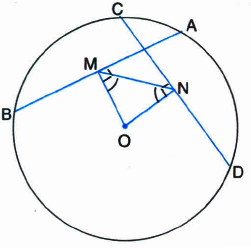
In figure, AB and CD are equal chords of a circle whose centre is O. If OM 丄 AB and ON 丄 CD, prove that \(\angle OMN=\angle ONM\)
19.
Given \(\Delta \)ABC, lines are drawn through A, B and C parallel respectively to the sides BC, CA and AB forming \(\Delta \)PQR. Show that BC = \(1\over2\) QR.
20.
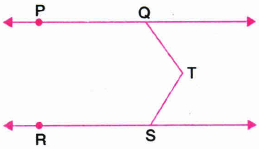
In figure PQ || RS and T is any point as shown in the figure then show that
\(\angle PQT+\angle QTS+\angle RST=360^{ 0 }\)
21.
Draw the graph of the equation 3x + y = 8. Use it to find some solutions of the equation and check from the graph whether x = 2, y = 2 is a solution.
22.
Find the zero of the polynomial \(px+q+r\)
23.
The distance of a point (0,-3) from the origin is:
0 units
Cannot be determined
-3 units
3 units
24.
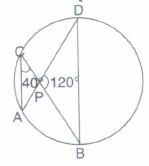
In the figure, ㄥACP=40 and ㄥBPD=120, then ㄥCBD=____________
25.
When a coin tossed, the probability of getting a head is?
26.
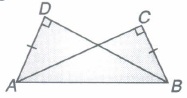
In the figure below, it is given that\(\triangle ABD\cong \triangle BAC\). What criteria is used to prove that the triangles are congruent?
27.
Write the co-efficient of x2 in the expansion of (x-2)3.
28.
What does a theorem require?
29.
Write the sum of \(0.\bar{3}\) and \(0.\bar{4}\)
1.
Total number of balls faced by Sachin = 40
No. of balls on which he hit a six = 12
Let E1, be the event of hitting a six.
\(\therefore \)No. of outcomes = 12
\(\therefore P(E_1)=\frac{12}{40}=\frac{3}{10}\)
Now, total No. of balls faced by Saurav = 30
Let E2 be the event of Saurav did not hit the boundary
No. of outcomes = 30 - 9 = 21
\(P(E_2)=\frac{21}{30}=\frac{7}{10}\)
2.
Vol. of cuboid = lbh
=24 \(\times\) 18 \(\times\) 4
= 1728 cu.cm.
Edge of a cube=\(\sqrt [ 3 ]{ 1728 } \)
= 12 cm
LSA = 4a2
=4 \(\times\)12 \(\times\)12
= 576 cm2.
3.
In \(\triangle\)PQR, we have
PR > PQ (Given)
\(\angle\).PQR > \(\angle\)PRQ
(\(\therefore\) angle opp. to larger side is greater)
\(\angle\)PQR + \(\angle\)1 > \(\angle\)PRQ + \(\angle\)1
(Adding L.l on both sides)
\(\angle\)PQR + \(\angle\)1 > \(\angle\)PRQ + \(\angle\)2 ...(i)
(\(\therefore\)PS is the bisector at \(\angle\)P \(\therefore\) \(\angle\)1 = \(\angle\)2)
Now, in MQS and MSR, we have
\(\angle\)PQR + \(\angle\)1 + \(\angle\)PSQ = 1800
and
\(\angle\)PRQ + \(\angle\)2 + \(\angle\)PSR = 1800
\(\angle\)PQR + \(\angle\)1 = 1800- \(\angle\)PSQ ...(ii)
and \(\angle\)PRQ + \(\angle\)2 = 1800-\(\angle\)PSQ ....(iii)
Substitude eq. (ii) & (ill) in eq. (i)
\(\therefore\) 1800 - \(\angle\)PSQ > 1800-\(\angle\)PSR
\(\Rightarrow\) \(\angle\)PSQ > - \(\angle\)PSR
\(\Rightarrow\) \(\angle\)PSQ < \(\angle\)PSR i.e.,\(\angle\)PSR > \(\angle\)PSQ
4.
Let, p(x)=x6-ax5+x4-ax3+3x-a+2
(x-a) is a factor of the polynomial p(x), then
p(a)=0
\(\Rightarrow\) a6-a\(\times\) a5+a4-a\(\times\)a3+3\(\times\)a-a+2
= 0
\(\Rightarrow\) a6-a6+a4-a4+3a-a+2
= 0
\(\Rightarrow\) 2a = -2 \(\Rightarrow\) a=-1.
5.
(i) Diameter = 14 cm
Radius (r) = \(\frac { 14 }{ 2 } cm=7cm\)
\(\therefore\) Surface area = \(4\pi { r }^{ 2 }\)
\(=4\times \frac { 22 }{ 7 } \times { \left( 7 \right) }^{ 2 }=616{ cm }^{ 2 }.\)
(ii) Diameter = 21 cm
Radius (r) = \(\frac { 21 }{ 2 } cm\)
\(\therefore\) Surface area = \(4\pi { r }^{ 2 }\)
\(=4\times \frac { 22 }{ 7 } \times { \left( \frac { 21 }{ 2 } \right) }^{ 2 }=1386{ cm }^{ 2 }.\)
(iii) Diameter = 3.5 m
Radius (r) = \(\frac { 3.5 }{ 2 } m=1.75m\)
\(\therefore\) Surface area = \(4\pi { r }^{ 2 }\)
\(=4\times \frac { 22 }{ 7 } \times { \left( 1.75 \right) }^{ 2 }\)
\(\\ =38.5{ m }^{ 2 }.\)
6.
For one tile a = 9 cm, b = 28 cm, c = 35 cm
\(\therefore s=\frac { a+b+c }{ 2 } =\frac { 9+28+35 }{ 2 } =36\) cm
\(\therefore \) Area of one tile \(=\sqrt { s(s-a)(s-b)(s-c) } \)
\(=\sqrt { 36(36-9)(36-28)(36-35) } \)
\(\\ =\sqrt { 36(27)(8)(1) } =\sqrt { 36\left( 9\times 3 \right) \left( 4\times 2 \right) } \)
\(=6\times 3\times 2\sqrt { 6 } =36\sqrt { 6 } \) cm2
\(\therefore \) Area of 16 tiles \(=36\sqrt { 6 } \times 16=576\sqrt { 6 } \)cm2
\(\therefore \) Cost of polishing the tiles at the rate of 50 p per cm2.
\(=576\sqrt { 6 } \times 50\) p = Rs. \(\frac { 576\sqrt { 6 } \times 50 }{ 100 } \)
= Rs. \(288\sqrt { 6 } \) = Rs. 705.60
7.
(i) \(\Delta \)PDC and quadrilateral ABCD lie on the same base DC and between the same parallels DC and AB.
(ii) \(\Delta \) TRQ and parallelogram SRQP lie on the same base RQ and between the same parallels RQ and SP.
(iii) Quadrilaterals APCD and ABQD lie on the same base AD and between the same parallels AD and BQ.
8.
(a) (0,5)
(b) (0,-3)
(c) (5,0)
(d) (-2,0)
9.
\(\frac { 2\sqrt { 3 } +3-\sqrt { 21 } }{ 3 } \)
10.
Median = average of 5th and 6th observations
24 = \(\frac{x+1+2x-13}{2}\)
⇒ 48 = 3x-12
⇒ 60 = 3x
⇒ x = 20
11.
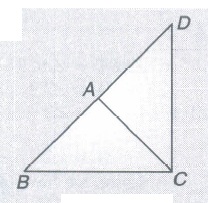
Things which are equal to the same thing are equal to one another.
12.
\(\sqrt[4]{16}=\sqrt[4]{2\times2\times2\times2}=2\)
\(\sqrt[3]{343}=\sqrt[3]{7\times7\times7}=7\)
\(\sqrt[5]{243}=\sqrt[5]{3\times3\times3\times3\times3}=3\)
\(\sqrt{196}\) = 14
ஃ \(\sqrt[4]{16}-6\sqrt[3]{343}+18\sqrt[5]{243}-\sqrt{196}\)
= 2- 6 x 7 + 18 x 3 - 14
= 2 - 42 + 54 - 14
= 56 - 56 = 0
13.
1000x = 237.\(\overline{237}\)
x = \(\frac{237}{999}\)
14.
2
15.
| Variable (x) | Frequency (f) | fx |
|---|---|---|
| 5 | 6 | 30 |
| 15 | 4 | 60 |
| 25 | 9 | 225 |
| 35 | 6 | 210 |
| 45 | 5 | 225 |
| Total | 30 | 750 |
\(\therefore\) Mean \(=\frac {{\sum fx}}{\sum f}= \frac {750}{30}=25\)
16.
Let the sides forming the right angle be a cm and b cm. Then,
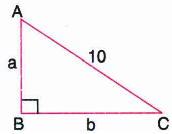
a + b + 10 = 24
\(\Rightarrow \) a + b = 14 ....(1)
Also, a2 + b2 = (10)2 |By Pythagoras Theorem
\(\Rightarrow \) a2 + b2 = 100 ...(2)
We know that (a + b)2 = a2 + b2 + 2ab
\(\Rightarrow \) (14)2 = 100+2ab
\(\Rightarrow \) 2ab = 96
\(\Rightarrow \) ab=48 ...(3)
Also, (a - b)2 = a2 + b2- 2ab
= 100 - 2\(\times \)48
= 100 - 96 = 4 | if a>b
\(\Rightarrow \) a- b = 2
Solving (1) and (4), we get a=8cm, b=6cm
\(\therefore \) Area = \(\frac { 1 }{ 2 } \)ab = \(\frac { 1 }{ 2 } \).8.6 = 24 cm2
17.
Steps of Construction
1. Draw a line segment MN = 5 cm.
2. With M as centre and 5 cm as radius, draw an arc on one side of MN.
3. With N as centre and 5 cm as radius, draw another arc on the same side of MN to intersect the former arc at L.
4. Join LM and LN. Then, \(\Delta \) LMN is the required equilateral triangle.
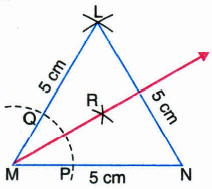
5. Taking M as centre and any radius, draw an arc to intersect the line segments MN and ML at P and Q respectively.
6. Next, taking P and Q as centres and with 1 the radius more than \(\frac { 1 }{ 2 } \) PQ, draw arcs to intersect each other, say at R.
7. Draw the ray MR. This ray MR is the required bisector of the \(\angle M\).
18.
Given: In figure, AB and CD are equal chords of a circle whose centre is O. OM 丄 AB and ON 丄 CD.
To Prove: \(\angle OMN=\angle ONM\).
Proof: ∵ Chord AB = Chord CD
∴ OM=ON .........(1)
| Equal chords of a circle are equidistant from the centre of the circle
In \(\Delta OMN\),
OM=ON I From (1)
∴ \(\angle OMN=\angle ONM\) | Angles opposite to equal sides of a triangle are equal.
19.
Given: \(\Delta \)ABC, lines are drawn through A, B and C parallel respectively to the sides BC, CA and AB forming \(\Delta \)QPR.
To Prove: BC = \(1\over2\) QR
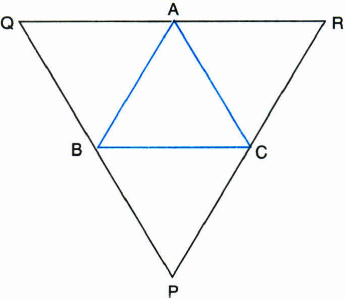
Proof: \(\because\) AQ IICB and AC IIQB
\(\therefore\) AQBC is a parallelogram
\(\therefore\) BC = QA .....(1) I Opposite sides of a II gm
\(\because\) AR II BC and AB II RC
\(\therefore\) ARCB is a parallelogram
\(\therefore\) BC = AR I Opposite sides of a II gm
From (1) and (2),
QA= AR = \(1\over2\) QR. ...(2)
From (1) and (3), BC = \(1\over2\) QR.
20.
Given PQ || RS and T is any point
To prove \(\angle PQT+\angle QTS+\angle RST=360^{ 0 }\)
Construction Through T, draw TU || PQ || RS
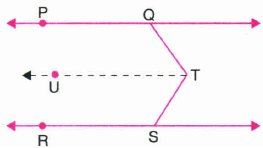
PQ || UT |By construction and a transversal QT intersects then
\(\therefore \angle PQT+\angle QTU=180^{ 0 }\)
The Sum of consecutive interior angles on the same sides of a transversal is \(180^{ 0 }\)
UT || RS
| By construction and a transversal TS intersect them
\(\therefore \angle UTS+\angle RST=180^{ 0 }\)
The Sum of consecutive interior angles on the same side of a transversal is \(180^{ 0 }\)
Adding (1) and (2) ,we get
\(\angle PQT+(\angle QTU+\angle UTS)+\angle RST=360^{ 0 }\)
\(\Rightarrow \angle PQT+\angle QTS+\angle RST=360^{ 0 }\)
21.
3x + y= 8
⇒ y = 8 - 3x
Table of solution
| X | 0 | 3 |
|---|---|---|
| Y | 8 | -1 |
We plot the points (0, 8) and (3, - 1) on the graph paper and join the same by a ruler to get the line which is the graph of the equation 3x + y = 8
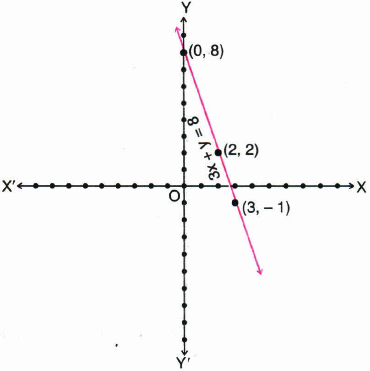
∵ Point (2, 2) lies on the graph
∴ x = 2, y = 2 is a solution of the given equation.
22.
\(px+q+r=0\)
\(\Rightarrow px=-(q+r) \)
\(\Rightarrow -x=-(\frac{q+r}{p})\)
\(\therefore\) \(-(\frac{q+r}{p})\) is the required zero.
23.
(d)
3 units
24.
()
[∵ Angles in the same segment are equal]
Now in ΔDPB
ㄥDPB+ㄥDBP+ㄥPDB=180°
⇒ 120°+ㄥDBP+40°=180°
ㄥDBP=180-(120°+40°)
ㄥDBP=20°
ㄥCBD=ㄥPBD=20°
25.
()
When a coin is tossed, total number of outcomes = 2(Head or Tail)
P(getting a head) = \(\frac{1}{2}\)
26.
()
\(\angle\)BDA = \(\angle\)ACB = 900 (Given)
AD = BC (Given)
AD = AB (Common)
\(\triangle ABD\cong \triangle BAC\) (By RHS)
27.
()
(x-2)3=(x)3-(2)3-3\(\times\)x\(\times\)2(x-2)
=x3-8-6x2+12x
Co-efficient of x2 in the expansion of (x-2)3=-6.
28.
()
Theorem requires a proof.
29.
()
\(0.\bar{3}+0.\bar{4}\)=(0.333...) + (0.444...)
= 0.777...
Let x = 0.777...
10x = 7.777...
⇒ 10x - x = (7.777...) - (0.777...)
⇒ 9x = 7.0
⇒ x = \(\frac{7}{9}\)

9th Standard CBSE Syllabus & Materials
9th Standard CBSE
CBSE 9th Mathematics Lines and Angles Sample Question Papers Study Material - QB365 Set A
NEW9th Standard CBSE
CBSE 9th Mathematics Introduction to Euclid's Geometry Sample Question Papers Study Material - QB365 Set A
NEW9th Standard CBSE
CBSE 9th Mathematics Linear Equations in Two Variables Sample Question Papers Study Material - QB365 Set A
NEW9th Standard CBSE
CBSE 9th Mathematics Coordinate Geometry Sample Question Papers Study Material - QB365 Set A



NCERT Books

Syllabus

Exam Pattern

Sample Question Papers

Previous year Question Papers

Important Notes

MCQ Practice test

NCERT Exemplers

Case study Questions

Image Based Questions

Passage based Questions

HOT Questions

Value Based Questions

Model Questions Papers
NCERT ( Book Back ) Questions

Assertion and Reason
Important Questions And Answers

CBSE 9th Standard CBSE Subjects
CBSE Standards