 100% FREE ACCESS
9th Standard CBSE Syllabus & Materials
9th Standard CBSE
CBSE 9th Science Is matter around us pure? - New Model Questions Papers Study Material - QB365 Set A
NEW9th Standard CBSE
CBSE 9th Science Matter in our surroundings - New Model Questions Papers Study Material - QB365 Set A
NEW9th Standard CBSE
CBSE 9th Mathematics Heron's Formula Sample Question Papers Study Material - QB365 Set A
NEW9th Standard CBSE
CBSE 9th Mathematics Circles Sample Question Papers Study Material - QB365 Set A
NEW9th Standard CBSE
CBSE 9th Mathematics Quadrilaterals Sample Question Papers Study Material - QB365 Set A
NEW9th Standard CBSE
CBSE 9th Mathematics Triangles Sample Question Papers Study Material - QB365 Set A

Published on: 29/10/2025
Download CBSE Class 9th Standard CBSE Mathematics question papers, sample papers, important questions, and previous year solved papers in PDF format. Get free study materials, NCERT solutions, and exam preparation resources for Class 9th Standard CBSE Mathematics
Questions + Answers key
Take MCQ Mathematics Test
1.
A coin is tossed 1200 times with the following outcomes:
Head:455, tail:745
Compute the probability for each case.
2.
For a mathematics test given to 15 students, the following marks (out of 100) are recorded:
| 41 | 39 | 48 | 52 | 46 |
| 62 | 54 | 40 | 96 | 52 |
| 95 | 40 | 52 | 52 | 60 |
Find the mean and mode of the above data.
3.
To construct a wall 25 m long, 0.3 m thick and 6 m high, bricks of dimensions 50 cm \(\times \) 15 cm \(\times \) 10 cm, each are used. If the mortar occupies \(\frac { 1 }{ 10 } \) th of the volume of the wall, find the number of bricks used.
4.
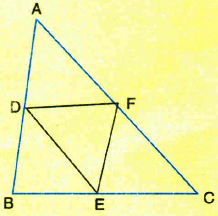
In \(\Delta \) ABC, D, E and F are midpoints of sides AB, BC and CA. If AB = 6 cm,BC = 7.2 cm and AC = 7.8 crn find the perimeter of \(\Delta \)DEF.
5.
Facts or information collected with a definite purpose are called:
Median
Mode
Data
Histogram
6.
The lateral surface area of a cube of side a is
4a2
6a2
3a2
2a2.
7.
If in a quadrilateral, two pairs of adjacent sides are equal, then it is called a
kite
trapezium
rhombus
square
8.
Show that the bisectors of angles of a parallelogram enclose a rectangle.
9.
ABCD is a quadrilateral in which the bisectors of ㄥA and ㄥC meet DC produced at Y and BA produced at X respectively. Prove that ㄥX+ㄥY=\(\frac{1}{2}\)(ㄥA+ㄥC)
10.
The following observations have been arranged in ascending order. If the median of the data in 65, find the value of x.
32,35,50,51,x,x+2,73,76,83,90
11.
Find the total surface area of a cone whose radius is \(\frac { r }{ 2 } \) and slant height is 21.
12.
A cylinder 3 m high, is open at the top. The circumference of its base is 22 cm. Find its total surface area. \(\left( Take\pi =\frac { 22 }{ 7 } \right) \)
13.
The score of 15 students in an examination out of 10 marks is as below: 3,9,7,5,6,3,7,6,7,4,7,7,4,8,2
Find the mean, mode and median.
14.
In the given figure, in a parallelogram ABCD, two points P and Q are taken on the diagonal BD such that DP = BQ. Show that:
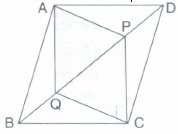
(i) ΔAPD≡ΔCQB
(ii) ΔAQB≡ΔCPD
(iii) APCQ is a parallelogram.
15.
In a cricket match, a batsman hits a boundary 6 times out of 30 balls she plays.Find the probability that she did not hit a boundary.
16.
Lead spheres of diameter 6 cm each are dropped into a cylindrical beaker containing some water and are fully submerged. If the diameter of the beaker is 18 cm and water level rises by 40 cm, find the number of lead spheres dropped in the water.
17.
Two solid spheres made of the same metal have masses 5920 g of and 740 g respectively. Determine the radius of the larger sphere, if the diameter of the smaller sphere is 5 cm.
18.
A cone of height 24 cm has a curved surface area 550 cm2. Find us volume.
19.
The % of marks obtained by students in the annual examination of a class in mathematics are given below:
| Percentage of marks | No. of students |
|---|---|
| 0-10 | 8 |
| 10-30 | 32 |
| 30-45 | 18 |
| 45-50 | 10 |
(i) How many students get less than 30% of marks?
(ii) Represent the data by histogram.
(iii) Which value is depicted by a student Ram obtaining the highest marks in the interval 45-50?
1.
Probability of getting head \(=\frac{455}{1200}\)
\(=\frac{91}{240}\)
Probability of getting tail\(=\frac{745}{1200}=\frac{149}{240}\)
2.
55,46,52
3.
5400
4.
10.5 cm
5.
Definition of data.
6.
(a)
4a2
7.
(a)
kite
8.
Let ABCD is a parallelogram
To show LMNO is a rectangle,
ㄥA+ㄥD=180°
\(\frac{1}{2}\)ㄥA+\(\frac{1}{2}\)ㄥD=90°
ㄥOAD+ㄥODA=90°
In ΔOAD,
ㄥOAD+ㄥADO+ㄥDOA=180°
⇒ ㄥDOA=90°
⇒ ㄥLON=90°
Similarly, ㄥOLM=ㄥLMN=ㄥMNO=90°
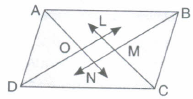
ஃ A quadrilateral with all angles, 90° is a rectangle. Also, opposite angles are equal. It is a rectangle.
9.
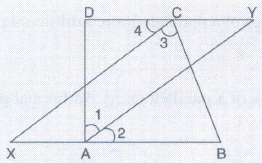
ㄥ1=ㄥ2=\(\frac{1}{2}\)ㄥA
ㄥ3=ㄥ4=\(\frac{1}{2}\)ㄥC
In ΔCXB,
ㄥ3+ㄥX+ㄥB=180° ...(i)
(By Angle sum property of a Δ)
In ΔDAY,
ㄥ1+ㄥY+ㄥD=180° ...(ii)
(By Angle sum property of a Δ)
Adding (i) and (ii),
ㄥ3+ㄥX+ㄥB+ㄥ1+ㄥY+ㄥD=180°+180°
i.e., ㄥX+ㄥY+ㄥ3+ㄥ1+ㄥB+ㄥD=180
i.e., ㄥX+ㄥY+\(\frac{1}{2}\)ㄥC+\(\frac{1}{2}\)ㄥA+ㄥB+ㄥD=360...(iii)
But, ㄥA+ㄥB+ㄥC+ㄥD=360...(iv)
(Angle sum property of a quadrilateral)
From (iii) and (iv),
∠X+ㄥY+\(\frac{1}{2}\)ㄥC+\(\frac{1}{2}\)ㄥA+ㄥB+ㄥD=ㄥA+ㄥB+ㄥC+ㄥD
i.e., ㄥX+ㄥY=ㄥA-\(\frac{1}{2}\)ㄥA+ㄥC-\(\frac{1}{2}\)ㄥC
=\(\frac{1}{2}\)ㄥA+\(\frac{1}{2}\)ㄥC
ㄥX+ㄥY=\(\frac{1}{2}\)(ㄥA+ㄥC)
Hence Proved.
10.
Number of observations (n) = 10, which is even,
\(\therefore\) Median
\(=\frac { { \left( \frac { n }{ 2 } \right) }^{ th }observation+{ \left( \frac { n }{ 2 } +1 \right) }^{ th }observation }{ 2 } \)
\(\Rightarrow 65=\frac { 5^{ th }observation+6^{ th }observation }{ 2 } \)
\(\Rightarrow\) \(65 = \frac {x+\left(x+2\right)}{2}\)
\(\Rightarrow\) 2x + 2 = 130
\(\Rightarrow\) 2x = 130 - 2 = 128
\(\Rightarrow\) \(x = \frac {128}{2}=64\)
11.
Total surface area
\(=\pi RL+\pi { R }^{ 2 }\)
\(\\ =\pi \left( \frac { r }{ 2 } \right) \left( 2l \right) +\pi { \left( \frac { r }{ 2 } \right) }^{ 2 }\)
\(\\ =\pi rl+\frac { \pi { r }^{ 2 } }{ 4 }\)
\( \\ =\frac { \pi r }{ 4 } \left( 4l+r \right) \)
12.
Let the base radius of the cylinder be r cm. Then,
\(2\pi r=22\)
\(\\ \Rightarrow \ 2\times \frac { 22 }{ 7 } \times r=22\)
\(\\ \Rightarrow r=\frac { 7 }{ 2 } \)
\( h=3m\)
\(\therefore \) Total surface area
\(=2\pi rh+\pi { r }^{ 2 }\)
\(\\ =2\times \frac { 22 }{ 7 } \times \frac { 7 }{ 2 } \times 3+\frac { 22 }{ 7 } \times \frac { 7 }{ 2 } \times \frac { 7 }{ 2 } \)
\(\\ =66+38.5\)
\(\\ =104.5{ m }^{ 2 }\)
13.
Writing the given data in ascending order: 2,3,3,4,4,5,6,6,7,7,7,7,7,8,9
Here n = 15, Mean = \(\frac { \sum { x } }{ n } \)
=\(\frac{85}{15}\)= 5.7
Mode = 7, Median = 8th term = 6
14.
In Δs APD and CQB
AD = BC (Opp. sides of a parallelogram)
PD = BQ (Given)
∠ADP=∠QBC
⇒ ΔAPD≡ΔCQB
⇒ AP = CQ (c.p.c.t)
In Δs AQB and CPD
AB = DC, BQ = DP
and ∠AQB=∠PDC
ஃ ΔAQB≡ΔCPB ⇒ AQ=CP
(iii) In quad. APCQ,
AP = CQ and AQ = CP
⇒ APCQ is a parallelogram.
15.
Let E be the event of hitting the boundary.
Then,
\(P(E)=\frac { Number\ of\ times\ the\ batswoman\ hits\ the\ boundary }{ Total\ number\ of\ balls\ she\ plays } \)
\(=\frac { 6 }{ 30 } =\frac { 1 }{ 5 } =0.2\)
Probability of not hitting the boundary
= 1- Probability of hitting the boundary
= 1- P(E) = 1 - 0.2 = 0.8
16.
90
17.
Let r and R be the radii of the smaller and larger spheres respectively, we have
\(r=\frac { 5 }{ 2 } cm\)
Volume of the smaller sphere \(=\frac { 4 }{ 3 } \pi { r }^{ 3 }=\frac { 4 }{ 3 } \pi { \left( \frac { 5 }{ 2 } \right) }^{ 3 }\)
\(=\frac { 4 }{ 3 } \times \pi \times \frac { 125 }{ 8 } { cm }^{ 3 }\)
Density of metal\(=\frac { mass }{ Valume } \)
\(=\frac { 740 }{ \frac { 4 }{ 3 } \pi \times \frac { 125 }{ 8 } } g\quad { cm }^{ 3 }\) ...........(i)
Volume of larger sphere = \(\frac { 4 }{ 3 } \pi { R }^{ 3 }\)
Density of metal=\(\frac { mass }{ Volume } =\frac { 5920 }{ \frac { 4 }{ 3 } \pi { R }^{ 3 } } \) ......(ii)
From (i) and (ii), we have
\(\frac { 740 }{ \frac { 4 }{ 3 } \pi \times \frac { 125 }{ 8 } } =\frac { 5920 }{ \frac { 4 }{ 3 } \pi { R }^{ 3 } } \)
\(\Rightarrow \quad { R }^{ 3 }=\frac { 5920\times 125 }{ 740\times 8 } \)
= 125
\(\Rightarrow\) R = 5 cm.
18.
Height of the cone(h) = 24 cm
Let r cm be the radius of the base and l cm an can be the slant height of the cone, then
\(l=\sqrt { { r }^{ 2 }+{ h }^{ 2 } } \)
\(=\sqrt { { r }^{ 2 }+{ 24 }^{ 2 } } \)
\(=\sqrt { { r }^{ 2 }+576 } \)
Now, curved surface area=\(\pi\)rl
\(\Rightarrow \ \frac { 22 }{ 7 } \times r\times \sqrt { { r }^{ 2 }+576 } =550\)
\(\Rightarrow \ r\sqrt { { r }^{ 2 }+576 } =550\times \frac { 7 }{ 22 } \)
\(\Rightarrow \ r\sqrt { { r }^{ 2 }+576 } =175\)
Squaring both the sides we get
r2 (r2 + 576) = 30625
(r2)2 + 576r2-30625 = 0
Let r2 = x
x2 + 576x - 30625 = 0
\(\Rightarrow\) x2 + 625x - 49x - 30625 = 0
\(\Rightarrow\) x(x + 625)- 49(x + 625) = 0
\(\Rightarrow\) (x + 625)(x - 49) = 0
\(\Rightarrow\) x + 625=0 or x - 49 = 0
\(\Rightarrow\) x = 625 or x = 49
not possible x = 49
\(\therefore\) r2= 49
\(\Rightarrow\) r = 7 cm
Volume & the cone = \(\frac { 1 }{ 3 } \pi { r }^{ 2 }h\)
\(=\frac { 1 }{ 3 } \times \frac { 22 }{ 7 } \times { 7 }^{ 2 }+24\)
= 1232 cm3.
19.
(i) Required number of students = 8 + 32 = 40
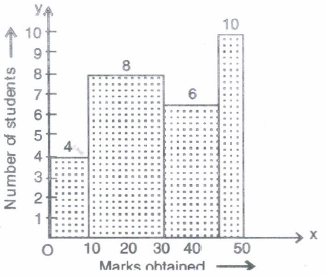
(ii) Here, We notice that classes are continuous but class-size is not the same for all the classes. We notice minimum class-size is of class 45-50, i.e., 5. We will first find proportionate length of rectangle (adjusted frequency) for each class.
Length of rectangle (adjusted frequency) =\(\frac { Frequency\ of\ Class }{ Width\ of\ class } \times Minimum\ class-size\)
| Marks (C.I.) |
Number of students(f) | Width of class (Clss-size) |
Length of rectangle |
|---|---|---|---|
| 0-10 | 8 | 10 | \(\frac{8}{10}\)x 5 = 4 |
| 10-30 | 32 | 20 | \(\frac{32}{20}\) x 5 = 8 |
| 30-45 | 18 | 15 | \(\frac{18}{15}\) x 5 = 6 |
| 45-50 | 10 | 5 | \(\frac{10}{5}\) x 5 = 10 |
Now, we construct rectangles with respective class-intervals as widths and adjusted frequencies as heights.
Histogram representing marks obtained by students in unit test of Mathematics.
(iii) Hardwork and Dilligence.

9th Standard CBSE Syllabus & Materials
9th Standard CBSE
CBSE 9th Mathematics Lines and Angles Sample Question Papers Study Material - QB365 Set A
NEW9th Standard CBSE
CBSE 9th Mathematics Introduction to Euclid's Geometry Sample Question Papers Study Material - QB365 Set A
NEW9th Standard CBSE
CBSE 9th Mathematics Linear Equations in Two Variables Sample Question Papers Study Material - QB365 Set A
NEW9th Standard CBSE
CBSE 9th Mathematics Coordinate Geometry Sample Question Papers Study Material - QB365 Set A



NCERT Books

Syllabus

Exam Pattern

Sample Question Papers

Previous year Question Papers

Important Notes

MCQ Practice test

NCERT Exemplers

Case study Questions

Image Based Questions

Passage based Questions

HOT Questions

Value Based Questions

Model Questions Papers
NCERT ( Book Back ) Questions

Assertion and Reason
Important Questions And Answers

CBSE 9th Standard CBSE Subjects
CBSE Standards