
 100% FREE ACCESS
9th Standard CBSE Syllabus & Materials
9th Standard CBSE
CBSE 9th Science Is matter around us pure? - New Model Questions Papers Study Material - QB365 Set A
NEW9th Standard CBSE
CBSE 9th Science Matter in our surroundings - New Model Questions Papers Study Material - QB365 Set A
NEW9th Standard CBSE
CBSE 9th Mathematics Heron's Formula Sample Question Papers Study Material - QB365 Set A
NEW9th Standard CBSE
CBSE 9th Mathematics Circles Sample Question Papers Study Material - QB365 Set A
NEW9th Standard CBSE
CBSE 9th Mathematics Quadrilaterals Sample Question Papers Study Material - QB365 Set A
NEW9th Standard CBSE
CBSE 9th Mathematics Triangles Sample Question Papers Study Material - QB365 Set A

Published on: 29/10/2025
Download CBSE Class 9th Standard CBSE Mathematics question papers, sample papers, important questions, and previous year solved papers in PDF format. Get free study materials, NCERT solutions, and exam preparation resources for Class 9th Standard CBSE Mathematics
Questions + Answers key
Take MCQ Mathematics Test
1.
The length and breadth of a hall are in the ratio 4:3 and its height is 550 cm. The cost of decorating its height is 550 cm. the cost of decorating its walls on Diwali (including doors and windows) at Rs. 6.60 per square meters is Rs 5082. Find the length and breadth of the room.
2.
A River 4 m deep and 60 m wide is following at the rate of 0.31 km/ hour. How much water will fall into the sea in a minute?
3.
A square piece of paper of side 22 cm is rolled to form a cylinder.Find the volume of the cylinder. (Take \(\pi =\frac{22}{7}\))
4.
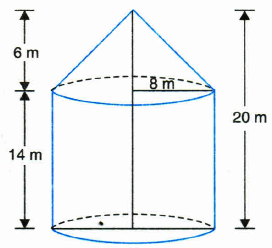
A cylindrical tent has a conical top with dimension as shown in the figure. Calculate the total cost of the canvas required to make the tent, if the cost of canvas is Rs 50 per sq. m.
5.
The circumference of the base of a 10 m high conical tent is 44 m. Calculate the length of the canvas used in making the tent if width of the canvas is 2 m.
6.
The radius and vertical height of a cone are 5 cm and 12 cm respectively. Find the curved surface area.
7.
A cylindrical vessel, without lid, has to be tin-coated including both of its sides. If the radius of its base is \(\frac { 1 }{ 2 } m\) and its height is 1.4 m, calculate the cost of tin-coating at the rate of Rs 50 per 1000 cm \(\left( Use\pi =3.14 \right) \)
8.
The dimensions of a rectangular box are in the ratio of 2 : 3 : 4 and the difference between the cost of covering it with sheet of paper at the rates of Rs 8 and Rs 9.50 per m2 is Rs 1248. Find the dimensions of the box.
9.
The length of a hall is 20 m and width 16 m. The sum of the areas of the floor and the flat roof is equal to the sum of the areas of the four walls. Find the height of the hall.
10.
Two cubes of side 6 cm each, are joined end to end. Find the surface area of the resulting cuboid.
11.
Two solid spheres made of the same metal have masses 5920 g of and 740 g respectively. Determine the radius of the larger sphere, if the diameter of the smaller sphere is 5 cm.
12.
A cone of height 24 cm has a curved surface area 550 cm2. Find us volume.
1.
l:b = 4:3, h = 550 cm,
l = 4y, b = 3y (taking y as constant)
h = 550 cm = 5.5 m
Total cost = L.S.A \(\times\)Rate per square metres
5082 = 2h(l + b)\(\times\)6.60
=2 \(\times\)5.5(4y + 3y) \(\times\)6.60
5082 = 2\(\times\)5.5\(\times\)7y\(\times\)6.60
10 = y
l = 4y = 4\(\times\)10 = 40 m
b = 3y = 3\(\times\)10 = 30 m
2.
0.31 km/hour
= 0.31 x 1000 m/hour
= 310 m/ hour
=\(\frac{310}{60}\) m/minute=\(\frac{31}{6}\) m/minute
ஃ Volume of water that falls into the sea in a minute
\(=4 \times60\times\frac{31}{6}=1240 \ m^3\)
3.
Let the base radius and height of the cylinder be r cm and h cm respectively.
Then,
\(2 \pi r=22\)
\(\Rightarrow 2\times \frac{22}{7}\times r=22\)
\(\Rightarrow r=\frac{7}{2}cm\)
h = 22 cm
ஃ Volume of the cylinder
\(=\pi r^2h\)
\(=\frac{22}{7}. \frac{7}{2}.\frac{7}{2}.22\)
= 847 cm3
4.
For cone
Base radius (r) = 8 m
Height (h) = 6 m
\(\therefore \) Slant height (l) = \(\sqrt { { r }^{ 2 }+{ h }^{ 2 } } \)
\(=\sqrt { { \left( 8 \right) }^{ 2 }+{ \left( 6 \right) }^{ 2 } } =10m\)
\(\therefore \) Curved surface area = \(\pi rl\)
\(=\pi \left( 8 \right) \left( 10 \right) \)
\(\\ =80\pi { m }^{ 2 }\)
For cylinder
Base radius (R) = 8 m
Height (H) = 14 m
\(\therefore \) Curved surface area = \(2\pi RH\)
\(=2\pi \left( 8 \right) \left( 14 \right) \)
\(\\ =224\pi { m }^{ 2 }\)
\(\therefore \) Total curved surface area = Curved surface area of the cone + Curved surface area of the cylinder
\(=80\pi +224\pi =304\pi { m }^{ 2 }\)
\(\\ =304\times 3.14{ m }^{ 2 }=954.56{ m }^{ 2 }\ \)
\(\therefore \) Cost of canvas = 954.56 \(\times\) 50
= Rs 47728
5.
Let the base radius of the conical tent be r m. Then,
\(2\pi r=44\)
\(\Rightarrow 2.\frac { 22 }{ 7 } .r=44\)
\(\\ \Rightarrow r=7m\)
\(\\ h=10m\)
\(\\ \ \therefore \ l=\sqrt { { r }^{ 2 }+{ h }^{ 2 } } \)
\(\\=\sqrt { 49+100 } =\sqrt { 149 } \)
\(\therefore\) Curved surface area = \(\pi rl\)
\(=\frac { 22 }{ 7 } .7.\sqrt { 149 } =22\sqrt { 149 } m\)
= Area of the canvas used
\(\therefore\) Length of the canvas used
\(=\frac { 22\sqrt { 149 } }{ 2 } m=11\sqrt { 149 } m\)
\(\\ =11\times 12.2m=134.2m\)
6.
r = 5 cm, h = 12 cm
\(\therefore l=\sqrt { { r }^{ 2 }+{ h }^{ 2 } } \)
\(\\ =\sqrt { { \left( 5 \right) }^{ 2 }+{ \left( 12 \right) }^{ 2 } } =\sqrt { 25+144 }\)
\( \\ =\sqrt { 169 } =13cm\)
Curved surface area \(=\pi rl\)
\(=\pi \left( 5 \right) \left( 13 \right) =65\pi { cm }^{ 2 }\)
7.
Radius of the base (r) \(=\frac { 1 }{ 2 } m\)
\(=\frac { 1 }{ 2 } \times 100cm=50cm\)
Height (h) = 1.4 m
= 1.4 \(\times\) 100 cm = 140 cm
Surface area to be tin-coated \(=2\left( 2\pi rh+\pi { r }^{ 2 } \right) \)
\(=2\left[ 2\times 3.14\times 50\times 140+3.14\times { \left( 50 \right) }^{ 2 } \right] \)
\(\\ =2\left[ 43960+7850 \right] =2\left( 51810 \right)\)
\( \\ =103620{ cm }^{ 2 }\)
\(\therefore \) Cost of tin-coating at the rate of Rs 50 per 1000 cm2
= Rs \(\frac { 50 }{ 1000 } \times 103620\) = Rs 5181.
8.
Let the dimensions of the box be 2k, 3k and 4k.
\(\therefore \) Total surface area = 2(lb + bh + hl)
= 2(2k.3k + 3k.4k + 4k.2k)
= 52k2m2
Cost of covering at the rate of Rs 8 per m2
= 52k2 \(\times\) 8 = Rs 416k2
Cost of covering at the rate of Rs 9.50 per m2
= 52k2 \(\times\) 9.50 = Rs 494k2
Difference between the costs
= Rs 494k2 - Rs 416k2 = Rs 78k2
According to the question,
78k2 = 1248
\(\Rightarrow\) k2 = 16 \(\Rightarrow\) k = 4
Hence, the dimensions of the box are 8 m, 12 m and 16 m.
9.
Let the height of the hall be h m.
Area of the floor = l \(\times\) b
= 20 16 = 320 m2
Area of the flat roof = l \(\times\) b
= 20 \(\times\) 16 = 320 m2
Sum of the areas of the four walls
= 2(l + b) h
= 2(20 +16) h = 72 h m2
According to the question,
72 h = 320 + 320
\(\Rightarrow \) 72h = 640 \(\Rightarrow\) \(h=\frac { 640 }{ 72 } m\)
\(\Rightarrow \) \(h=\frac { 80 }{ 9 } m\)
Hence, the height of the hall is \(\frac { 80 }{ 9 } m.\)
10.
For resulting cuboid
Length (l) = 6 + 6 = 12 cm
Breadth (b) = 6 cm
Height (h) = 6 cm
\(\therefore \) Surface area
= 2(lb + bh + hl)
= 2(12 \(\times\) 6 + 6 \(\times\) 6 + 6 \(\times\) 12)
= 360 cm2
11.
Let r and R be the radii of the smaller and larger spheres respectively, we have
\(r=\frac { 5 }{ 2 } cm\)
Volume of the smaller sphere \(=\frac { 4 }{ 3 } \pi { r }^{ 3 }=\frac { 4 }{ 3 } \pi { \left( \frac { 5 }{ 2 } \right) }^{ 3 }\)
\(=\frac { 4 }{ 3 } \times \pi \times \frac { 125 }{ 8 } { cm }^{ 3 }\)
Density of metal\(=\frac { mass }{ Valume } \)
\(=\frac { 740 }{ \frac { 4 }{ 3 } \pi \times \frac { 125 }{ 8 } } g\quad { cm }^{ 3 }\) ...........(i)
Volume of larger sphere = \(\frac { 4 }{ 3 } \pi { R }^{ 3 }\)
Density of metal=\(\frac { mass }{ Volume } =\frac { 5920 }{ \frac { 4 }{ 3 } \pi { R }^{ 3 } } \) ......(ii)
From (i) and (ii), we have
\(\frac { 740 }{ \frac { 4 }{ 3 } \pi \times \frac { 125 }{ 8 } } =\frac { 5920 }{ \frac { 4 }{ 3 } \pi { R }^{ 3 } } \)
\(\Rightarrow \quad { R }^{ 3 }=\frac { 5920\times 125 }{ 740\times 8 } \)
= 125
\(\Rightarrow\) R = 5 cm.
12.
Height of the cone(h) = 24 cm
Let r cm be the radius of the base and l cm an can be the slant height of the cone, then
\(l=\sqrt { { r }^{ 2 }+{ h }^{ 2 } } \)
\(=\sqrt { { r }^{ 2 }+{ 24 }^{ 2 } } \)
\(=\sqrt { { r }^{ 2 }+576 } \)
Now, curved surface area=\(\pi\)rl
\(\Rightarrow \ \frac { 22 }{ 7 } \times r\times \sqrt { { r }^{ 2 }+576 } =550\)
\(\Rightarrow \ r\sqrt { { r }^{ 2 }+576 } =550\times \frac { 7 }{ 22 } \)
\(\Rightarrow \ r\sqrt { { r }^{ 2 }+576 } =175\)
Squaring both the sides we get
r2 (r2 + 576) = 30625
(r2)2 + 576r2-30625 = 0
Let r2 = x
x2 + 576x - 30625 = 0
\(\Rightarrow\) x2 + 625x - 49x - 30625 = 0
\(\Rightarrow\) x(x + 625)- 49(x + 625) = 0
\(\Rightarrow\) (x + 625)(x - 49) = 0
\(\Rightarrow\) x + 625=0 or x - 49 = 0
\(\Rightarrow\) x = 625 or x = 49
not possible x = 49
\(\therefore\) r2= 49
\(\Rightarrow\) r = 7 cm
Volume & the cone = \(\frac { 1 }{ 3 } \pi { r }^{ 2 }h\)
\(=\frac { 1 }{ 3 } \times \frac { 22 }{ 7 } \times { 7 }^{ 2 }+24\)
= 1232 cm3.

9th Standard CBSE Syllabus & Materials
9th Standard CBSE
CBSE 9th Mathematics Lines and Angles Sample Question Papers Study Material - QB365 Set A
NEW9th Standard CBSE
CBSE 9th Mathematics Introduction to Euclid's Geometry Sample Question Papers Study Material - QB365 Set A
NEW9th Standard CBSE
CBSE 9th Mathematics Linear Equations in Two Variables Sample Question Papers Study Material - QB365 Set A
NEW9th Standard CBSE
CBSE 9th Mathematics Coordinate Geometry Sample Question Papers Study Material - QB365 Set A



NCERT Books

Syllabus

Exam Pattern

Sample Question Papers

Previous year Question Papers

Important Notes

MCQ Practice test

NCERT Exemplers

Case study Questions

Image Based Questions

Passage based Questions

HOT Questions

Value Based Questions

Model Questions Papers
NCERT ( Book Back ) Questions

Assertion and Reason
Important Questions And Answers

CBSE 9th Standard CBSE Subjects
CBSE Standards